‘x’ is the product which is obtained from propanenitrile and stannous chloride in the presence of hydrochloric acid followed by hydrolysis. ‘y’ is the product which is obtained from the but-2-ene by the ozonolysis followed by hydrolysis. From the following, which product is not obtained when one mole of ‘x’ and one mole of ‘y’ react with each other in the presence of alkali followed by heating?
### Core Logic
First, identify products 'x' and 'y' based on the given name reactions.
Reaction 1: Stephen's Reduction
Propanenitrile (CH_3-CH_2-Cequiv N$CH_3-CH_2-C\equiv N$) reacts with SnCl_2 / HCl$SnCl_2 / HCl$ followed by H_3O^+$H_3O^+$ to give propanal.
CH_3-CH_2-CHO$CH_3-CH_2-CHO$ is product (X).
Reaction 2: Reductive Ozonolysis
But-2-ene (CH_3-CH=CH-CH_3$CH_3-CH=CH-CH_3$) undergoes ozonolysis to give two moles of ethanal.
CH_3-CHO$CH_3-CHO$ is product (Y).
### Step 1: Cross-Aldol Condensation
Reacting (X) and (Y) in alkali with heat leads to a cross-aldol condensation producing a mixture of four alpha,beta$\alpha,\beta$-unsaturated aldehydes (two self-aldol and two cross-aldol products).
Reactants: CH_3-CH_2-CHO$CH_3-CH_2-CHO$ and CH_3-CHO$CH_3-CHO$
### Step 2: Finding Products
Possible aldol condensation products:
1. Ethanal + Ethanal (Self) rightarrow$\rightarrow$ But-2-enal
2. Propanal + Propanal (Self) rightarrow$\rightarrow$ 2-Methylpent-2-enal
3. Ethanal (Enolate) + Propanal (Electrophile) rightarrow$\rightarrow$ Pent-2-enal
4. Propanal (Enolate) + Ethanal (Electrophile) rightarrow$\rightarrow$ 2-Methylbut-2-enal
Comparing with the given options, 3-Methylbut-2-enal is NOT formed.
### Pattern Recognition
To quickly identify cross-aldol products, simply remove two alpha$\alpha$-hydrogens from one molecule and the carbonyl oxygen from the other, then connect them with a double bond.
### Evaluation Rubric / Model Answer
null
### Chapter Mix
Class 12 Chemistry: Aldehydes Ketones and Carboxylic Acids
Class 11 Chemistry: Hydrocarbons
Keywords:#stannous chloride#JEE Main 2026 Morning Q56#Aldehydes Ketones and Carboxylic Acids JEE Main 2026#Aldol Condensation and Ozonolysis JEE Main 2026
More Aldehydes Ketones and Carboxylic Acids Previous-Year Questions
Q61jee_main_2026_21_jan_morningChemical Reactions of Aldehydes and Ketones
An organic compound “P” of molecular formula C_6H_12O_3$C_{6}H_{12}O_{3}$ gives positive Iodoform test but negative Tollen’s test. When “P” is treated with dilute acid, it produces “Q”. “Q” gives positive Tollen’s test and also iodoform test. The structure of “P” is :
D.mathrmCH_3-CO-CO-CH_3 text (with acetal structure)$\mathrm{CH_3-CO-CO-CH_3} \text{ (with acetal structure)}$
Solution
### Core Logic
Compound P (C_6H_12O_3$C_6H_{12}O_3$) gives a positive iodoform test, indicating it has a methyl ketone group (CH_3CO-$CH_3CO-$). It gives a negative Tollen's test, indicating no free aldehyde group.
On acidic hydrolysis, P yields Q. Compound Q gives both positive iodoform test and Tollen's test, meaning Q contains both a methyl ketone and an aldehyde group.
Looking at the options, if P is an acetal of an aldehyde, acidic hydrolysis will regenerate the aldehyde.
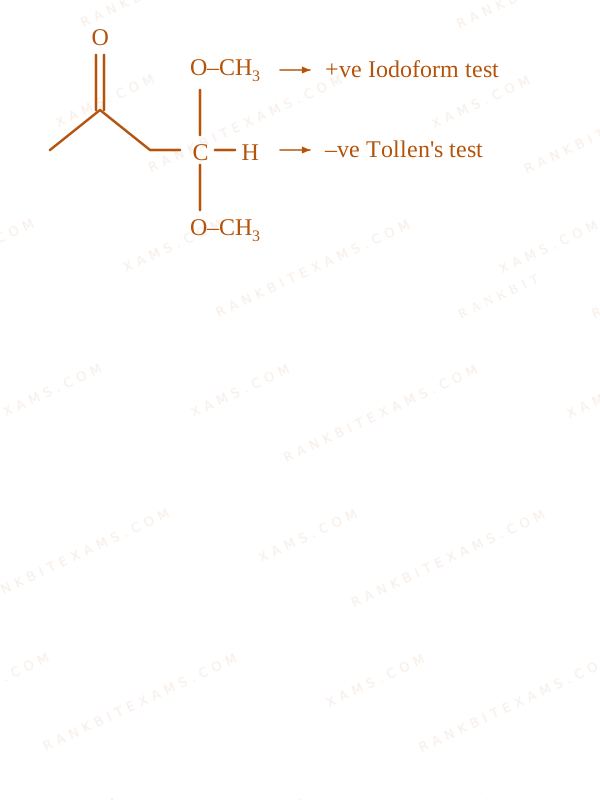
Option 2 is mathrmCH_3-CO-CH_2-CH(OCH_3)_2$\mathrm{CH_3-CO-CH_2-CH(OCH_3)_2}$ (an acetal of aldehyde).
This compound 'P' has a CH_3CO-$CH_3CO-$ group (positive iodoform) and an acetal (protected aldehyde, negative Tollen's).
On hydrolysis:
mathrmCH_3-CO-CH_2-CH(OCH_3)_2 xrightarrowmathrmH_2O/H^+ mathrmCH_3-CO-CH_2-CHO + 2mathrmCH_3OH$$\mathrm{CH_3-CO-CH_2-CH(OCH_3)_2} \xrightarrow{\mathrm{H_2O/H^+}} \mathrm{CH_3-CO-CH_2-CHO} + 2\mathrm{CH_3OH}$$
The product Q (mathrmCH_3-CO-CH_2-CHO$\mathrm{CH_3-CO-CH_2-CHO}$) has a methyl ketone (positive iodoform test) and an aldehyde (positive Tollen's test).
Chemical Reactions of Aldehydes and Ketones diagram for Q61 - JEE Main 2026 Morning
### Pattern Recognition
Whenever an aldehyde test becomes positive *after* hydrolysis, it points to a protected aldehyde, usually an acetal or hemiacetal. A compound with molecular formula C_n H_2n O_3$C_n H_{2n} O_3$ often represents a keto-acetal.
### Evaluation Rubric / Model Answer
null
### Chapter Mix
Class 12 Chemistry: Aldehydes, Ketones and Carboxylic Acids
Class 12 Chemistry: Alcohols, Phenols and Ethers
Q57jee_main_2026_21_jan_eveningName Reactions
Match List-I with List-II.
List-I (Reagents)
List-II (Reaction Name Involving Aldehydes)
A. textH_2, textPd-textBaSO_4$\text{H}_2, \text{Pd}-\text{BaSO}_4$
I. Etard Reaction
B. textSnCl_2, textHCl$\text{SnCl}_2, \text{HCl}$
II. Rosenmund Reduction
C. textCrO_2textCl_2, textCS_2$\text{CrO}_2\text{Cl}_2, \text{CS}_2$
III. Gatterman–Koch Reaction
D. textCO, textHCl, textAnhyd. textAlCl_3$\text{CO}, \text{HCl}, \text{Anhyd. } \text{AlCl}_3$
IV. Stephen Reaction
Choose the correct answer from the options given below:
### Core Logic
- A. textH_2, textPd-textBaSO_4 rightarrow$\text{H}_2, \text{Pd}-\text{BaSO}_4 \rightarrow$ II. Rosenmund Reduction
- B. textSnCl_2, textHCl rightarrow$\text{SnCl}_2, \text{HCl} \rightarrow$ IV. Stephen Reaction
- C. textCrO_2textCl_2, textCS_2 rightarrow$\text{CrO}_2\text{Cl}_2, \text{CS}_2 \rightarrow$ I. Etard Reaction
- D. textCO, textHCl, textAnhyd. textAlCl_3 rightarrow$\text{CO}, \text{HCl}, \text{Anhyd. } \text{AlCl}_3 \rightarrow$ III. Gatterman–Koch Reaction
### Step 1: Final Conclusion
Combining the correct matching gives A-II, B-IV, C-I, D-III, which is option (4).
### Pattern Recognition
Sees: standard name reactions for aldehyde preparation.
Trap: Confusing Etard reagent with Gatterman-Koch or Stephen reduction.
### Chapter Mix
Class 12 Chemistry: Aldehydes, Ketones and Carboxylic Acids
### Core Logic
(A) NH_2-NH_2 / KOH$NH_2-NH_2 / KOH$: Hydrazine with base is used in Wolff-Kishner Reduction to reduce carbonyls to alkanes. (A rightarrow$\rightarrow$ III)
(B) [Ag(NH_3)_2]OH$[Ag(NH_3)_2]OH$: Ammoniacal silver nitrate is Tollen's reagent, used in Tollen's Test to differentiate aldehydes from ketones. (B rightarrow$\rightarrow$ I)
(C) Aqueous CuSO_4$CuSO_4$ + Sodium Potassium Tartrate + KOH: This is Fehling's solution (mixture of Fehling A and Fehling B). Used in Fehling's Test. (C rightarrow$\rightarrow$ IV)
(D) Zn-Hg / HCl$Zn-Hg / HCl$: Zinc amalgam with concentrated hydrochloric acid is the reagent for Clemmensen Reduction. (D rightarrow$\rightarrow$ II)
### Step 1: Final Matching
The correct matches are A-III, B-I, C-IV, D-II.
### Pattern Recognition
Pure factual matching strictly based on NCERT name reactions and distinguishing tests for carbonyl compounds.
### Evaluation Rubric / Model Answer
null
### Chapter Mix
Class 12 Chemistry: Aldehydes Ketones and Carboxylic Acids
Q68jee_main_2026_22_january_eveningCross-Aldol and Cannizzaro Reactions
The compound A, textC_8textH_8textO_2$\text{C}_8\text{H}_8\text{O}_2$ reacts with acetophenone to form a single product via cross-Aldol condensation. The compound A on reaction with conc. NaOH forms a substituted benzyl alcohol as
A. 2-hydroxy acetophenone
B. 4-methoxy benzaldehyde
C. 4-hydroxy benzaldehyde
D. 4-methyl benzoic acid
Solution
### Related Formula
textAr-CHO + textconc. NaOH xrightarrowtextCannizzaro textAr-CH_2textOH + textAr-COO^-$$\text{Ar-CHO} + \text{conc. NaOH} \xrightarrow{\text{Cannizzaro}} \text{Ar-CH}_2\text{OH} + \text{Ar-COO}^-$$
### Core Logic
Step 1: Compound A has molecular formula textC_8textH_8textO_2$\text{C}_8\text{H}_8\text{O}_2$ and undergoes Cannizzaro reaction with conc. NaOH implies$\implies$ A lacks alpha$\alpha$-hydrogen and is an aromatic aldehyde.
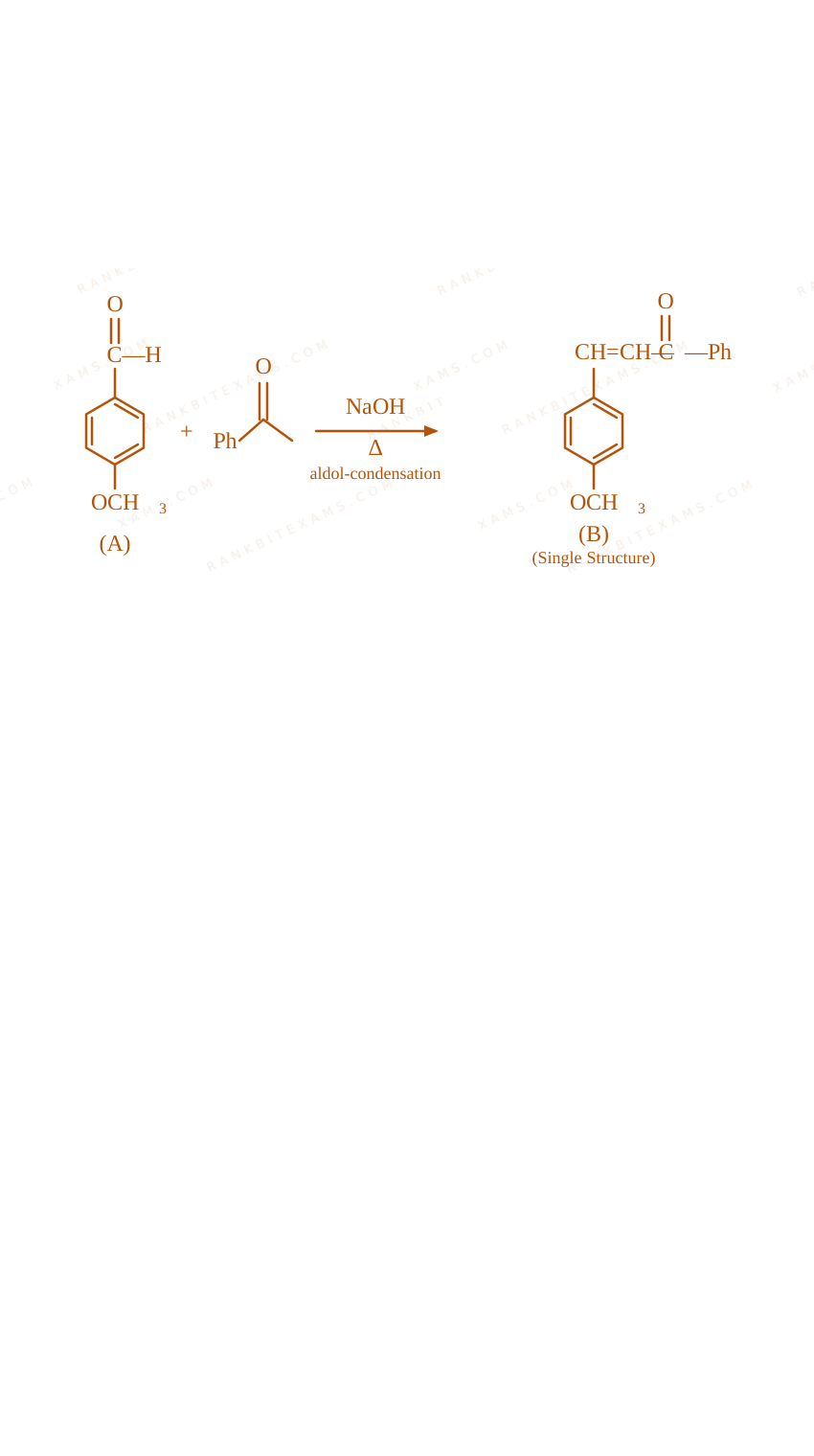
Step 2: Compound A is 4-methoxy benzaldehyde (textCH_3textO-C_6textH_4text-CHO$\text{CH}_3\text{O-C}_6\text{H}_4\text{-CHO}$).
Step 3: Cross-Aldol condensation with acetophenone yields a single aldol condensation product (B)$(B)$ structure.
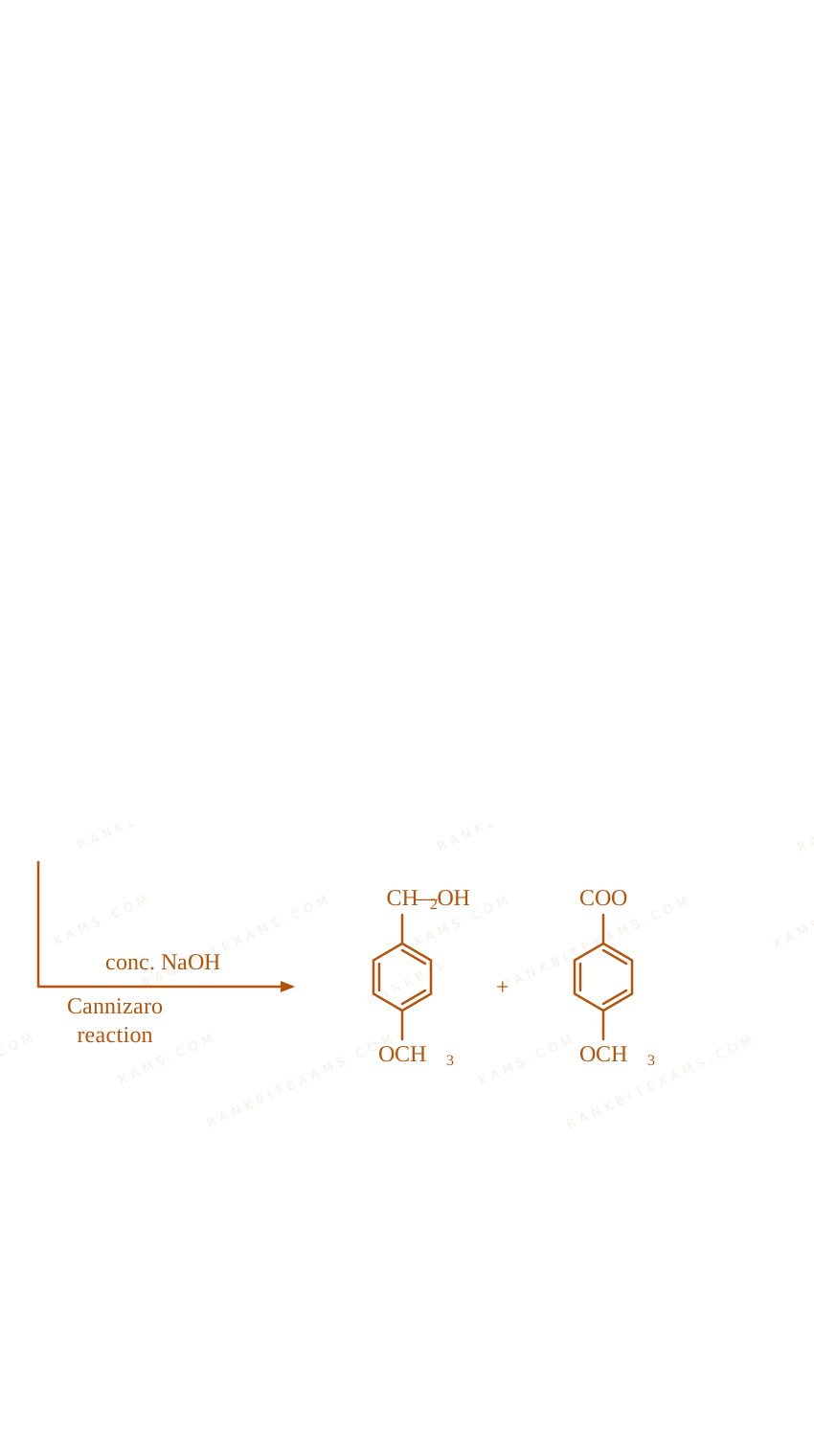
Step 4: Cannizzaro reaction with conc. NaOH produces 4-methoxybenzyl alcohol and 4-methoxybenzoate anion.
Cross-aldol and Cannizzaro reaction diagram for Q68 - JEE Main 2026 EveningCross-aldol and Cannizzaro reaction diagram for Q68 - JEE Main 2026 Evening
### Pattern Recognition
Sees: textC_8textH_8textO_2$\text{C}_8\text{H}_8\text{O}_2$ undergoing Cannizzaro to form substituted benzyl alcohol.
Shortcut: Presence of -textCHO$-\text{CHO}$ without alpha$\alpha$-H and -textOCH_3$-\text{OCH}_3$ ring substituent points directly to 4-methoxy benzaldehyde.
### Evaluation Rubric / Model Answer
null
### Chapter Mix
Class 12 Chemistry: Aldehydes, Ketones and Carboxylic Acids
Q54jee_main_2026_23_january_morningOxidation of Alcohols and Alkene Reactions
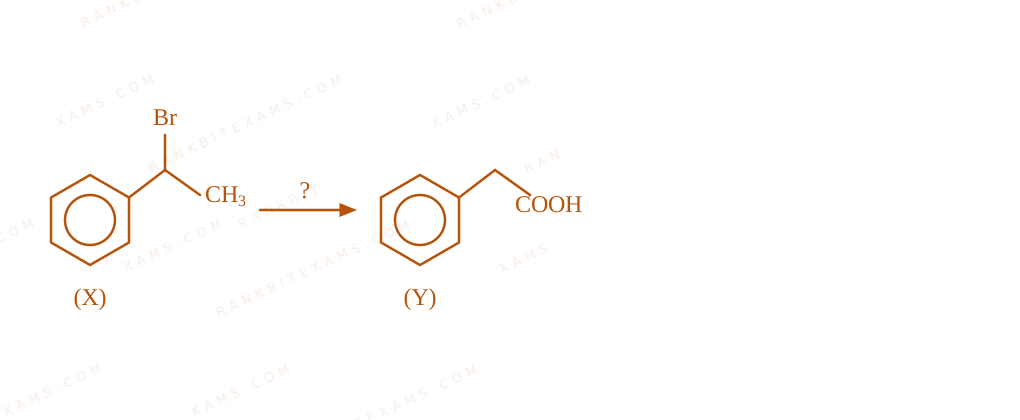
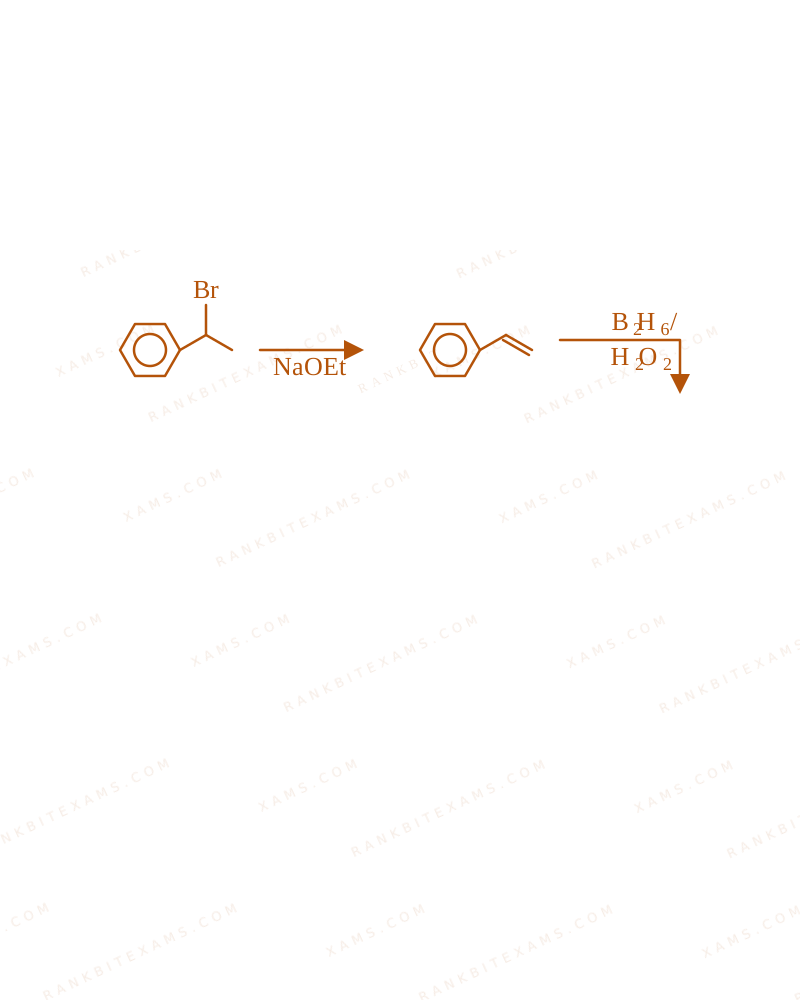
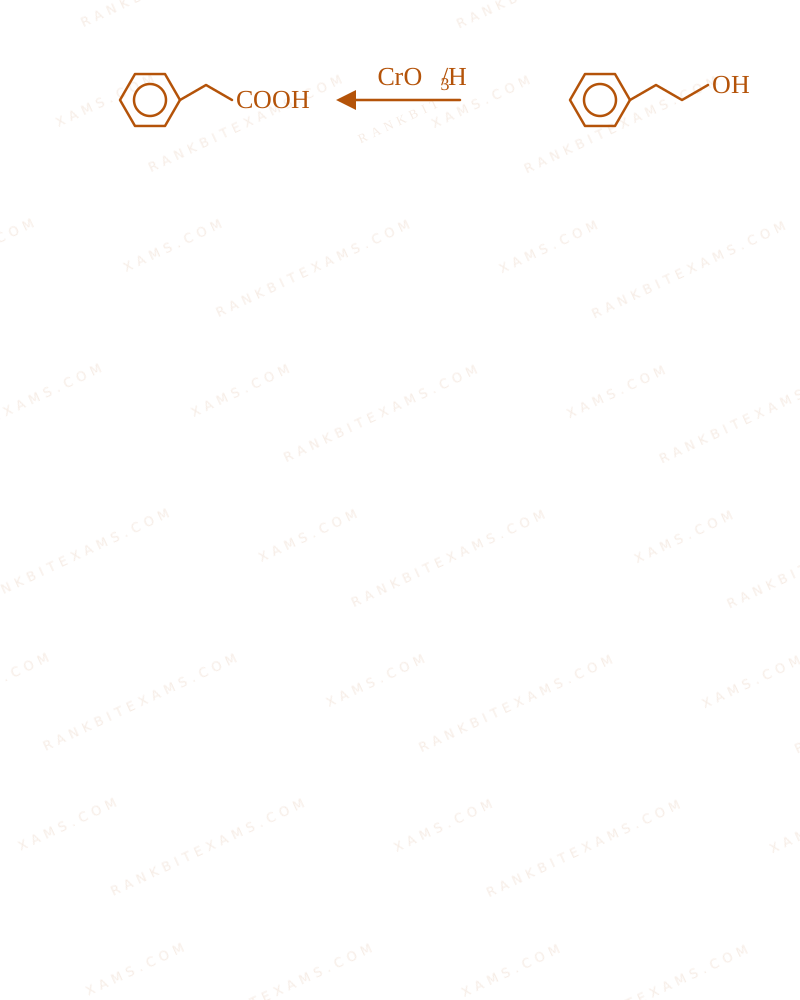
The image shows an organic conversion from a bromo-substituted cyclopentene to a carboxylic acid derivative.
The correct sequence of reagents for the above conversion of X to Y is :
A.text(i) NaOH (aq) (ii) Jones reagent (iii) H_3O^+$\text{(i) NaOH (aq) (ii) Jones reagent (iii) }H_{3}O^{+}$
B.text(i) B_2H_6 / H_2O_2text (ii) NaOEt (iii) Jones reagent$\text{(i) }B_{2}H_{6} / H_{2}O_{2}\text{ (ii) NaOEt (iii) Jones reagent}$
C.text(i) Jones reagent (ii) NaOEt (iii) Hot KMnO_4text /KOH$\text{(i) Jones reagent (ii) NaOEt (iii) Hot }KMnO_{4}\text{ /KOH}$
D.text(i) NaOEt (ii) B_2H_6/H_2O_2text (iii) Jones reagent$\text{(i) NaOEt (ii) }B_{2}H_{6}/H_{2}O_{2}\text{ (iii) Jones reagent}$
Solution
### Core Logic
The transformation requires converting a cyclic bromoalkane into a conjugated cyclic carboxylic acid. The steps required are elimination to form an alkene, anti-Markovnikov hydration to an alcohol, and finally oxidation.
### Step 1: Elimination
Treating the starting material with NaOEt (a strong base) promotes an E2 elimination, forming a conjugated diene in the cyclopentane ring.
The image shows an organic conversion from a bromo-substituted cyclopentene to a carboxylic acid derivative.
### Step 2: Hydroboration-Oxidation
Using B_2H_6 / H_2O_2$B_2H_6 / H_2O_2$ (Hydroboration-oxidation) adds water across the less hindered double bond in an anti-Markovnikov fashion, placing an -OH group on the terminal carbon attached to the ring.
### Step 3: Strong Oxidation
Finally, utilizing Jones reagent (CrO_3 / H^+$CrO_3 / H^+$) strongly oxidizes the primary alcohol directly into a carboxylic acid (-COOH$-COOH$), yielding the desired product Y.
The image shows an organic conversion from a bromo-substituted cyclopentene to a carboxylic acid derivative.
### Pattern Recognition
Formation of a new double bond alongside chain functionalization generally implies Base-catalyzed E2 followed by functional group addition (like hydroboration) and terminal oxidation.
### Evaluation Rubric / Model Answer
null
### Chapter Mix
Class 12 Chemistry: Aldehydes Ketones and Carboxylic Acids
Class 11 Chemistry: Hydrocarbons
Class 12 Chemistry: Alcohols Phenols and Ethers
More Aldehydes Ketones and Carboxylic Acids Questions — jee_main_2026_23_january_morning
We Map Every Repeating Question in Competitive Exams.
Say goodbye to generic mock test fatigue. RankBit uses smart analysis to group past exam questions into their foundational Repeating Question Types. Find chapter weightage, track repeating questions, and score higher with targeted practice.
Select Your Target Exam
Choose an exam track below to find formulas per chapter and patterns.
Syncing Exam Intelligence
Mapping formulas and patterns across all tracks…
PATH A — FULL LENGTH PRACTICE
Full Mock Test Hub
Simulate real NTA exam conditions with fully tracked mocks. Time yourself against past papers.
Practice past-year questions one chapter at a time. Pick an exam → subject → chapter and get every PYQ for that topic — pulled together from all past papers — with the chapter's key formulas alongside.