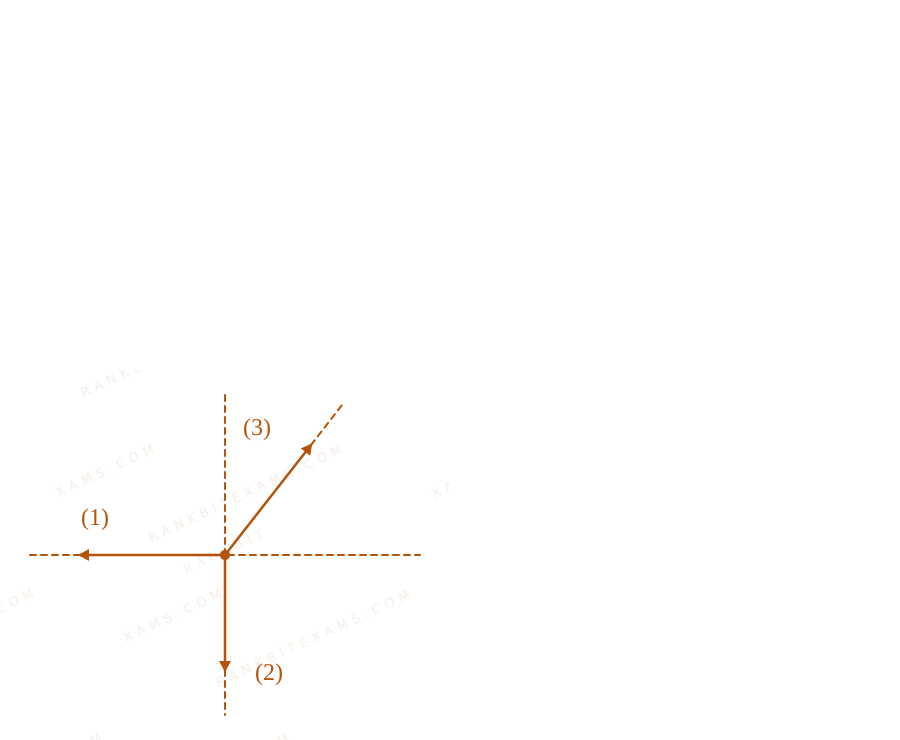
A body of mass 14 kg initially at rest explodes and breaks into three fragments of masses in the ratio 2 : 2 : 3. The two pieces of equal masses fly off perpendicular to each other with a speed of 18 m/s each. The velocity of the heavier fragment is ____m/s.
Vector diagram illustrating the trajectories of the explosive fragments.
A.10sqrt2$10\sqrt{2}$
B.12sqrt2$12\sqrt{2}$
C.12$12$
D.24sqrt2$24\sqrt{2}$
Solution & Explanation
### Related Formula
vecp_textinitial = vecp_textfinal$$\vec{p}_{\text{initial}} = \vec{p}_{\text{final}}$$M_1vecV_1 + M_2vecV_2 + M_3vecV_3 = 0$$M_1\vec{V}_1 + M_2\vec{V}_2 + M_3\vec{V}_3 = 0$$
### Core Logic
Vector diagram illustrating the trajectories of the explosive fragments.
The total mass is 14 \, mathrmkg$14 \, \mathrm{kg}$ and breaks in ratio 2:2:3$2:2:3$. Let the masses be M_1$M_1$, M_2$M_2$, and M_3$M_3$.
M_1 = frac27 times 14 = 4 \, mathrmkg$$M_1 = \frac{2}{7} \times 14 = 4 \, \mathrm{kg}$$M_2 = frac27 times 14 = 4 \, mathrmkg$$M_2 = \frac{2}{7} \times 14 = 4 \, \mathrm{kg}$$M_3 = frac37 times 14 = 6 \, mathrmkg$$M_3 = \frac{3}{7} \times 14 = 6 \, \mathrm{kg}$$
### Step 1: Setup Momentum Equations
Since M_1$M_1$ and M_2$M_2$ fly off perpendicular to each other, let their velocity vectors be along the x and y axes. Because the total momentum must be zero, we align the fragments opposite to the final 3rd fragment's direction for simplicity, or just use standard axes.
Let vecV_1 = -18hati$\vec{V}_1 = -18\hat{i}$ and vecV_2 = -18hatj$\vec{V}_2 = -18\hat{j}$. Note that the solution simplifies the mass ratio directly to 2, 2, 3$2, 2, 3$ as relative masses for the momentum equation:
2(-18hati) + 2(-18hatj) + 3vecV_3 = 0$$2(-18\hat{i}) + 2(-18\hat{j}) + 3\vec{V}_3 = 0$$
### Step 2: Solve for Velocity
vecV_3 = frac36hati + 36hatj3 = 12hati + 12hatj$$\vec{V}_3 = \frac{36\hat{i} + 36\hat{j}}{3} = 12\hat{i} + 12\hat{j}$$
Magnitude of vecV_3$\vec{V}_3$:
|vecV_3| = sqrt12^2 + 12^2 = 12sqrt2 \, mathrmm/s$$|\vec{V}_3| = \sqrt{12^2 + 12^2} = 12\sqrt{2} \, \mathrm{m/s}$$
### Pattern Recognition
In a 3-part explosion from rest, the momentum of the third piece must be equal and opposite to the vector sum of the other two pieces. You can use the ratio of masses directly in the momentum conservation equation instead of absolute masses to save time.
### Evaluation Rubric / Model Answer
null
### Chapter Mix
Class 11 Physics: Center of Mass and Collisions
Keywords:#body initially at rest explodes#JEE Main 2026 Evening Q27#Center of Mass and Collisions JEE Main 2026#Conservation of Momentum JEE Main 2026#explosion fragments#momentum vectors#perpendicular paths
We Map Every Repeating Question in Competitive Exams.
Say goodbye to generic mock test fatigue. RankBit uses smart analysis to group past exam questions into their foundational Repeating Question Types. Find chapter weightage, track repeating questions, and score higher with targeted practice.
Select Your Target Exam
Choose an exam track below to find formulas per chapter and patterns.
Syncing Exam Intelligence
Mapping formulas and patterns across all tracks…
PATH A — FULL LENGTH PRACTICE
Full Mock Test Hub
Simulate real NTA exam conditions with fully tracked mocks. Time yourself against past papers.
Practice past-year questions one chapter at a time. Pick an exam → subject → chapter and get every PYQ for that topic — pulled together from all past papers — with the chapter's key formulas alongside.