The area of the region enclosed between the circles x² + y² = 4 and x² + (y - 2)² = 4 is:

Solution & Explanation

Related Formula
∫ √(a² - x²) dx = (x)/(2)√(a² - x²) + (a²)/(2) ⁻¹((x)/(a))
Core Logic

Area Between Two Curves diagram for Q12 - JEE Main 2026 Evening
The intersection points of x² + y² = 4 and x² + (y-2)² = 4: Subtracting the equations gives y² - (y-2)² = 0 y² - (y² - 4y + 4) = 0 4y = 4 y = 1. Substitute y=1 back: x² + 1 = 4 x = ± √(3). The points of intersection are (√(3), 1) and (-√(3), 1).

The area is symmetric about the y-axis, so we integrate from x = 0 to x = √(3) and double the result. Upper curve is the lower arc of the top circle: y = 2 - √(4-x²) -- wait, the area is bounded by the top arc of the bottom circle and the bottom arc of the top circle. Upper curve for area: y = √(4-x²) (from x²+y²=4) Lower curve for area: y = 2 - √(4-x²) (from x²+(y-2)²=4)

A = 2∫₀√(3) [√(4-x²) - (2 - √(4-x²))] dx
Step 1: Integration
A = 2∫₀√(3) (2√(4-x²) - 2) dx = 4∫₀√(3) (√(4-x²) - 1) dx A = 4[ (1)/(2)(x√(4-x²) + 4 ⁻¹(x)/(2)) - x ]₀√(3)

Evaluating the limits:

= 4[ (1)/(2)(√(3)(1) + 4 ⁻¹( √(3)2)) - √(3) - (0) ] = 4[ (1)/(2)(√(3) + 4((π)/(3))) - √(3) ] = 4[ √(3)2 + (2π)/(3) - √(3) ] = 4[ (2π)/(3) - √(3)2 ] = (8π)/(3) - 2√(3) = (2)/(3)(4π - 3√(3)) (Sq. units)
Pattern Recognition

For intersecting identical circles with centres on an axis, symmetry simplifies the integration drastically. Recognize that integrating the circle arc function handles the bulk of the calculation.

Chapter Mix

Class 12 Maths: Area Under Curves

Reference Study Guides

More Area Under Curves Previous-Year Questions — Page 2

Q19 jee_main_2026_24_january_morning Area Under the Curve
Let A₁ be the bounded area enclosed by the curves y = x² + 2, x + y = 8 and y-axis that lies in the first quadrant. Let A₂ be the bounded area enclosed by the curves y = x² + 2, y² = x, x = 2, and y-axis that lies in the first quadrant. Then A₁ - A₂ is equal to
  • A. (2)/(3)(2√(2)+1)
  • B. (2)/(3)(4√(2)+1)
  • C. (2)/(3)(√(2)+1)
  • D. (2)/(3)(3√(2)+1)

Solution

Related Formula
Area = ∫ₐb (yupper - ylower) dx
Core Logic

For A₁: Intersection of y = x² + 2 and x + y = 8. x + (x² + 2) = 8 ⇒ x² + x - 6 = 0 ⇒ (x+3)(x-2) = 0. In first quadrant, x = 2. Intersection point is (2, 6).
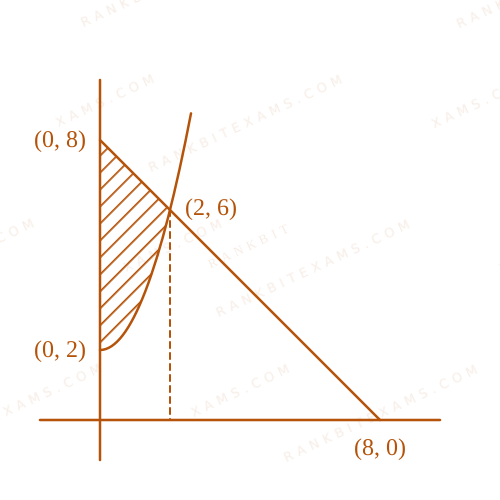
Area A1 boundaries visualization

Step 1: Calculate A1
A₁ = ∫₀² ((8 - x) - (x² + 2)) dx = ∫₀² (6 - x - x²) dx A₁ = [ 6x - (x²)/(2) - (x³)/(3) ]₀² = 12 - 2 - (8)/(3) = 10 - (8)/(3) = (22)/(3)
Step 2: Area A2 Definition

For A₂: Enclosed by y = x² + 2, y = √(x), x=2 and y-axis. Upper curve: y = x²+2, Lower curve: y = √(x).
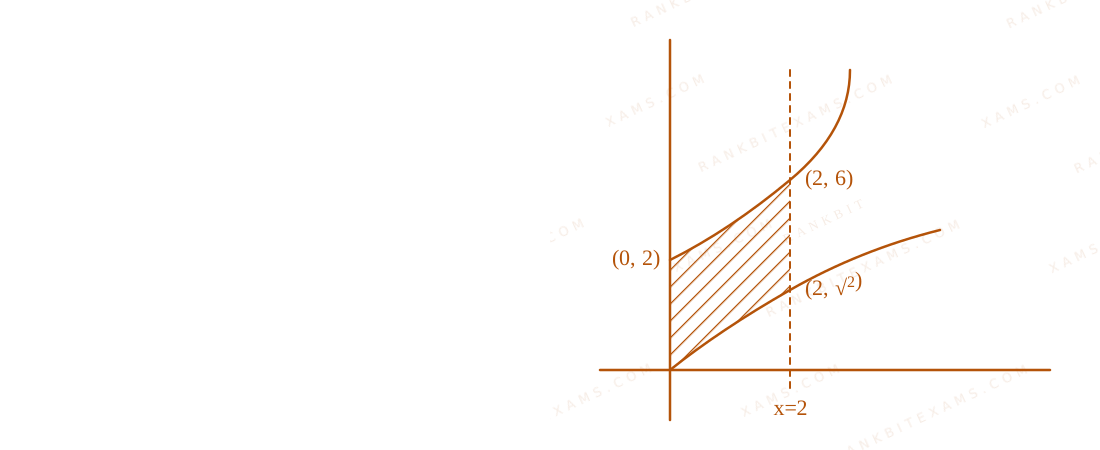
Area A1 boundaries visualization

Step 3: Calculate A2
A₂ = ∫₀² (x² + 2 - √(x)) dx A₂ = [ (x³)/(3) + 2x - x3/23/2 ]₀² A₂ = (8)/(3) + 4 - (2)/(3)(23/2) = (20)/(3) - 4√(2)3
Step 4: Difference of Areas
A₁ - A₂ = (22)/(3) - ( (20)/(3) - 4√(2)3 ) = (2)/(3) + 4√(2)3 = (2)/(3) (1 + 2√(2))
Pattern Recognition

Carefully identify the bounding regions. A₁ uses a line as the upper bound, A₂ strips away a root curve as its lower bound. Integrating separately before subtracting avoids algebraic alignment errors.

Chapter Mix

Class 12 Maths: Application of Integrals
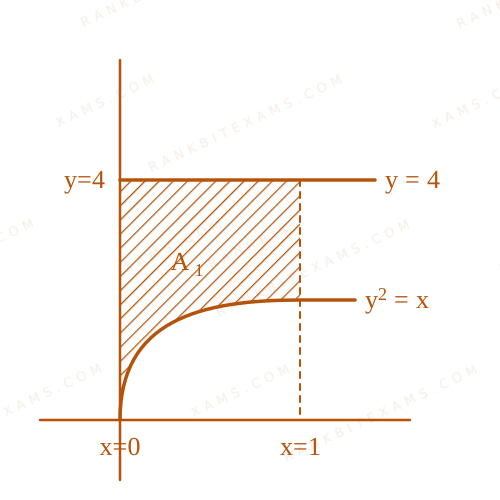
Q12 jee_main_2026_24_january_evening Area bounded by Modulus and Parabola
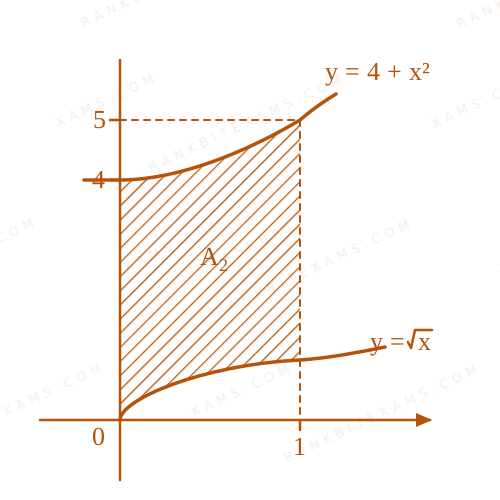
Let f(α) denote the area of the region in the first quadrant bounded by x = 0, x = 1, y² = x and y = |α x - 5| - |1 - α x| + α x². Then (f(0) + f(1)) is equal to
  • A. 9
  • B. 14
  • C. 7
  • D. 12

Solution

Related Formula
Area = ∫x₁x₂ (yupper - ylower) dx
Core Logic

Evaluate f(0) by setting α = 0 in the function for y.

At α = 0 y = |0· x - 5| - |1 - 0· x| + 0· x²

y = |-5| - |1| = 5 - 1 = 4

So for f(0), the bounded area A₁ is between y = 4, y = √(x), from x = 0 to x = 1.

Area bounded by Modulus and Parabola

Step 1: Calculating f(0)
A₁ = ∫₀¹ (4 - √(x)) dx = [ 4x - x3/23/2 ]₀¹ = 4(1) - (2)/(3)(1) = (10)/(3)

So, f(0) = (10)/(3).

Step 2: Determining curve for f(1)

Evaluate f(1) by setting α = 1 in the function for y.

At α = 1 y = |x - 5| - |1 - x| + x². Since the area is restricted to x in [0, 1]: x - 5 is negative, so |x - 5| = 5 - x. 1 - x is positive, so |1 - x| = 1 - x.

y = (5 - x) - (1 - x) + x² y = 5 - x - 1 + x + x² = 4 + x²

Area bounded by Modulus and Parabola

Step 3: Calculating f(1)

For f(1), the bounded area A₂ is between y = 4 + x² and y = √(x), from x = 0 to x = 1.

A₂ = ∫₀¹ ((4 + x²) - √(x)) dx = [ 4x + (x³)/(3) - x3/23/2 ]₀¹ = ( 4 + (1)/(3) - (2)/(3) ) = 4 - (1)/(3) = (11)/(3)

So, f(1) = (11)/(3).

Step 4: Final Sum
|f(0) + f(1)| = | A₁ + A₂ | = | (10)/(3) + (11)/(3) | = (21)/(3) = 7

Area bounded by Modulus and Parabola

Pattern Recognition

Modulus functions combined with parametric limits should be instantly resolved by plugging in the bounds of x (here [0,1]) to drop the absolute value signs before attempting any integral.

Chapter Mix

Class 12 Maths: Area Under the Curve Class 11 Maths: Modulus Function

Q13 jee_main_2026_28_january_morning Area under Curves
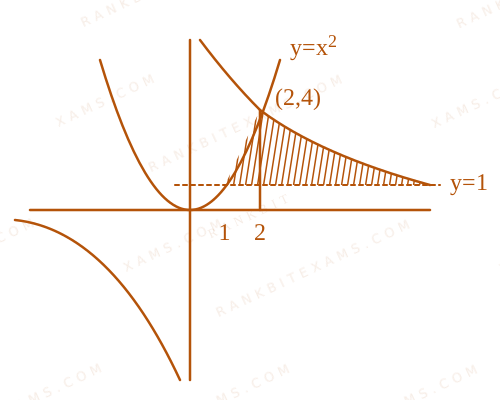
The area of the region R=(x,y):xy≤ 8, 1≤ y≤ x², x≥ 0 is
  • A. (1)/(3)(49 ₑ(2)-15)
  • B. (2)/(3)(20 ₑ(2)+9)
  • C. (2)/(3)(24 ₑ(2)-7)
  • D. (1)/(3)(40 ₑ(2)+27)

Solution

Core Logic

Area under Curves
Area under Curves
The region is bounded by three primary curves in the first quadrant (x≥0):

  • y ≥ 1 (horizontal line)
  • y ≤ x² (upward-opening parabola)
  • xy ≤ 8 y ≤ (8)/(x) (rectangular hyperbola)
  • Find points of intersection: Intersection of y = x² and y = (8)/(x):

x² = (8)/(x) x³ = 8 x = 2

At x = 2, y = 4. So they meet at (2, 4).

Intersection of y = x² and y = 1:

x² = 1 x = 1

Intersection of y = (8)/(x) and y = 1:

1 = (8)/(x) x = 8

The region spans from x = 1 to x = 8. The upper boundary changes at x = 2.

Step 1: Set up Integrals

For x in [1, 2], the upper curve is y = x² and the lower is y = 1. For x in [2, 8], the upper curve is y = (8)/(x) and the lower is y = 1.

A = ∫₁² (x² - 1) dx + ∫₂⁸ ((8)/(x) - 1) dx
Step 2: Integration

Calculate the first integral:

I₁ = [ (x³)/(3) - x ]₁² = ( (8)/(3) - 2 ) - ( (1)/(3) - 1 ) = (2)/(3) - (-(2)/(3)) = (4)/(3)

Calculate the second integral:

I₂ = [ 8 ln x - x ]₂⁸ = (8 ln 8 - 8) - (8 ln 2 - 2)

Since ln 8 = 3 ln 2:

I₂ = 24 ln 2 - 8 - 8 ln 2 + 2 = 16 ln 2 - 6

Total Area A:

A = (4)/(3) + 16 ln 2 - 6 = 16 ln 2 - (14)/(3) A = (48 ln 2 - 14)/(3) = (2)/(3)(24 ln 2 - 7)
Chapter Mix

Class 12 Mathematics: Application of Integrals

Q11 jee_main_2026_28_january_evening Area Bounded by Parabolas and Lines
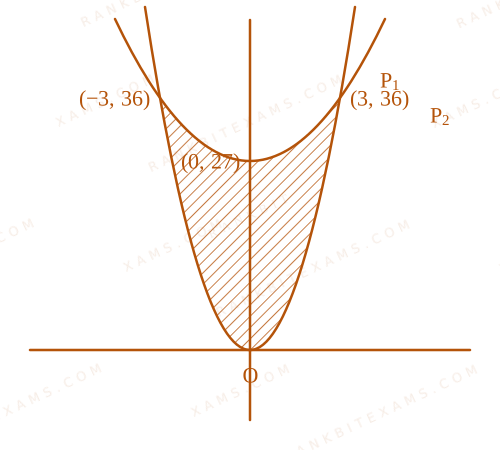
Let P₁: y = 4x² and P₂: y = x² + 27 be two parabolas. If the area of the bounded region enclosed between P₁ and P₂ is six times the area of the bounded region enclosed between the line y = α x, α > 0 and P₁, then α is equal to:
  • A. 8
  • B. 15
  • C. 12
  • D. 6

Solution

Related Formula

Area enclosed by y = f(x) and y = g(x) from x=a to x=b:

A = ∫ₐ^b |f(x) - g(x)| dx

Area between x² = 4ay and line x = my is (8a²)/(3m³).

Core Logic

Find Points of Intersection for P₁ and P₂:

4x² = x² + 27 ⇒ 3x² = 27 ⇒ x = ± 3

Parabolas intersection bounds

Area bounded between P₁ and P₂:

A₁ = ∫₋₃³ ((x² + 27) - 4x²) dx = 2 ∫₀³ (27 - 3x²) dx A₁ = 2 [27x - x³]₀³ = 2(81 - 27) = 108 sq. units
Execution

Area between P₁ and y = α x is given as 108 / 6 = 18 sq. units. For x² = 4ay and x = my, area is (8a²)/(3m³). Here, the parabola is x² = (y)/(4) and line is x = (y)/(α). Thus, 4a = (1)/(4) ⇒ a = (1)/(16), and m = (1)/(α).

Parabolas intersection bounds

Applying the formula:

(8(1/16)²)/(3(1/α)³) = 18 (8 / 256)/(3 / α³) = 18 ⇒ (α³)/(96) = 18 α³ = 18 × 96 = 1728

α = 12

Pattern Recognition

Using the standard result (8a²)/(3m³) for the area bounded between x²=4ay and x=my avoids tedious integration for straight lines intersecting parabolas at the origin.

Chapter Mix

Class 12 Maths: Application of Integrals

Q73 jee_main_2025_02_april_morning Area Between Curves
If the area of the region (x, y): | 4 - x ^ 2 | ≤ y ≤ x ^ 2, y ≤ 4, x ≥ 0 is ( 80√(2)α - β), α, β in N, then α + β is equal to ________.
Numerical Answer. Answer: 22 to 22

Solution

Related Formula

Area bounded by functions integrated with respect to y axis:

Area = ∫cd (xright - xleft) dy
Core Logic

Identify the bounding graphs and intersection coordinates in the first quadrant, then construct standard definite integrals along the vertical axis.

Area Between Curves diagram for Q73 - JEE Main 2025 Morning

Step 1: Unpack Bounding Curves

The condition |4-x²| ≤ y splits into two sections at x=2:

  • For 0 ≤ x ≤ 2 4 - x² ≤ y x² ≥ 4 - y x = √(4-y)
  • For x ≥ 2 x² - 4 ≤ y x² ≤ 4 + y x = √(4+y)
  • Also bounded by y ≤ x² x ≥ √(y), and the outer cap constraint y ≤ 4.

Step 2: Construct the Integral Area Formula

Integrating with respect to y covers the region bounded on the left by √(y) and √(4-y), and on the right by √(4+y):

A = ∫₀⁴ √(4+y) dy - ∫₀² √(4-y) dy - ∫₂⁴ √(y) dy
Step 3: Evaluate the Definite Integrals
A = [ (4+y)3/23/2 ]₀⁴ + [ (4-y)3/23/2 ]₀² - [ y3/23/2 ]₂⁴

Evaluating these values precisely:

A = (2)/(3)(83/2 - 43/2) + (2)/(3)(23/2 - 43/2) - (2)/(3)(43/2 - 23/2) A = 80√(2)3 - 16
Step 4: Solve for Constants

Compare the final value expression to ( 80√(2)α - β):

α = 3, β = 16 α + β = 3 + 16 = 22
Pattern Recognition

Integrating along the vertical axis (y-direction) is significantly faster here because it avoids splitting the domain across multiple vertical segments on the horizontal x-axis.

Chapter Mix

Class 12 Mathematics: Application of Integrals

More Area Under Curves Questions — jee_main_2026_23_january_evening

Practice all Area Under Curves previous-year questions →

Rankbit System
JEE Physics: Waves (+15.5%) | Electrostatics: Concentric Shells (-29.7%) | Modern Physics: Photoelectric Clones (+34.2%) | Mathematics: Definite Integrals (+18.1%) | Chemistry: Coordination Splitting (-11.4%) | JEE Physics: Waves (+15.5%) | Electrostatics: Concentric Shells (-29.7%) | Modern Physics: Photoelectric Clones (+34.2%) | Mathematics: Definite Integrals (+18.1%) | Chemistry: Coordination Splitting (-11.4%)