Chemical structures related to the options provided for the iodoform differentiation test.Iodoform test can differentiate between
A. Methanol and Ethanol
B. CH₃COOH$CH_{3}COOH$ and CH₃CH₂COOH$CH_{3}CH_{2}COOH$
C. Cyclohexene and cyclohexanone
D. Diethyl ether and Pentan-3-one
E. Anisole and acetone
Choose the correct answer from the options given below:
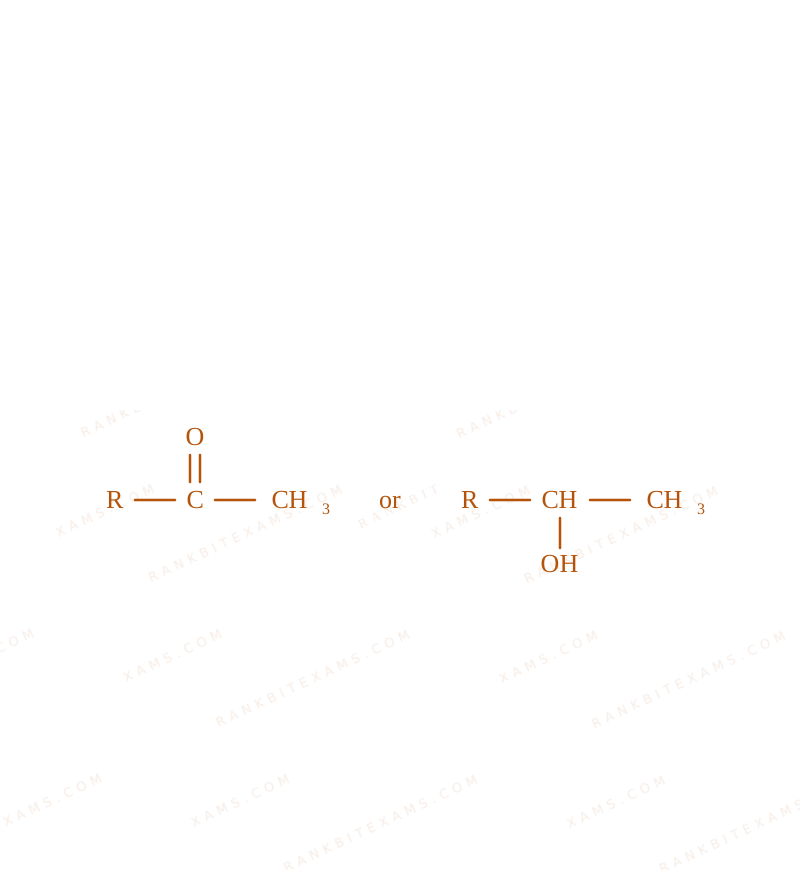
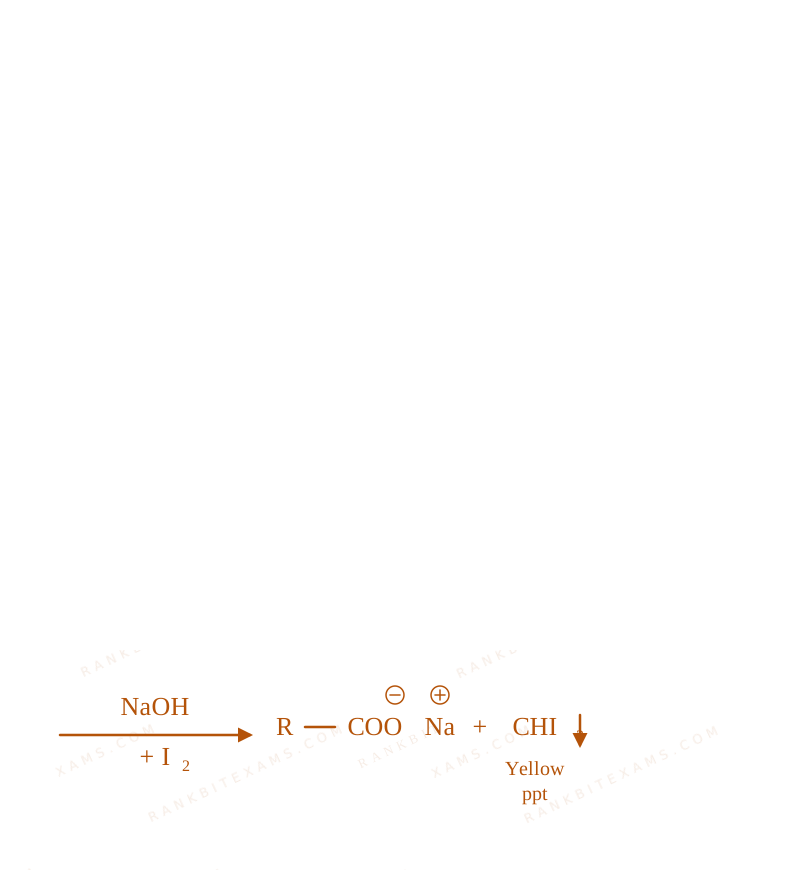
The iodoform test gives a positive result for compounds containing a methyl ketone group (-CO-CH₃$-CO-CH_3$) or a secondary alcohol with an adjacent methyl group (-CH(OH)-CH₃$-CH(OH)-CH_3$), which gets oxidized to a methyl ketone under the reaction conditions.
A. Methanol vs Ethanol: Ethanol (CH₃CH₂OH$CH_3CH_2OH$) contains the -CH(OH)-CH₃$-CH(OH)-CH_3$ terminal structure and gives a positive test. Methanol (CH₃OH$CH_3OH$) does not. (Can differentiate)
B. Neither CH₃COOH$CH_3COOH$ nor CH₃CH₂COOH$CH_3CH_2COOH$ gives the iodoform test since carboxylic acids do not undergo this reaction despite having a terminal methyl in acetic acid. (Cannot differentiate)
C. Neither cyclohexene nor cyclohexanone has a methyl group adjacent to the carbonyl/alcohol carbon. (Cannot differentiate)
D. Neither diethyl ether (CH₃CH₂-O-CH₂CH₃$CH_3CH_2-O-CH_2CH_3$) nor pentan-3-one (CH₃CH₂-CO-CH₂CH₃$CH_3CH_2-CO-CH_2CH_3$) has a methyl ketone group. (Cannot differentiate)
E. Acetone (CH₃-CO-CH₃$CH_3-CO-CH_3$) gives a positive test. Anisole (Ph-O-CH₃$Ph-O-CH_3$) does not. (Can differentiate)
Step 1: Final Selection
Only pairs A and E contain exactly one compound that gives a positive iodoform test, allowing for chemical differentiation.
Pattern Recognition
Look strictly for CH₃-C=O$CH_3-C=O$ or CH₃-CH-OH$CH_3-CH-OH$. If a molecule lacks these exact terminal fragments, it will fail the iodoform test.
Chapter Mix
Class 12 Chemistry: Aldehydes, Ketones and Carboxylic Acids
Class 12 Chemistry: Alcohols, Phenols and Ethers
Chemical structures related to the options provided for the iodoform differentiation test.Chemical structures related to the options provided for the iodoform differentiation test.
Keywords:#Iodoform test can differentiate between#JEE Main 2026 Evening Q58#Aldehydes, Ketones and Carboxylic Acids JEE Main 2026#Iodoform Reaction JEE Main 2026#Iodoform test#Methanol#Ethanol#Cyclohexene
More Aldehydes, Ketones and Carboxylic Acids Previous-Year Questions — Page 7
Q45jee_main_2025_24_jan_morningChemical Reactions of Ketones
The product (A) formed in the following reaction sequence is :
C H _ 3 - C ≡ C H [ (i i) H _ 2 / N i ](i) H g ^ 2 +, H _ 2 S O _ 4 (A)$$\mathrm {C H} _ {3} - \mathrm {C} \equiv \mathrm {C H} \xrightarrow [ (\mathrm {i i}) \mathrm {H} _ {2} / \mathrm {N i} ]{(\mathrm {i}) \mathrm {H} g ^ {2 +}, \mathrm {H} _ {2} \mathrm {S O} _ {4}} (A)$$
Breaking down the multi-step reaction path sequence:
Hydration of propyne using Kucherov's trigger condition (Hg²⁺, H₂SO₄$Hg^{2+}, H_2SO_4$) adds water across the triple bond via Markovnikov's rule. The intermediate enol undergoes tautomerization to yield acetone (CH₃-CO-CH₃$CH_3-CO-CH_3$).
Reacting acetone with HCN$HCN$ drives nucleophilic addition at the carbonyl carbon, forming a cyanohydrin intermediate: CH₃-C(OH)(CH₃)-CN$CH_3-C(OH)(CH_3)-CN$.
Introducing a reducing agent (H₂/Ni$H_2/Ni$) selectively converts the nitrile group (-CN$-CN$) into a primary amine side chain (-CH₂-NH₂$-CH_2-NH_2$).
The final synthesized structure is: CH₃-C(OH)(CH₃)-CH₂-NH₂$\mathrm{CH}_3-\mathrm{C}(\mathrm{OH})(\mathrm{CH}_3)-\mathrm{CH}_2-\mathrm{NH}_2$. Chemical Reactions of Ketones step sequence product chart for Q45
Pattern Recognition
Alkyne hydration produces a ketone carbonyl system. Cyanohydrin synthesis introduces a carbon coordinate, which subsequently reduces to a primary aliphatic amine functional group.
Chapter Mix
Class 12 Chemistry: Aldehydes, Ketones and Carboxylic Acids
Q48jee_main_2025_24_jan_morningReactions of Carboxylic Acids
Xg of benzoic acid on reaction with aq. NaHCO₃$\mathrm{NaHCO_3}$ release CO₂$\mathrm{CO}_{2}$ that occupied 11.2 L volume at STP. X is ______ g.
Numerical Answer.Answer: 61 to 61
Solution
Related Formula
Moles of gas at STP = V in Liters22.4 L/mol$$\text{Moles of gas at STP} = \frac{V\text{ in Liters}}{22.4 \text{ L/mol}}$$
Carboxylic acids react with sodium bicarbonate in a straightforward 1:1$1:1$ molar ratio, releasing exactly 1 mole of carbon dioxide gas per mole of acid group.
Chapter Mix
Class 12 Chemistry: Aldehydes, Ketones and Carboxylic Acids
Q37jee_main_2025_28_jan_eveningOxidation of Alkylbenzenes
The total number of compounds from below when treated with hot KMnO₄$KMnO_{4}$ giving benzoic acid is:
The image lists seven distinct aromatic side-chain hydrocarbon structures to assess for side-chain oxidation.
A. 3
B. 4
C. 6
D. 5
Solution
Related Formula
Side-chain oxidation criteria:
Ar-CH(R)₂ hot KMnO₄ Ar-COOH$$\text{Ar-CH(R)}_2 \xrightarrow{\text{hot } KMnO_4} \text{Ar-COOH}$$
Requires the presence of at least one benzylic hydrogen atom on the aromatic side chain structure.
Core Logic
Alkyl side chains on a benzene ring are oxidized entirely down to a carboxylic acid group (benzoic acid) by strong oxidizing agents like hot alkaline KMnO₄$KMnO_4$, provided the benzylic carbon contains at least one hydrogen atom.
The last biphenyl derivative undergoes complex disruption or ring cleavages and does not cleanly yield simple benzoic acid under standard monocyclic oxidation definitions.
Step 1: Counting Valid Targets
The compounds that undergo oxidation to form benzoic acid are toluene, ethylbenzene, isopropylbenzene, isobutylbenzene, and n-propylbenzene.
Total count = 5 compounds.
The image lists seven distinct aromatic side-chain hydrocarbon structures to assess for side-chain oxidation.
Pattern Recognition
Look immediately at the benzylic carbon (the carbon bonded directly to the ring). If it is a quaternary center (like in tert-butylbenzene) or lacks a hydrogen atom entirely, mark it as unreactive to hot KMnO₄$KMnO_4$ side-chain oxidation.
Chapter Mix
Class 12 Chemistry: Aldehydes, Ketones and Carboxylic Acids
Qjee_main_2025_29_jan_morningClemmensen Reduction
The product (P) formed in the following reaction is:
The structural flowchart indicates a multi-functional molecule treated with Zn-Hg/HCl.
The provided reaction relies on classic Clemmensen Reduction reagent configurations (Zn-Hg / HCl$\mathrm{Zn-Hg} / \mathrm{HCl}$). This reagent explicitly selective targets ketone/aldehyde carbonyl centers (>C=O$>\mathrm{C}=\mathrm{O}$) and converts them cleanly into methylene units (-CH₂-$-\mathrm{CH}_2-$). Any free aliphatic alcohol functionalities (-OH$-\mathrm{OH}$) located on the ring are preserved under these reductive conditions. Thus, the ketone group on the ring is cleanly converted to -CH₂-$-\mathrm{CH}_2-$, yielding option (3):
The structural flowchart indicates a multi-functional molecule treated with Zn-Hg/HCl.
Class 12 Chemistry: Aldehydes, Ketones and Carboxylic Acids
Qjee_main_2025_29_jan_morningChemical Reactions of Carbonyl Compounds
Based on the reaction sequence:
A structural flow charts the transformation of a cyclic dialcohol into final product S.
0.1 mole of compound 'S' will weigh ________ g.
(Given molar mass in g mol⁻¹$\mathrm{g \, mol^{-1}}$ C:12, H:1, O:16)
A structural flow charts the transformation of a cyclic dialcohol into final product S.
Reactant: 2-(hydroxymethyl)cyclopentan-1-ol.
Step 1: Excess CrO₃$\mathrm{CrO}_3$ (Jones oxidation) oxidizes the secondary alcohol to a ketone and the primary alcohol to a carboxylic acid arrow$\rightarrow$ Product P.
Step 2: Reaction with 1 mole of glycol protects the ketone selectively as a cyclic ketal arrow$\rightarrow$ Product Q.
Step 3: Treatment with CH₃MgI$\mathrm{CH}_3\mathrm{MgI}$ targets the free carboxylic acid (or ester equivalent) to form a methyl ketone after workup arrow$\rightarrow$ Product R.
Step 4: NaBH₄$\mathrm{NaBH}_4$ reduces the methyl ketone to a secondary alcohol, and acid workup deprotects the ketal back to the original ketone arrow$\rightarrow$ Compound S.
Chemical structural formula of S: 2-(1-hydroxyethyl)cyclopentan-1-one (C₇H₁₂O₂$\mathrm{C}_7\mathrm{H}_{12}\mathrm{O}_2$).
Molar mass of S (C₇H₁₂O₂$\mathrm{C}_7\mathrm{H}_{12}\mathrm{O}_2$):
Ketal groups serve as stable protective masks that shield ketones, allowing selective organometallic reactions to take place elsewhere on the molecule.
Chapter Mix
Class 12 Chemistry: Aldehydes, Ketones and Carboxylic Acids
More Aldehydes, Ketones and Carboxylic Acids Questions — jee_main_2026_23_january_evening
Practice past-year questions one chapter at a time. Pick an exam → subject → chapter and get every PYQ for that topic — pulled together from all past papers — with the chapter's key formulas alongside.