JEE Main · Physics → Steady

Atoms and Nuclei appeared 23 times across 3 years — 2.7% of Physics. This question is from Nuclear Size and Distance of Closest Approach.

Year 2026 2025 2024 Total
Questions 8 8 7 23

7.9 MeV α-particle scatters from a target material of atomic number 79. From the given data the estimated diameter of nuclei of the target material is (approximately) \_\_\_\_ m. [ 14π ε₀ = 9 × 10⁹ Nm² / C² and electron charge = 1.6 × 10⁻¹⁹ C]

Solution & Explanation

Related Formula
r₀ = (1)/(4πε₀) (q₁ q₂)/(K)
Core Logic

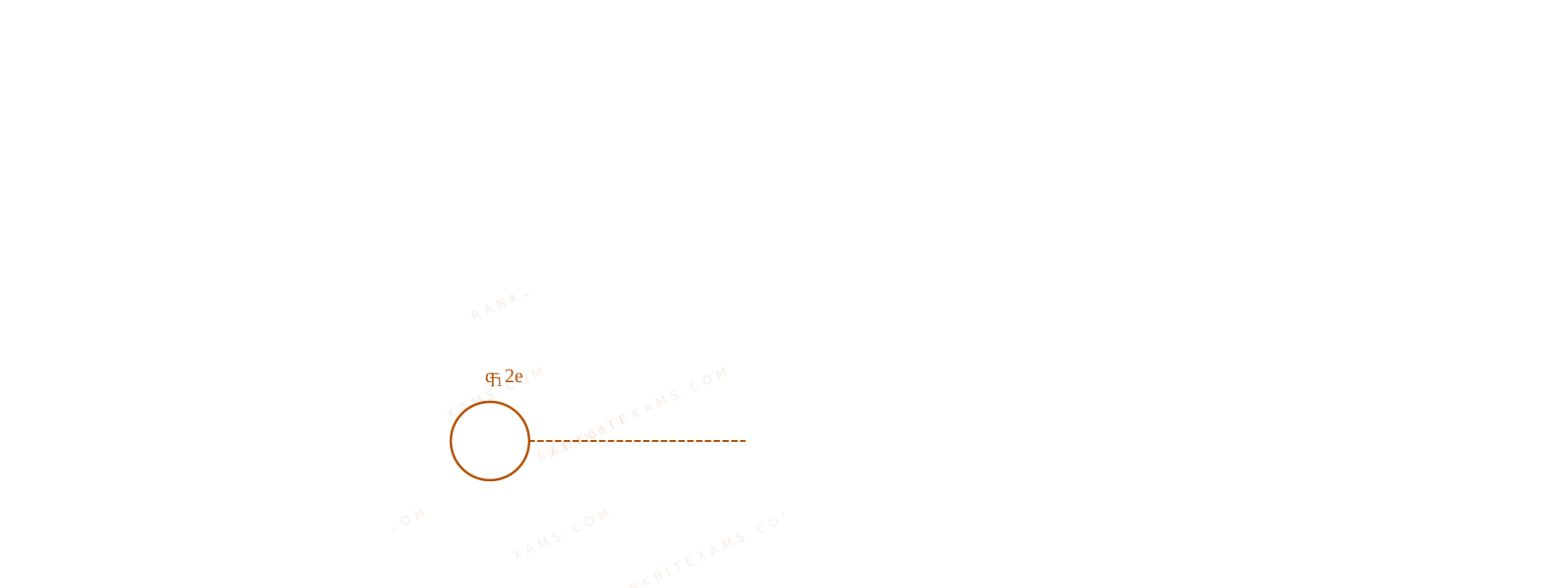
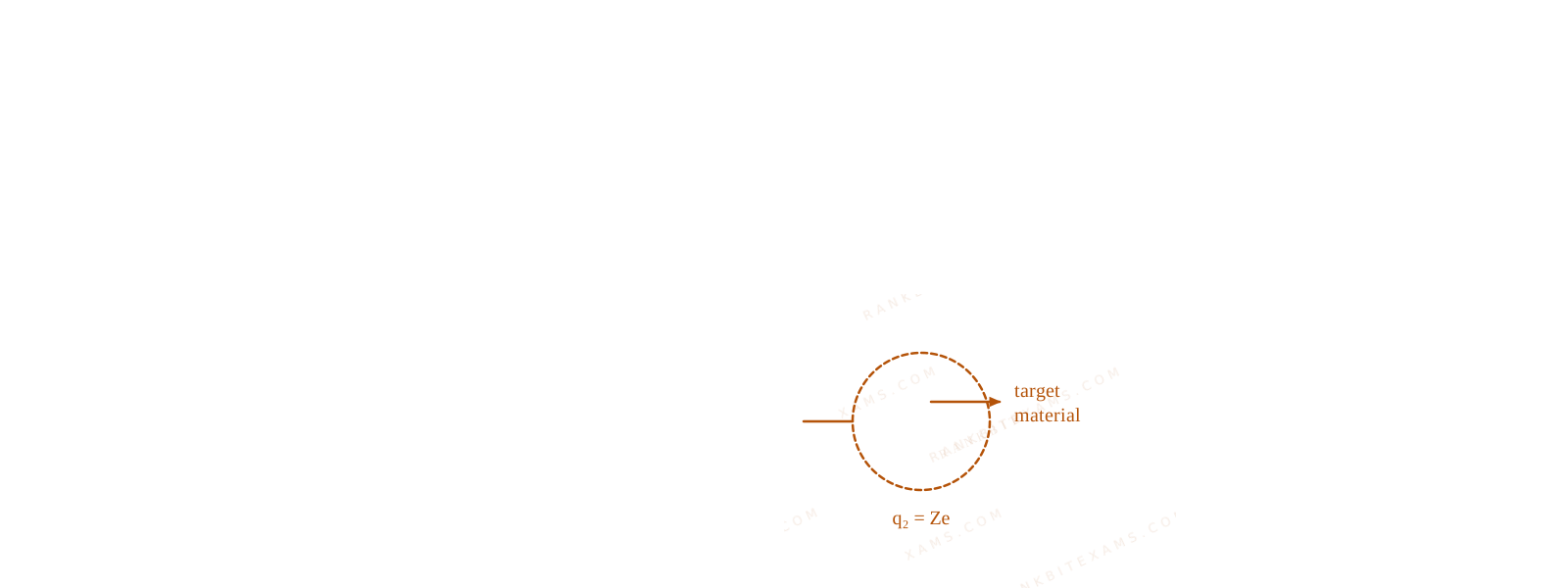
Nuclear scattering setup diagram for Q27 - JEE Main 2026 Morning

Using mechanical energy conservation:

PEᵢ + KEᵢ = PEf + KEf 0 + 7.9 × 10⁶ × 1.6 × 10⁻¹⁹ = (k(2e)(Ze))/(r) + 0 r = 9 × 10⁹ × 2 × (1.6 × 10⁻¹⁹)² × 797.9 × 10⁶ × 1.6 × 10⁻¹⁹ = 2.88 × 10⁻¹⁴ m

For diameter:

D = 2r = 5.76 × 10⁻¹⁴ m
Pattern Recognition

Sees: Alpha particle scattering + atomic number + kinetic energy. Shortcut: Equate initial kinetic energy to electrostatic potential energy at closest approach distance r, then double for diameter D = 2r. Check: Results align with option (1). ✓

Chapter Mix

Class 12 Physics: Atoms and Nuclei

Nuclear scattering setup diagram for Q27 - JEE Main 2026 Morning

Reference Study Guides

More Atoms and Nuclei Previous-Year Questions — Page 3

Q19 jee_main_2025_08_april_evening Nuclear Properties
For a nucleus of mass number A and radius R, the mass density of nucleus can be represented as:
  • A. A³
  • B. A(1)/(3)
  • C. A(2)/(3)
  • D. Independent of A

Solution

Related Formula
R = R₀ A(1)/(3) ρ = Mass of NucleusVolume of Nucleus

where, R₀ = empirical constant (≈ 1.2~fm) A = mass number (number of nucleons)

Core Logic

Let m be the average mass of a single nucleon (proton/neutron).

  • Total mass of the nucleus M ≈ A · m
  • Volume of the nucleus V = (4)/(3) π R³ = (4)/(3) π (R₀ A1/3)³ = (4)/(3) π R₀³ A
  • Now, calculate the mass density ρ:

ρ = (M)/(V) = (A · m)/((4)/(3) π R₀³ A) = (3 m)/(4π R₀³)

Since m and R₀ are constant parameters, the mass density is constant and independent of A.

Pattern Recognition

Sees: "Nuclear mass density representation" → Highly dense, constant. Shortcut: Since volume V ∝ A and mass M ∝ A, their ratio is constant. The density is on the order of 10¹⁷~kg/m³, which is completely independent of the size of the specific nucleus. ✓

Chapter Mix

Class 12 Physics: Nuclear Physics

Q12 jee_main_2025_28_jan_morning Radioactivity and Beta Decay
Choose the correct nuclear process from the below options [p: proton, n: neutron, e⁻ : electron, e⁺ : positron, v: neutrino, ν : antineutrino]
  • A. narrow p + e⁻ + v
  • B. n→ p + e⁻ + v
  • C. narrow p + e⁺ + v
  • D. narrow p + e⁺ + v

Solution

Core Logic

In basic β^- emission processes, a neutron decays inside a nucleus to satisfy lepton numbers and conservation rules:

n arrow p + e^- + ν
Step 1: Conservation Cross-Check

Charge Balance: 0 arrow (+1) + (-1) + 0 = 0 (Conserved) Lepton Family Index: 0 arrow 0 + (+1) + (-1) = 0 (Conserved via antineutrino entry).

This perfectly isolates option (1).

Pattern Recognition

Negative beta emission is always accompanied by an antineutrino, whereas positive positron transformation releases a regular neutrino molecule.

Chapter Mix

Class 12 Physics: Nuclei

Q13 jee_main_2025_03_april_morning Nuclear Fission and Fusion Q-Value
Match the LIST-I with LIST-II
LIST-ILIST-II
A. ¹n + ²³⁵₉₂U arrow ¹⁴⁰₅₄Xe + ⁹⁴₃₈Sr + 2¹₀nI. Chemical reaction
B. 2H₂ + O₂ arrow 2H₂OII. Fusion with +ve Q value
C. ²₁H + ²₁H arrow ³He + ¹₀nIII. Fission
D. ¹₁H + ³₁H arrow ²₁H + ²₁HIV. Fusion with -ve Q value
Choose the correct answer from the options given below:
  • A. A-II, B-I, C-III, D-IV
  • B. A-III, B-I, C-II, D-IV
  • C. A-II, B-I, C-IV, D-III
  • D. A-III, B-I, C-IV, D-II

Solution

Related Formula
  • Nuclear Fission: Heavy nucleus splits into intermediate lighter fragments after absorbing a neutron.
  • Nuclear Fusion: Extremely light isotopes combine to form heavier nuclei.
  • Q-value: Positive for exothermic nuclear processes (releasing energy) and negative for endothermic nuclear processes (absorbing energy).
Core Logic

Let us check each reaction:

  • Reaction A: ¹n + ²³⁵₉₂U arrow ¹⁴⁰₅₄Xe + ⁹⁴₃₈Sr + 2¹₀n
  • This is a heavy Uranium nucleus absorbing a neutron and splitting into smaller fragments. This is the definition of Nuclear Fission (III).

  • Reaction B: 2H₂ + O₂ arrow 2H₂O
  • This represents the combination of hydrogen and oxygen molecules to form water, which is a classic exothermic Chemical reaction (I).

  • Reaction C: ²₁H + ²₁H arrow ³He + ¹₀n
  • Light Deuterium nuclei fuse together to form Helium-3, releasing considerable energy (Q > 0). This is Fusion with positive Q value (II).

  • Reaction D: ¹₁H + ³₁H arrow ²₁H + ²₁H
  • Proton and Tritium reacting to form Deuteron products. Since this reaction has products with a lower binding energy than the reactants, it is an endothermic process. Hence, it is Fusion with negative Q value (IV).

Step 1: Alignment

Let's summarize the matches:

  • A arrow III
  • B arrow I
  • C arrow II
  • D arrow IV
  • This perfectly corresponds to Option (2).

Pattern Recognition

Identifying chemical vs. nuclear reactions is trivial (chemical reactions involve molecular change like 2H₂ + O₂, whereas nuclear reactions involve changes in nuclear isotopes). Always use chemical reactions to instantly lock in a match (B-I) and narrow down options!

Chapter Mix

Class 12 Physics: Nuclei Class 11 Chemistry: Chemical Bonding and Molecular Structure

Q1 jee_main_2025_04_april_evening Radioactivity
A radioactive material P first decays into Q and then Q decays to non-radioactive material R. Which of the following figure represents time dependent mass of P, Q and R?
  • A.
  • B.
  • C.
  • D.

Solution

Related Formula
N = N₀ e-λ t

where λ is the decay constant.

Core Logic

Initially, only material P is present, so its mass decreases exponentially from a maximum value to zero. Material Q is formed from P and then decays into R, so its mass initially increases from zero, reaches a maximum, and then decreases to zero. Material R is stable and accumulated over time, so its mass increases continuously from zero and levels off at a maximum value equal to the initial mass of P.

Step 1: Graphical Identification

Looking at the options, option (2) correctly depicts the exponential decay of P, the transient rise and fall of Q, and the continuous growth of R to a stable value.

Radioactive decay curves for P, Q, and R

Pattern Recognition

For sequential decay P arrow Q arrow R, parent P always starts at max and drops to 0. Intermediate Q starts at 0, peaks, and returns to 0. Final stable product R starts at 0 and grows asymptotically to max value.

Chapter Mix

Class 12 Physics: Nuclei

Q20 jee_main_2025_04_april_morning Bohr's Model of Hydrogen Atom
Considering the Bohr model of hydrogen like atoms, the ratio of the radius 5th orbit of the electron in Li²⁺ and He⁺ is
  • A. (3)/(2)
  • B. (4)/(9)
  • C. (9)/(4)
  • D. (2)/(3)

Solution

Related Formula

Bohr orbit radius expression:

rₙ ∝ (n²)/(Z)

For a constant orbit index (n = 5):

r₅ ∝ (1)/(Z)

where Z is the atomic atomic number identifier.

Core Logic

Identify the atomic values:

  • For Li²⁺ implies ZLi = 3
  • For He⁺ implies ZHe = 2
Step 1: Compute Ratio

Set up the inverse scaling ratio format:

rLi²⁺rHe⁺ = ZHeZLi = (2)/(3)
Pattern Recognition

Since orbit numbers are identical, the radius is purely inversely proportional to the atomic nuclear charge Z.

Chapter Mix

Class 12 Physics: Atoms

More Atoms and Nuclei Questions — jee_main_2026_22_january_morning

Practice all Atoms and Nuclei previous-year questions →

Rankbit System
JEE Physics: Waves (+15.5%) | Electrostatics: Concentric Shells (-29.7%) | Modern Physics: Photoelectric Clones (+34.2%) | Mathematics: Definite Integrals (+18.1%) | Chemistry: Coordination Splitting (-11.4%) | JEE Physics: Waves (+15.5%) | Electrostatics: Concentric Shells (-29.7%) | Modern Physics: Photoelectric Clones (+34.2%) | Mathematics: Definite Integrals (+18.1%) | Chemistry: Coordination Splitting (-11.4%)