### Core Logic
- A. textH_2, textPd-textBaSO_4 rightarrow$\text{H}_2, \text{Pd}-\text{BaSO}_4 \rightarrow$ II. Rosenmund Reduction
- B. textSnCl_2, textHCl rightarrow$\text{SnCl}_2, \text{HCl} \rightarrow$ IV. Stephen Reaction
- C. textCrO_2textCl_2, textCS_2 rightarrow$\text{CrO}_2\text{Cl}_2, \text{CS}_2 \rightarrow$ I. Etard Reaction
- D. textCO, textHCl, textAnhyd. textAlCl_3 rightarrow$\text{CO}, \text{HCl}, \text{Anhyd. } \text{AlCl}_3 \rightarrow$ III. Gatterman–Koch Reaction
### Step 1: Final Conclusion
Combining the correct matching gives A-II, B-IV, C-I, D-III, which is option (4).
### Pattern Recognition
Sees: standard name reactions for aldehyde preparation.
Trap: Confusing Etard reagent with Gatterman-Koch or Stephen reduction.
### Chapter Mix
Class 12 Chemistry: Aldehydes, Ketones and Carboxylic Acids
Keywords:#Match List-I with List-II List-I Reagents#JEE Main 2026 Evening Q57#Aldehydes, Ketones and Carboxylic Acids JEE Main 2026#Name Reactions JEE Main 2026
More Aldehydes, Ketones and Carboxylic Acids Previous-Year Questions
Q61jee_main_2026_21_jan_morningChemical Reactions of Aldehydes and Ketones
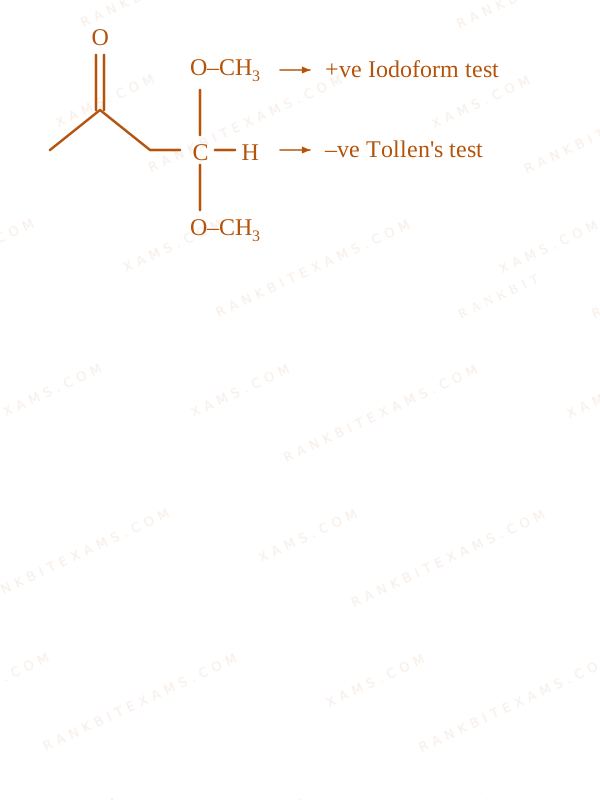
An organic compound “P” of molecular formula C_6H_12O_3$C_{6}H_{12}O_{3}$ gives positive Iodoform test but negative Tollen’s test. When “P” is treated with dilute acid, it produces “Q”. “Q” gives positive Tollen’s test and also iodoform test. The structure of “P” is :
D.mathrmCH_3-CO-CO-CH_3 text (with acetal structure)$\mathrm{CH_3-CO-CO-CH_3} \text{ (with acetal structure)}$
Solution
### Core Logic
Compound P (C_6H_12O_3$C_6H_{12}O_3$) gives a positive iodoform test, indicating it has a methyl ketone group (CH_3CO-$CH_3CO-$). It gives a negative Tollen's test, indicating no free aldehyde group.
On acidic hydrolysis, P yields Q. Compound Q gives both positive iodoform test and Tollen's test, meaning Q contains both a methyl ketone and an aldehyde group.
Looking at the options, if P is an acetal of an aldehyde, acidic hydrolysis will regenerate the aldehyde.
Option 2 is mathrmCH_3-CO-CH_2-CH(OCH_3)_2$\mathrm{CH_3-CO-CH_2-CH(OCH_3)_2}$ (an acetal of aldehyde).
This compound 'P' has a CH_3CO-$CH_3CO-$ group (positive iodoform) and an acetal (protected aldehyde, negative Tollen's).
On hydrolysis:
mathrmCH_3-CO-CH_2-CH(OCH_3)_2 xrightarrowmathrmH_2O/H^+ mathrmCH_3-CO-CH_2-CHO + 2mathrmCH_3OH$$\mathrm{CH_3-CO-CH_2-CH(OCH_3)_2} \xrightarrow{\mathrm{H_2O/H^+}} \mathrm{CH_3-CO-CH_2-CHO} + 2\mathrm{CH_3OH}$$
The product Q (mathrmCH_3-CO-CH_2-CHO$\mathrm{CH_3-CO-CH_2-CHO}$) has a methyl ketone (positive iodoform test) and an aldehyde (positive Tollen's test).
Chemical Reactions of Aldehydes and Ketones diagram for Q61 - JEE Main 2026 Morning
### Pattern Recognition
Whenever an aldehyde test becomes positive *after* hydrolysis, it points to a protected aldehyde, usually an acetal or hemiacetal. A compound with molecular formula C_n H_2n O_3$C_n H_{2n} O_3$ often represents a keto-acetal.
### Evaluation Rubric / Model Answer
null
### Chapter Mix
Class 12 Chemistry: Aldehydes, Ketones and Carboxylic Acids
Class 12 Chemistry: Alcohols, Phenols and Ethers
Q57jee_main_2026_21_jan_eveningName Reactions
Match List-I with List-II.
List-I (Reagents)
List-II (Reaction Name Involving Aldehydes)
A. textH_2, textPd-textBaSO_4$\text{H}_2, \text{Pd}-\text{BaSO}_4$
I. Etard Reaction
B. textSnCl_2, textHCl$\text{SnCl}_2, \text{HCl}$
II. Rosenmund Reduction
C. textCrO_2textCl_2, textCS_2$\text{CrO}_2\text{Cl}_2, \text{CS}_2$
III. Gatterman–Koch Reaction
D. textCO, textHCl, textAnhyd. textAlCl_3$\text{CO}, \text{HCl}, \text{Anhyd. } \text{AlCl}_3$
IV. Stephen Reaction
Choose the correct answer from the options given below:
### Core Logic
- A. textH_2, textPd-textBaSO_4 rightarrow$\text{H}_2, \text{Pd}-\text{BaSO}_4 \rightarrow$ II. Rosenmund Reduction
- B. textSnCl_2, textHCl rightarrow$\text{SnCl}_2, \text{HCl} \rightarrow$ IV. Stephen Reaction
- C. textCrO_2textCl_2, textCS_2 rightarrow$\text{CrO}_2\text{Cl}_2, \text{CS}_2 \rightarrow$ I. Etard Reaction
- D. textCO, textHCl, textAnhyd. textAlCl_3 rightarrow$\text{CO}, \text{HCl}, \text{Anhyd. } \text{AlCl}_3 \rightarrow$ III. Gatterman–Koch Reaction
### Step 1: Final Conclusion
Combining the correct matching gives A-II, B-IV, C-I, D-III, which is option (4).
### Pattern Recognition
Sees: standard name reactions for aldehyde preparation.
Trap: Confusing Etard reagent with Gatterman-Koch or Stephen reduction.
### Chapter Mix
Class 12 Chemistry: Aldehydes, Ketones and Carboxylic Acids
Qjee_main_2025_02_april_eveningPreparation of Carboxylic Acids
Consider the following reactions. From these reactions which reaction will give carboxylic acid as a major product?
(A) mathrmR - C equiv N xrightarrow[textmild condition]mathrm(i) H^+ / H_2O$\mathrm{R - C \equiv N} \xrightarrow[\text{mild condition}]{\mathrm{(i) H^+ / H_2O}}$
(B) mathrmR - MgX xrightarrow[mathrm(ii) H_3O^+]mathrm(i) CO_2$\mathrm{R - MgX} \xrightarrow[\mathrm{(ii) H_3O^+}]{{\mathrm{(i) CO_2}}}$
(C) mathrmR - C equiv N xrightarrow[mathrm(ii) H_3O^+]mathrm(i) SnCl_2 / HCl$\mathrm{R - C \equiv N} \xrightarrow[\mathrm{(ii) H_3O^+}]{{\mathrm{(i) SnCl_2 / HCl}}}$
(D) mathrmR cdot CH_2 cdot OH xrightarrowmathrmPCC$\mathrm{R \cdot CH_2 \cdot OH} \xrightarrow{\mathrm{PCC}}$
(E)Preparation of Carboxylic Acids
Choose the correct answer from the options given below:
A.textA and D only$\text{A and D only}$
B.textA, B and E only$\text{A, B and E only}$
C.textB, C and E only$\text{B, C and E only}$
D.textB and E only$\text{B and E only}$
Solution
### Related Formula
mathrmR-MgX + CO_2 rightarrow R-COOMgX xrightarrowH_3O^+ R-COOH$$\mathrm{R-MgX + CO_2 \rightarrow R-COOMgX \xrightarrow{H_3O^+} R-COOH}$$
### Core Logic
Let's analyze each reaction path to determine the major organic product:
- **Reaction (A)**: Acidic hydrolysis of a nitrile under *mild conditions* yields an amide:
mathrmR-Cequiv N rightarrow R-CONH_2$$\mathrm{R-C\equiv N \rightarrow R-CONH_2}$$
(Full conversion to carboxylic acid requires strong conditions and extended heating).
- **Reaction (B)**: Carbonation of Grignard reagent using solid carbon dioxide (dry ice) followed by acid hydrolysis yields a carboxylic acid:
mathrmR-MgX + CO_2 rightarrow R-COOMgX xrightarrowH_3O^+ R-COOH$$\mathrm{R-MgX + CO_2 \rightarrow R-COOMgX \xrightarrow{H_3O^+} R-COOH}$$
- **Reaction (C)**: Stephen reduction converts nitrile to aldehyde:
mathrmR-Cequiv N xrightarrowSnCl_2/HCl R-CH=NH xrightarrowH_3O^+ R-CHO$$\mathrm{R-C\equiv N \xrightarrow{SnCl_2/HCl} R-CH=NH \xrightarrow{H_3O^+} R-CHO}$$
- **Reaction (D)**: Pyridinium chlorochromate (PCC) is a mild oxidising agent that converts primary alcohols selectively to aldehydes:
mathrmR-CH_2-OH xrightarrowPCC R-CHO$$\mathrm{R-CH_2-OH \xrightarrow{PCC} R-CHO}$$
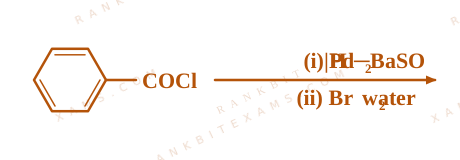
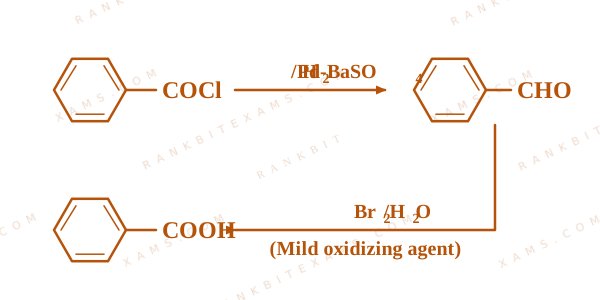
- **Reaction (E)**
Preparation of Carboxylic Acids : Rosenmund reduction reduces acid chloride to aldehyde first:
rightarrow$\rightarrow$ R-CHO
Subsequent oxidation with bromine water (which is a mild oxidising agent that selective oxidizes aldehydes but does not affect ketones) converts the aldehyde to carboxylic acid:
mathrmR-CHO xrightarrowBr_2/water R-COOH$$\mathrm{R-CHO \xrightarrow{Br_2/water} R-COOH}$$
### Step 1: Final Tally
Thus, reactions (B) and (E) successfully yield carboxylic acid as the major organic product.
### Pattern Recognition
Remember: Bromine water (mathrmBr_2/H_2O$\mathrm{Br_2/H_2O}$) is a mild, selective oxidising agent commonly used to oxidise aldoses and other aldehydes to monocarboxylic acids without degrading carbon-carbon chains.
### Evaluation Rubric / Model Answer
null
### Chapter Mix
Class 12 Chemistry: Aldehydes, Ketones and Carboxylic Acids
Qjee_main_2025_02_april_morningReactions of Phenolic Benzaldehydes
Given below are two statements :
Statement (I): Vanillin
Reactions of Phenolic Benzaldehydes will react with NaOH and also with Tollen's reagent.
Statement (II) : Vanillin
Reactions of Phenolic Benzaldehydes will undergo self aldol condensation very easily.
In the light of the above statements, choose the most appropriate answer from the options given below:
A.(1)\ textStatement I is incorrect but Statement II is correct$(1)\ \text{Statement I is incorrect but Statement II is correct}$
B.(2)\ textStatement I is correct but Statement II is incorrect$(2)\ \text{Statement I is correct but Statement II is incorrect}$
C.(3)\ textBoth Statement I and Statement II are incorrect$(3)\ \text{Both Statement I and Statement II are incorrect}$
D.(4)\ textBoth Statement I and Statement II are correct$(4)\ \text{Both Statement I and Statement II are correct}$
Solution
### Related Formula
Phenolic protons react with standard strong bases:
mathrmAr-OH + NaOH rightarrow Ar-ONa + H_2O$$\mathrm{Ar-OH + NaOH \rightarrow Ar-ONa + H_2O}$$
Aldol condensation structural requirement: Requires presence of acidic alpha$\alpha$-hydrogen atoms connected to carbonyl centers.
### Core Logic
Let's analyze functional groups within the Vanillin molecular framework:
* Vanillin contains a phenolic hydroxyl group, an aromatic ether, and a formyl functional group (benzaldehyde derivative).
* **Statement I**: The presence of the phenolic -mathrmOH$-\mathrm{OH}$ group allows acid-base reaction with mathrmNaOH$\mathrm{NaOH}$ directly Vanillin structural functional group verification for Q36. The aldehyde center readily reduces Tollen's reagent to produce a silver mirror. (Statement I is accurate).
* **Statement II**: Vanillin lacks any alpha-hydrogens adjacent to its carbonyl carbon, preventing it from undergoing self-aldol condensation. (Statement II is false).
### Pattern Recognition
Benzaldehyde and its substituted derivatives (like vanillin or benzaldehyde itself) never undergo self-aldol condensation because they lack alpha$\alpha$-carbons with abstractable protons. Instead, they typically perform Cannizzaro transformations when exposed to highly concentrated alkaline media.
### Evaluation Rubric / Model Answer
null
### Chapter Mix
Class 12 Chemistry: Aldehydes, Ketones and Carboxylic Acids
More Aldehydes, Ketones and Carboxylic Acids Questions — jee_main_2026_22_january_morning
We Map Every Repeating Question in Competitive Exams.
Say goodbye to generic mock test fatigue. RankBit uses smart analysis to group past exam questions into their foundational Repeating Question Types. Find chapter weightage, track repeating questions, and score higher with targeted practice.
Select Your Target Exam
Choose an exam track below to find formulas per chapter and patterns.
Syncing Exam Intelligence
Mapping formulas and patterns across all tracks…
PATH A — FULL LENGTH PRACTICE
Full Mock Test Hub
Simulate real NTA exam conditions with fully tracked mocks. Time yourself against past papers.
Practice past-year questions one chapter at a time. Pick an exam → subject → chapter and get every PYQ for that topic — pulled together from all past papers — with the chapter's key formulas alongside.
.svg)
.svg)
