JEE Main · Chemistry → Steady

Alcohols Phenols and Ethers appeared 23 times across 3 years — 2.7% of Chemistry. This question is from Reimer Tiemann Reaction.

Year 2026 2025 2024 Total
Questions 7 5 11 23

Given below are two statements: Statement I: Phenol on treatment with CHCl₃/aq. KOH under refluxing condition, followed by acidification produces p-hydroxy benzaldehyde as the major product and o-hydroxy benzaldehyde as the minor product. Statement II: The mixture of p-hydroxybenzaldehyde and o-hydroxybenzaldehyde can be easily separated through steam distillation. In the light of the above statements, choose the correct answer from the options given below:

Solution & Explanation

Related Formula

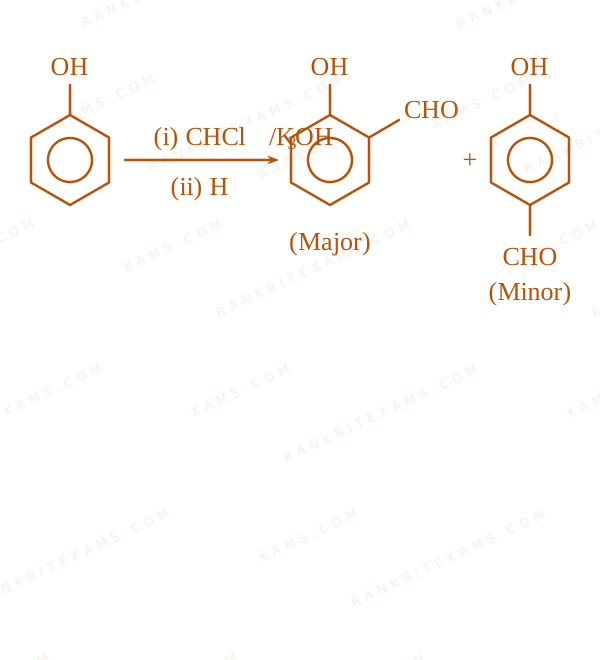
Reimer-Tiemann Reaction: Phenol CHCl₃, KOH o-hydroxybenzaldehyde (Salicylaldehyde) as major product.

Core Logic

Statement I claims that p-hydroxybenzaldehyde is the major product. This is incorrect. In the Reimer-Tiemann reaction, ortho-hydroxybenzaldehyde (salicylaldehyde) is the major product due to the stabilization of the intermediate and product via intramolecular hydrogen bonding.

Reimer-Tiemann reaction mechanism diagram

Statement II states that the mixture of p-hydroxybenzaldehyde and o-hydroxybenzaldehyde can be separated by steam distillation. This is true. Ortho-hydroxybenzaldehyde forms intramolecular hydrogen bonds, making it more volatile (steam volatile), whereas the para-isomer forms intermolecular hydrogen bonds, increasing its boiling point and making it non-steam volatile.

Step 1: Final Conclusion

Therefore, Statement I is false but Statement II is true.

Pattern Recognition

Always remember: Ortho-isomers capable of intramolecular H-bonding are steam volatile. Para-isomers exhibit intermolecular H-bonding and are not steam volatile.

Chapter Mix

Class 12 Chemistry: Alcohols Phenols and Ethers

Reference Study Guides

More Alcohols Phenols and Ethers Previous-Year Questions — Page 5

Q jee_main_2024_30_january_evening Preparation of Alcohols
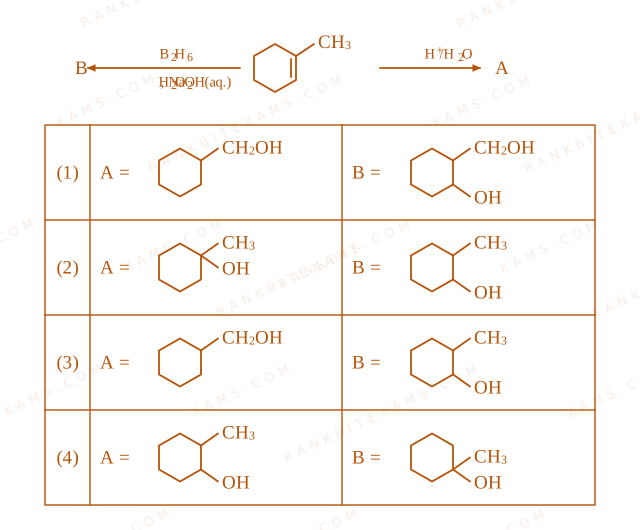
Product A and B formed in the following set of reactions are:
Preparation of Alcohols diagram for Q66 - JEE Main 2024 Evening
The diagram shows a reaction pathway for synthesizing product A and B.
  • A. A = CH₂OH , B = CH₂OH
  • B. A = CH₃OH , B = CH₃OH
  • C. A = CH₂OH , B = CH₃OH
  • D. A = CH₃OH , B = CH₃OH

Solution

Core Logic

The given substrate is an alkene attached to a benzene ring (styrene derivative).

Reaction 1: Acid-catalyzed hydration (H^+ / H₂O) This proceeds via Markovnikov's rule. The proton attacks the alkene to form the most stable carbocation (benzyllic and secondary). Water then attacks this carbocation to yield the alcohol at the substituted position (product A: Ph-CH(OH)-CH₃).

Reaction 2: Hydroboration-Oxidation (B₂H₆, then H₂O₂/NaOH) This proceeds via anti-Markovnikov addition of water across the double bond without carbocation rearrangement. The OH group adds to the less substituted carbon atom of the alkene (product B: Ph-CH₂-CH₂-OH).

Reaction pathway for products A and B diagram for Q66 - JEE Main 2024 Evening
The diagram shows a reaction pathway for synthesizing product A and B.

Pattern Recognition

H^+/H₂O = Markovnikov hydration (carbocation intermediate). B₂H₆ / H₂O₂, OH^- = Anti-Markovnikov hydration (concerted, no rearrangement).

Chapter Mix

Class 12 Chemistry: Alcohols Phenols and Ethers Class 11 Chemistry: Hydrocarbons

Q69 jee_main_2024_31_jan_morning Chemical Reactions of Alcohols
Given below are two statements: One is labelled as Assertion A and the other is labelled as Reason R: Assertion A: Alcohols react both as nucleophiles and electrophiles. Reason R: Alcohols react with active metals such as sodium, potassium and aluminum to yield corresponding alkoxides and liberate hydrogen. In the light of the above statements, choose the correct answer from the options given below:
  • A. A is false but R is true.
  • B. A is true but R is false.
  • C. Both A and R are true and R is the correct explanation of A.
  • D. Both A and R are true but R is NOT the correct explanation of A.

Solution

Core Logic

Assertion (A) is correct. Alcohols can act as nucleophiles (in reactions involving O-H bond cleavage) and as electrophiles (in reactions involving C-O bond cleavage after protonation).

Reason (R) is correct. Alcohols react with active metals to form alkoxides and H₂ gas.

However, Reason (R) only explains the acidic nature of the O-H bond (which relates to nucleophilic behavior when broken) but does not explain the electrophilic behavior (C-O cleavage). Thus, (R) is not the correct explanation for (A).

Chapter Mix

Class 12 Chemistry: Alcohols, Phenols and Ethers

Q74 jee_main_2024_31_jan_morning Acidity of Phenols
Given below are two statements: One is labelled as Assertion A and the other is labelled as Reason R: Assertion A: pKₐ value of phenol is 10.0 while that of ethanol is 15.9. Reason R: Ethanol is stronger acid than phenol. In the light of the above statements, choose the correct answer from the options given below:
  • A. A is true but R is false.
  • B. A is false but R is true.
  • C. Both A and R are true and R is the correct explanation of A.
  • D. Both A and R are true but R is NOT the correct explanation of A.

Solution

Core Logic

Assertion A is true: Phenol has a pKₐ of around 10.0, and ethanol has a pKₐ of around 15.9.

Reason R is false: A lower pKₐ value implies higher acidity. Therefore, phenol is a stronger acid than ethanol. This is because the conjugate base of phenol (phenoxide ion) is resonance-stabilized, whereas the ethoxide ion is destabilized by the +I effect of the ethyl group.

Chapter Mix

Class 12 Chemistry: Alcohols, Phenols and Ethers

More Alcohols Phenols and Ethers Questions — jee_main_2026_22_january_morning

Practice all Alcohols Phenols and Ethers previous-year questions →

Rankbit System
JEE Physics: Waves (+15.5%) | Electrostatics: Concentric Shells (-29.7%) | Modern Physics: Photoelectric Clones (+34.2%) | Mathematics: Definite Integrals (+18.1%) | Chemistry: Coordination Splitting (-11.4%) | JEE Physics: Waves (+15.5%) | Electrostatics: Concentric Shells (-29.7%) | Modern Physics: Photoelectric Clones (+34.2%) | Mathematics: Definite Integrals (+18.1%) | Chemistry: Coordination Splitting (-11.4%)