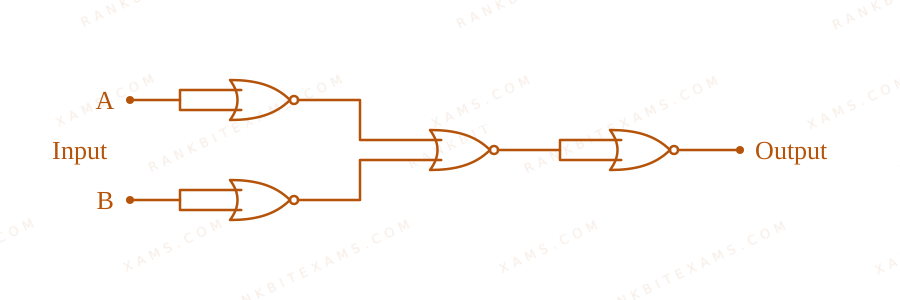
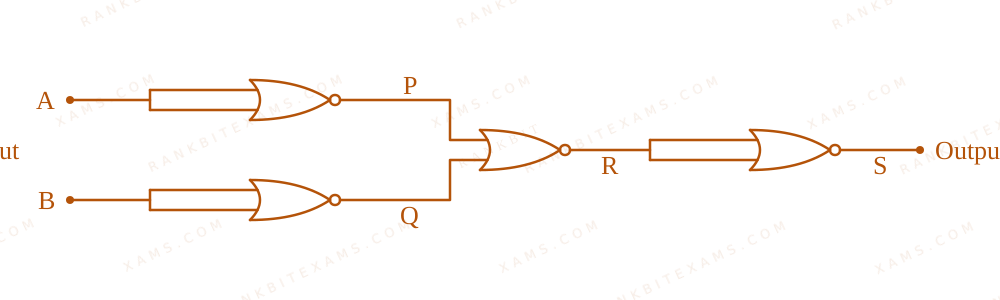
The given circuit works as :
Logic Gates diagram for Q42 - JEE Main 2026 Morning
Circuit containing multiple interconnected logic gates leading to a final output.

Solution & Explanation

### Related Formula De Morgan's Laws: overlineA + overlineB = overlineA cdot B overlineoverlineA = A ### Core Logic Analyzing the circuit diagram:
Logic Gates solution diagram for Q42 - JEE Main 2026 Morning
Circuit containing multiple interconnected logic gates leading to a final output.
- Top branch has a NOT gate on A, so P = overlineA - Bottom branch has a NOT gate on B, so Q = overlineB - They enter a NOR gate, giving output R = overlineoverlineA + overlineB - Finally, R passes through a NOT gate to give S = overlineR ### Step 1: Boolean Simplification R = overlineoverlineA + overlineB = overlineoverlineAB = AB S = overlineR = overlineAB The expression overlineAB is the Boolean expression for a NAND gate. ### Pattern Recognition Two NOTs feeding into a NOR equals an AND gate (AB). Adding a final NOT gate turns the AND into a NAND. ### Evaluation Rubric / Model Answer null ### Chapter Mix Class 12 Physics: Semiconductor Electronics
More Semiconductor Electronics Previous-Year Questions — Page 2

Q13 jee_main_2025_28_jan_morning Logic Gates
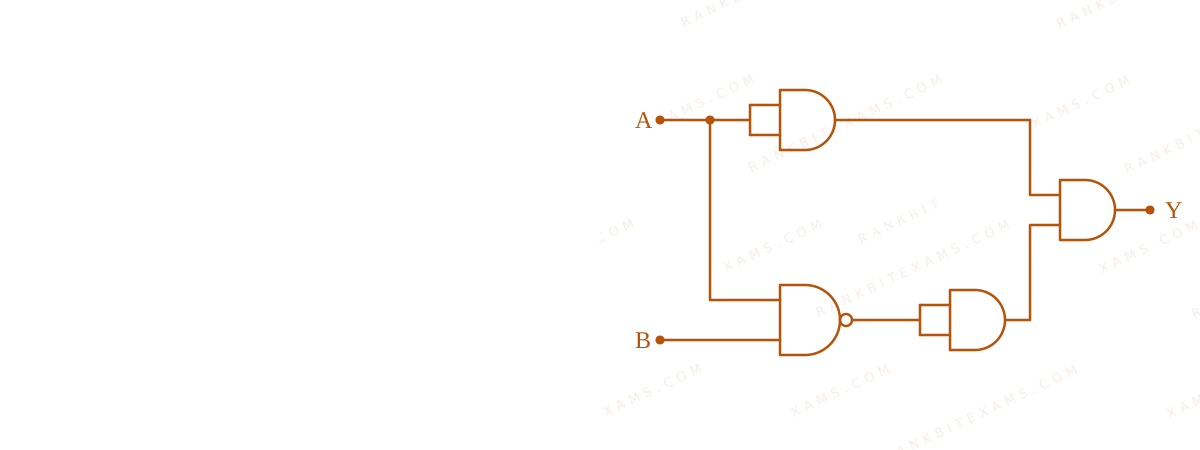
Which of the following circuits has the same output as that of the given circuit?
Logic Gates diagram for Q13 - JEE Main 2025 Morning
A combination gate circuit configuration evaluated for total Boolean output expressions.
  • A. textCircuit (1)
  • B. textCircuit (2)
  • C. textCircuit (3)
  • D. textCircuit (4)

Solution

### Core Logic Let's perform Boolean analysis on the configuration steps mapped below: mathrmP = mathrmA cdot barmathrmB mathrmQ = mathrmA cdot mathrmB mathrmY = overlinemathrmP + mathrmQ = overlinemathrmA cdot barmathrmB + mathrmA cdot mathrmB Factoring using distributive Boolean rules: mathrmY = overlinemathrmA cdot (mathrmB + barmathrmB) = overlinemathrmA cdot 1 mathrmY = barmathrmA ### Step 1: Final Reduction The expression reduces to a simple inverter (NOT gate) processing input A. This aligns with Circuit (1), matching option (1). ### Pattern Recognition Identify standard combinations: (mathrmA text AND NOT mathrmB) text OR (mathrmA text AND mathrmB) collapses back into simply input A because operand B covers all possible states. ### Evaluation Rubric / Model Answer null ### Chapter Mix Class 12 Physics: Semiconductor Electronics: Materials, Devices and Simple Circuits
Q3 jee_main_2025_03_april_morning Logic Gates
Choose the correct logic circuit for the given truth table having inputs A and B.
InputsOutput
ABY
000
010
101
111
  • A. Circuit (1)
  • B. Circuit (2)
  • C. Circuit (3)
  • D. Circuit (4)

Solution

### Related Formula Let us inspect the Boolean expression for the output Y from the truth table. From the table: - If A=0, Y=0 regardless of B. - If A=1, Y=1 regardless of B. Thus, the truth table is represented by the simple direct logical equation: Y = A ### Core Logic Let's check the Boolean output of the options shown in the question paper: - **Circuit (1)**: Inputs A and B go into an OR gate, outputting (A + B). This output and B then go to an AND gate. Y = (A + B) cdot B = Acdot B + Bcdot B = B(A + 1) = B This gives Y = B (Not matching table). - **Circuit (2)**: Inputs A and B go into an OR gate, outputting (A + B). This and A then go into an AND gate. Y = (A + B) cdot A = Acdot A + Acdot B = A + Acdot B = A(1 + B) = A This gives Y = A (Perfect match to the truth table where Y exactly copies A). ### Step 1: Verification of Circuit (2) Let's double-check the truth table values for Circuit (2): - For A=0, B=0: Y = (0 + 0) cdot 0 = 0. - For A=0, B=1: Y = (0 + 1) cdot 0 = 0. - For A=1, B=0: Y = (1 + 0) cdot 1 = 1. - For A=1, B=1: Y = (1 + 1) cdot 1 = 1. This perfectly matches the given truth table. Therefore, Circuit (2) is correct. ### Pattern Recognition Identify the logic expression directly from the truth table first! Notice that Y is completely independent of B and strictly equals A. This immediately points to any Boolean simplification that collapses to A (such as absorption law: A(A+B) = A). ### Evaluation Rubric / Model Answer null ### Chapter Mix Class 12 Physics: Semiconductor Electronics: Materials, Devices and Simple Circuits
Q16 jee_main_2025_04_april_evening Extrinsic Semiconductors
Consider a n-type semiconductor in which n_e and n_h are number of electrons and holes, respectively. (A) Holes are minority carriers (B) The dopant is a pentavalent atom (C) n_en_hne n_i^2 (where n_i is number of electrons or holes in semiconductor when it is in intrinsic form) (D) n_en_hge n_i^2 (E) The holes are not generated due to the donors Choose the correct answer from the options given below:
  • A. (A), (C), (D) only
  • B. (A), (C), (E) only
  • C. (A), (B), (E) only
  • D. (A), (B), (C) only

Solution

### Related Formula Mass Action Law: n_e cdot n_h = n_i^2 ### Core Logic Let's analyze each statement for an n-type semiconductor: - (A) Holes are minority carriers: True, electrons are the majority carriers. - (B) The dopant is a pentavalent atom: True (like Phosphorus, Arsenic) which provides extra free electrons. - (C) and (D) contradict the fundamental mass action law n_e n_h = n_i^2, so they are False. - (E) Holes are generated purely due to thermal excitation, not due to donor atoms: True. ### Step 1: Assemble Correct Set Statements (A), (B), and (E) are explicitly correct. ### Pattern Recognition Mass action law (n_e n_h = n_i^2) holds uniformly for both doped types at thermal equilibrium. In n-type systems, donors directly inject electrons only; holes emerge solely from thermal breakages of lattice bonds. ### Evaluation Rubric / Model Answer null ### Chapter Mix Class 12 Physics: Semiconductor Electronics
Q15 jee_main_2025_04_april_morning Logic Gates
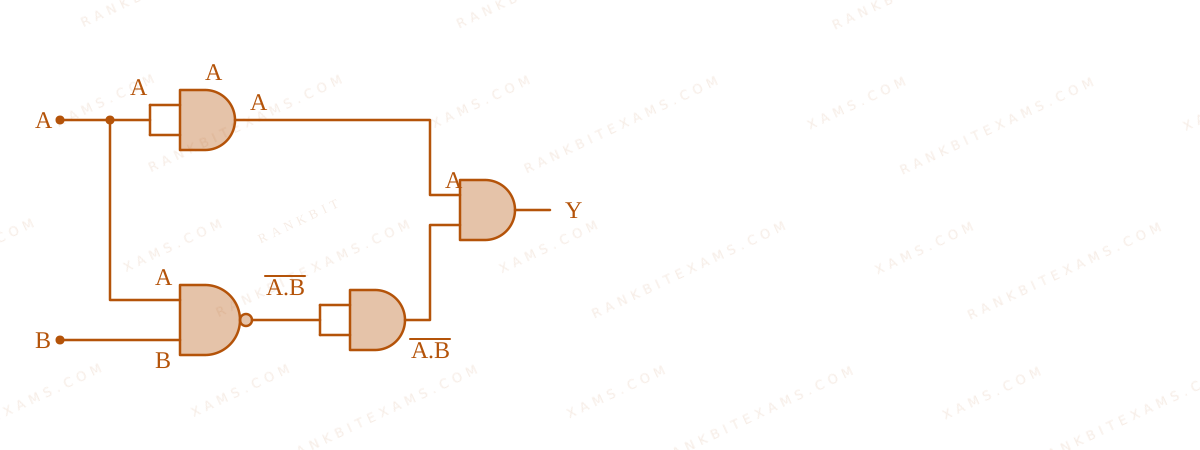
The Boolean expression Y=AoverlineBC+overlineAoverlineC can be realised with which of the following gate configurations. A. One 3-input AND gate, 3 NOT gates and one 2-input OR gate, One 2-input AND gate B. One 3-input AND gate, 1 NOT gate, One 2-input NOR gate and one 2-input OR gate C. 3-input OR gate, 3 NOT gates and one 2-input AND gate Choose the correct answer from the options given below
  • A. B, C Only
  • B. A, B Only
  • C. A, B, C Only
  • D. A, C Only

Solution

### Related Formula Given logical expression: Y = AoverlineBC + overlineAoverlineC By Boolean theorem logic: overlineAoverlineC = overlineA+C quad text(NOR configuration) ### Core Logic Let's analyze configuration options A and B: * **Configuration A:** Creates AoverlineBC via one 3-input AND gate and one NOT gate for B. Creates overlineAoverlineC via one 2-input AND gate and two separate NOT gates for A and C. Finally combines them using a 2-input OR gate. This perfectly mirrors the terms. (Total gates: one 3-input AND, one 2-input AND, three NOT, one 2-input OR).
Logic circuit layout A for Q15 - JEE Main 2025 Morning
### Step 1: Verify Configuration B * **Configuration B:** Creates AoverlineBC via one 3-input AND gate and one NOT gate for B. Re-writes the secondary term overlineAoverlineC into overlineA+C, which corresponds directly to a single 2-input NOR gate. Merges both sub-tracks using a 2-input OR gate. This is also completely valid.
Logic circuit layout A for Q15 - JEE Main 2025 Morning
### Pattern Recognition Always utilize De Morgan's identity triggers to dynamically simplify multiple product complements like overlineAoverlineC into unified NOR formats. ### Evaluation Rubric / Model Answer null ### Chapter Mix Class 12 Physics: Semiconductor Electronics
Q15 jee_main_2025_24_jan_evening Logic Gates
The output of the circuit is low (zero) for :
Digital logic gate circuit diagram with inputs X and Y Q15
The figure contains a digital combination logic gate configuration with input variables X and Y.
(A) X = 0, Y = 0 (B) X = 0, Y = 1 (C) X = 1, Y = 0 (D) X = 1, Y = 1 Choose the correct answer from the options given below:
  • A. (A), (C) and (D) only
  • B. (A), (B) and (C) only
  • C. (B), (C) and (D) only
  • D. (A), (B) and (D) only

Solution

### Core Logic Let us check the gate outputs row-by-row to find the boolean expression or map the truth table values:
Truth table matrix visualization for Q15
The figure contains a digital combination logic gate configuration with input variables X and Y.
beginarrayccc X & Y & textOutput \hline 0 & 0 & 1 \ 0 & 1 & 0 \ 1 & 0 & 0 \ 1 & 1 & 0 endarray The output is low (zero) for configurations (B) X=0, Y=1, (C) X=1, Y=0, and (D) X=1, Y=1. Therefore, options (B), (C) and (D) only are correct. ### Pattern Recognition The truth table profile matches a standard NOR logic configuration where the output is 1 only when all input lines are completely low. ### Evaluation Rubric / Model Answer null ### Chapter Mix Class 12 Physics: Semiconductor Electronics
More Semiconductor Electronics Questions — jee_main_2026_21_jan_morning

Practice all Semiconductor Electronics previous-year questions →

Rankbit System
JEE Physics: Waves (+15.5%) | Electrostatics: Concentric Shells (-29.7%) | Modern Physics: Photoelectric Clones (+34.2%) | Mathematics: Definite Integrals (+18.1%) | Chemistry: Coordination Splitting (-11.4%) | JEE Physics: Waves (+15.5%) | Electrostatics: Concentric Shells (-29.7%) | Modern Physics: Photoelectric Clones (+34.2%) | Mathematics: Definite Integrals (+18.1%) | Chemistry: Coordination Splitting (-11.4%)
YOUR FIRST PREP STEP STARTS HERE

We Map Every Repeating Question in Competitive Exams.

Say goodbye to generic mock test fatigue. RankBit uses smart analysis to group past exam questions into their foundational Repeating Question Types. Find chapter weightage, track repeating questions, and score higher with targeted practice.

Select Your Target Exam

Choose an exam track below to find formulas per chapter and patterns.

Syncing Exam Intelligence

Mapping formulas and patterns across all tracks…

PATH A — FULL LENGTH PRACTICE

Full Mock Test Hub

Simulate real NTA exam conditions with fully tracked mocks. Time yourself against past papers.

Now Live Open
PATH B — TARGETED PRACTICE

Topic-wise Practice Hub

Practice past-year questions one chapter at a time. Pick an exam → subject → chapter and get every PYQ for that topic — pulled together from all past papers — with the chapter's key formulas alongside.

Loading Questions... Browse Topics
Latest from the Blog
View all →

Loading articles...