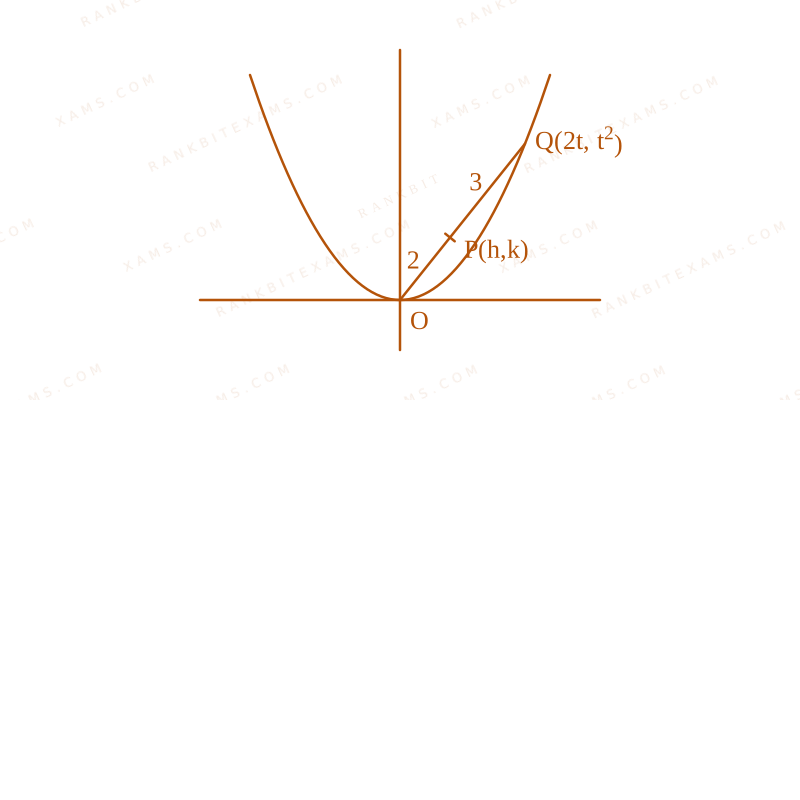
Let O be the vertex of the parabola x^2=4y and Q be any point on it. Let the locus of the point P, which divides the line segment OQ internally in the ratio 2: 3 be the conic C. Then the equation of the chord of C, which is bisected at the point (1, 2), is:

Solution & Explanation

### Related Formula textSection Formula: quad P = fracm cdot Q + n cdot Om + n textChord bisected at (x_1, y_1) : quad T = S_1 ### Core Logic Given parabola x^2 = 4y, its vertex O = (0, 0). A general point Q on x^2 = 4y is (2t, t^2). Let P(h, k) divide OQ in ratio 2:3. By section formula: h = frac2(2t) + 3(0)5 = frac4t5 k = frac2(t^2) + 3(0)5 = frac2t^25
Locus of point dividing parabolic chord for Q20 - JEE Main 2026 Morning
### Step 1: Finding the Locus C From h = frac4t5, we get t = frac5h4. Substitute into k: k = frac25 left(frac5h4right)^2 = frac25 cdot frac25h^216 = frac5h^28 8k = 5h^2 Rightarrow 5x^2 = 8y So the conic C is the parabola 5x^2 = 8y. ### Step 2: Chord bisected at a point We need the equation of the chord of C: 5x^2 - 8y = 0 bisected at (x_1, y_1) = (1, 2). Use T = S_1. T = 5xx_1 - 4(y + y_1) = 5x(1) - 4(y + 2) = 5x - 4y - 8 S_1 = 5(1)^2 - 8(2) = 5 - 16 = -11 Equating T and S_1: 5x - 4y - 8 = -11 5x - 4y + 3 = 0 ### Pattern Recognition Internal division locus of a vertex chord on standard conic identically scales the conic. Once the child-conic is found, standard mid-point chord protocol (T=S_1) strictly applies algebraically. ### Evaluation Rubric / Model Answer null ### Chapter Mix Class 11 Maths: Parabola Class 11 Maths: Straight Lines

Reference Study Guides

More Parabola Previous-Year Questions — Page 9

Q13 jee_main_2024_01_february_morning Properties of Ellipse and Hyperbola
For 0, if the eccentricity of the hyperbola x^2-y^2csc^2theta=5 is sqrt7 times the eccentricity of the ellipse x^2csc^2theta+y^2=5, then the value of theta is:
  • A. fracpi6
  • B. frac5pi12
  • C. fracpi3
  • D. fracpi4

Solution

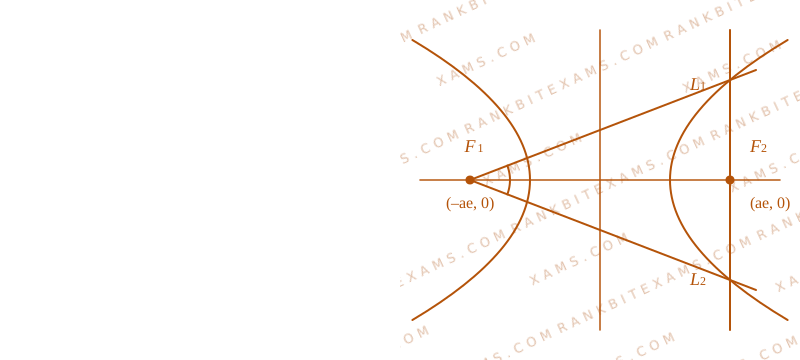
### Related Formula - Eccentricity of hyperbola fracx^2a^2 - fracy^2b^2 = 1: e_h = sqrt1 + fracb^2a^2 - Eccentricity of ellipse fracx^2B^2 + fracy^2A^2 = 1 (where A > B): e_e = sqrt1 - fracB^2A^2 ### Core Logic Let's rewrite both equations in their standard forms: 1. **Hyperbola:** x^2 - y^2csc^2theta = 5 implies fracx^25 - fracy^25sin^2theta = 1 Here, a^2 = 5 and b^2 = 5sin^2theta. e_h = sqrt1 + frac5sin^2theta5 = sqrt1 + sin^2theta 2. **Ellipse:** x^2csc^2theta + y^2 = 5 implies fracx^25sin^2theta + fracy^25 = 1 Since 0 < theta < pi/2, we know 0 < sintheta < 1 implies 5sin^2theta < 5. Thus, the major axis is along the y-axis, meaning A^2 = 5 and B^2 = 5sin^2theta. e_e = sqrt1 - frac5sin^2theta5 = sqrt1 - sin^2theta = costheta ### Step 1: Setting up the Equation and Solving Given e_h = sqrt7e_e, squaring both sides yields: e_h^2 = 7e_e^2 1 + sin^2theta = 7(1 - sin^2theta) 1 + sin^2theta = 7 - 7sin^2theta 8sin^2theta = 6 implies sin^2theta = frac34 Since theta in (0, pi/2): sintheta = fracsqrt32 implies theta = fracpi3 ### Pattern Recognition Sees: Conic parameters tied dynamically to trigonometry. Trap: In the ellipse equation, do not automatically assume the x-axis holds the major axis. Since sin^2theta < 1, the denominator under y^2 is larger, making it a vertical ellipse. ### Evaluation Rubric / Model Answer null ### Chapter Mix Class 11 Mathematics: Conic Sections Class 11 Mathematics: Trigonometric Functions
Q16 jee_main_2024_01_february_morning Properties of Ellipse and Hyperbola
Let fracx^2a^2+fracy^2b^2=1, a>b be an ellipse, whose eccentricity is frac1sqrt2 and the length of the latus rectum is sqrt14. Then the square of the eccentricity of fracx^2a^2-fracy^2b^2=1 is:
  • A. 3
  • B. 7/2
  • C. 3/2
  • D. 5/2

Solution

### Related Formula - Eccentricity of an ellipse (a>b): e_E^2 = 1 - fracb^2a^2 - Eccentricity of a hyperbola: e_H^2 = 1 + fracb^2a^2 ### Core Logic Given the eccentricity of the ellipse is e_E = frac1sqrt2: e_E^2 = 1 - fracb^2a^2 implies left(frac1sqrt2right)^2 = 1 - fracb^2a^2 frac12 = 1 - fracb^2a^2 implies fracb^2a^2 = frac12 ### Step 1: Finding Hyperbola Eccentricity The required equation asks for the square of the eccentricity of the conjugate parameter hyperbola fracx^2a^2 - fracy^2b^2 = 1: e_H^2 = 1 + fracb^2a^2 Substituting the derived ratio fracb^2a^2 = frac12: e_H^2 = 1 + frac12 = frac32 Thus, the square of the eccentricity is frac32. ### Pattern Recognition Sees: Linked parameters between ellipse and hyperbola. Shortcut: Notice that information about the latus rectum length (sqrt14) is a deliberate distractor! Since the definition of hyperbola eccentricity squared (e_H^2 = 1 + b^2/a^2) relies solely on the dimensionless ratio fracb^2a^2, you don't need to compute absolute scales for a or b. ### Evaluation Rubric / Model Answer null ### Chapter Mix Class 11 Mathematics: Conic Sections
Q18 jee_main_2024_01_february_morning Intersection of Circles
Let C:x^2+y^2=4 and C^prime:x^2+y^2-4lambda x+9=0 be two circles. If the set of all values of lambda so that the circles C and C' intersect at two distinct points, is R - [a, b], then the point (8a+12,16b-20) lies on the curve:
  • A. x^2+2y^2-5x+6y=3
  • B. 5x^2-y=-11
  • C. x^2-4y^2=7
  • D. 6x^2+y^2=42

Solution

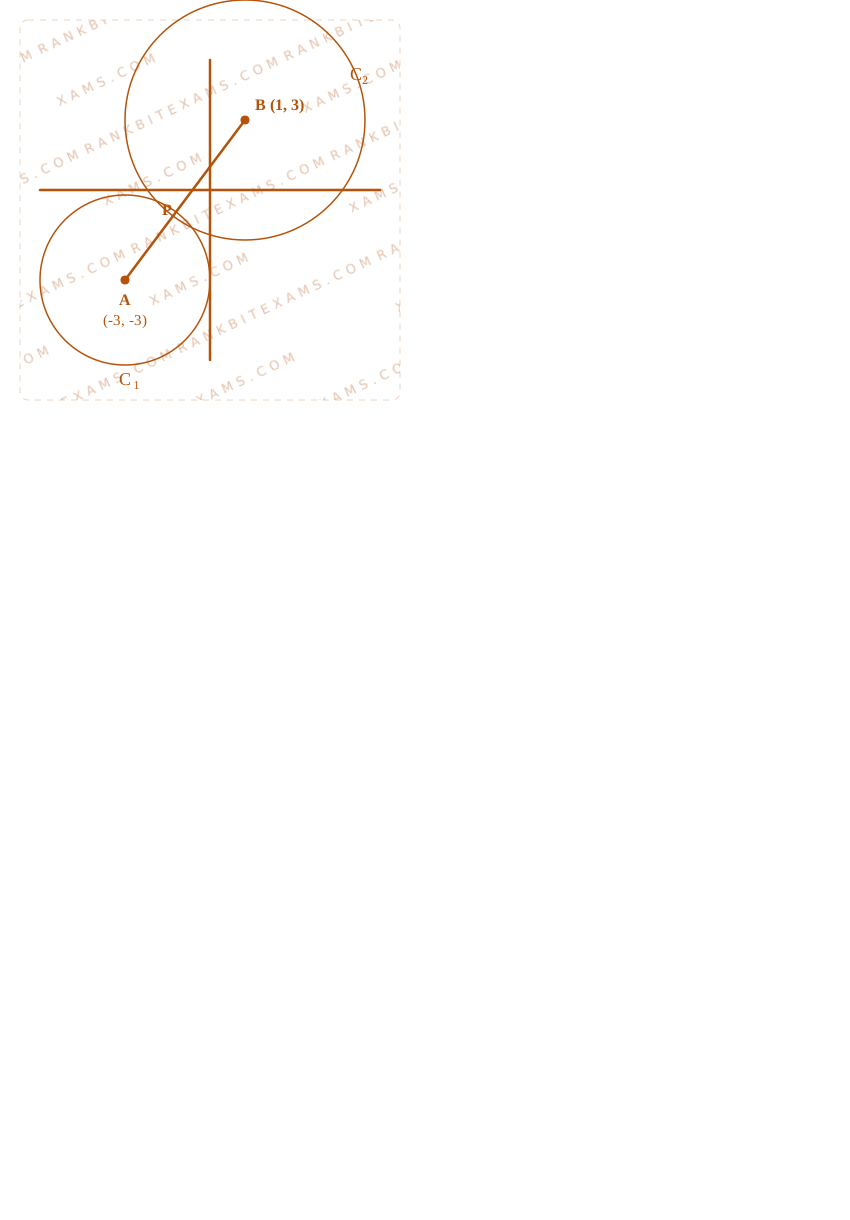
### Related Formula For two circles with centers C_1, C_2 and radii r_1, r_2 to intersect at two distinct real points, the distance between their centers must satisfy: |r_1 - r_2| < C_1C_2 < r_1 + r_2 ### Core Logic Extracting properties from the circle equations: - Circle C: x^2 + y^2 = 4 implies Center C_1 = (0,0), Radius r_1 = 2 - Circle C': x^2 + y^2 - 4lambda x + 9 = 0 implies Center C_2 = (2lambda, 0), Radius r_2 = sqrt(-2lambda)^2 - 9 = sqrt4lambda^2 - 9 For real intersection conditions, the radius must be defined: 4lambda^2 - 9 > 0 implies lambda^2 > frac94 quad implies (1) Distance between centers: C_1C_2 = sqrt(2lambda - 0)^2 + 0^2 = |2lambda|. ### Step 1: Formulate the Triangle Inequality Solutions Applying the intersection condition: |2 - sqrt4lambda^2 - 9| < |2lambda| < 2 + sqrt4lambda^2 - 9 The right side inequality |2lambda| < 2 + sqrt4lambda^2 - 9 is always valid for real radii. Solving the left side inequality by squaring: left(2 - sqrt4lambda^2 - 9right)^2 < (2lambda)^2 4 + (4lambda^2 - 9) - 4sqrt4lambda^2 - 9 < 4lambda^2 -5 - 4sqrt4lambda^2 - 9 < 0 implies 4sqrt4lambda^2 - 9 > -5 Since a square root is always non-negative, square both sides to get the strict bound: 16(4lambda^2 - 9) > 25 implies 64lambda^2 - 144 > 25 64lambda^2 > 169 implies lambda^2 > frac16964 quad implies (2) Combining bounds (1) and (2), condition (2) is more restrictive, meaning: lambda in left(-infty, -frac138right) cup left(frac138, inftyright) This can be written as mathbbR - left[-frac138, frac138right]. ### Step 2: Coordinate Analysis of the Target Point Comparing our interval with mathbbR - [a, b], we identify: a = -frac138, quad b = frac138 Now, substitute these bounds to locate the coordinates of our target point (8a+12, \, 16b-20): - x-coordinate: 8left(-frac138right) + 12 = -13 + 12 = -1 - y-coordinate: 16left(frac138right) - 20 = 26 - 20 = 6 Hence, the point is (-1, 6). ### Step 3: Test Point against the Options Substitute (-1, 6) into the given curves to find a match: Testing Option (4): 6x^2 + y^2 = 42 6(-1)^2 + (6)^2 = 6(1) + 36 = 42 Since LHS = RHS, the point satisfies the curve in Option (4). ### Pattern Recognition Sees: Dynamic variable interval limits forming loci requirements. Shortcut: When checking inequalities like |2 - sqrtz| < 2lambda, algebraic squaring helps simplify the terms quickly by eliminating the parameter 4lambda^2 from both sides. ### Evaluation Rubric / Model Answer null ### Chapter Mix Class 11 Mathematics: Conic Sections (Circles) Class 11 Mathematics: Linear Inequalities
Q26 jee_main_2024_01_february_morning Tangents and Condition of Tangency
Let the line L -:sqrt2x+y=alpha pass through the point of the intersection P (in the first quadrant) of the circle x^2+y^2=3 and the parabola x^2=2y. Let the line L touch two circles C_1 and C_2 of equal radius 2sqrt3. If the centres Q₁ and Q_2 of the circles C_1 and C_2 lie on the y-axis, then the square of the area of the triangle PQ_1Q_2 is equal to
Numerical Answer. Answer: 72 to 72

Solution

### Related Formula - Distance from a point (x_0, y_0) to a straight line Ax + By + C = 0 is: d = frac|Ax_0 + By_0 + C|sqrtA^2 + B^2 - Tangency Condition: Perpendicular distance from the center of a circle to a line must equal its radius (d = r). ### Core Logic First, find the point of intersection P between the circle x^2 + y^2 = 3 and the parabola x^2 = 2y: 2y + y^2 = 3 implies y^2 + 2y - 3 = 0 (y + 3)(y - 1) = 0 implies y = 1 quad text(since P text lies in the first quadrant) Substituting y = 1 back: x^2 = 2(1) implies x = sqrt2. Thus, point P = (sqrt2, 1). ### Step 1: Solve for Line Parameter alpha Since P(sqrt2, 1) lies on line L: sqrt2x + y = alpha: sqrt2(sqrt2) + 1 = alpha implies 2 + 1 = alpha implies alpha = 3 So the equation of line L is sqrt2x + y - 3 = 0. ### Step 2: Find Centers Q1 and Q2 The centers lie on the y-axis, so let their coordinates be (0, k). The perpendicular distance to line L is equal to the radius 2sqrt3: frac|sqrt2(0) + k - 3|sqrt(sqrt2)^2 + 1^2 = 2sqrt3 frac|k - 3|sqrt3 = 2sqrt3 implies |k - 3| = 6 Unfolding the absolute parameter: - k - 3 = 6 implies k = 9 implies Q_1 = (0, 9) - k - 3 = -6 implies k = -3 implies Q_2 = (0, -3) ### Step 3: Evaluate Triangle Area Squared Using the matrix determinant method for the area of triangle PQ_1Q_2: textArea = frac12 beginvmatrix sqrt2 & 1 & 1 \\ 0 & 9 & 1 \\ 0 & -3 & 1 endvmatrix = frac12 left| sqrt2 cdot (9 - (-3)) right| = 6sqrt2 Squaring the final area value: textArea^2 = (6sqrt2)^2 = 72 ### Pattern Recognition Sees: Intersecting conics interacting via tangent logic matrix calculations. Shortcut: Since the base Q_1Q_2 sits entirely on the y-axis, its length is simply 9 - (-3) = 12. The height corresponds to the x-coordinate of point P, which is sqrt2. Area is frac12 times 12 times sqrt2 = 6sqrt2, saving determinant steps. ### Evaluation Rubric / Model Answer null ### Chapter Mix Class 11 Mathematics: Conic Sections (Circles and Parabolas) Class 10 Coordinate Geometry: Area of Triangles
Q23 jee_main_2024_29_january_evening Parabola
Let P(alpha, beta) be a point on the parabola y^2 = 4x. If P also lies on the chord of the parabola x^2 = 8y whose mid point is left(1, frac54right), then (alpha - 28)(beta - 8) is equal to
Numerical Answer. Answer: 192 to 192

Solution

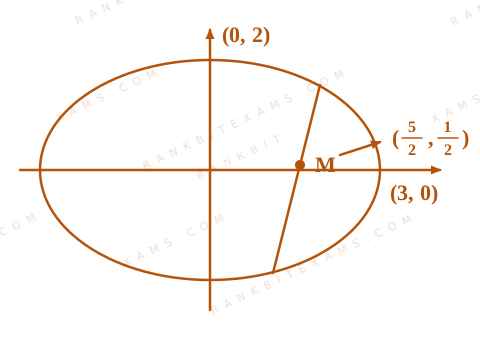
### Related Formula Equation of chord with given midpoint (x_1, y_1) is T = S_1. ### Core Logic For the parabola x^2 = 8y, the equation of the chord with midpoint left(1, frac54right) is: x(1) - 4left(y + frac54right) = 1^2 - 8left(frac54right) x - 4y - 5 = 1 - 10 = -9 x - 4y + 4 = 0 quad dots (i) ### Step 1: Point Intersection with Paraboloid Curve Since P(alpha, beta) lies on this chord and also on y^2 = 4x: 1) alpha - 4beta + 4 = 0 implies alpha = 4beta - 4 2) beta^2 = 4alpha Substituting alpha into the equation: beta^2 = 4(4beta - 4) implies beta^2 - 16beta + 16 = 0 ### Step 2: Calculating the Target Value We need to find the value of (alpha - 28)(beta - 8). Substitute alpha = 4beta - 4 into this targeted expression: textValue = (4beta - 4 - 28)(beta - 8) = (4beta - 32)(beta - 8) = 4(beta - 8)(beta - 8) = 4(beta^2 - 16beta + 64) From the quadratic step, we know beta^2 - 16beta = -16. Substituting this: textValue = 4(-16 + 64) = 4(48) = 192 ### Pattern Recognition Do not solve for ugly root combinations explicitly if the target expression can be algebraically mapped back to the defining quadratic equations. This prevents unnecessary fractional math steps. ### Evaluation Rubric / Model Answer null ### Chapter Mix Class 11 Mathematics: Conic Sections

More Parabola Questions — jee_main_2026_21_jan_morning

Practice all Parabola previous-year questions →

Rankbit System
JEE Physics: Waves (+15.5%) | Electrostatics: Concentric Shells (-29.7%) | Modern Physics: Photoelectric Clones (+34.2%) | Mathematics: Definite Integrals (+18.1%) | Chemistry: Coordination Splitting (-11.4%) | JEE Physics: Waves (+15.5%) | Electrostatics: Concentric Shells (-29.7%) | Modern Physics: Photoelectric Clones (+34.2%) | Mathematics: Definite Integrals (+18.1%) | Chemistry: Coordination Splitting (-11.4%)
YOUR FIRST PREP STEP STARTS HERE

We Map Every Repeating Question in Competitive Exams.

Say goodbye to generic mock test fatigue. RankBit uses smart analysis to group past exam questions into their foundational Repeating Question Types. Find chapter weightage, track repeating questions, and score higher with targeted practice.

Select Your Target Exam

Choose an exam track below to find formulas per chapter and patterns.

Syncing Exam Intelligence

Mapping formulas and patterns across all tracks…

PATH A — FULL LENGTH PRACTICE

Full Mock Test Hub

Simulate real NTA exam conditions with fully tracked mocks. Time yourself against past papers.

Now Live Open
PATH B — TARGETED PRACTICE

Topic-wise Practice Hub

Practice past-year questions one chapter at a time. Pick an exam → subject → chapter and get every PYQ for that topic — pulled together from all past papers — with the chapter's key formulas alongside.

Loading Questions... Browse Topics
Latest from the Blog
View all →

Loading articles...