Let f: R to (0, infty) be a twice differentiable function such that f(3) = 18 , f'(3) = 0 and f''(3) = 4 . Then lim_x to 1 left( log_e left( fracf(2 + x)f(3) right)^frac18(x-1)^2 right) is equal to:

Solution & Explanation

### Related Formula For a limit of 1^infty form, lim_x to a [g(x)]^h(x) equals: e^lim_x to a h(x)[g(x) - 1] ### Core Logic Let T = lim_x to 1 left( fracf(x + 2)f(3) right)^frac18(x - 1)^2. As x to 1, fracf(x+2)f(3) to fracf(3)f(3) = 1. The exponent goes to infty. This is a standard 1^infty form. T = e^lim_x to 1 frac18(x - 1)^2 left( fracf(x + 2) - f(3)f(3) right) ### Step 1: Simplify Exponent Limit Given f(3) = 18: T = e^lim_x to 1 frac18(x - 1)^2 left( fracf(x + 2) - f(3)18 right) T = e^lim_x to 1 fracf(x + 2) - f(3)(x - 1)^2 This is a frac00 form limit. ### Step 2: Apply L'Hopital's Rule Differentiate numerator and denominator w.r.t x: T = e^lim_x to 1 fracf'(x + 2)2(x - 1) This is still a frac00 form since f'(3) = 0. Apply L'Hopital's Rule again: T = e^lim_x to 1 fracf''(x + 2)2 Substitute x = 1: T = e^fracf''(3)2 ### Step 3: Final Calculation Given f''(3) = 4: T = e^frac42 = e^2 The question asks for log_e(T): log_e(T) = log_e(e^2) = 2 ### Pattern Recognition When expanding f(x) around an extrema (f'(a)=0) inside a 1^infty limit form, double L'Hopital isolates the second derivative divided by the Taylor factorial (2! = 2). The limit elegantly shrinks directly to f''(a)/2. ### Evaluation Rubric / Model Answer null ### Chapter Mix Class 11 Maths: Limits and Derivatives Class 12 Maths: Limits, Continuity and Differentiability

Reference Study Guides

More Limits, Continuity and Differentiability Previous-Year Questions — Page 5

Q68 jee_main_2025_24_jan_evening Number of Real Solutions of Equations
The number of real solution(s) of the equation x^2+3x+2=min\|x-3|, |x+2|\ is: [cite: 3396, 3397]
  • A. 2
  • B. 0
  • C. 3
  • D. 1

Solution

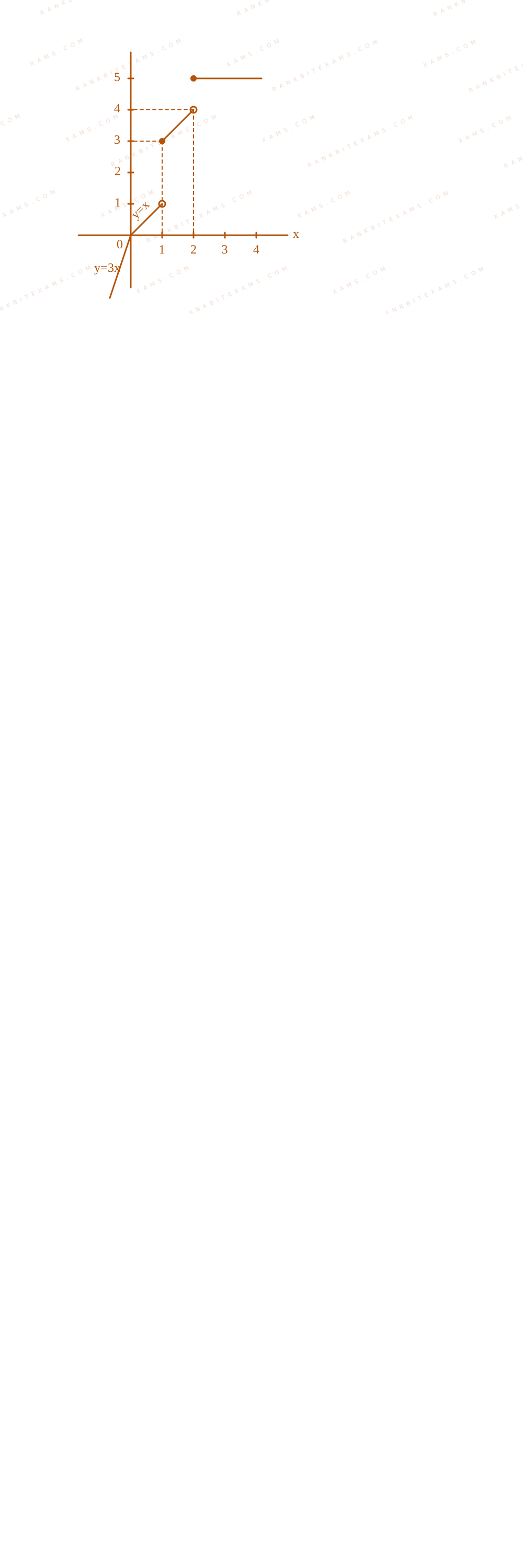
### Related Formula The function min\f(x), g(x)\ chooses the lower vertical path between the two curves at any coordinate x. ### Core Logic Analyze the conditions for the \right-hand function min\|x-3|, |x+2|\: - The intersection of |x-3| = |x+2| happens at x - 3 = -(x + 2) Rightarrow 2x = 1 Rightarrow x = 0.5. - For x le 0.5, |x+2| le |x-3| Rightarrow min = |x+2|. - For x > 0.5, |x-3| le |x+2| Rightarrow min = |x-3|.
Min function intersection graph for Q68 - JEE Main 2025 Evening
### Step 1: Check Interval x le -2 Here, |x+2| = -(x+2) = -x-2: x^2 + 3x + 2 = -x - 2 Rightarrow x^2 + 4x + 4 = 0 (x+2)^2 = 0 Rightarrow x = -2 This is a valid solution as it lies precisely within the interval condition boundary. ### Step 2: Check Interval -2 < x le 0.5 Here, |x+2| = x+2: x^2 + 3x + 2 = x + 2 Rightarrow x^2 + 2x = 0 x(x+2) = 0 Rightarrow x = 0 quad textor quad x = -2 Only x = 0 fits inside this interval. ### Step 3: Check Interval x > 0.5 Here, min = |x-3| = 3-x: x^2 + 3x + 2 = 3 - x Rightarrow x^2 + 4x - 1 = 0 x = frac-4 pm sqrt16 - 4(1)(-1)2 = -2 pm sqrt5 Evaluating values: -2 + sqrt5 approx 0.236, which does not satisfy x > 0.5. Thus, no real roots occur in this span. Combining valid points, we find exactly 2 distinct real solutions (x = -2, 0). ### Pattern Recognition Sketching a rough visualization showing the parabola crossing below the sharp wedge of the combined absolute values makes it visually clear that there are exactly two crossing points, confirming the algebraic count. ### Evaluation Rubric / Model Answer null ### Chapter Mix Class 11 Mathematics: Quadratic Equations Class 12 Mathematics: Limits, Continuity and Differentiability
Q57 jee_main_2025_24_jan_morning Limits of Algebraic and Trigonometric Functions
lim_x to 0 csc x left(sqrt2cos^2 x + 3cos x - sqrtcos^2 x + sin x + 4right) is equal to :
  • A. 0
  • B. frac12sqrt5
  • C. frac1sqrt15
  • D. -frac12sqrt5

Solution

### Related Formula To evaluate limits of indeterminate types containing radical forms, rationalize the numerator directly by multiplying by its conjugate element matching: (sqrtA - sqrtB)(sqrtA + sqrtB) = A - B ### Core Logic Rewrite the expression as a fraction with sin x in the denominator and rationalize the numerator: lim_x to 0 frac(2cos^2 x + 3cos x) - (cos^2 x + sin x + 4)sin x cdot left(sqrt2cos^2 x + 3cos x + sqrtcos^2 x + sin x + 4right) = lim_x to 0 fraccos^2 x + 3cos x - sin x - 4sin x cdot left(sqrt2cos^2 x + 3cos x + sqrtcos^2 x + sin x + 4right) ### Step 1: Simplify Numerator and Group Terms Express the numerator terms to isolate algebraic patterns: cos^2 x + 3cos x - 4 - sin x = (cos x - 1)(cos x + 4) - sin x Substitute this back into our rationalized limit format: = lim_x to 0 frac(cos x - 1)(cos x + 4) - sin xsin x cdot left(sqrt2cos^2 x + 3cos x + sqrtcos^2 x + sin x + 4right) ### Step 2: Distribute sin x in Denominator Split the limit across the two separated numerator expressions: = lim_x to 0 left[ fraccos x - 1sin x cdot (cos x + 4) - 1 right] cdot frac1sqrt2(1)+3 + sqrt1+0+4 Evaluate the limit component values: lim_x to 0 fraccos x - 1sin x = lim_x to 0 frac-2sin^2(x/2)2sin(x/2)cos(x/2) = lim_x to 0 [-tan(x/2)] = 0 Substituting this zero value simplifies the numerator expression directly: = left[ 0 cdot (1 + 4) - 1 right] cdot frac1sqrt5 + sqrt5 = frac-12sqrt5 ### Pattern Recognition Recognizing that fraccos x - 1sin x to 0 as x to 0 isolates the non-vanishing trigonometric components without needing full multi-stage application of L'Hôpital's rule. ### Evaluation Rubric / Model Answer null ### Chapter Mix Class 11 Mathematics: Limits and Derivatives
Q72 jee_main_2025_28_jan_evening Limits of Trigonometric Functions
Let f(x)=lim_nrightarrow inftysum_r=0^nleft(fractan(x/2^r+1)+tan^3(x/2^r+1)1-tan^2(x/2^r+1)right). Then lim_xrightarrow0frace^x-e^f(x)(x-f(x)) is equal to
Numerical Answer. Answer: 1 to 1

Solution

### Related Formula Trigonometric identity: fractantheta + tan^3theta1-tan^2theta = tantheta left( frac1+tan^2theta1-tan^2theta right) = fractanthetacos 2theta Also note standard telescopic identity: tan 2phi - tanphi = fractanphicos 2phi ### Core Logic Let theta = fracx2^r+1. The term inside the summation simplifies to: tanleft(fracx2^rright) - tanleft(fracx2^r+1right) Now, evaluating the summation: sum_r=0^n left[ tanleft(fracx2^rright) - tanleft(fracx2^r+1right) right] = tan x - tanleft(fracx2^n+1right) Taking the limit as n to infty, tanleft(fracx2^n+1right) to tan(0) = 0. Therefore, f(x) = tan x. ### Step 1: Evaluate the Limit We need to find: lim_xrightarrow0frace^x-e^tan xx-tan x Factor out e^tan x from the numerator: lim_xrightarrow0 e^tan x cdot left[ frace^x-tan x - 1x-tan x right] Let u = x - tan x. As x to 0, u to 0. The limit becomes: lim_urightarrow0 e^0 cdot left[ frace^u - 1u right] = 1 times 1 = 1 ### Pattern Recognition Standard limit substitution lim_y to 0 frace^y - 1y = 1 applies cleanly whenever the argument in the exponent matches the entire denominator layout. ### Evaluation Rubric / Model Answer null ### Chapter Mix Class 11 Mathematics: Trigonometry Class 12 Mathematics: Limits, Continuity and Differentiability
Q jee_main_2025_29_jan_morning Limits of Special Series
The value of lim_nto inftyleft(sum_K = 1^nfrack^3 + 6k^2 + 11k + 5(k + 3)!right) is:
  • A. frac43
  • B. 2
  • C. frac73
  • D. frac53

Solution

### Related Formula sum_k=1^infty left( frac1k! - frac1(k+3)! right) implies textTelescoping Series simplification ### Core Logic Rewrite the numerator polynomial to establish factor terms matching the factorial expansion base (k+3): k^3 + 6k^2 + 11k + 5 = (k^3 + 6k^2 + 11k + 6) - 1 = (k+1)(k+2)(k+3) - 1 ### Step 1: Simplify General Term T_k = frac(k+1)(k+2)(k+3)(k+3)! - frac1(k+3)! T_k = frac1k! - frac1(k+3)! This creates a clean telescoping layout format structure. ### Step 2: Sum the Series Writing out expanded \partial sums up to infinity: S = left( frac11! + frac12! + frac13! + frac14! + dots right) - left( frac14! + frac15! + frac16! + dots right) All higher terms cancel out systematically, leaving exactly the leading remaining fragments: S = frac11! + frac12! + frac13! = 1 + frac12 + frac16 = frac106 = frac53 ### Pattern Recognition Whenever factorials dominate fraction denominators, manipulate structural terms to align components via Telescoping sums (V_n - V_n-k). ### Evaluation Rubric / Model Answer null ### Chapter Mix Class 11 Mathematics: Limits, Continuity and Differentiability Class 11 Mathematics: Sequences and Series
Q73 jee_main_2025_29_jan_morning Sandwich Theorem and Greatest Integer Function
Let [t] be the greatest integer less than or equal to t. Then the least value of mathbfp in mathbbN for which lim_mathrmx to 0^+ left( mathrmx left( left[ frac1mathrmx right] + left[ frac2mathrmx right] + dots + left[ fracmathrmpmathrmx right] right) - mathrmx^2 left( left[ frac1mathrmx^2 right] + left[ frac2^2mathrmx^2 right] + dots + left[ frac9^2mathrmx^2 right] right) right) geq 1 is equal to
Numerical Answer. Answer: 24

Solution

### Related Formula lim_x to 0^+ x left[ frackx right] = k sum_k=1^n k = fracn(n+1)2, quad sum_k=1^n k^2 = fracn(n+1)(2n+1)6 ### Core Logic Using properties of Greatest Integer Function limits, as x to 0^+, fraction values diverge cleanly to continuous variable distributions: lim_x to 0^+ x left[ frackx right] = k implies sum_k=1^p k = fracp(p+1)2 Similarly, for the second block component part: lim_x to 0^+ x^2 left[ frack^2x^2 right] = k^2 implies sum_k=1^9 k^2 = frac9 times 10 times 196 = 285 ### Step 1: Setup Inequality Formulation Combine evaluated limits component parts: fracp(p+1)2 - 285 geq 1 fracp(p+1)2 geq 286 implies p(p+1) geq 572 ### Step 2: Solve for least natural number Evaluate product bounds of adjacent integers: If p = 23 implies 23 times 24 = 552 (False) If p = 24 implies 24 times 25 = 600 (True) Therefore, the least natural value of p is 24. ### Pattern Recognition Greatest Integer fractions simplify directly to standard scalar values inside limits evaluated at infinity or zero, letting you drop brackets and treat them as arithmetic sequences. ### Evaluation Rubric / Model Answer null ### Chapter Mix Class 11 Mathematics: Limits

More Limits, Continuity and Differentiability Questions — jee_main_2026_21_jan_morning

Practice all Limits, Continuity and Differentiability previous-year questions →

Rankbit System
JEE Physics: Waves (+15.5%) | Electrostatics: Concentric Shells (-29.7%) | Modern Physics: Photoelectric Clones (+34.2%) | Mathematics: Definite Integrals (+18.1%) | Chemistry: Coordination Splitting (-11.4%) | JEE Physics: Waves (+15.5%) | Electrostatics: Concentric Shells (-29.7%) | Modern Physics: Photoelectric Clones (+34.2%) | Mathematics: Definite Integrals (+18.1%) | Chemistry: Coordination Splitting (-11.4%)
YOUR FIRST PREP STEP STARTS HERE

We Map Every Repeating Question in Competitive Exams.

Say goodbye to generic mock test fatigue. RankBit uses smart analysis to group past exam questions into their foundational Repeating Question Types. Find chapter weightage, track repeating questions, and score higher with targeted practice.

Select Your Target Exam

Choose an exam track below to find formulas per chapter and patterns.

Syncing Exam Intelligence

Mapping formulas and patterns across all tracks…

PATH A — FULL LENGTH PRACTICE

Full Mock Test Hub

Simulate real NTA exam conditions with fully tracked mocks. Time yourself against past papers.

Now Live Open
PATH B — TARGETED PRACTICE

Topic-wise Practice Hub

Practice past-year questions one chapter at a time. Pick an exam → subject → chapter and get every PYQ for that topic — pulled together from all past papers — with the chapter's key formulas alongside.

Loading Questions... Browse Topics
Latest from the Blog
View all →

Loading articles...