If the domain of the function f(x) = cos^-1left(frac2x - 511 - 3xright) + sin^-1(2x^2 - 3x + 1) is the interval [alpha, beta] , then alpha + 2beta is equal to :

Solution & Explanation

### Related Formula For inverse trigonometric functions sin^-1(g(x)) and cos^-1(h(x)), the arguments must satisfy: -1 leq g(x) leq 1 -1 leq h(x) leq 1 ### Core Logic Given f(x) = cos^-1left(frac2x - 511 - 3xright) + sin^-1(2x^2 - 3x + 1) We establish two simultaneous inequalities for the domain: 1) -1 leq frac2x - 511 - 3x leq 1 2) -1 leq 2x^2 - 3x + 1 leq 1 ### Step 1: Solve the Quadratic Inequality From -1 leq 2x^2 - 3x + 1 leq 1: Split into two parts: 2x^2 - 3x + 2 geq 0 (This is always true as discriminant D < 0, a > 0) 2x^2 - 3x leq 0 Rightarrow x(2x - 3) leq 0 x in left[0, frac32right] dots(i) ### Step 2: Solve the Rational Inequality From -1 leq frac2x - 511 - 3x leq 1: Part A: frac2x - 511 - 3x + 1 geq 0 Rightarrow frac2x - 5 + 11 - 3x11 - 3x geq 0 Rightarrow frac6 - x11 - 3x geq 0
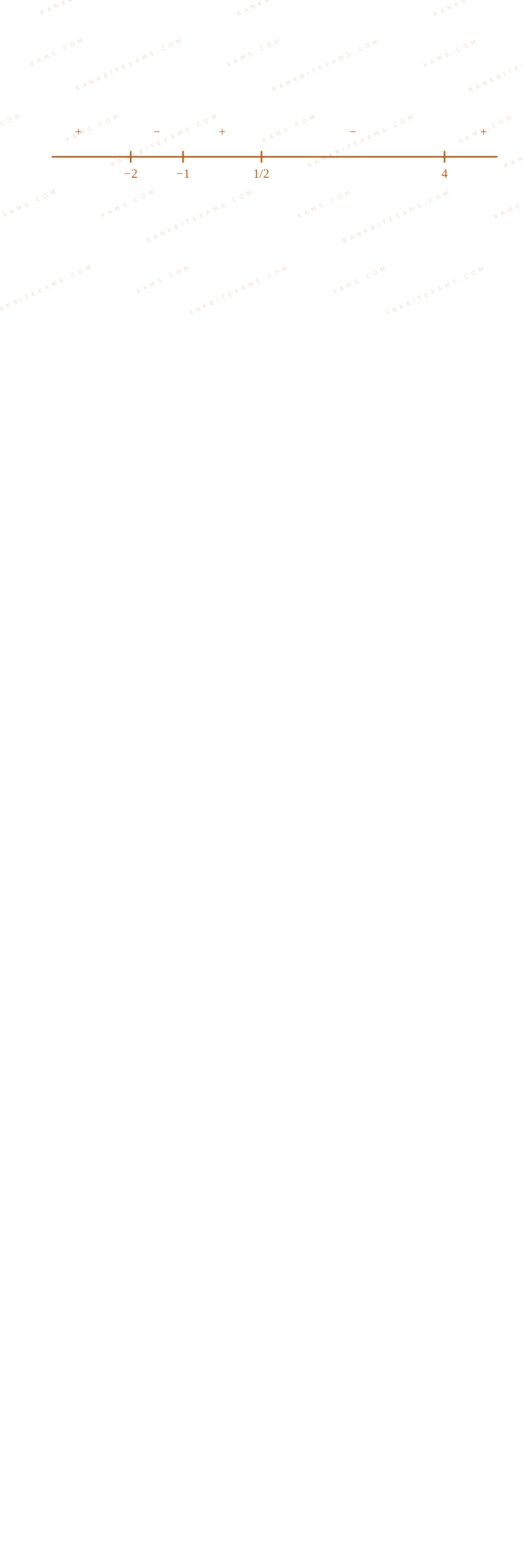
Domain interval number line diagram for Q1 - JEE Main 2026 Morning
x in left(-infty, frac113right) cup [6, infty) Part B: frac2x - 511 - 3x - 1 leq 0 Rightarrow frac5x - 1611 - 3x leq 0 Rightarrow x in left(-infty, frac165right] cup left(frac113, inftyright) Intersection of Part A and Part B: x in left(-infty, frac165right] cup [6, infty) dots(ii) ### Step 3: Final Intersection Taking the intersection of (i) and (ii): x in left[0, frac32right] Comparing this with [\alpha, \beta], we have \alpha = 0, \beta = \frac{3}{2}. Therefore, \alpha + 2\beta = 0 + 2\left(\frac{3}{2}\right) = 3 ### Pattern Recognition Whenever dealing with dual inverse trig terms, strictly isolate the bounding intervals [-1, 1]$ for each argument separately and use a number line intersection to find the strictest common region. ### Evaluation Rubric / Model Answer null ### Chapter Mix Class 12 Maths: Functions Class 11 Maths: Linear Inequalities

Reference Study Guides

More Functions Previous-Year Questions — Page 6

Q71 jee_main_2025_24_jan_evening Number of Functions under Constraints
Number of functions f:\1,2,dots,100\rightarrow\0,1\, that assign 1 to exactly one of the positive integers less than or equal to 98, is equal to \_\_\_\_.
Numerical Answer. Answer: 392

Solution

### Related Formula Fundamental Counting Principle: If an operation can be performed in n_1 ways, followed by a second operation in n_2 ways, the total configurations equal n_1 times n_2. ### Core Logic The domain set contains integers from 1 to 100. We divide the mapping requirements across distinct subsets of this domain[cite: 4064, 4068, 4069].
Function mapping grid for Q71 - JEE Main 2025 Evening
### Step 1: Choose the single element from \1, 2, dots, 98\ We must assign the image value 1 to exactly one positive integer from the \subset \1, 2, dots, 98\. The number of ways to pick this single element is : binom981 = 98 text ways ### Step 2: Mapping remaining elements The remaining 97 elements in the \1, 2, dots, 98\ \subset cannot map to 1, so they must map to 0. This leaves exactly 1 choice per remaining element. For the final two elements in the domain, 99 and 100, there are no structural constraints [cite: 4068, 4069]: - Element 99 can map to either 0 or 1 (2 options) . - Element 100 can map to either 0 or 1 (2 options). ### Step 3: Total functions combination Multiply the independent choices together : textTotal functions = 98 times 2 times 2 = 392 [cite: 4065, 4067] ### Pattern Recognition Separate domains tightly into restricted blocks vs completely free components. Realizing that elements 99 and 100 behave independently with full co-domain targets leaves a clear product formulation. ### Evaluation Rubric / Model Answer null ### Chapter Mix Class 12 Mathematics: Relations and Functions Class 11 Mathematics: Permutations and Combinations
Q53 jee_main_2025_24_jan_morning Functional Relations and Equations
Let f: mathbbR - \0\ to mathbbR be a function such that f(x) - 6fleft(frac1xright) = frac353x - frac52 If lim_x to 0 left( frac1alpha x + f(x) right) = beta for some alpha, beta in mathbbR, then alpha + 2beta is equal to :
  • A. 3
  • B. 5
  • C. 4
  • D. 6

Solution

### Related Formula For functional equations with inversion, substituting x to frac1x establishes a solvable system of algebraic equations to isolate f(x) directly. ### Core Logic The given equation is: f(x) - 6fleft(frac1xright) = frac353x - frac52 quad dots (1) Substitute x to frac1x in equation (1): fleft(frac1xright) - 6f(x) = frac35x3 - frac52 quad dots (2) ### Step 1: Eliminate f(1/x) Multiply equation (2) by 6 and add it to equation (1): left[ f(x) - 6fleft(frac1xright) right] + 6 left[ fleft(frac1xright) - 6f(x) right] = left( frac353x - frac52 right) + 6 left( frac35x3 - frac52 right) f(x) - 36f(x) = frac353x - frac52 + 70x - 15 -35f(x) = 70x + frac353x - frac352 Divide across by -35: f(x) = -2x - frac13x + frac12 ### Step 2: Evaluate the Limit We are given that the following limit evaluates to a finite constant beta: lim_x to 0 left( frac1alpha x + f(x) right) = beta lim_x to 0 left( frac1alpha x - 2x - frac13x + frac12 right) = beta lim_x to 0 left( left[ frac1alpha - frac13 right] frac1x - 2x + frac12 right) = beta For the limit to be a finite value, the coefficient of frac1x must vanish completely: frac1alpha - frac13 = 0 implies alpha = 3 When alpha = 3, the limit simplifies directly to the constant term: beta = lim_x to 0 left( -2x + frac12 right) = frac12 ### Step 3: Calculate Final Value Substitute the determined parameters alpha and beta: alpha + 2beta = 3 + 2left(frac12right) = 3 + 1 = 4 ### Pattern Recognition In limit problems involving fractional components where x to 0, any term like frac1x or higher negative powers must have a net coefficient of zero to guarantee existence of a finite limit value. ### Evaluation Rubric / Model Answer null ### Chapter Mix Class 11 Mathematics: Functions Class 11 Mathematics: Limits and Derivatives
Q55 jee_main_2025_24_jan_morning Symmetric Property of Functions
Let f(x) = frac2^x + 2 + 162^2x + 1 + 2^x + 4 + 32 . Then the value of 8left(fleft(frac115 ight) + fleft(frac215 ight) + ldots + fleft(frac5915 ight) ight) is equal to :
  • A. 118
  • B. 92
  • C. 102
  • D. 108

Solution

### Related Formula Many finite fractional sum questions involving functional terms rely on identifying an underlying symmetric summation invariant, typically of the form f(x) + f(k-x) = textconstant. ### Core Logic First simplify the expression for f(x) algebraically: f(x) = frac4 cdot 2^x + 162 cdot (2^x)^2 + 16 cdot 2^x + 32 Factor out 4 from the numerator and 2 from the denominator: f(x) = frac4(2^x + 4)2[(2^x)^2 + 8 cdot 2^x + 16] = frac2(2^x + 4)(2^x + 4)^2 = frac22^x + 4 ### Step 1: Establish Symmetry Pairings Let's check the value of f(x) + f(4-x): f(4-x) = frac22^4-x + 4 = frac2frac162^x + 4 = frac2 cdot 2^x16 + 4 cdot 2^x = frac2 cdot 2^x4(2^x + 4) = frac2^x2(2^x + 4) Now compute the sum directly: f(x) + f(4-x) = frac22^x + 4 + frac2^x2(2^x + 4) = frac4 + 2^x2(2^x + 4) = frac12 Hence, whenever two input arguments sum up to 4, the sum of their functional values is exactly frac12. ### Step 2: Group the Finite Series Terms Consider the terms inside the requested sequence: frac115 + frac5915 = frac6015 = 4 implies fleft(frac115 ight) + fleft(frac5915 ight) = frac12 frac215 + frac5815 = frac6015 = 4 implies fleft(frac215 ight) + fleft(frac5815 ight) = frac12 This complementary pairing continues up to: fleft(frac2915 ight) + fleft(frac3115 ight) = frac12 This yields exactly 29 distinct pairs. The single middle term left unpaired corresponds to: textMiddle Term = fleft(frac3015 ight) = f(2) = frac22^2 + 4 = frac28 = frac14 ### Step 3: Evaluate Final Expression Compute the total value by multiplying the grouped sum by 8: textTotal = 8 cdot left[ 29 cdot left(frac12right) + frac14 right] textTotal = 8 cdot frac292 + 8 cdot frac14 = 116 + 2 = 118 ### Pattern Recognition Whenever a symmetric set of arguments is presented inside a summation matching frackn + fracN-kn = textconstant, look for an algebraic reduction of f(x) that yields a uniform constant sum for symmetric pairs. ### Evaluation Rubric / Model Answer null ### Chapter Mix Class 11 Mathematics: Functions
Q64 jee_main_2025_28_jan_evening Range and Onto Functions
Let f:[0,3]rightarrow A be defined by f(x)=2x^3-15x^2+36x+7 and g:[0,infty)rightarrow B be defined by g(x)=fracx^2025x^2025+1. If both the functions are onto and S=\xin Z:xin Atext or xin B\, then n(S) is equal to:
  • A. 30
  • B. 36
  • C. 29
  • D. 31

Solution

### Related Formula For a function to be onto, its Codomain must equal its Range. ### Core Logic First, find range A for f(x) = 2x^3 - 15x^2 + 36x + 7 over [0, 3]. Differentiating f(x): f'(x) = 6x^2 - 30x + 36 = 6(x^2 - 5x + 6) = 6(x-2)(x-3) Critical points are x=2 and x=3. Evaluate f(x) at boundary and critical points: - f(0) = 7 - f(2) = 2(8) - 15(4) + 36(2) + 7 = 16 - 60 + 72 + 7 = 35 - f(3) = 2(27) - 15(9) + 36(3) + 7 = 54 - 135 + 108 + 7 = 34 Thus, Range A = [7, 35]. ### Step 1: Find Range B for g(x) Now look at g(x) = fracx^2025x^2025+1 = 1 - frac1x^2025+1 over [0, infty). - At x = 0, g(0) = 0. - As x to infty, g(x) to 1. Since g(x) is continuous and monotonically strictly increasing, Range B = [0, 1). ### Step 2: Find the Integer Count of Union Set S S = \x in mathbbZ : x in A text or x in B\ = mathbbZ cap (A cup B) A cup B = [0, 1) cup [7, 35] The integers in this set are: - From [0, 1): x = 0 - From [7, 35]: x = 7, 8, 9, dots, 35 Total number of integers n(S): n(S) = 1 + (35 - 7 + 1) = 1 + 29 = 30 ### Pattern Recognition The condition 'or' means union. Be careful not to include integers between 1 and 6 since they are not present in either continuous range segment. ### Evaluation Rubric / Model Answer null ### Chapter Mix Class 12 Mathematics: Functions Class 12 Mathematics: Application of Derivatives
Q65 jee_main_2025_28_jan_evening Domain of Inverse Trigonometric Functions
Let [x] denote the greatest integer less than or equal to x. Then domain of f(x)=sec^-1(2[x]+1) is:
  • A. (-infty,-1]cup[0,infty)
  • B. (-infty,infty)
  • C. (-infty,-1]cup[1,infty)
  • D. (-infty,infty)-\0\

Solution

### Related Formula The domain of sec^-1(y) is given by |y| ge 1, which means: y le -1 quad textor quad y ge 1 ### Core Logic For f(x) = sec^-1(2[x]+1) to be defined: 2[x] + 1 le -1 quad textor quad 2[x] + 1 ge 1 ### Step 1: Solve individual inequalities Case 1: 2[x] + 1 le -1 implies 2[x] le -2 implies [x] le -1 This holds true for all x < 0, i.e., x in (-infty, 0). Case 2: 2[x] + 1 ge 1 implies 2[x] ge 0 implies [x] ge 0 This holds true for all x ge 0, i.e., x in [0, infty). ### Step 2: Take Union of the Solutions textDomain = (-infty, 0) cup [0, infty) = (-infty, infty) ### Pattern Recognition Since [x] covers all integer values and 2[x]+1 forms all odd integer values, the expression inside sec^-1 is always a non-zero integer. Non-zero integers always have absolute value ge 1. Hence, it is valid for all real numbers. ### Evaluation Rubric / Model Answer null ### Chapter Mix Class 11 Mathematics: Functions Class 12 Mathematics: Inverse Trigonometric Functions

More Functions Questions — jee_main_2026_21_jan_morning

Practice all Functions previous-year questions →

Rankbit System
JEE Physics: Waves (+15.5%) | Electrostatics: Concentric Shells (-29.7%) | Modern Physics: Photoelectric Clones (+34.2%) | Mathematics: Definite Integrals (+18.1%) | Chemistry: Coordination Splitting (-11.4%) | JEE Physics: Waves (+15.5%) | Electrostatics: Concentric Shells (-29.7%) | Modern Physics: Photoelectric Clones (+34.2%) | Mathematics: Definite Integrals (+18.1%) | Chemistry: Coordination Splitting (-11.4%)
YOUR FIRST PREP STEP STARTS HERE

We Map Every Repeating Question in Competitive Exams.

Say goodbye to generic mock test fatigue. RankBit uses smart analysis to group past exam questions into their foundational Repeating Question Types. Find chapter weightage, track repeating questions, and score higher with targeted practice.

Select Your Target Exam

Choose an exam track below to find formulas per chapter and patterns.

Syncing Exam Intelligence

Mapping formulas and patterns across all tracks…

PATH A — FULL LENGTH PRACTICE

Full Mock Test Hub

Simulate real NTA exam conditions with fully tracked mocks. Time yourself against past papers.

Now Live Open
PATH B — TARGETED PRACTICE

Topic-wise Practice Hub

Practice past-year questions one chapter at a time. Pick an exam → subject → chapter and get every PYQ for that topic — pulled together from all past papers — with the chapter's key formulas alongside.

Loading Questions... Browse Topics
Latest from the Blog
View all →

Loading articles...