If the domain of the function f(x) = cos^-1left(frac2x - 511 - 3xright) + sin^-1(2x^2 - 3x + 1) is the interval [alpha, beta] , then alpha + 2beta is equal to :

Solution & Explanation

### Related Formula For inverse trigonometric functions sin^-1(g(x)) and cos^-1(h(x)), the arguments must satisfy: -1 leq g(x) leq 1 -1 leq h(x) leq 1 ### Core Logic Given f(x) = cos^-1left(frac2x - 511 - 3xright) + sin^-1(2x^2 - 3x + 1) We establish two simultaneous inequalities for the domain: 1) -1 leq frac2x - 511 - 3x leq 1 2) -1 leq 2x^2 - 3x + 1 leq 1 ### Step 1: Solve the Quadratic Inequality From -1 leq 2x^2 - 3x + 1 leq 1: Split into two parts: 2x^2 - 3x + 2 geq 0 (This is always true as discriminant D < 0, a > 0) 2x^2 - 3x leq 0 Rightarrow x(2x - 3) leq 0 x in left[0, frac32right] dots(i) ### Step 2: Solve the Rational Inequality From -1 leq frac2x - 511 - 3x leq 1: Part A: frac2x - 511 - 3x + 1 geq 0 Rightarrow frac2x - 5 + 11 - 3x11 - 3x geq 0 Rightarrow frac6 - x11 - 3x geq 0
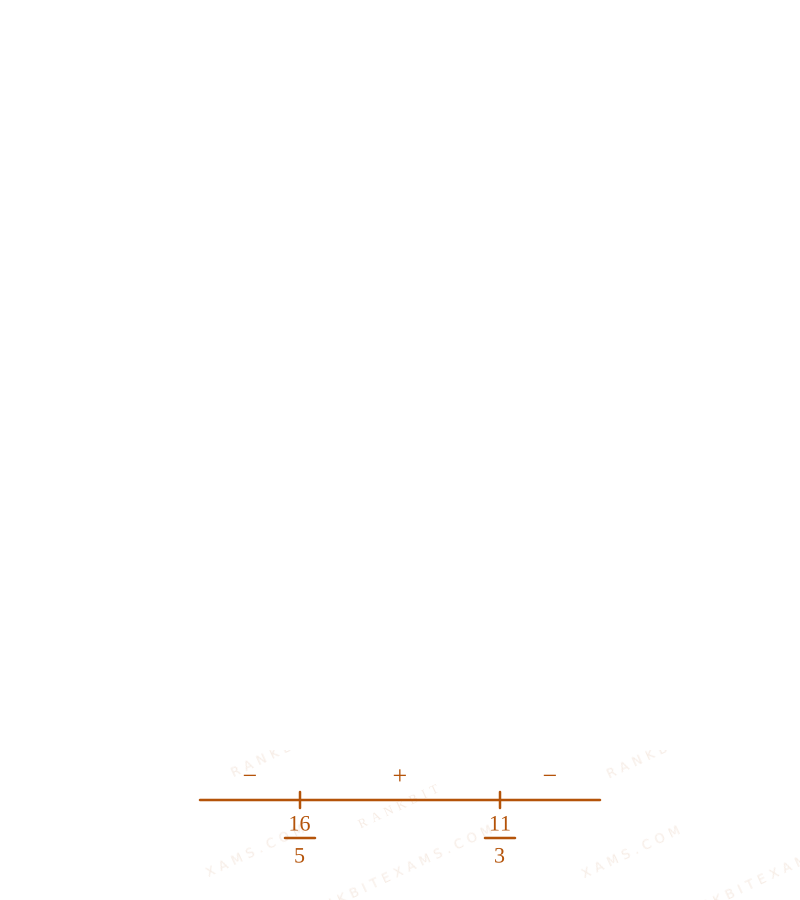
Domain interval number line diagram for Q1 - JEE Main 2026 Morning
x in left(-infty, frac113right) cup [6, infty) Part B: frac2x - 511 - 3x - 1 leq 0 Rightarrow frac5x - 1611 - 3x leq 0 Rightarrow x in left(-infty, frac165right] cup left(frac113, inftyright) Intersection of Part A and Part B: x in left(-infty, frac165right] cup [6, infty) dots(ii) ### Step 3: Final Intersection Taking the intersection of (i) and (ii): x in left[0, frac32right] Comparing this with [\alpha, \beta], we have \alpha = 0, \beta = \frac{3}{2}. Therefore, \alpha + 2\beta = 0 + 2\left(\frac{3}{2}\right) = 3 ### Pattern Recognition Whenever dealing with dual inverse trig terms, strictly isolate the bounding intervals [-1, 1]$ for each argument separately and use a number line intersection to find the strictest common region. ### Evaluation Rubric / Model Answer null ### Chapter Mix Class 12 Maths: Functions Class 11 Maths: Linear Inequalities

Reference Study Guides

More Functions Previous-Year Questions — Page 10

Q6 jee_main_2024_31_jan_morning Composition of Functions
If f(x) = frac4x + 36x - 4, x neq frac23 and (fof)(x) = g(x), where g : mathbbR - left\frac23right\ to mathbbR - left\frac23right\, then (gogog)(4) is equal to
  • A. -frac1920
  • B. frac1920
  • C. -4
  • D. 4

Solution

### Core Logic f(x) = frac4x + 36x - 4 Compute g(x) = f(f(x)): g(x) = frac4left(frac4x + 36x - 4right) + 36left(frac4x + 36x - 4right) - 4 = frac16x + 12 + 18x - 1224x + 18 - 24x + 16 = frac34x34 = x ### Step 1: Composition Evaluation Since g(x) = x, g is the identity function. (gogog)(4) = g(g(g(4))) = 4 ### Evaluation Rubric / Model Answer null ### Chapter Mix Class 12 Maths: Relations and Functions
Q29 jee_main_2024_31_jan_morning Equivalence Relations
Let A = \1, 2, 3, 4\ and R = \(1, 2), (2, 3), (1, 4)\ be a relation on A. Let S be the equivalence relation on A such that R subset S and the number of elements in S is n. Then, the minimum value of n is
Numerical Answer. Answer: 16 to 16

Solution

### Core Logic S must be reflexive, symmetric, and transitive, containing (1,2), (2,3), and (1,4). Symmetric property forces (2,1), (3,2), (4,1) in S. Transitive property: (1,2) and (2,3) implies (1,3) in S. Symmetric implies (3,1) in S. (4,1) and (1,2) implies (4,2) in S. Symmetric implies (2,4) in S. (4,1) and (1,3) implies (4,3) in S. Symmetric implies (3,4) in S. ### Step 1: Universal Relation Since 1 is related to 2, 3, 4 and the relation is an equivalence relation (which creates partitions), all elements 1, 2, 3, and 4 must fall into the same single equivalence class. Thus, S must contain all possible ordered pairs in A times A. ### Step 2: Final Count Number of elements in A times A = 4 times 4 = 16. Minimum value of n is 16. ### Pattern Recognition If a relation connects all elements in a set to each other through a chain, its equivalence closure is the universal relation A times A. ### Evaluation Rubric / Model Answer null ### Chapter Mix Class 12 Maths: Relations and Functions

More Functions Questions — jee_main_2026_21_jan_morning

Practice all Functions previous-year questions →

Rankbit System
JEE Physics: Waves (+15.5%) | Electrostatics: Concentric Shells (-29.7%) | Modern Physics: Photoelectric Clones (+34.2%) | Mathematics: Definite Integrals (+18.1%) | Chemistry: Coordination Splitting (-11.4%) | JEE Physics: Waves (+15.5%) | Electrostatics: Concentric Shells (-29.7%) | Modern Physics: Photoelectric Clones (+34.2%) | Mathematics: Definite Integrals (+18.1%) | Chemistry: Coordination Splitting (-11.4%)
YOUR FIRST PREP STEP STARTS HERE

We Map Every Repeating Question in Competitive Exams.

Say goodbye to generic mock test fatigue. RankBit uses smart analysis to group past exam questions into their foundational Repeating Question Types. Find chapter weightage, track repeating questions, and score higher with targeted practice.

Select Your Target Exam

Choose an exam track below to find formulas per chapter and patterns.

Syncing Exam Intelligence

Mapping formulas and patterns across all tracks…

PATH A — FULL LENGTH PRACTICE

Full Mock Test Hub

Simulate real NTA exam conditions with fully tracked mocks. Time yourself against past papers.

Now Live Open
PATH B — TARGETED PRACTICE

Topic-wise Practice Hub

Practice past-year questions one chapter at a time. Pick an exam → subject → chapter and get every PYQ for that topic — pulled together from all past papers — with the chapter's key formulas alongside.

Loading Questions... Browse Topics
Latest from the Blog
View all →

Loading articles...
