The area of the region, inside the ellipse x² + 4y² = 4$x^{2} + 4y^{2} = 4$ and outside the region bounded by the curves y = |x| - 1$y = |x| - 1$ and y = 1 - |x|$y = 1 - |x|$ , is:
A.2(π - 1)$2(\pi - 1)$
B.2π - (1)/(2)$2\pi - \frac{1}{2}$
C.3(π - 1)$3(\pi - 1)$
D.2π - 1$2\pi - 1$
Solution & Explanation
Related Formula
Area of an ellipse (x²)/(a²) + (y²)/(b²) = 1$\frac{x^2}{a^2} + \frac{y^2}{b^2} = 1$ is given by:
Area = π a b$$\text{Area} = \pi a b$$
Area of a rhombus bounded by |x| + |y| = a$|x| + |y| = a$ is 2a²$2a^2$.
Core Logic
The given curves form a bounded geometric area.
Ellipse: x² + 4y² = 4 ⇒ (x²)/(4) + (y²)/(1) = 1$x^2 + 4y^2 = 4 \Rightarrow \frac{x^2}{4} + \frac{y^2}{1} = 1$.
Here, a = 2$a = 2$, b = 1$b = 1$.
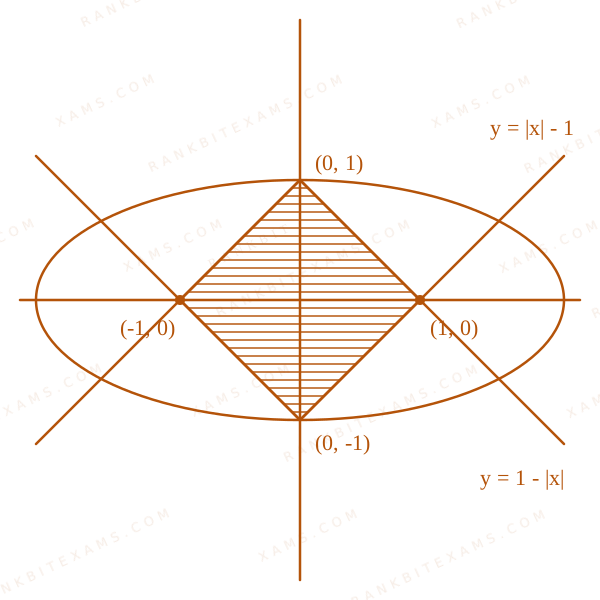
The region to be excluded is bounded by y = |x| - 1$y = |x| - 1$ and y = 1 - |x|$y = 1 - |x|$, which rearranges to |x| + |y| = 1$|x| + |y| = 1$. This forms a square/rhombus centered at the origin with vertices at (1, 0), (0, 1), (-1, 0), (0, -1)$(1, 0), (0, 1), (-1, 0), (0, -1)$.
Excluded Area (Rhombus |x| + |y| = 1$|x| + |y| = 1$):
The rhombus consists of 4 identical right-angled triangles in each quadrant.
Area of one triangle = (1)/(2) × base × height = (1)/(2) × 1 × 1 = (1)/(2)$\frac{1}{2} \times \text{base} \times \text{height} = \frac{1}{2} \times 1 \times 1 = \frac{1}{2}$.
Total excluded area = 4 × (1)/(2) = 2$4 \times \frac{1}{2} = 2$.
Step 2: Calculate Required Area
Ellipse and Modulus area diagram for Q2 - JEE Main 2026 Morning
Required Area = Area of ellipse -$-$ Shaded Area
= 2π - 2$= 2\pi - 2$= 2(π - 1)$= 2(\pi - 1)$
Pattern Recognition
Transform absolute value equations y = ±(|x| - a)$y = \pm(|x| - a)$ into |x| + |y| = a$|x| + |y| = a$ to instantly recognize a standard rhombus, allowing direct geometry formulas instead of integration.
Chapter Mix
Class 12 Maths: Area Under Curves
Class 11 Maths: Conic Sections
Q5jee_main_2024_31_jan_morningArea bounded by Parabolas and Inequalities
The area of the region (x,y): y² ≤ 4x, x < 4, (xy(x - 1)(x - 2))/((x - 3)(x - 4)) > 0, x ≠ 3$\left\{(x,y): y^2 \le 4x, x < 4, \frac{xy(x - 1)(x - 2)}{(x - 3)(x - 4)} > 0, x \neq 3\right\}$ is
A.(16)/(3)$$\frac{16}{3}$$
B.(64)/(3)$$\frac{64}{3}$$
C.(8)/(3)$$\frac{8}{3}$$
D.(32)/(3)$$\frac{32}{3}$$
Solution
Core Logic
Given y² ≤ 4x$y^2 \le 4x$ and x < 4$x < 4$.
Analyze the inequality (xy(x-1)(x-2))/((x-3)(x-4)) > 0$\frac{xy(x-1)(x-2)}{(x-3)(x-4)} > 0$ considering y > 0$y > 0$ and y < 0$y < 0$ separately.
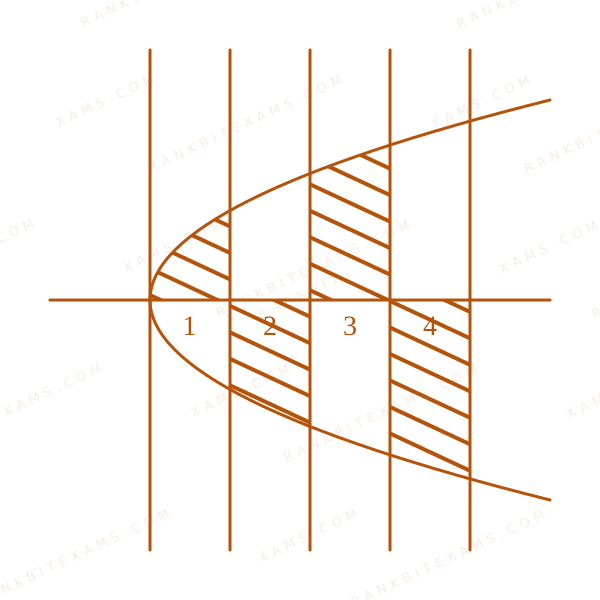
Area bounded by Parabolas and Inequalities diagram for Q5 - JEE Main 2024 Morning
Step 1: Case I (y > 0)
If y > 0$y > 0$, the inequality reduces to (x(x-1)(x-2))/((x-3)(x-4)) > 0$\frac{x(x-1)(x-2)}{(x-3)(x-4)} > 0$.
Using wavy curve method and given x in (0, 4)$x \in (0, 4)$:
x in (0, 1) (2, 3)$x \in (0, 1) \cup (2, 3)$.
Step 2: Case II (y < 0)
If y < 0$y < 0$, the inequality reduces to (x(x-1)(x-2))/((x-3)(x-4)) < 0$\frac{x(x-1)(x-2)}{(x-3)(x-4)} < 0$.
Using wavy curve method and given x in (0, 4)$x \in (0, 4)$:
x in (1, 2) (3, 4)$x \in (1, 2) \cup (3, 4)$.
Step 3: Area Computation
Because the regions map perfectly without overlap in opposite quadrants relative to the x-axis, they form complete parabolic strips when combined:
Area = 2 ∫₀⁴ √(x) dx = 2 · (2)/(3)[x3/2]₀⁴ = (4)/(3) · 8 = (32)/(3)$= 2 \int_{0}^{4} \sqrt{x} dx = 2 \cdot \frac{2}{3}[x^{3/2}]_{0}^{4} = \frac{4}{3} \cdot 8 = \frac{32}{3}$.
Chapter Mix
Class 12 Maths: Area Under Curves
Class 11 Maths: Linear Inequalities
More Area Under Curves Questions — jee_main_2026_21_jan_morning
Practice past-year questions one chapter at a time. Pick an exam → subject → chapter and get every PYQ for that topic — pulled together from all past papers — with the chapter's key formulas alongside.