If ∫₀¹4 ⁻¹(1-2x+4x²)dx=a ⁻¹(2)-b ₑ(5), where a, b in N, then (2a+b) is equal to ____.

Numerical Answer Type:
Enter a numerical value Answer: 9 to 9 +4 marks

Solution & Explanation

Related Formula
⁻¹(y) = ⁻¹((1)/(y)) ⁻¹((x - y)/(1 + xy)) = ⁻¹x - ⁻¹y King's Property: ∫₀^a f(x)dx = ∫₀^a f(a-x)dx
Core Logic

Let I = ∫₀¹ ⁻¹(1-2x+4x²) dx. Convert ⁻¹ to ⁻¹:

⁻¹(1 + 2x(2x-1)) = ⁻¹( (1)/(1 + 2x(2x-1)) )

Notice that 2x - (2x-1) = 1. Thus, the integrand is ⁻¹( (2x - (2x-1))/(1 + 2x(2x-1)) ).

I = ∫₀¹ ( ⁻¹(2x) - ⁻¹(2x-1) ) dx
Step 1: Apply Definite Integral Properties

Applying King's property to the second term ∫₀¹ ⁻¹(2x-1) dx:

x → 1-x ∫₀¹ ⁻¹(2(1-x)-1) dx = ∫₀¹ ⁻¹(1-2x) dx = -∫₀¹ ⁻¹(2x-1) dx

Wait, this implies ∫₀¹ ⁻¹(2x-1) dx = 0! Thus, I = ∫₀¹ ⁻¹(2x) dx.

Step 2: Integration by Parts

Solve ∫₀¹ ⁻¹(2x) · 1 dx:

I = [ x ⁻¹(2x) ]₀¹ - ∫₀¹ x (2)/(1+4x²) dx I = ⁻¹(2) - (1)/(4) ∫₀¹ (8x)/(1+4x²) dx

Let 1+4x² = t 8x dx = dt. At x=0, t=1; at x=1, t=5.

I = ⁻¹(2) - (1)/(4) ∫₁⁵ (dt)/(t) = ⁻¹(2) - (1)/(4) ln(5)
Step 3: Compare and Calculate Result

The original integral has a factor of 4:

4I = 4 ⁻¹(2) - ln(5)

Compare with a ⁻¹(2) - b ₑ(5):

a = 4, b = 1

Therefore, 2a + b = 2(4) + 1 = 9.

Pattern Recognition

Always convert ⁻¹ quadratic inputs into ⁻¹(x-y)/(1+xy) forms. Apply King's property on symmetric limits; often one piece vanishes entirely.

Chapter Mix

Class 12 Maths: Definite Integrals Class 12 Maths: Inverse Trigonometric Functions

Reference Study Guides

More Definite Integrals Previous-Year Questions — Page 6

Q53 jee_main_2025_29_jan_evening Area Enclosed by Two Curves
Let the area enclosed between the curves |y| = 1 - x² and x² + y² = 1 be α. If 9α = β π + γ, β, γ are integers, then the value of |β - γ| equals
  • A. 27
  • B. 18
  • C. 15
  • D. 33

Solution

Related Formula

Area enclosed between two symmetric functions across four quadrants:

α = 4 × ( Area of circle in 1st quadrant - ∫₀¹ yparabola dx )
Core Logic

The curves are symmetric across the axes. The region is enclosed between the unit circle x² + y² = 1 and the parabolas y = ±(1 - x²).
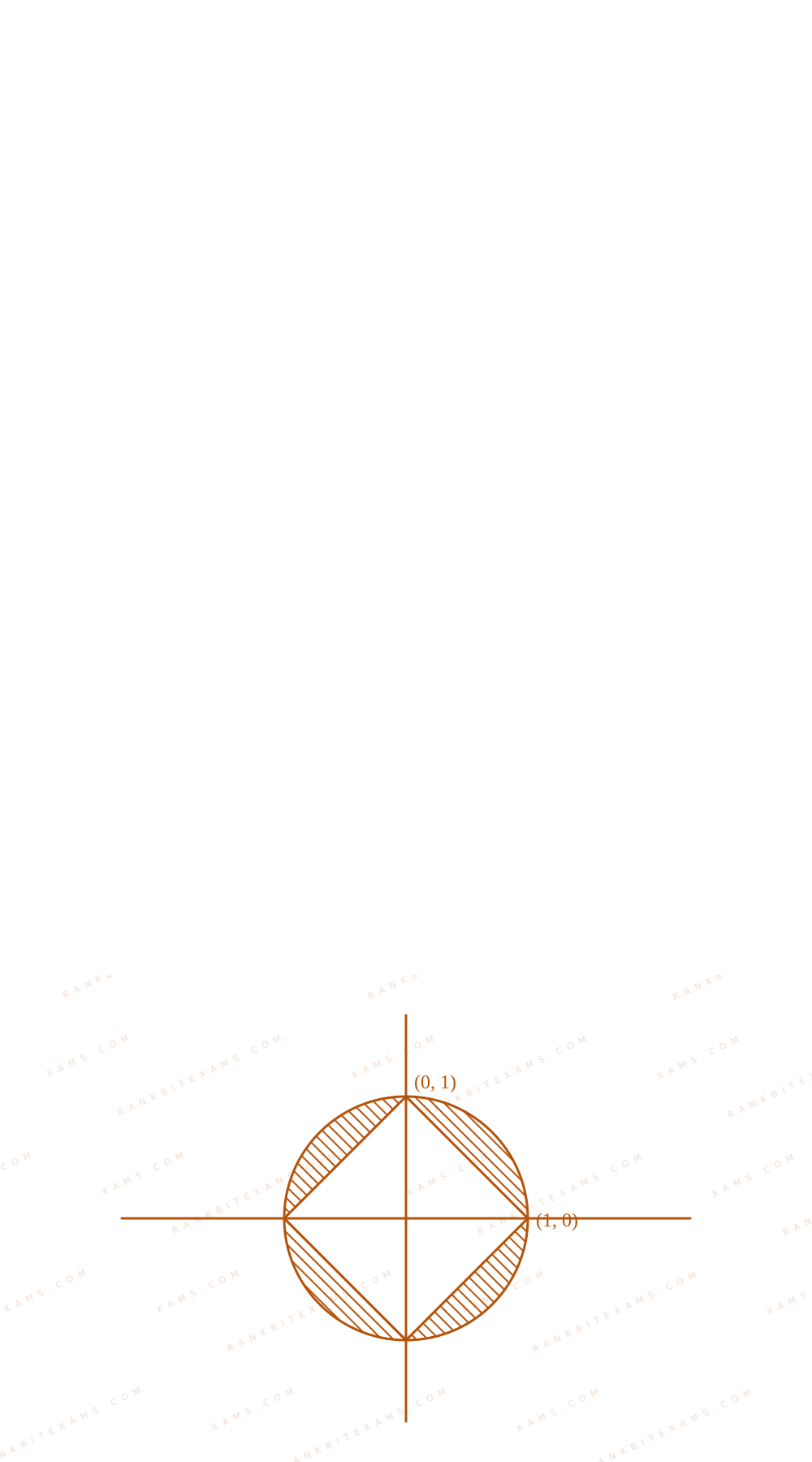
Area Enclosed by Two Curves diagram for Q53 - JEE Main 2025 Evening

By symmetry, the area α in the first quadrant is the area under the circle minus the area under the parabola from x=0 to x=1.

Step 1: Calculate the Area Components

Area of a circle quadrant with r=1 is (π)/(4).

Area under the parabola:

∫₀¹ (1 - x²) dx = [ x - (x³)/(3) ]₀¹ = 1 - (1)/(3) = (2)/(3)
Step 2: Evaluate the Total Area
α = 4 [ (π)/(4) - (2)/(3) ] = π - (8)/(3)

Multiplying both sides by 9:

9α = 9π - 24

Comparing with 9α = βπ + γ, we get:

β = 9, γ = -24

Hence,

|β - γ| = |9 - (-24)| = 33
Pattern Recognition

Symmetry helps divide the integration work by 4. Recognizing standard shapes (like a circle sector) allows you to bypass complex integration entirely for half of the problem.

Chapter Mix

Class 12 Mathematics: Integral Calculus

Q71 jee_main_2025_29_jan_evening Integration of Modulus and Greatest Integer Functions
If 24∫₀(pi)/(4)( |4x - (pi)/(12)| + [2 x])dx = 2π +α, where [· ] denotes the greatest integer function, then α is equal to
Numerical Answer. Answer: 12 to 12

Solution

Related Formula

Additivity property of definite integrals over split interval boundary points:

∫ₐc g(x) dx = ∫ₐb g(x) dx + ∫bc g(x) dx
Core Logic

Separate the integration tracking flow into two component operations:

I₁ = ∫₀(pi)/(4) |4x - (pi)/(12)| dx I₂ = ∫₀(pi)/(4) [2 x] dx
Step 1: Solve Modulus Integral Term

The argument changes sign inside absolute value bounds when 4x - (pi)/(12) = 0 x = (pi)/(48):

I₁ = ∫₀(pi)/(48) - (4x - (pi)/(12)) dx + ∫(pi)/(48)(pi)/(4) (4x - (pi)/(12)) dx = (1)/(4) [ (4x - (pi)/(12)) ]₀(pi)/(48) - (1)/(4) [ (4x - (pi)/(12)) ](pi)/(48)(pi)/(4)

Evaluating across numerical boundaries gives:

24 · I₁ = 24((1)/(2)) = 12
Step 2: Solve Greatest Integer Component and Combine

Analyze step limits inside greatest integer block [2 x]: For x in [0, (pi)/(6)), 0 ≤ 2 x < 1 [2 x] = 0. For x in [(pi)/(6), (pi)/(4)], 1 ≤ 2 x < √(2) [2 x] = 1.

I₂ = ∫₀(pi)/(6) 0 dx + ∫(pi)/(6)(pi)/(4) 1 dx = (pi)/(4) - (pi)/(6) = (pi)/(12)

Combine both sections aggregated by multiplier 24:

Total = 12 + 24((pi)/(12)) = 2π + 12

Comparing directly with expression statement parameters 2π + α isolates response value: α = 12

Pattern Recognition

Modulus arguments and step functions require isolating inflection transition numbers directly to break integrations up neatly.

Chapter Mix

Class 12 Mathematics: Definite Integration

Q jee_main_2025_28_jan_morning Properties of Definite Integrals (King's Property)
If ∫-(π)/(2)(π)/(2)(96x² ²x)/((1 + e^x)) dx = π (α π² +β),α ,β in Z, then (α + β)² equals:
  • A. 144
  • B. 196
  • C. 100
  • D. 64

Solution

Related Formula

King's property for definite integration:

∫ₐ^b f(x) dx = ∫ₐ^b f(a+b-x) dx
Core Logic

Apply the identity x → -x to the integral:

I = ∫-(π)/(2)(π)/(2) (96x² ² x)/(1 + e^x) dx = ∫-(π)/(2)(π)/(2) 96x² ² x1 + e-x dx
Step 1: Adding both integral variations

Adding the equations eliminates the exponential denominator term (1+e^x):

2I = ∫-(π)/(2)(π)/(2) 96x² ² x · [(1)/(1+e^x) + (e^x)/(1+e^x)] dx I = 48 ∫₀(π)/(2) x² (1 + 2x) dx
Step 2: Evaluating the integrated components

Integrating by parts gives:

I = π (2π² - 12)

Matching coefficients with the template: α = 2 and \beta = -12.

(α + β)² = (2 - 12)² = (-10)² = 100
Pattern Recognition

Exponential denominators like 1+e^x in symmetric integral intervals are prime candidates for simplification using King's property.

Chapter Mix

Class 12 Maths: Definite Integrals

Q65 jee_main_2025_03_april_morning Methods of Integration by Substitution
Let f(x) = ∫ x³√(3 - x²) dx. If 5f(√(2)) = -4, then f(1) is equal to:
  • A. - 2√(2)5
  • B. - 8√(2)5
  • C. - 4√(2)5
  • D. - 6√(2)5

Solution

Related Formula

Method of algebraic parameter substitution: Set 3-x² = t² -2xdx = 2tdt xdx = -tdt

Core Logic

Perform the specified variable parameter replacement steps:

3 - x² = t² x dx = -t dt

Rewrite the internal integral block components:

f(x) = ∫ x² · √(3-x²) · (x dx) = ∫ (3-t²) · t · (-t dt) = ∫ (t⁴ - 3t²) dt = (t⁵)/(5) - t³ + C

Return to original reference variable x:

f(x) = (3-x²)5/25 - (3-x²)3/2 + C
Step 1: Constant integration resolving

Evaluate function boundary conditions at x = √(2):

f(√(2)) = (3-2)5/25 - (3-2)3/2 + C = (1)/(5) - 1 + C = -(4)/(5) + C

Given 5f(√(2)) = -4 f(√(2)) = -(4)/(5).

-(4)/(5) + C = -(4)/(5) C = 0
Step 2: Numeric tracking value

Evaluate final targeted definition state value at x=1:

f(1) = (3-1)5/25 - (3-1)3/2 = 25/25 - 23/2 = 23/2((2)/(5) - 1) = 2√(2)(-(3)/(5)) = - 6√(2)5
Pattern Recognition

Splitting powers of x to create a direct match with internal derivative differential flags speeds up the integration transformation sequence.

Chapter Mix

Class 12 Mathematics: Integrals

Q67 jee_main_2025_03_april_morning Definite Integral of Greatest Integer Function
Let the domain of the function f(x) = ₂ ₄ ₆(3 + 4x - x²) be (a, b). If ∫₀b-a[x²]dx = p - √(q) - √(r), where p, q, r in N and (p, q, r) = 1, and [·] represents the greatest integer function, then p + q + r is equal to:
  • A. 10
  • B. 8
  • C. 11
  • D. 9

Solution

Related Formula

Domain of log chain iterations: For ₂ ₄(M) > 0, we require ₄(M) > 1 M > 4.

Core Logic

Trace internal arguments outward sequentially:

₄ ₆(3 + 4x - x²) > 0 ₆(3 + 4x - x²) > 1 3 + 4x - x² > 6¹ x² - 4x + 3 < 0 (x-1)(x-3) < 0 x in (1, 3)

Thus, determine limits:

a = 1, b = 3 b - a = 2
Step 1: Setting up the greatest integer function integration

We need to evaluate ∫₀² [x²] dx. Identify step boundary switch locations inside range [0, 2]:

  • For x in [0, 1): [x²] = 0
  • For x in [1, √(2)): [x²] = 1
  • For x in [√(2), √(3)): [x²] = 2
  • For x in [√(3), 2): [x²] = 3
  • Set up separate boundary component integrations:

∫₀² [x²] dx = ∫₀¹ 0 dx + ∫₁√(2) 1 dx + ∫√(2)√(3) 2 dx + ∫√(3)² 3 dx = 0 + (√(2) - 1) + 2(√(3) - √(2)) + 3(2 - √(3)) = √(2) - 1 + 2√(3) - 2√(2) + 6 - 3√(3) = 5 - √(2) - √(3)
Step 2: Matching coefficients

Compare values with requested answer template shape:

5 - √(2) - √(3) = p - √(q) - √(r) p = 5, q = 2, r = 3 Final Sum = p + q + r = 5 + 2 + 3 = 10
Pattern Recognition

Integrals over greatest integer configurations change value exactly where the inner expression tracks through integer milestones. Mapping boundaries accurately resolves calculations smoothly.

Chapter Mix

Class 12 Mathematics: Integrals

More Definite Integrals Questions — jee_main_2026_21_jan_evening

Practice all Definite Integrals previous-year questions →

Rankbit System
JEE Physics: Waves (+15.5%) | Electrostatics: Concentric Shells (-29.7%) | Modern Physics: Photoelectric Clones (+34.2%) | Mathematics: Definite Integrals (+18.1%) | Chemistry: Coordination Splitting (-11.4%) | JEE Physics: Waves (+15.5%) | Electrostatics: Concentric Shells (-29.7%) | Modern Physics: Photoelectric Clones (+34.2%) | Mathematics: Definite Integrals (+18.1%) | Chemistry: Coordination Splitting (-11.4%)