Rankbit System
JEE Physics: Waves (+15.5%) | Electrostatics: Concentric Shells (-29.7%) | Modern Physics: Photoelectric Clones (+34.2%) | Mathematics: Definite Integrals (+18.1%) | Chemistry: Coordination Splitting (-11.4%) | JEE Physics: Waves (+15.5%) | Electrostatics: Concentric Shells (-29.7%) | Modern Physics: Photoelectric Clones (+34.2%) | Mathematics: Definite Integrals (+18.1%) | Chemistry: Coordination Splitting (-11.4%)

A body of mass 'm' connected to a massless and unstretchable string goes in a vertical circle of radius 'R' under gravity g. The other end of the string is fixed at the center of a circle. If velocity at top of circular path is n sqrtgR , where, n geq 1 , then ratio of kinetic energy of the body at bottom to that at top of the circle is [cite: 1, 2]

Solution & Explanation

### Related Formula V_textBottom = sqrtV_textTop^2 + 4gR ### Core Logic Given velocity at the top position : V_textTop = sqrtn^2 gR By work-energy theorem, mechanical energy conservation between the top and bottom positions gives : V_textBottom = sqrtn^2 gR + 4gR Since KE = frac12m v^2, the ratio of kinetic energy at the bottom to that at the top is [cite: 2, 112]: textRatio = fracV_textBottom^2V_textTop^2 = fracn^2 gR + 4gRn^2 gR = fracn^2 + 4n^2 ### Pattern Recognition Kinetic energy change in vertical circles always gains a fixed additive value of 2mg(2R) = 4mgR due to gravity work[cite: 112, 687]. ### Chapter Mix Class 11 Physics: Work, Energy and Power

Reference Study Guides

More Work, Energy and Power Previous-Year Questions — Page 2

Q11 2025 Elastic Collisions in One Dimension
Given below are two statements. One is labelled as Assertion (A) and the other is labelled as Reason (R). Assertion (A): Three identical spheres of same mass undergo one dimensional motion as shown in figure with initial velocities v_A = 5mathrm~m/s, v_B = 2mathrm~m/s, v_C = 4mathrm~m/s. If we wait sufficiently long for elastic collision to happen, then v_A = 4mathrm~m/s, v_B = 2mathrm~m/s, v_C = 5mathrm~m/s will be the final velocities. Reason (R): In an elastic collision between identical masses, two objects exchange their velocities. In the light of the above statements, choose the correct answer from the options given below:
  • A. textBoth (A) and (R) are true but (R) is NOT the correct explanation of (A)
  • B. text(A) is true but (R) is false
  • C. textBoth (A) and (R) are true and (R) is the correct explanation of (A)
  • D. text(A) is false but (R) is true

Solution

### Related Formula v_1' = v_2 quad textand quad v_2' = v_1 for perfectly elastic collision (e=1) when masses are identical (m_1 = m_2). ### Core Logic Reason (R) states that identical masses exchange their velocities during elastic collision, which is mathematically correct. Let us trace the sequence of collisions chronologically: 1. Since v_A = 5mathrm~m/s and v_B = 2mathrm~m/s, sphere A collides with sphere B. After this collision, they swap velocities: v_A' = 2mathrm~m/s, quad v_B' = 5mathrm~m/s 2. Now sphere B has velocity v_B' = 5mathrm~m/s and sphere C has v_C = 4mathrm~m/s. Sphere B will collide with C. After swapping: v_B'' = 4mathrm~m/s, quad v_C' = 5mathrm~m/s 3. Looking at the values now: v_A' = 2mathrm~m/s and v_B'' = 4mathrm~m/s. No more collisions occur. Therefore, the final velocities are v_A = 2mathrm~m/s, v_B = 4mathrm~m/s, v_C = 5mathrm~m/s. The values given in Assertion (A) are wrong. Hence, (A) is false but (R) is true.
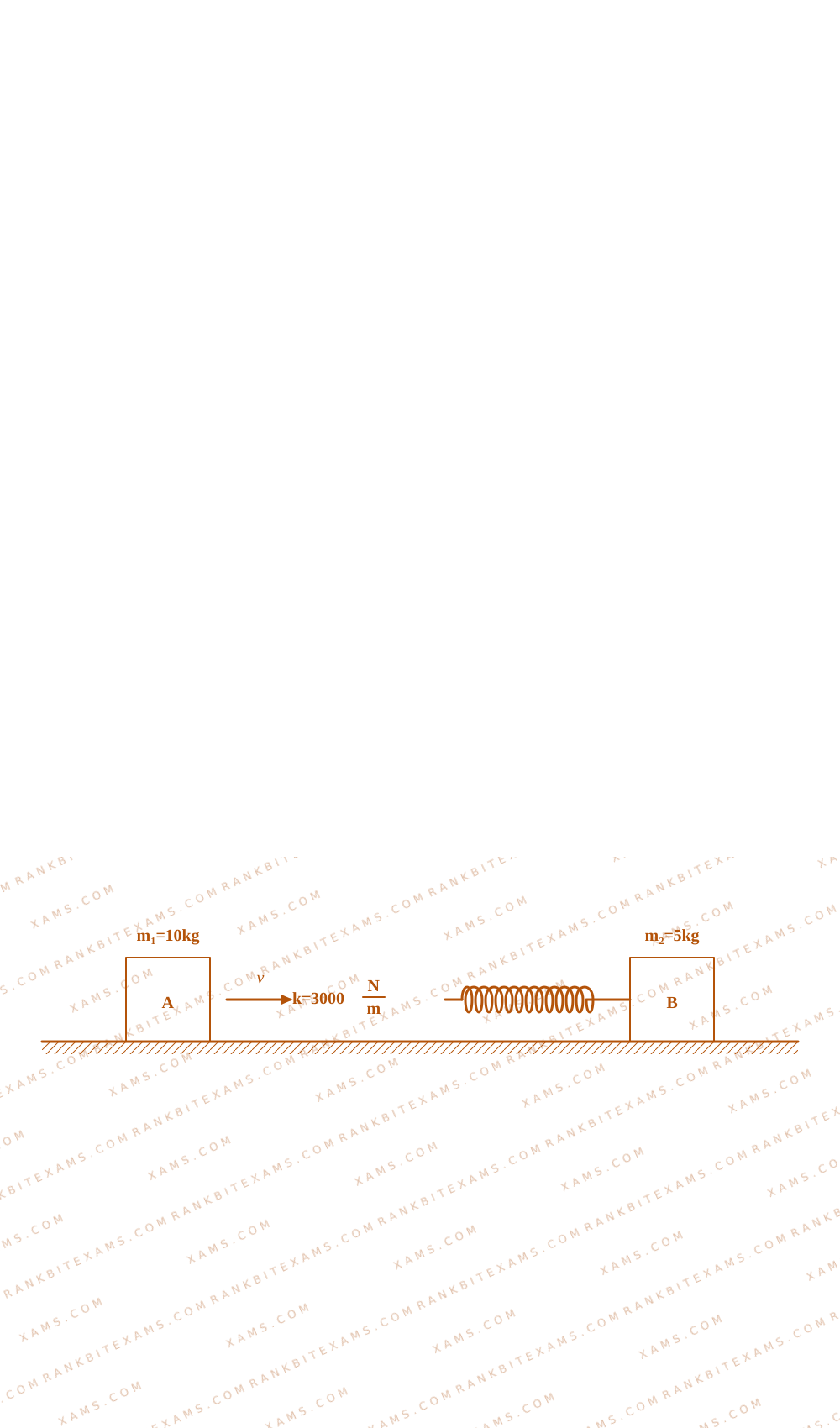
Elastic Collisions Step 1 diagram for Q11 - JEE Main 2025 Evening
### Pattern Recognition Velocity exchange happens pairwise in sequential order. Do not try to solve simultaneous conservation laws across all three blocks at once; handle each collision step-by-step from left to right. ### Evaluation Rubric / Model Answer null ### Chapter Mix Class 11 Physics: Work, Energy and Power
Q10 2025 Conservation of Mechanical Energy
A bead of mass mathrmm slides without friction on the wall of a vertical circular hoop of radius mathrmR as shown in figure. The bead moves under the combined action of gravity and a massless spring (k) attached to the bottom of the hoop. The equilibrium length of the spring is mathrmR . If the bead is released from top of the hoop with (negligible) zero initial speed, velocity of bead, when the length of spring becomes mathrmR , would be (spring constant is mathrmk , g is acceleration due to gravity)
Conservation of Mechanical Energy diagram for Q10 - JEE Main 2025 Morning
A bead sliding along a vertical circular ring constrained by a tracking baseline spring system.
  • A. 2 sqrtmathrmgR + fracmathrmkR^2mathrmm
  • B. sqrt2 mathrmRg + frac4 mathrmkR^2mathrmm
  • C. sqrt2Rg + frackR^2m
  • D. sqrt3Rg + frackR^2m

Solution

### Core Logic Let's apply the comprehensive Work-Energy theorem framework across key layout tracking nodes:
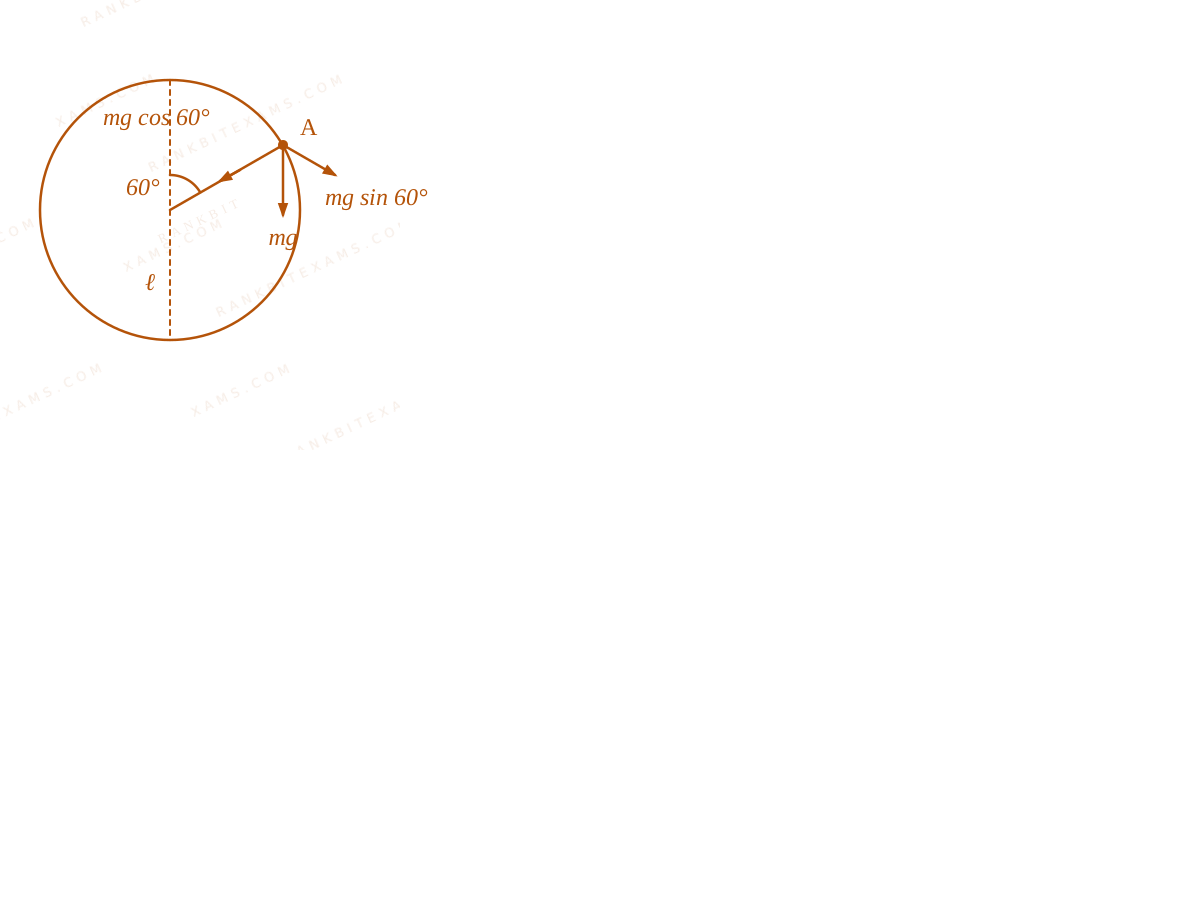
Geometric resolution angle resolution profile for Q10
A bead sliding along a vertical circular ring constrained by a tracking baseline spring system.
mathrmW_textall = Delta mathrmK mathrmM g (mathrmR + mathrmR cos 60^circ) + frac12 mathrmk (mathrmR^2 - 0^2) = frac12 mathrmm v^2 Simplifying the gravitational shift and potential expansions: mathrmM g frac3mathrmR2 + fracmathrmkmathrmR^22 = frac12 mathrmm v^2 ### Step 1: Final Kinematic Value mathrmv = sqrt3mathrmgR + fracmathrmkmathrmR^2mathrmm Matches parameters specified by option (4). ### Pattern Recognition Isolate spring metrics at node points: Initial extension equals 2mathrmR - mathrmR = mathrmR. Final extension is 0 since spring length matching mathrmR satisfies unextended conditions. ### Evaluation Rubric / Model Answer null ### Chapter Mix Class 11 Physics: Work, Energy and Power
Q11 2025 Conservative and Non-conservative Forces
Given below are two statements: one is labelled as Assertion A and the other is labelled as Reason R. Assertion A: In a central force field, the work done is independent of the path chosen Reason R: Every force encountered in mechanics does not have an associated potential energy. In the light of the above statements, choose the most appropriate answer from the options given below:
  • A. mathbfAtext is true but mathbfRtext is false
  • B. textBoth mathbfAtext and mathbfRtext are true but mathbfRtext is NOT the correct explanation of mathbfA
  • C. textBoth mathbfAtext and mathbfRtext are true and mathbfRtext is the correct explanation of mathbfA
  • D. mathbfAtext is false but mathbfRtext is true

Solution

### Core Logic Assertion A: Central force configurations depend solely on the positional distance parameter mathrmr. They are strictly conservative fields, making path metrics completely irrelevant for total work evaluation. (True) Reason R: Non-conservative profiles like friction or drag dissipate thermal energy paths and do not possess any state potential energy function. (True) Since statement R provides general information about non-conservative forces rather than stating why central fields are path independent, it fails as a direct explanatory bridge. ### Step 1: Final Conclusion Both assertions are factually accurate, but R is not the appropriate explanation for A. This selects option (2). ### Pattern Recognition Conservative fields allow defining potential profiles (F = -nabla mathrmU); non-conservative structures completely break this relation. ### Evaluation Rubric / Model Answer null ### Chapter Mix Class 11 Physics: Work, Energy and Power
Q16 2025 Conservation of Mechanical Energy
A particle is released from height S above the surface of the earth. At certain height its kinetic energy is three times its potential energy. The height from the surface of the earth and the speed of the particle at that instant are respectively.
  • A. fracS2, sqrtfrac3gS2
  • B. fracS2, frac3gS2
  • C. fracS4, frac3gS2
  • D. fracS4, sqrtfrac3gS2

Solution

### Related Formula Conservation of Mechanical Energy: E_texttotal = K + U = textconstant At the initial height S (velocity v = 0): E_texttotal = mgS At any height x above the ground: U = mgx quad textand quad K = frac12mv^2 ### Core Logic Let the height of the particle at that instant be x. We are given: K = 3U Substitute the energy terms: frac12mv^2 = 3mgx By energy conservation: K + U = E_texttotal 3U + U = mgS implies 4U = mgS 4(mgx) = mgS implies x = fracS4 ### Step 1: Calculating the Speed Now find the speed v at this height x = S/4. Since K = 3U: frac12mv^2 = 3mgx frac12mv^2 = 3mgleft(fracS4right) v^2 = frac6gS4 = frac3gS2 v = sqrtfrac3gS2 ### Pattern Recognition Standard ratio trick: If K = n U, then by energy conservation (n+1)U = E_texttotal. This immediately yields: x = fracSn+1 Here n = 3, so x = S/4. This rapid shortcut lets you find the height in a split second! ### Evaluation Rubric / Model Answer null ### Chapter Mix Class 11 Physics: Work, Energy and Power
Q16 2025 Conservative and Non-Conservative Forces
Which one of the following forces cannot be expressed in terms of potential energy? [cite: 145]
  • A. Coulomb's force [cite: 146]
  • B. Gravitational force [cite: 147]
  • C. Frictional force [cite: 148]
  • D. Restoring force [cite: 149]

Solution

### Core Logic Potential energy functions are strictly mathematically defined exclusively for conservative force interactions via the relationship F = -fracdUdx[cite: 727]. Coulomb's force, Gravitational force, and Spring restoring force are completely path-independent conservative fields[cite: 146, 147, 149]. Frictional force is a path-dependent, dissipative non-conservative force[cite: 148, 727, 728]. Consequently, it is impossible to define a scalar potential energy function for mechanical friction[cite: 727, 728]. ### Pattern Recognition Whenever you encounter a potential energy definition requirement, remember that it is a direct marker for conservative fields. Dissipative forces like friction or viscous drag instantly break this condition[cite: 727, 728]. ### Evaluation Rubric / Model Answer null ### Chapter Mix Class 11 Physics: Work, Energy and Power

More Work, Energy and Power Questions — jee_main_2025_29_jan_morning

Practice all Work, Energy and Power previous-year questions →

YOUR FIRST PREP STEP STARTS HERE

We Map Every Repeating Question in Competitive Exams.

Say goodbye to generic mock test fatigue. RankBit uses smart analysis to group past exam questions into their foundational Repeating Question Types. Find chapter weightage, track repeating questions, and score higher with targeted practice.

Select Your Target Exam

Choose an exam track below to find formulas per chapter and patterns.

Syncing Exam Intelligence

Mapping formulas and patterns across all tracks…

PATH A — FULL LENGTH PRACTICE

Full Mock Test Hub

Simulate real NTA exam conditions with fully tracked mocks. Time yourself against past papers.

Under Development
PATH B — TARGETED PRACTICE

Topic-wise Practice Hub

Practice past-year questions one chapter at a time. Pick an exam → subject → chapter and get every PYQ for that topic — pulled together from all past papers — with the chapter's key formulas alongside.

Loading Questions... Browse Topics
Latest from the Blog
View all →

Loading articles...