Rankbit System
JEE Physics: Waves (+15.5%) | Electrostatics: Concentric Shells (-29.7%) | Modern Physics: Photoelectric Clones (+34.2%) | Mathematics: Definite Integrals (+18.1%) | Chemistry: Coordination Splitting (-11.4%) | JEE Physics: Waves (+15.5%) | Electrostatics: Concentric Shells (-29.7%) | Modern Physics: Photoelectric Clones (+34.2%) | Mathematics: Definite Integrals (+18.1%) | Chemistry: Coordination Splitting (-11.4%)

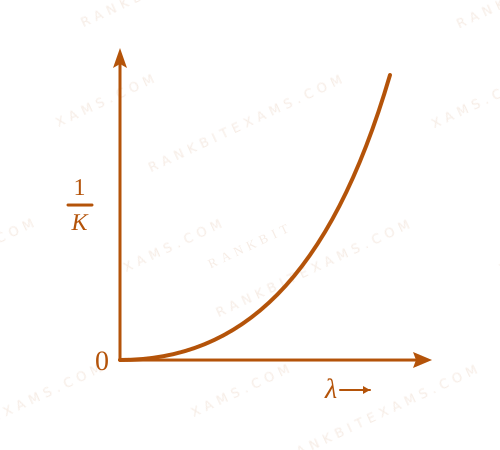
If lambda and K are de Broglie Wavelength and kinetic energy, respectively, of a particle with constant mass. The correct graphical representation for the particle will be :-

Solution & Explanation

### Related Formula lambda = frachsqrt2mK lambda^2 = left(frach^22mright) frac1K ### Core Logic Rearranging the de Broglie equation displays a parabolic relationship when evaluating squared attributes or corresponding axes coordinates. Given standard lambda vs frac1sqrtK layout tracking, it exhibits an upward facing parabolic behavior matching option (2) layout. ### Chapter Mix Class 12 Physics: Dual Nature of Radiation and Matter

More Dual Nature of Radiation and Matter Previous-Year Questions — Page 2

Q10 2025 Photoelectric Effect and Intensity
Given below are two statements: one is labelled as Assertion A and the other is labelled as Reason R. Assertion A: In photoelectric effect, on increasing the intensity of incident light the stopping potential increases. Reason R: Increase in intensity of light increases the rate of photoelectrons emitted, provided the frequency of incident light is greater than threshold frequency. In the light of the above statements, choose the correct answer from the options given below
  • A. Both A and R are true but R is NOT the correct explanation of A
  • B. A is false but R is true
  • C. A is true but R is false
  • D. Both A and R are true and R is the correct explanation of A

Solution

### Related Formula Einstein's photoelectric equation: eV_s = h u - phi where: * V_s = stopping potential * u = frequency of light * phi = work function * Intensity formula: I = fracn h uA cdot t (where n is rate of photons). ### Core Logic * **Assertion Analysis:** Stopping potential V_s depends strictly linearly on frequency u and work function phi. It is completely independent of the beam intensity. Therefore, Assertion A is **false**. * **Reason Analysis:** Intensity tracks the flux counts of photons per second. Increasing intensity drives up the quantum count of ejected charges, given u > u_0. Thus, Reason R is **true**. ### Pattern Recognition Stopping Potential leftrightarrow Frequency/Energy characteristic. Photo-current / Emission Rate leftrightarrow Photon Intensity/Flux counts. ### Evaluation Rubric / Model Answer null ### Chapter Mix Class 12 Physics: Dual Nature of Radiation and Matter
Q5 2025 De Broglie Wavelength of Electron
A photo-emissive substance is illuminated with a radiation of wavelength lambda_i so that it releases electrons with de-Broglie wavelength lambda_c The longest wavelength of radiation that can emit photoelectron is lambda_0. Expression for de-Broglie wavelength is given by: (m: mass of the electron, h: Planck's constant and c: speed of light) [cite: 39, 41]
  • A. lambda_e=sqrtfrach2mc(frac1lambda_i-frac1lambda_o) [cite: 46]
  • B. lambda_c=sqrtfrachlambda_02mc [cite: 47]
  • C. lambda_e=frachsqrt2mc(frac1lambda_i-frac1lambda_o) [cite: 48]
  • D. lambda_c=sqrtfrachlambda_i2mc [cite: 49]

Solution

### Related Formula textK.E = E - W [cite: 681] lambda_e = frachsqrt2mtextK.E, quad E = frachclambda_i, quad W = frachclambda_0 [cite: 682] ### Core Logic From the de-Broglie wavelength relationship, squaring both sides yields: [cite: 682] frach^22mlambda_e^2 = textK.E = frachclambda_i - frachclambda_0 = hcleft(frac1lambda_i - frac1lambda_0right) [cite: 682] Simplifying for lambda_e: [cite: 682] lambda_e^2 = frach^22mhcleft(frac1lambda_i - frac1lambda_0right) = frach2mcleft(frac1lambda_i - frac1lambda_0right) lambda_e = sqrtfrach2mcleft(frac1lambda_i - frac1lambda_0right) [cite: 682] ### Pattern Recognition Einstein's photoelectric equation relates kinetic energy linearly to frac1lambda parameters[cite: 681, 682]. Combining this directly into the momentum term sqrt2mK under the Planck constant yields the standard reciprocal root difference layout[cite: 682]. ### Evaluation Rubric / Model Answer null ### Chapter Mix Class 12 Physics: Dual Nature of Radiation and Matter
Q12 2025 Photoelectric Effect
In photoelectric effect, the stopping potential (V_0) v/s frequency ( u) curve is plotted. (h is the Planck's constant and phi_0 is work function of metal) (A) V_0 v/s u is linear (B) The slope of V_0 v/s u curve = fracphi_0h (C) h constant is related to the slope of V_0 v/s u line (D) The value of electric charge of electron is not required to determine h using the V_0 v/s u curve. (E) The work function can be estimated without knowing the value of h. Choose the correct answer from the options given below :
  • A. (A), (B) and (C) only
  • B. (C) and (D) only
  • C. (A), (C) and (E) only
  • D. (D) and (E) only

Solution

### Related Formula h u = phi_0 + K_textmax = phi_0 + eV_0 V_0 = left(frache ight) u - fracphi_0e ### Core Logic Analyzing each statement: - (A) V_0 text v/s u is a straight line equation (y = mx + c). True. - (B) Slope is frache, not fracphi_0h. False. - (C) The slope involves Planck's constant h. True. - (D) To find h from the slope (m = h/e), you must multiply the slope by the electronic charge e. Thus, e is required. False. - (E) The u-intercept occurs when V_0 = 0 implies u_textth = fracphi_0h. The y-intercept is -phi_0/e. Therefore, we can find phi_0 from the intercepts knowing only e or by looking at the scale parameters carefully, without explicitly knowing h. True. Hence, statements (A), (C), and (E) are correct. ### Pattern Recognition Einstein's photoelectric equation yields a straight-line plot for V_0 vs u where slope is universally frache for all metals. ### Evaluation Rubric / Model Answer null ### Chapter Mix Class 12 Physics: Dual Nature of Radiation and Matter
Q17 2025 Relativistic Mechanics
The energy E and momentum p of a moving body of mass m are related by some equation. Given that c represents the speed of light, identify the correct equation.
  • A. E^2 = pc^2 + m^2c^4
  • B. E^2 = pc^2 + m^2c^2
  • C. E^2 = p^2c^2 + m^2c^2
  • D. E^2 = p^2c^2 + m^2c^4

Solution

### Related Formula Relativistic total energy equation: E^2 = p^2c^2 + m_0^2c^4 ### Core Logic We can verify this equation via dimensional analysis: - Dimension of energy, [E] = M^1 L^2 T^-2 implies [E^2] = M^2 L^4 T^-4 - Dimension of momentum times light speed, [pc] = (M^1 L^1 T^-1) cdot (L^1 T^-1) = M^1 L^2 T^-2 implies [p^2c^2] = M^2 L^4 T^-4 - Rest energy square term, [m^2c^4] = M^2 cdot (L^1 T^-1)^4 = M^2 L^4 T^-4 Since all terms share identical dimensions, this relativistic identity is structurally valid. The matching option is (4). ### Pattern Recognition This is Einstein's famous energy-momentum relation of special relativity, fundamental to high-energy modern physics contexts. ### Evaluation Rubric / Model Answer null ### Chapter Mix Class 12 Physics: Dual Nature of Radiation and Matter
Q23 2025 Photon Theory of Light
The ratio of the power of a light source S_1 to that the light source S_2 is 2. S_1 is emitting 2 times 10^15 photons per second at 600 nm. If the wavelength of the source S_2 is 300 nm, then the number of photons per second emitted by S_2 is ____ times 10^14 .
Numerical Answer. Answer: 5 to 5

Solution

### Related Formula Power of a light source: P = n E_textphoton = n left(frachclambda ight) where n is the number of photons emitted per second. ### Core Logic Taking the ratio of power for source 1 and source 2: fracP_1P_2 = fracn_1 left(frachclambda_1 ight)n_2 left(frachclambda_2 ight) = left(fraclambda_2lambda_1 ight) fracn_1n_2 Given data: - fracP_1P_2 = 2 - n_1 = 2 times 10^15\ mathrmphotons/s - lambda_1 = 600\ mathrmnm - lambda_2 = 300\ mathrmnm Substitute the values: 2 = left(frac300600 ight) times frac2 times 10^15n_2 2 = frac12 times frac2 times 10^15n_2 implies n_2 = frac10^152 = 5 times 10^14\ mathrmphotons/s The question asks for the value multiplying 10^14, which is 5. ### Pattern Recognition Power relies on both the delivery rate and individual photon packet energy. Lower wavelength means more energetic packets, requiring fewer photons to emit the same power. ### Evaluation Rubric / Model Answer null ### Chapter Mix Class 12 Physics: Dual Nature of Radiation and Matter

More Dual Nature of Radiation and Matter Questions — jee_main_2025_29_jan_morning

Practice all Dual Nature of Radiation and Matter previous-year questions →

YOUR FIRST PREP STEP STARTS HERE

We Map Every Repeating Question in Competitive Exams.

Say goodbye to generic mock test fatigue. RankBit uses smart analysis to group past exam questions into their foundational Repeating Question Types. Find chapter weightage, track repeating questions, and score higher with targeted practice.

Select Your Target Exam

Choose an exam track below to find formulas per chapter and patterns.

Syncing Exam Intelligence

Mapping formulas and patterns across all tracks…

PATH A — FULL LENGTH PRACTICE

Full Mock Test Hub

Simulate real NTA exam conditions with fully tracked mocks. Time yourself against past papers.

Under Development
PATH B — TARGETED PRACTICE

Topic-wise Practice Hub

Practice past-year questions one chapter at a time. Pick an exam → subject → chapter and get every PYQ for that topic — pulled together from all past papers — with the chapter's key formulas alongside.

Loading Questions... Browse Topics
Latest from the Blog
View all →

Loading articles...