Let [t] be the greatest integer less than or equal to t. Then the least value of p in N for which x → 0⁺ ( x ( [ 1x ] + [ 2x ] + + [ px ] ) - x² ( [ 1x² ] + [ 2²x² ] + + [ 9²x² ] ) ) ≥ 1 is equal to

Numerical Answer Type:
Enter a numerical value Answer: 24 +4 marks

Solution & Explanation

Related Formula
x → 0^+ x [ (k)/(x) ] = k Σk=1ⁿ k = (n(n+1))/(2), Σk=1ⁿ k² = (n(n+1)(2n+1))/(6)
Core Logic

Using properties of Greatest Integer Function limits, as x → 0^+, fraction values diverge cleanly to continuous variable distributions:

x → 0^+ x [ (k)/(x) ] = k Σk=1p k = (p(p+1))/(2)

Similarly, for the second block component part:

x → 0^+ x² [ (k²)/(x²) ] = k² Σk=1⁹ k² = (9 × 10 × 19)/(6) = 285
Step 1: Setup Inequality Formulation

Combine evaluated limits component parts:

(p(p+1))/(2) - 285 ≥ 1 (p(p+1))/(2) ≥ 286 p(p+1) ≥ 572
Step 2: Solve for least natural number

Evaluate product bounds of adjacent integers: If p = 23 23 × 24 = 552 (False) If p = 24 24 × 25 = 600 (True) Therefore, the least natural value of p is 24.

Pattern Recognition

Greatest Integer fractions simplify directly to standard scalar values inside limits evaluated at infinity or zero, letting you drop brackets and treat them as arithmetic sequences.

Chapter Mix

Class 11 Mathematics: Limits

Reference Study Guides

More Limits Previous-Year Questions — Page 10

Q20 jee_main_2024_30_jan_morning Limits
Let f:[-(π)/(2),(π)/(2)] → R be a differentiable function such that f(0) = (1)/(2). If the x → 0 x ∫₀x f(t) dtex² - 1 = α, then 8α² is equal to:
  • A. 16
  • B. 2
  • C. 1
  • D. 4

Solution

Related Formula
y → 0 (e^y - 1)/(y) = 1

Leibniz Integral Rule:

(d)/(dx) ∫₀^x f(t) dt = f(x)
Core Logic

Given limit is:

α = x → 0 x ∫₀x f(t) dtex² - 1

Multiply and divide the denominator by x² to use standard exponential limit:

α = x → 0 x ∫₀x f(t) dt( ex² - 1x²) · x²

Since x→ 0 ex² - 1x² = 1, the expression simplifies to:

α = x → 0 x ∫₀x f(t) dt1 · x² = x → 0 ∫₀x f(t) dtx
Step 1: Applying L'Hôpital's Rule

This is a 0/0 form. Apply L'Hôpital's Rule by differentiating numerator and denominator w.r.t x:

α = x → 0 (d)/(dx) ∫₀x f(t) dt(d)/(dx)(x) = x → 0 (f(x))/(1)

By continuity of differentiable function f at 0: α = f(0)

Step 2: Final Calculation

We are given f(0) = (1)/(2), so α = (1)/(2). We need to find 8α²:

8α² = 8 ((1)/(2))² = 8 ((1)/(4)) = 2
Pattern Recognition

Standard expansion/limits on isolated terms in denominators immediately reduce the power of x, setting up a trivial Leibniz derivative application.

Chapter Mix

Class 11 Maths: Limits and Derivatives Class 12 Maths: Integrals
Q29 jee_main_2024_30_jan_morning Differentiability
If the function f(x) = cases (1)/(|x|) & ,|x| ≥ 2 ax² + 2b & ,|x| < 2 cases is differentiable on R, then 48 (a + b) is equal to
Numerical Answer. Answer: 15 to 15

Solution

Related Formula
Continuity at x=c: x → c^- f(x) = x → c^+ f(x) Differentiability at x=c: x → c^- f'(x) = x → c^+ f'(x)
Core Logic

Rewrite the piecewise function without absolute values:

f(x) = cases (1)/(x) & , x ≥ 2 ax² + 2b & , -2 < x < 2 -(1)/(x) & , x ≤ -2 cases
Step 1: Applying Continuity

For f(x) to be continuous at x = 2:

x → 2^- (ax² + 2b) = x → 2^+ (1)/(x) a(2)² + 2b = (1)/(2) ⇒ 4a + 2b = (1)/(2) (1)

Because the function is even, continuity at x = -2 yields the exact same equation: 4a + 2b = 1/2.

Step 2: Applying Differentiability

Find the derivative f'(x) for piecewise sections:

f'(x) = cases -(1)/(x²) & , x > 2 2ax & , -2 < x < 2 (1)/(x²) & , x < -2 cases

For f(x) to be differentiable at x = 2:

x → 2^- (2ax) = x → 2^+ (-(1)/(x²)) 4a = -(1)/(4) ⇒ a = -(1)/(16)
Step 3: Finding variables and final target

Substitute a back into equation (1):

4(-(1)/(16)) + 2b = (1)/(2) -(1)/(4) + 2b = (1)/(2) ⇒ 2b = (3)/(4) ⇒ b = (3)/(8)

We need to evaluate 48(a + b):

48(-(1)/(16) + (3)/(8)) = 48((-1 + 6)/(16)) = 48((5)/(16)) = 3 × 5 = 15
Pattern Recognition

Piecewise differentiability forces simultaneous linear equations matching function values and their first derivatives at boundary limits.

Chapter Mix

Class 12 Maths: Continuity and Differentiability

Q10 jee_main_2024_31_jan_evening Limits of Functions
Let f: R → (0, ∞) be strictly increasing function such that x → ∞ (f(7x))/(f(x)) = 1. Then, the value of x arrow ∞ [ (f(5x))/(f(x)) - 1 ] is equal to
  • A. 4
  • B. 0
  • C. 7/5
  • D. 1

Solution

Related Formula
Sandwich / Squeeze Theorem: If g(x) ≤ h(x) ≤ k(x) and g(x) = k(x) = L, then h(x) = L
Core Logic

Since f is a strictly increasing function mapping to (0,∞): For x > 0, we have x < 5x < 7x. Thus, f(x) < f(5x) < f(7x). Divide everything by f(x) (which is strictly positive):

1 < (f(5x))/(f(x)) < (f(7x))/(f(x))

Take the limit as x → ∞:

x→∞ 1 ≤ x→∞ (f(5x))/(f(x)) ≤ x→∞ (f(7x))/(f(x)) 1 ≤ x→∞ (f(5x))/(f(x)) ≤ 1

Therefore, x→∞ (f(5x))/(f(x)) = 1. The required value is:

x arrow ∞ [ (f(5x))/(f(x)) - 1 ] = 1 - 1 = 0
Chapter Mix

Class 11 Maths: Limits and Derivatives Class 12 Maths: Continuity and Differentiability

Q14 jee_main_2024_31_jan_evening Differentiability
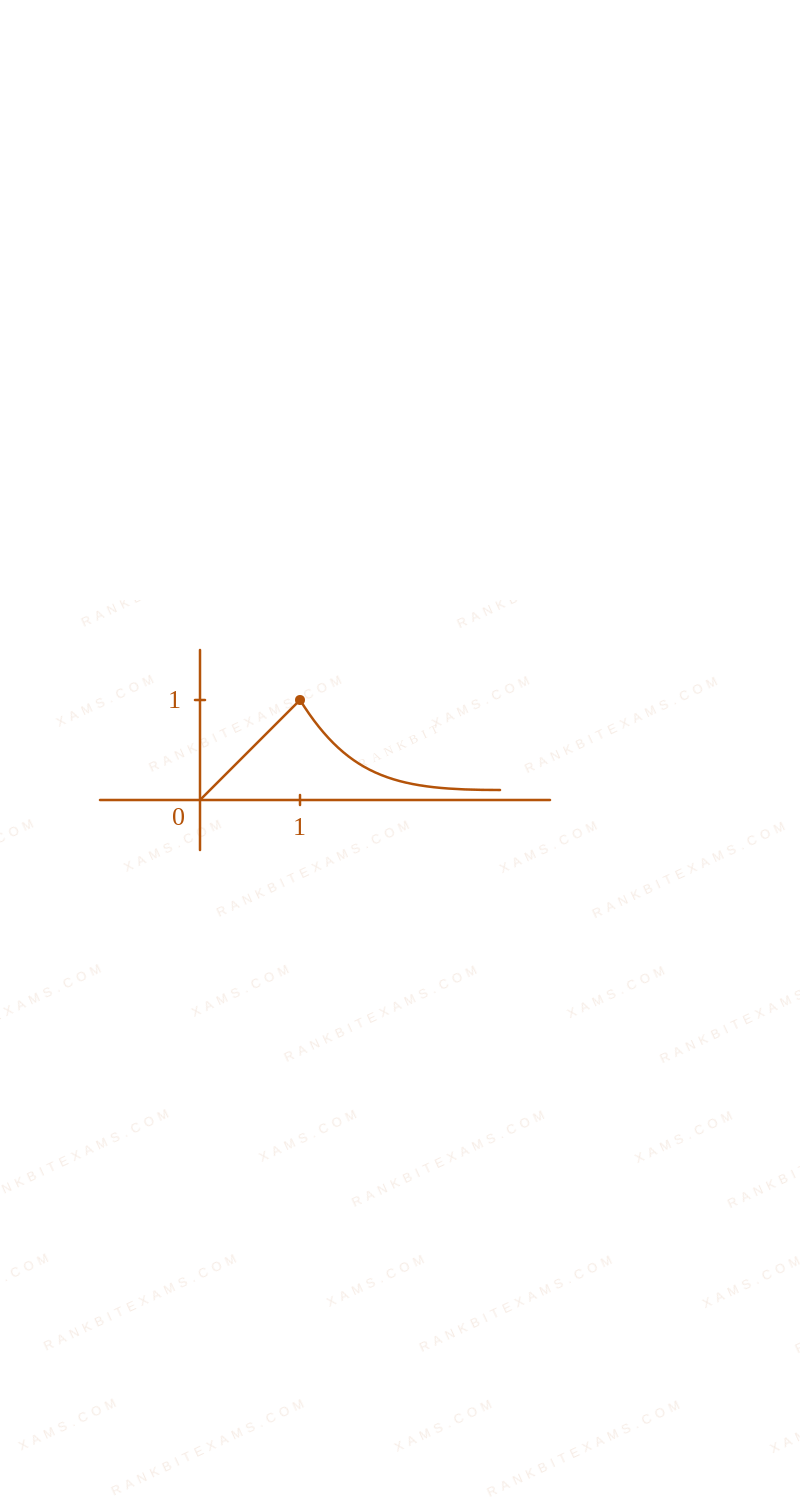
Consider the function f:(0,∞)→ R defined by f(x) = e^-| ₑx|. If m and n be respectively the number of points at which f is not continuous and f is not differentiable, then m + n is
  • A. 0
  • B. 3
  • C. 1
  • D. 2

Solution

Core Logic

Differentiability diagram for Q14 - JEE Main 2024 Evening

The function is f(x) = e-|ln x|. Rewrite piecewise for (0, ∞):

f(x) = cases e-(-ln x) & if 0 < x < 1 e-ln x & if x ≥ 1 cases f(x) = cases eln x = x & if 0 < x < 1 1eln x = (1)/(x) & if x ≥ 1 cases

Check continuity at x = 1:

x → 1^- f(x) = x → 1^- x = 1 x → 1^+ f(x) = x → 1^+ (1)/(x) = 1

f(1) = 1. The function is continuous everywhere on (0, ∞). Thus, m = 0.

Check differentiability at x = 1:

LHD = x → 1^- f'(x) = 1 RHD = x → 1^+ f'(x) = -(1)/(x²)|x=1 = -1

Since LHD ≠ RHD, the function is not differentiable at x = 1. Thus, n = 1.

Finally, m + n = 0 + 1 = 1.

Chapter Mix

Class 12 Maths: Continuity and Differentiability

Q27 jee_main_2024_31_jan_evening Maclaurin Series / L'Hopital
If x → 0 ax²e^x - b ₑ(1 + x) + cxe-xx² x = 1, then 16(a² + b² + c²) is equal to
Numerical Answer. Answer: 81 to 81

Solution

Related Formula
e^x = 1 + x + (x²)/(2!) + ln(1+x) = x - (x²)/(2) + (x³)/(3) - x ≈ x x² x ≈ x³
Core Logic

Expand the numerator terms using Maclaurin series around x=0:

ax² (1 + x + (x²)/(2) + ) - b (x - (x²)/(2) + (x³)/(3) - ) + cx (1 - x + (x²)/(2) - (x³)/(6) + )

Denominator behavior is x³. Group by powers of x: Coefficient of x: -b + c = 0 c = b Coefficient of x²: a + (b)/(2) - c = 0 a = c - (b)/(2) = (b)/(2) Coefficient of x³: a - (b)/(3) + (c)/(2) = 1

Substitute a = b/2 and c = b into the x³ equation:

(b)/(2) - (b)/(3) + (b)/(2) = 1 b - (b)/(3) = 1 (2b)/(3) = 1 b = (3)/(2)

This gives c = (3)/(2) and a = (3)/(4).

Calculate the required value:

16(a² + b² + c²) = 16((9)/(16) + (9)/(4) + (9)/(4)) = 9 + 36 + 36 = 81
Chapter Mix

Class 11 Maths: Limits and Derivatives

More Limits Questions — jee_main_2025_29_jan_morning

Practice all Limits previous-year questions →

Rankbit System
JEE Physics: Waves (+15.5%) | Electrostatics: Concentric Shells (-29.7%) | Modern Physics: Photoelectric Clones (+34.2%) | Mathematics: Definite Integrals (+18.1%) | Chemistry: Coordination Splitting (-11.4%) | JEE Physics: Waves (+15.5%) | Electrostatics: Concentric Shells (-29.7%) | Modern Physics: Photoelectric Clones (+34.2%) | Mathematics: Definite Integrals (+18.1%) | Chemistry: Coordination Splitting (-11.4%)
