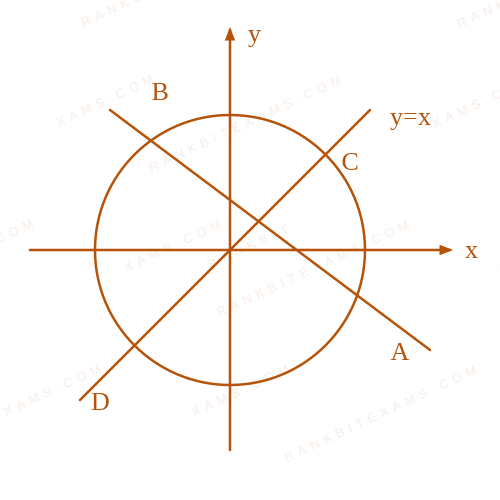
Let the line x + y = 1 meet the circle x² + y² = 4 at the points A and B. If the line perpendicular to AB and passing through the mid point of the chord AB intersects the circle at C and D, then the area of the quadrilateral ADBC is equal to

Solution & Explanation

Related Formula
Area of a quadrilateral with perpendicular diagonals d₁ and d₂ = (1)/(2) d₁ d₂
Core Logic

The line perpendicular to chord AB passing through its midpoint is the diameter of the circle because the perpendicular bisector of any chord passes through the center. Thus, CD is a diameter, making its length equal to 2R = 4.

Chord of a Circle diagram for Q51 - JEE Main 2025 Morning

Step 1: Find Length of Chord AB

The perpendicular distance p from the center (0,0) to the line x + y - 1 = 0 is:

p = |0 + 0 - 1|√(1² + 1²) = 1√(2)

Length of chord AB = 2√(R² - p²) = 2√(4 - (1)/(2)) = 2√((7)/(2)) = √(14).

Step 2: Area Calculation

Since CD is the perpendicular bisector of AB, the diagonals of quadrilateral ADBC are perpendicular. Therefore, the area is:

Area = (1)/(2) × AB × CD = (1)/(2) × √(14) × 4 = 2√(14)
Pattern Recognition

Whenever a line passes through the midpoint of a chord and is perpendicular to it, recognize instantly that it is a diameter. The area of the quadrilateral formed is then simply the area of two triangles sharing the diameter as a base, or (1)/(2) d₁ d₂.

Chapter Mix

Class 11 Mathematics: Circles Class 11 Mathematics: Straight Lines

More Circles Previous-Year Questions — Page 3

Q11 jee_main_2026_22_january_evening Hyperbola Properties and Area of Triangle
Let P(10, 2√(15)) be a point on the hyperbola (x²)/(a²) - (y²)/(b²) = 1, whose foci are S and S'. If the length of its latus rectum is 8, then the square of the area of Δ PSS' is equal to:
  • A. 4200
  • B. 900
  • C. 1462
  • D. 2700

Solution

Related Formula

Latus rectum length = (2b²)/(a) = 8 b² = 4a. Focal length = 2ae = 2√(a² + b²).

Core Logic

Substitute P(10, 2√(15)) and b² = 4a into hyperbola equation:

(100)/(a²) - (60)/(4a) = 1 a² + 15a - 100 = 0 (a + 20)(a - 5) = 0 a = 5 (a > 0)

Thus, b² = 20 b = √(20).

Step 1: Calculate Focal Distance and Area

Focal distance SS' = 2ae = 2 √(a² + b²) = 2 √(25 + 20) = 6√(5). Area of Δ PSS' = (1)/(2) × base × height = (1)/(2) (6√(5)) (2√(15)) = 30√(3) = A.

Step 2: Square of Area
A² = (30√(3))² = 900 × 3 = 2700
Pattern Recognition

Use latus rectum relation to reduce hyperbola parameter to single variable quadratic.

Chapter Mix

Class 11 Maths: Conic Sections
Q16 jee_main_2026_22_january_evening Ellipse Focal Distances
Let S and S' be the foci of the ellipse (x²)/(25) + (y²)/(9) = 1 and P(α, β) be a point on the ellipse in the first quadrant. If (SP)² + (S'P)² - SP · S'P = 37, then α² + β² is equal to:
  • A. 15
  • B. 11
  • C. 17
  • D. 13

Solution

Related Formula

For ellipse (x²)/(a²) + (y²)/(b²) = 1: SP + S'P = 2a = 10, e = √(1 - b²/a²) = √(1 - 9/25) = 4/5. Focal distances: SP = a - eα = 5 - (4)/(5)α, S'P = a + eα = 5 + (4)/(5)α.

Core Logic

Using algebraic identity:

(SP + S'P)² - 3 SP · S'P = 37 100 - 3 SP · S'P = 37 SP · S'P = 21

Substitute focal distance formula:

25 - (16)/(25)α² = 21 (16)/(25)α² = 4 α² = (25)/(4)
Step 1: Calculate beta^2 and Sum

Substitute α² into ellipse equation (α²)/(25) + (β²)/(9) = 1:

(1)/(4) + (β²)/(9) = 1 β² = (27)/(4) α² + β² = (25)/(4) + (27)/(4) = (52)/(4) = 13
Pattern Recognition

Express (SP)² + (S'P)² - SP · S'P in terms of (SP+S'P) to determine SP · S'P instantly.

Chapter Mix

Class 11 Maths: Conic Sections
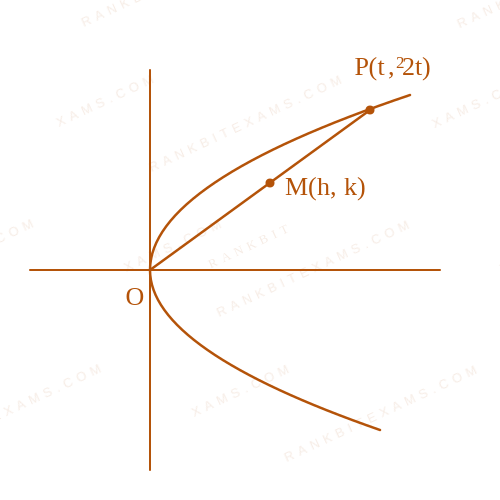
Q17 jee_main_2026_22_january_evening Locus of Midpoint of Chord
Let the locus of the mid-point of the chord through the origin O of the parabola y² = 4x be the curve S. Let P be any point on S. Then the locus of the point, which internally divides OP in the ratio 3:1, is:
  • A. 3y² = 2x
  • B. 2y² = 3x
  • C. 3x² = 2y
  • D. 2x² = 3y

Solution

Related Formula

Section formula for internal division in ratio m:n:

R(h,k) = ( (m x₂ + n x₁)/(m+n), (m y₂ + n y₁)/(m+n) )
Core Logic

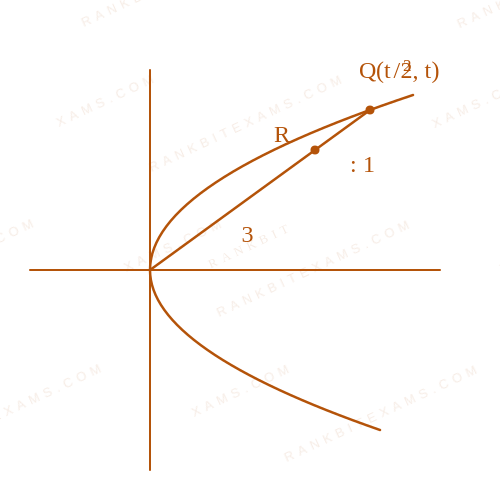
Locus of midpoint diagram for Q17 - JEE Main 2026 Evening

Let chord endpoint be Q(t², 2t). Midpoint M(h,k) of OQ:

h = (t²)/(2), k = t k² = 2h

So curve S is y² = 2x.

Now P lies on S: y² = 2x, so P = ((t²)/(2), t). Point R(h,k) divides OP in ratio 3:1:

Step 1: Section Formula Application

Locus of midpoint diagram for Q17 - JEE Main 2026 Evening

h = (3(t²/2) + 0)/(4) = (3t²)/(8), k = (3(t) + 0)/(4) = (3t)/(4)

From k = (3t)/(4) t = (4k)/(3). Substitute into h:

h = (3)/(8) ((4k)/(3))² = (3)/(8) · (16k²)/(9) = (2k²)/(3) 2k² = 3h 2y² = 3x
Pattern Recognition

Parametrize midpoint curve S, then re-apply section ratio to derive final locus equation.

Chapter Mix

Class 11 Maths: Conic Sections

Q1 jee_main_2026_23_january_morning Hyperbola
Let the domain of the function f(x) = ₃ ₅ ₇(9x - x² - 13) be the interval (m, n). Let the hyperbola (x²)/(a²) - (y²)/(b²) = 1 have eccentricity (n)/(3) and the length of the latus rectum (8m)/(3). Then b² - a² is equal to:
  • A. 5
  • B. 11
  • C. 9
  • D. 7

Solution

Related Formula
e = √(1 + (b²)/(a²)) L.R. = (2b²)/(a)
Core Logic

For the domain of the given logarithmic function, the argument of the innermost logarithm must be strictly greater than 1 because of the nested logs:

₅( ₇(9x-x²-13))>0 ⇒ ₇(9x-x²-13) > 1 ⇒ 9x-x²-13 > 7 ⇒ x²-9x+20 < 0 ⇒ (x-4)(x-5) < 0

Thus, 4 < x < 5. Therefore, the domain interval is (4, 5), yielding m = 4 and n = 5.

Step 1: Hyperbola Properties

Given eccentricity e = (n)/(3) = (5)/(3):

e = √(1 + (b²)/(a²)) = (5)/(3) ⇒ (b²)/(a²) = (25)/(9) - 1 = (16)/(9) ⇒ (b)/(a) = (4)/(3)

Given the length of the latus rectum is (8m)/(3):

(2b²)/(a) = (8(4))/(3) = (32)/(3) ⇒ 2b((b)/(a)) = (32)/(3) ⇒ 2b((4)/(3)) = (32)/(3) ⇒ 8b = 32 ⇒ b = 4

Since (b)/(a) = (4)/(3), we get a = 3.

Step 2: Final Calculation

We need to find b² - a²:

b² - a² = (4)² - (3)² = 16 - 9 = 7
Pattern Recognition

Nested logarithmic domains require unpacking from the outside in: ₐ(X) > 0 ⇒ X > 1. Linking function domains to coordinate geometry parameters is a standard JEE cross-topic pattern.

Chapter Mix

Class 11 Maths: Conic Sections Class 11 Maths: Relations and Functions
Q5 jee_main_2026_23_january_morning Ellipse
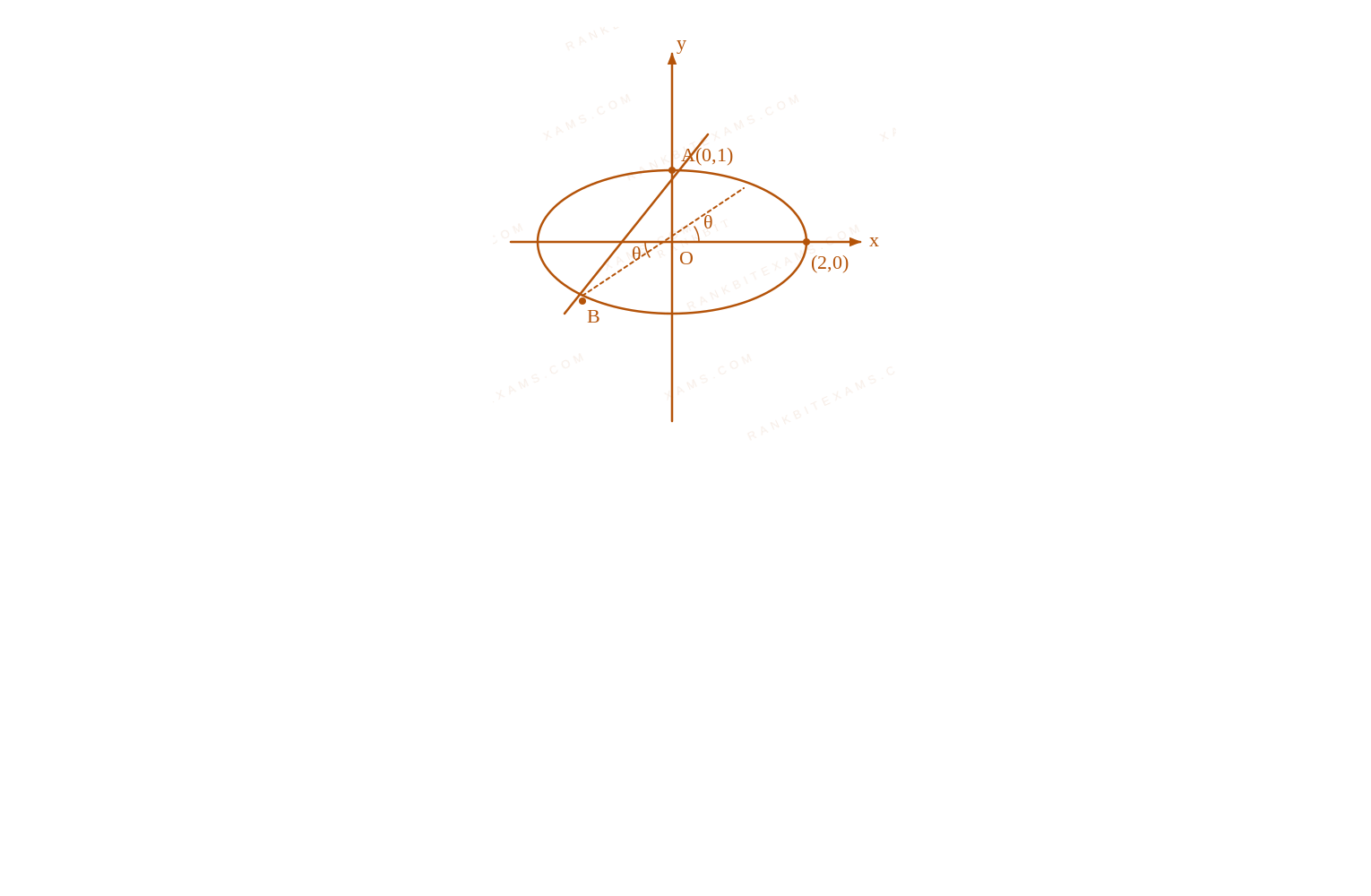
Let the line y - x = 1 intersect the ellipse (x²)/(2) + (y²)/(1) = 1 at the points A and B. Then the angle made by the line segment AB at the center of the ellipse is:
  • A. π - ⁻¹((1)/(4))
  • B. (π)/(2) + ⁻¹((1)/(4))
  • C. (π)/(2) + 2 ⁻¹((1)/(4))
  • D. (π)/(2) - ⁻¹((1)/(4))

Solution

Related Formula
θ = | (m₁ - m₂)/(1 + m₁ m₂) |
Core Logic

Find the intersection points of the line y = x + 1 and the ellipse (x²)/(2) + y² = 1.

Ellipse diagram for Q5 - JEE Main 2026 Morning
Substitute y = x + 1 into the ellipse equation:

(x²)/(2) + (x + 1)² = 1 x² + 2(x² + 2x + 1) = 2 3x² + 4x = 0 ⇒ x(3x + 4) = 0

This gives x = 0 or x = -(4)/(3).

Step 1: Calculate Intersection Points

For x = 0, y = 1 ⇒ A(0, 1). For x = -(4)/(3), y = -(4)/(3) + 1 = -(1)/(3) ⇒ B(-(4)/(3), -(1)/(3)).

Ellipse diagram for Q5 - JEE Main 2026 Morning

Step 2: Find Angle at the Origin

Let O(0,0) be the center of the ellipse. The angle made by segment AB at O is ∠ AOB. The slope of OA is m₁ = (1 - 0)/(0 - 0) = ∞ (which means OA is along the y-axis, angle is π/2). The slope of OB is m₂ = (-1/3 - 0)/(-4/3 - 0) = (1)/(4). The angle of OB with the positive x-axis is θ = ⁻¹((1)/(4)). The total angle ∠ AOB is (π)/(2) + θ = (π)/(2) + ⁻¹((1)/(4)).

Pattern Recognition

When solving line-conic intersection, explicit extraction of points (A, B) is often simpler than using homogenization if the intersection yields simple rational or integer coordinates.

Chapter Mix

Class 11 Maths: Conic Sections Class 11 Maths: Straight Lines

Rankbit System
JEE Physics: Waves (+15.5%) | Electrostatics: Concentric Shells (-29.7%) | Modern Physics: Photoelectric Clones (+34.2%) | Mathematics: Definite Integrals (+18.1%) | Chemistry: Coordination Splitting (-11.4%) | JEE Physics: Waves (+15.5%) | Electrostatics: Concentric Shells (-29.7%) | Modern Physics: Photoelectric Clones (+34.2%) | Mathematics: Definite Integrals (+18.1%) | Chemistry: Coordination Splitting (-11.4%)