The correct option with order of melting points of the pairs (Mn, Fe), (Tc, Ru) and (Re, Os) is :
A.Fe < Mn$\mathrm{Fe} < \mathrm{Mn}$ , Ru < Tc$\mathrm{Ru} < \mathrm{Tc}$ and Re < Os$\mathrm{Re} < \mathrm{Os}$
B.Mn < Fe, Tc < Ru$\mathrm{Mn} < \mathrm{Fe}, \mathrm{Tc} < \mathrm{Ru}$ and Re < Os$\mathrm{Re} < \mathrm{Os}$
C.Mn < Fe, Tc < Ru$\mathrm{Mn} < \mathrm{Fe}, \mathrm{Tc} < \mathrm{Ru}$ and Os < Re$\mathrm{Os} < \mathrm{Re}$
D.Fe < Mn$\mathrm{Fe} < \mathrm{Mn}$ , Ru < Tc$\mathrm{Ru} < \mathrm{Tc}$ and Os < Re$\mathrm{Os} < \mathrm{Re}$
Solution & Explanation
Formulas Used
Melting point trends in 3d$3d$, 4d$4d$, and 5d$5d$ series transition metals depend on the extent of metallic bonding and d$d$-electron participation.
Core Logic
According to NCERT transition element periodic trends:
3d$3d$ Series (Mn$\mathrm{Mn}$ vs Fe$\mathrm{Fe}$): Manganese (Mn$\mathrm{Mn}$, 3d⁵ 4s²$3d^5 4s^2$) has an abnormally low melting point compared to Iron (Fe$\mathrm{Fe}$, 3d⁶ 4s²$3d^6 4s^2$) because its stable, half-filled d⁵$d^5$ configuration holds d$d$-electrons more tightly, reducing their participation in metallic bonding arrow Mn < Fe$\rightarrow \mathbf{\mathrm{Mn} < \mathrm{Fe}}$.
4d$4d$ Series (Tc$\mathrm{Tc}$ vs Ru$\mathrm{Ru}$): Technetium (Tc$\mathrm{Tc}$, 4d⁵ 5s²$4d^5 5s^2$) similarly shows a dip in melting point compared to Ruthenium (Ru$\mathrm{Ru}$, 4d⁷ 5s¹$4d^7 5s^1$) due to the stable 4d⁵$4d^5$ configuration arrow Tc < Ru$\rightarrow \mathbf{\mathrm{Tc} < \mathrm{Ru}}$.
5d$5d$ Series (Re$\mathrm{Re}$ vs Os$\mathrm{Os}$): Rhenium (Re$\mathrm{Re}$, 5d⁵ 6s²$5d^5 6s^2$) has optimal interatomic interaction and a higher melting point than Osmium (Os$\mathrm{Os}$, 5d⁶ 6s²$5d^6 6s^2$) arrow Os < Re$\rightarrow \mathbf{\mathrm{Os} < \mathrm{Re}}$.
Combining these trends yields: Mn < Fe$\mathrm{Mn} < \mathrm{Fe}$, Tc < Ru$\mathrm{Tc} < \mathrm{Ru}$, and Os < Re$\mathrm{Os} < \mathrm{Re}$
Pattern Recognition
Stable half-filled d⁵$d^5$ configurations in 3d$3d$ (Mn$\mathrm{Mn}$) and 4d$4d$ (Tc$\mathrm{Tc}$) restrict d$d$-electron delocalization, creating characteristic dips in melting point curves compared to adjacent metals.
Correct Option:(C)
More The d-and f-Block Elements Previous-Year Questions — Page 8
Qjee_main_2024_30_january_eveningCompounds of Transition Elements
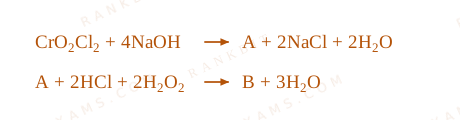
A and B formed in the following reactions are:
Compounds of Transition Elements
A.A = Na₂CrO₄, B = CrO₅$\text{A = Na}_2\text{CrO}_4\text{, B = CrO}_5$
B.A = Na₂Cr₂O₄, B = CrO₄$\text{A = Na}_2\text{Cr}_2\text{O}_4\text{, B = CrO}_4$
C.A = Na₂Cr₂O₇, B = CrO₃$\text{A = Na}_2\text{Cr}_2\text{O}_7\text{, B = CrO}_3$
D.A = Na₂Cr₂O₇, B = CrO₅$\text{A = Na}_2\text{Cr}_2\text{O}_7\text{, B = CrO}_5$
Solution
Core Logic
Step 1: Chromyl chloride (CrO₂Cl₂$CrO_2Cl_2$) reacts with an alkali like NaOH$NaOH$ to give a yellow solution of sodium chromate (Na₂CrO₄$Na_2CrO_4$).
Step 2: Sodium chromate (Na₂CrO₄$Na_2CrO_4$) reacts with hydrogen peroxide (H₂O₂$H_2O_2$) in an acidic medium (HCl$HCl$) to yield the deep blue colored chromium pentoxide (CrO₅$CrO_5$, also known as chromium(VI) oxide peroxide).
Note: NaCl$NaCl$ formation implies the overall balanced reaction uses the acid for neutralization/salt formation.
Pattern Recognition
Chromyl chloride test intermediate: Yellow solution = Na₂CrO₄$Na_2CrO_4$.
Reaction of chromate with H₂O₂$H_2O_2$ in acid = Blue peroxide CrO₅$CrO_5$ (butterfly structure).
Chapter Mix
Class 12 Chemistry: The d and f Block Elements
Class 11 Chemistry: Redox Reactions
Q70jee_main_2024_30_january_eveningProperties of Transition Metal Compounds
The orange colour of K₂Cr₂O₇$K_2Cr_2O_7$ and purple colour of KMnO₄$KMnO_4$ is due to
B.d arrow d transition in KMnO₄ and charge transfer transitions in K₂Cr₂O₇$\text{d} \rightarrow \text{d transition in KMnO}_4 \text{ and charge transfer transitions in K}_2\text{Cr}_2\text{O}_7$
C.d arrow d transition in K₂Cr₂O₇ and charge transfer transitions in KMnO₄.$\text{d} \rightarrow \text{d transition in K}_2\text{Cr}_2\text{O}_7 \text{ and charge transfer transitions in KMnO}_4.$
D.d arrow d transition in both.$\text{d} \rightarrow \text{d transition in both.}$
Solution
Core Logic
In K₂Cr₂O₇$K_2Cr_2O_7$, Chromium is in the +6$+6$ oxidation state, which means its electronic configuration is d⁰$d^0$. Since there are no d-electrons, d-d$d-d$ transitions cannot occur. The orange color is due to ligand-to-metal charge transfer (LMCT) from oxygen to chromium.
Similarly, in KMnO₄$KMnO_4$, Manganese is in the +7$+7$ oxidation state, which also corresponds to a d⁰$d^0$ configuration. Again, no d-d$d-d$ transitions are possible. The intense purple color is due to ligand-to-metal charge transfer (LMCT) from oxygen to manganese.
Step 1: Final Conclusion
Both compounds owe their colors to charge transfer transitions.
Pattern Recognition
Compounds of transition metals in their highest oxidation states (where they have d⁰$d^0$ configurations, like Cr⁺⁶$Cr^{+6}$, Mn⁺⁷$Mn^{+7}$, V⁺⁵$V^{+5}$) are deeply colored primarily due to Charge Transfer spectra, NOT d-d transitions.
Chapter Mix
Class 12 Chemistry: The d and f Block Elements
Q71jee_main_2024_30_january_eveningPreparation and Properties of KMnO4
Alkaline oxidative fusion of MnO₂$MnO_2$ gives "A" which on electrolytic oxidation in alkaline solution produces B. A and B respectively are:
A.Mn₂O₇ and MnO₄^-$\text{Mn}_2\text{O}_7 \text{ and MnO}_4^-$
B.MnO₄²⁻ and MnO₄^-$\text{MnO}_4^{2-} \text{ and MnO}_4^-$
C.Mn₂O₃ and MnO₄²⁻$\text{Mn}_2\text{O}_3 \text{ and MnO}_4^{2-}$
D.MnO₄²⁻ and Mn₂O₇$\text{MnO}_4^{2-} \text{ and Mn}_2\text{O}_7$
Solution
Core Logic
Step 1: Alkaline oxidative fusion of MnO₂$MnO_2$ (pyrolusite ore) with KOH$KOH$ in the presence of O₂$O_2$ (or an oxidizing agent like KNO₃$KNO_3$) yields the green-colored manganate ion (MnO₄²⁻$MnO_4^{2-}$).
Step 2: Electrolytic oxidation of the manganate ion (MnO₄²⁻$MnO_4^{2-}$) in an alkaline medium converts it to the purple-colored permanganate ion (MnO₄^-$MnO_4^-$).
An ion is diamagnetic if all its electrons are paired (i.e., zero unpaired electrons).
Let's write the electronic configuration for the elements in question.
Ions with an empty f-subshell (f⁰$f^0$, e.g., La³⁺, Ce⁴⁺$La^{3+}, Ce^{4+}$) or a completely filled f-subshell (f¹⁴$f^{14}$, e.g., Lu³⁺, Yb²⁺$Lu^{3+}, Yb^{2+}$) are invariably diamagnetic.
Chapter Mix
Class 12 Chemistry: The d- and f-Block Elements
Q76jee_main_2024_30_jan_morningTransition Elements
Let's determine the electronic configuration for each species by first writing the neutral atom's configuration, and then removing electrons starting from the outermost 4s$4s$ orbital.
Practice past-year questions one chapter at a time. Pick an exam → subject → chapter and get every PYQ for that topic — pulled together from all past papers — with the chapter's key formulas alongside.