The molar mass of the water insoluble product formed from the fusion of chromite ore mathrm(FeCr_2O_4)$\mathrm{(FeCr_2O_4)}$ with mathrmNa_2mathrmCO_3$\mathrm{Na}_2\mathrm{CO}_3$ in presence of mathrmO_2$\mathrm{O}_2$ is ________ mathrmg \, mol^-1$\mathrm{g \, mol^{-1}}$.
Numerical Answer Type:
Enter a numerical valueAnswer: 160 to 160+4 marks
Solution & Explanation
### Related Formula
textBalanced fusion reaction process description$$\text{Balanced fusion reaction process description}$$
### Core Logic
Write the balanced chemical equation for the industrial preparation stage of chromate salts:
4mathrmFeCr_2O_4 + 8mathrmNa_2CO_3 + 7mathrmO_2 rightarrow 8mathrmNa_2CrO_4 + 2mathrmFe_2O_3 + 8mathrmCO_2$$4\mathrm{FeCr_2O_4} + 8\mathrm{Na_2CO_3} + 7\mathrm{O_2} \rightarrow 8\mathrm{Na_2CrO_4} + 2\mathrm{Fe_2O_3} + 8\mathrm{CO_2}$$
Evaluating the solubilities of the products:
* mathrmNa_2CrO_4$\mathrm{Na_2CrO_4}$ is highly soluble in water.
* mathrmFe_2O_3$\mathrm{Fe_2O_3}$ (Iron(III) oxide) is water-insoluble.
Molar Mass of mathrmFe_2O_3$\mathrm{Fe_2O_3}$:
M = (2 cdot 55.85) + (3 cdot 16.0) simeq (2 cdot 56) + (3 cdot 16) = 112 + 48 = 160 mathrm~g/mol$$M = (2 \cdot 55.85) + (3 \cdot 16.0) \simeq (2 \cdot 56) + (3 \cdot 16) = 112 + 48 = 160 \mathrm{~g/mol}$$
### Pattern Recognition
Transition metal oxides in high oxidation states with minimal ionic breakdown parameters reliably act as insoluble precipitates in water.
### Chapter Mix
Class 12 Chemistry: The d-and f-Block Elements
More The d-and f-Block Elements Previous-Year Questions — Page 6
### Core Logic
The noble gas configuration of Xenon (Z=54$Z=54$) provides the primary core layout. For Neodymium (Z=60$Z=60$), the 6 remaining valence electrons distribute into the inner 4textf$4\text{f}$ orbital subshell rather than filling the 5textd$5\text{d}$ subshell due to shielding effects. This results in an absolute atomic ground state electronic configuration of text[Xe] 4textf^4 6texts^2$\text{[Xe]} 4\text{f}^4 6\text{s}^2$.
### Pattern Recognition
Lanthanide filling sequences generally bypass 5d$5d$ progression except for specific exceptions (La, Gd, Lu).
### Chapter Mix
Class 12 Chemistry: d-and f-Block Elements
Q63jee_main_2024_29_jan_morningPotassium Dichromate and Chromyl Chloride Test
In chromyl chloride test for confirmation of Cl^-$Cl^-$ ion, a yellow solution is obtained. Acidification of the solution and addition of amyl alcohol and 10\%$10\%$H_2O_2$H_2O_2$ turns organic layer blue indicating formation of chromium pentoxide. The oxidation state of chromium in that is
A.+6$+6$
B.+5$+5$
C.+10$+10$
D.+3$+3$
Solution
### Core Logic
The reaction sequence for the chromyl chloride test is:
Cl^- + K_2Cr_2O_7 + H_2SO_4 rightarrow CrO_2Cl_2$$Cl^- + K_2Cr_2O_7 + H_2SO_4 \rightarrow CrO_2Cl_2$$
The chromyl chloride gas is then passed through a basic medium (like NaOH$NaOH$) to form a yellow solution of chromate ions:
CrO_2Cl_2 xrightarrowtextBasic medium CrO_4^2- + Cl^-$$CrO_2Cl_2 \xrightarrow{\text{Basic medium}} CrO_4^{2-} + Cl^-$$
Acidification of the yellow CrO_4^2-$CrO_4^{2-}$ solution followed by the addition of H_2O_2$H_2O_2$ and amyl alcohol yields a blue-colored organic layer due to the formation of chromium pentoxide (CrO_5$CrO_5$).
CrO_4^2- xrightarrow[textyellow solution,
1. textAcidification CrO_5 text (blue compound)$$CrO_4^{2-} \xrightarrow[\text{yellow solution},
{1. \text{Acidification}} CrO_5 \text{ (blue compound)}$$
### Step 1: Oxidation State Calculation
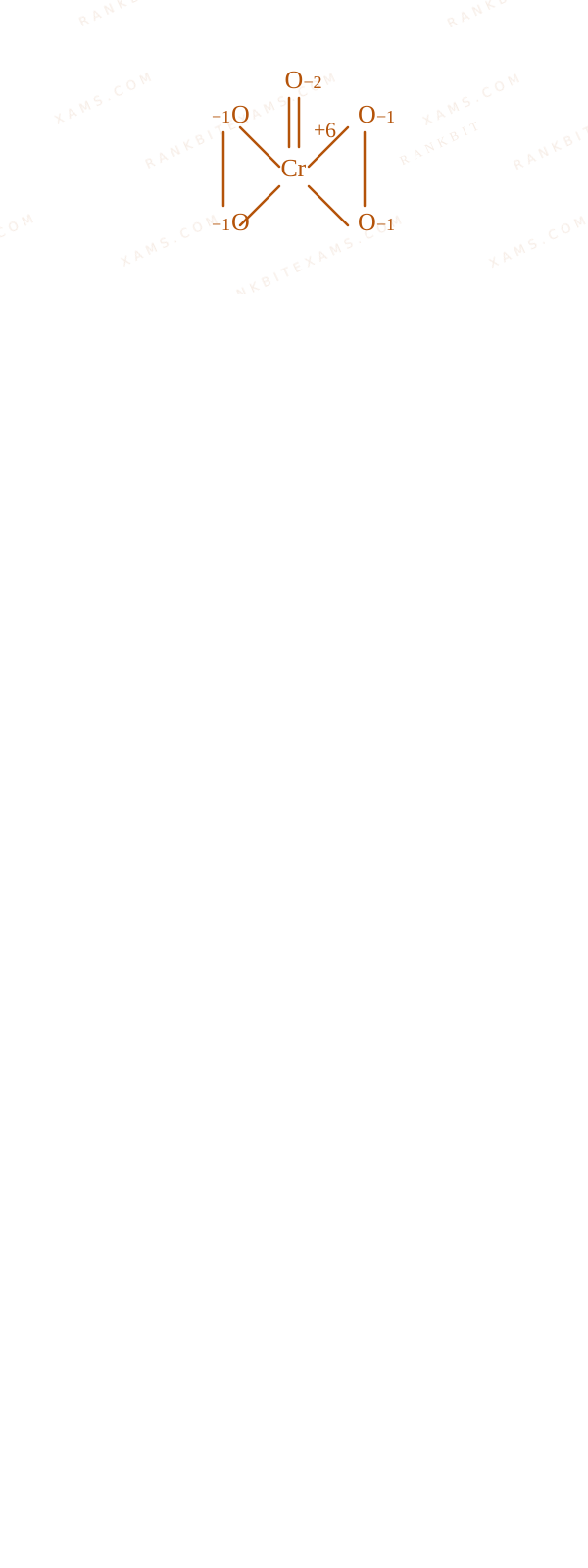
Potassium Dichromate and Chromyl Chloride Test diagram for Q63 - JEE Main 2024 Morning
The structure of chromium pentoxide (CrO_5$CrO_5$) features a distinctive "butterfly" arrangement. It contains one double-bonded oxide oxygen (O^2-$O^{2-}$) and four peroxide oxygens (O_2^2-$O_2^{2-}$). Therefore, there are 2 peroxo linkages.
Let the oxidation state of Chromium be x$x$.
x + 1(-2) + 4(-1) = 0$$x + 1(-2) + 4(-1) = 0$$x - 2 - 4 = 0$x - 2 - 4 = 0$x = +6$x = +6$
Thus, the oxidation state of Cr in CrO_5$CrO_5$ is +6$+6$.
### Pattern Recognition
A classic oxidation state trap. Calculating simply via formula CrO_5$CrO_5$ yields x - 10 = 0 implies x = +10$x - 10 = 0 \implies x = +10$, which is impossible for Chromium (max +6). Whenever calculation exceeds the maximum group valency, peroxide bonds are present.
### Evaluation Rubric / Model Answer
null
### Chapter Mix
Class 12 Chemistry: d and f Block Elements
Class 11 Chemistry: Redox Reactions
### Core Logic
Potassium permanganate (KMnO_4$KMnO_4$) is a strong oxidizing agent. When heated to 513mathrmK$513\mathrm{K}$, it undergoes thermal decomposition to give potassium manganate (K_2MnO_4$K_2MnO_4$), manganese dioxide (MnO_2$MnO_2$), and oxygen gas (O_2$O_2$).
The balanced chemical equation is:
2KMnO_4 xrightarrowDelta K_2MnO_4 + MnO_2 + O_2$$2KMnO_4 \xrightarrow{\Delta} K_2MnO_4 + MnO_2 + O_2$$
### Step 1: Final Identification
The products formed along with O_2$O_2$ are K_2MnO_4$K_2MnO_4$ (green) and MnO_2$MnO_2$ (black).
### Evaluation Rubric / Model Answer
null
### Chapter Mix
Class 12 Chemistry: d and f Block Elements
In alkaline medium. MnO_4^-$MnO_4^-$ oxidises I^-$I^-$ to
A.IO_4^-$IO_4^-$
B.IO^-$IO^-$
C.I_2$I_2$
D.IO_3^-$IO_3^-$
Solution
### Core Logic
The behavior of the permanganate ion (MnO_4^-$MnO_4^-$) varies with the pH of the medium.
In a faintly alkaline or neutral medium, MnO_4^-$MnO_4^-$ oxidizes iodide (I^-$I^-$) completely to iodate (IO_3^-$IO_3^-$) while getting reduced to manganese dioxide (MnO_2$MnO_2$).
The balanced ionic equation is:
2MnO_4^- + H_2O + I^- rightarrow 2MnO_2 + 2OH^- + IO_3^-$$2MnO_4^- + H_2O + I^- \rightarrow 2MnO_2 + 2OH^- + IO_3^-$$
### Pattern Recognition
Rule of thumb for I^-$I^-$ oxidation by KMnO_4$KMnO_4$:
In acidic medium: I^- rightarrow I_2$I^- \rightarrow I_2$
In alkaline/neutral medium: I^- rightarrow IO_3^-$I^- \rightarrow IO_3^-$
### Evaluation Rubric / Model Answer
null
### Chapter Mix
Class 12 Chemistry: d and f Block Elements
Q70jee_main_2024_30_january_eveningProperties of Transition Metal Compounds
The orange colour of K_2Cr_2O_7$K_2Cr_2O_7$ and purple colour of KMnO_4$KMnO_4$ is due to
B.textd rightarrow textd transition in KMnO_4 text and charge transfer transitions in K_2textCr_2textO_7$\text{d} \rightarrow \text{d transition in KMnO}_4 \text{ and charge transfer transitions in K}_2\text{Cr}_2\text{O}_7$
C.textd rightarrow textd transition in K_2textCr_2textO_7 text and charge transfer transitions in KMnO_4.$\text{d} \rightarrow \text{d transition in K}_2\text{Cr}_2\text{O}_7 \text{ and charge transfer transitions in KMnO}_4.$
D.textd rightarrow textd transition in both.$\text{d} \rightarrow \text{d transition in both.}$
Solution
### Core Logic
In K_2Cr_2O_7$K_2Cr_2O_7$, Chromium is in the +6$+6$ oxidation state, which means its electronic configuration is d^0$d^0$. Since there are no d-electrons, d-d$d-d$ transitions cannot occur. The orange color is due to ligand-to-metal charge transfer (LMCT) from oxygen to chromium.
Similarly, in KMnO_4$KMnO_4$, Manganese is in the +7$+7$ oxidation state, which also corresponds to a d^0$d^0$ configuration. Again, no d-d$d-d$ transitions are possible. The intense purple color is due to ligand-to-metal charge transfer (LMCT) from oxygen to manganese.
### Step 1: Final Conclusion
Both compounds owe their colors to charge transfer transitions.
### Pattern Recognition
Compounds of transition metals in their highest oxidation states (where they have d^0$d^0$ configurations, like Cr^+6$Cr^{+6}$, Mn^+7$Mn^{+7}$, V^+5$V^{+5}$) are deeply colored primarily due to Charge Transfer spectra, NOT d-d transitions.
### Evaluation Rubric / Model Answer
null
### Chapter Mix
Class 12 Chemistry: The d and f Block Elements
We Map Every Repeating Question in Competitive Exams.
Say goodbye to generic mock test fatigue. RankBit uses smart analysis to group past exam questions into their foundational Repeating Question Types. Find chapter weightage, track repeating questions, and score higher with targeted practice.
Select Your Target Exam
Choose an exam track below to find formulas per chapter and patterns.
Syncing Exam Intelligence
Mapping formulas and patterns across all tracks…
PATH A — FULL LENGTH PRACTICE
Full Mock Test Hub
Simulate real NTA exam conditions with fully tracked mocks. Time yourself against past papers.
Practice past-year questions one chapter at a time. Pick an exam → subject → chapter and get every PYQ for that topic — pulled together from all past papers — with the chapter's key formulas alongside.