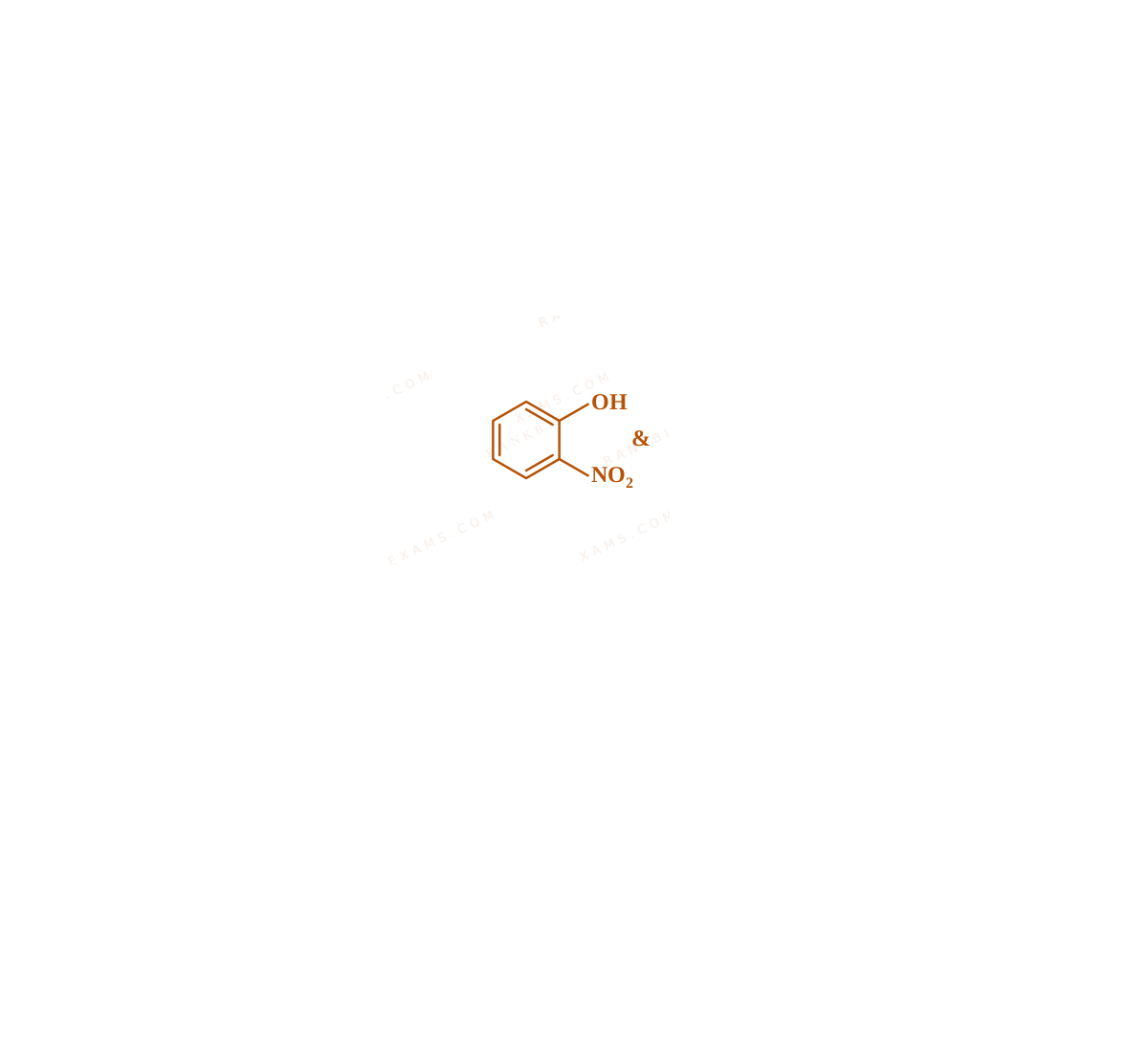
The steam volatile compounds among the following are:
Choose the correct answer from the options given below:
Four different disubstituted benzene structures are indexed to show spatial isomer distributions.
A.(B) and (D) only
B.(A) and (C) only
C.(A) and (B) only
D.(A), (B) and (C) only
Solution & Explanation
### Related Formula
textIntramolecular H-bonding implies textLower boiling point implies textSteam Volatile$$\text{Intramolecular H-bonding} \implies \text{Lower boiling point} \implies \text{Steam Volatile}$$
### Core Logic
Purification via steam distillation requires a high relative vapor pressure at the boiling point of water. Let us assess the isomers :
* (A) o-Nitrophenol contains an -mathrmOH$-\mathrm{OH}$ group right next to an -mathrmNO_2$-\mathrm{NO}_2$ group, allowing for strong intramolecular hydrogen bonding. This minimizes external interactions, lowering the boiling point and making it steam volatile .
* (B) o-Nitroaniline similarly stabilizes itself via internal intramolecular hydrogen bonding between the amine and nitro components, making it steam volatile .
* (C) & (D) The para isomers form extensive intermolecular networks with neighboring molecules, which significantly elevates their boiling points and prevents steam volatility .
Four different disubstituted benzene structures are indexed to show spatial isomer distributions.Four different disubstituted benzene structures are indexed to show spatial isomer distributions.
Hence, compounds (A) and (B) are steam volatile, matching option (3).
### Pattern Recognition
ortho-substituted functional networks form self-contained internal loops through hydrogen bonding, preventing external pairing and maximizing volatility.
### Evaluation Rubric / Model Answer
null
### Chapter Mix
Class 11 Chemistry: Organic Chemistry - Some Basic Principles and Techniques
Class 11 Chemistry: Chemical Bonding and Molecular Structure
Four different disubstituted benzene structures are indexed to show spatial isomer distributions.
'Adsorption' principle is used for which of the following purification method?
A.textExtraction$\text{Extraction}$
B.textChromatography$\text{Chromatography}$
C.textDistillation$\text{Distillation}$
D.textSublimation$\text{Sublimation}$
Solution
### Core Logic
The fundamental principle used in chromatography (such as column chromatography or thin-layer chromatography) is adsorption. Different components of a mixture are adsorbed to different extents on an adsorbent stationary phase.
### Evaluation Rubric / Model Answer
null
### Chapter Mix
Class 11 Chemistry: Organic Chemistry - Some Basic Principles and Techniques
### Core Logic
(A) Simple distillation is used to separate a mixture of miscible liquids with a sufficiently large difference in their boiling points, such as chloroform and aniline. (A rightarrow$\rightarrow$ IV)
(B) Fractional distillation is used to separate crude oil fractions. (B rightarrow$\rightarrow$ III)
(C) Steam distillation is used to separate steam-volatile substances that are immiscible with water, like an aniline-water mixture. (C rightarrow$\rightarrow$ II)
(D) Distillation under reduced pressure is used for liquids that decompose at or below their normal boiling points, like separating glycerol from spent lye. (D rightarrow$\rightarrow$ I)
### Evaluation Rubric / Model Answer
null
### Chapter Mix
Class 11 Chemistry: Organic Chemistry - Some Basic Principles and Techniques
We Map Every Repeating Question in Competitive Exams.
Say goodbye to generic mock test fatigue. RankBit uses smart analysis to group past exam questions into their foundational Repeating Question Types. Find chapter weightage, track repeating questions, and score higher with targeted practice.
Select Your Target Exam
Choose an exam track below to find formulas per chapter and patterns.
Syncing Exam Intelligence
Mapping formulas and patterns across all tracks…
PATH A — FULL LENGTH PRACTICE
Full Mock Test Hub
Simulate real NTA exam conditions with fully tracked mocks. Time yourself against past papers.
Practice past-year questions one chapter at a time. Pick an exam → subject → chapter and get every PYQ for that topic — pulled together from all past papers — with the chapter's key formulas alongside.
.svg "Intramolecular Hydrogen Bonding, Steam Volatility, Purification Patterns")