### Related Formula
E_textcell = E_textcell^circ - fracRTnF ln Q$$E_{\text{cell}} = E_{\text{cell}}^{\circ} - \frac{RT}{nF} \ln Q$$
### Core Logic
Let us explicitly formulate the complete chemical oxidation-reduction equations :
Anode oxidation: mathrmMg_(s) rightarrow mathrmMg^2+_(aq) + 2e^-$\mathrm{Mg}_{(s)} \rightarrow \mathrm{Mg}^{2+}_{(aq)} + 2e^-$
Cathode reduction: 2mathrmAg^+_(aq) + 2e^- rightarrow 2mathrmAg_(s)$2\mathrm{Ag}^{+}_{(aq)} + 2e^- \rightarrow 2\mathrm{Ag}_{(s)}$
Net total equation :
mathrmMg_(s) + 2mathrmAg^+_(aq) rightleftharpoons mathrmMg^2+_(aq) + 2mathrmAg_(s)$$\mathrm{Mg}_{(s)} + 2\mathrm{Ag}^{+}_{(aq)} \rightleftharpoons \mathrm{Mg}^{2+}_{(aq)} + 2\mathrm{Ag}_{(s)}$$
Total transferred moles of electrons n = 2$n = 2$ .
Reaction quotient :
Q = frac[mathrmMg^2+][mathrmAg^+]^2$$Q = \frac{[\mathrm{Mg}^{2+}]}{[\mathrm{Ag}^{+}]^2}$$
Substituting into Nernst form :
E_textcell = E_textcell^circ - fracRT2F lnleft( frac[mathrmMg^2+][mathrmAg^+]^2 right)$$E_{\text{cell}} = E_{\text{cell}}^{\circ} - \frac{RT}{2F} \ln\left( \frac{[\mathrm{Mg}^{2+}]}{[\mathrm{Ag}^{+}]^2} \right)$$
Inverting the inside quotient changes the sign of the logarithm term from negative to positive:
E_textcell = E_textcell^circ + fracRT2F lnleft( frac[mathrmAg^+]^2[mathrmMg^2+] right)$$E_{\text{cell}} = E_{\text{cell}}^{\circ} + \frac{RT}{2F} \ln\left( \frac{[\mathrm{Ag}^{+}]^2}{[\mathrm{Mg}^{2+}]} \right)$$
### Pattern Recognition
A standard negative logarithmic quotient can always toggle into an addition configuration by inverting the products/reactants variables concentration ratio.
More Electrochemistry Previous-Year Questions — Page 2
Q35jee_main_2025_07_april_morningKohlrausch's Law
Given below are two statements:
Statement I: Mohr's salt is composed of only three types of ions-ferrous, ammonium and sulphate.
Statement II: If the molar conductance at infinite dilution of ferrous, ammonium and sulphate ions are mathbfx_1$\mathbf{x}_1$, mathbfx_2$\mathbf{x}_2$ and mathbfx_3$\mathbf{x}_3$mathrmS\ cm^2\ mathrmmol^-1$\mathrm{S\ cm}^2\ \mathrm{mol}^{-1}$, respectively then the molar conductance for Mohr's salt solution at infinite dilution would be given by mathbfx_1 + mathbfx_2 + 2mathbfx_3$\mathbf{x}_1 + \mathbf{x}_2 + 2\mathbf{x}_3$.
In the light of the given statements, choose the correct answer from the options given below:
A.textBoth Statement I and Statement II are false$\text{Both Statement I and Statement II are false}$
B.textStatement I is false but Statement II is true$\text{Statement I is false but Statement II is true}$
C.textStatement I is true but Statement II is false$\text{Statement I is true but Statement II is false}$
D.textBoth Statement I and Statement II are true$\text{Both Statement I and Statement II are true}$
Solution
### Related Formula
lambda_m^infty = nu_+ lambda_+^infty + nu_- lambda_-^infty$$\lambda_m^{\infty} = \nu_+ \lambda_+^{\infty} + \nu_- \lambda_-^{\infty}$$
### Core Logic
Statement I: Mohr's salt is a double salt with chemical formula:
mathrmFeSO_4 cdot (NH_4)_2SO_4 cdot 6H_2O$$\mathrm{FeSO_4 \cdot (NH_4)_2SO_4 \cdot 6H_2O}$$
When dissolved in water, it completely dissociates into three distinct ionic species:
mathrmFe^2+ text (ferrous), quad mathrmNH_4^+ text (ammonium), quad textand mathrmSO_4^2- text (sulphate)$$\mathrm{Fe}^{2+} \text{ (ferrous)}, \quad \mathrm{NH}_4^+ \text{ (ammonium)}, \quad \text{and } \mathrm{SO}_4^{2-} \text{ (sulphate)}$$
Thus, Statement I is true.
Statement II: According to Kohlrausch's law of independent migration of ions:
lambda_m^infty(textMohr's Salt) = 1 cdot lambda_m^infty(mathrmFe^2+) + 2 cdot lambda_m^infty(mathrmNH_4^+) + 2 cdot lambda_m^infty(mathrmSO_4^2-)$$\lambda_m^{\infty}(\text{Mohr's Salt}) = 1 \cdot \lambda_m^{\infty}(\mathrm{Fe}^{2+}) + 2 \cdot \lambda_m^{\infty}(\mathrm{NH}_4^+) + 2 \cdot \lambda_m^{\infty}(\mathrm{SO}_4^{2-})$$lambda_m^infty = x_1 + 2x_2 + 2x_3$$\lambda_m^{\infty} = x_1 + 2x_2 + 2x_3$$
Statement II claims the expression is x_1 + x_2 + 2x_3$x_1 + x_2 + 2x_3$ (missing the coefficient 2$2$ for ammonium). Thus, Statement II is false.
### Pattern Recognition
Kohlrausch's law matches stoichiometric coefficients directly to the ion quantities released. Mohr's salt formula contains (NH_4)_2$(NH_4)_2$, requiring a multiplier of 2$2$ for ammonium ion conductance.
### Evaluation Rubric / Model Answer
null
### Chapter Mix
Class 12 Chemistry: Electrochemistry
Class 12 Chemistry: d- and f-Block Elements
Q48jee_main_2025_07_april_morningNernst Equation
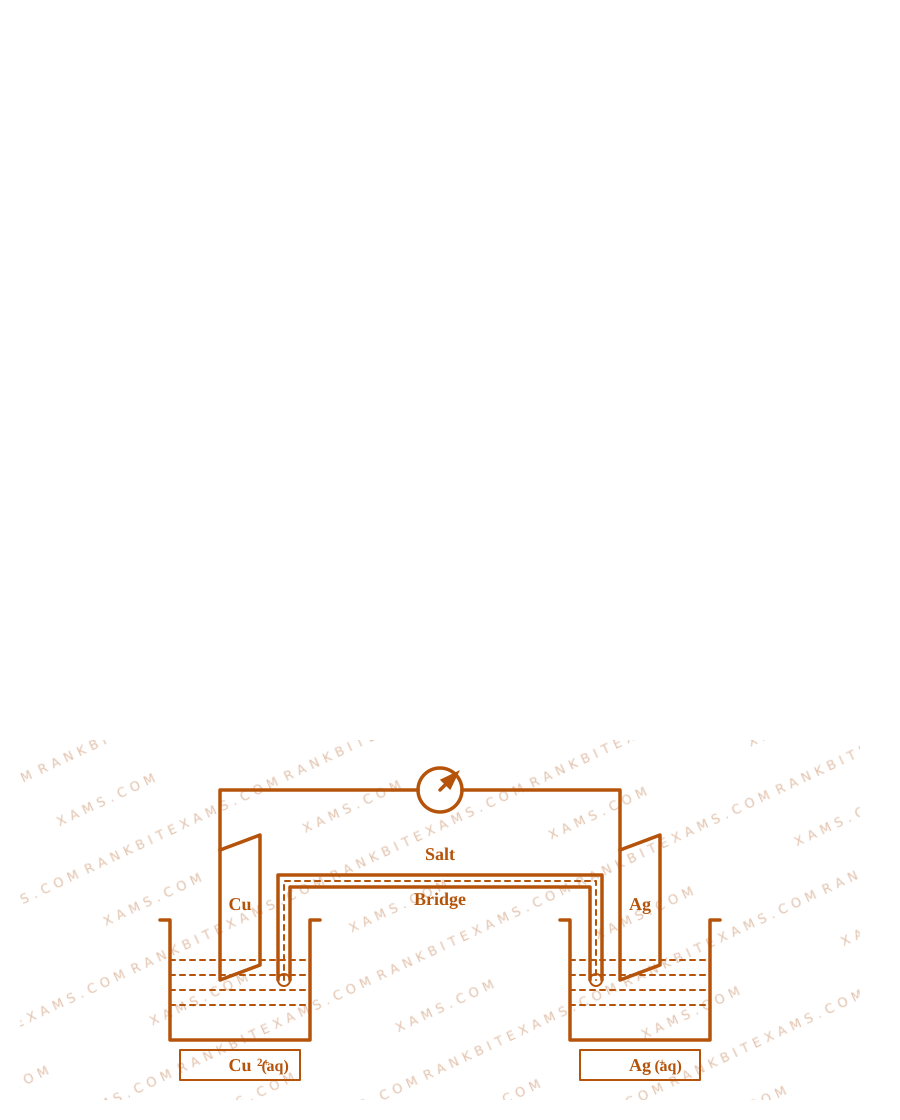
1 Faraday electricity was passed through mathrmCu^2+$\mathrm{Cu}^{2+}$ (1.5 M, 1 L)/Cu and 0.1 Faraday was passed through mathrmAg^+$\mathrm{Ag}^{+}$ (0.2 M, 1 L)/Ag electrolytic cells. After this, the two cells were connected as shown below to make an electrochemical cell. The emf of the cell thus formed at 298 K is ______ V.
The cell assembly combines Cu and Ag half cells after individual initial electrolysis modifications.
Given:
mathrmE_mathrmCu^2+/mathrmCu^circ = 0.34 mathrm~V$\mathrm{E}_{\mathrm{Cu}^{2+}/\mathrm{Cu}}^{\circ} = 0.34 \mathrm{~V}$mathrmE_mathrmAg^+/mathrmAg^circ = 0.8 mathrm~V$\mathrm{E}_{\mathrm{Ag}^{+}/\mathrm{Ag}}^{\circ} = 0.8 \mathrm{~V}$frac2.303RTF = 0.06 mathrm~V$\frac{2.303RT}{F} = 0.06 \mathrm{~V}$
Numerical Answer.Answer: 0.4 to 0.4
Solution
### Related Formula
E_textcell = E^circ_textcell - frac0.06n log Q$$E_{\text{cell}} = E^{\circ}_{\text{cell}} - \frac{0.06}{n} \log Q$$
### Core Logic
First, analyze the electrolysis step to determine final ionic concentrations:
1. **For mathrmCu^2+/mathrmCu$\mathrm{Cu}^{2+}/\mathrm{Cu}$ half-cell**:
- Initial moles of mathrmCu^2+ = 1.5 text M times 1 text L = 1.5 text mol$\mathrm{Cu}^{2+} = 1.5 \text{ M} \times 1 \text{ L} = 1.5 \text{ mol}$.
- Reductive half-reaction: mathrmCu^2+ + 2mathrme^- rightarrow mathrmCu$\mathrm{Cu}^{2+} + 2\mathrm{e}^- \rightarrow \mathrm{Cu}$.
- Passing 1 text Faraday$1 \text{ Faraday}$ converts: frac12 = 0.5 text mol$\frac{1}{2} = 0.5 \text{ mol}$ of mathrmCu^2+$\mathrm{Cu}^{2+}$.
- Remaining moles of mathrmCu^2+ = 1.5 - 0.5 = 1.0 text mol$\mathrm{Cu}^{2+} = 1.5 - 0.5 = 1.0 \text{ mol}$.
- Final concentration [mathrmCu^2+] = 1.0 text M$[\mathrm{Cu}^{2+}] = 1.0 \text{ M}$.
2. **For mathrmAg^+/mathrmAg$\mathrm{Ag}^{+}/\mathrm{Ag}$ half-cell**:
- Initial moles of mathrmAg^+ = 0.2 text M times 1 text L = 0.2 text mol$\mathrm{Ag}^+ = 0.2 \text{ M} \times 1 \text{ L} = 0.2 \text{ mol}$.
- Reductive half-reaction: mathrmAg^+ + mathrme^- rightarrow mathrmAg$\mathrm{Ag}^+ + \mathrm{e}^- \rightarrow \mathrm{Ag}$.
- Passing 0.1 text Faraday$0.1 \text{ Faraday}$ converts: 0.1 text mol$0.1 \text{ mol}$ of mathrmAg^+$\mathrm{Ag}^+$.
- Remaining moles of mathrmAg^+ = 0.2 - 0.1 = 0.1 text mol$\mathrm{Ag}^+ = 0.2 - 0.1 = 0.1 \text{ mol}$.
- Final concentration [mathrmAg^+] = 0.1 text M$[\mathrm{Ag}^+] = 0.1 \text{ M}$.
Now, connect the two components into a galvanic cell:
- Anode reaction: mathrmCu(s) rightarrow mathrmCu^2+mathrm(aq) + 2mathrme^-$\mathrm{Cu(s)} \rightarrow \mathrm{Cu}^{2+}\mathrm{(aq)} + 2\mathrm{e}^-$
- Cathode reaction: 2mathrmAg^+mathrm(aq) + 2mathrme^- rightarrow 2mathrmAg(s)$2\mathrm{Ag}^{+}\mathrm{(aq)} + 2\mathrm{e}^- \rightarrow 2\mathrm{Ag(s)}$
- Net cell reaction: mathrmCu(s) + 2mathrmAg^+mathrm(aq) rightarrow mathrmCu^2+mathrm(aq) + 2mathrmAg(s)$\mathrm{Cu(s)} + 2\mathrm{Ag}^{+}\mathrm{(aq)} \rightarrow \mathrm{Cu}^{2+}\mathrm{(aq)} + 2\mathrm{Ag(s)}$
- n = 2$n = 2$
Calculate standard cell potential:
E^circ_textcell = E^circ_mathrmAg^+/mathrmAg - E^circ_mathrmCu^2+/mathrmCu = 0.80 - 0.34 = 0.46 text V$$E^{\circ}_{\text{cell}} = E^{\circ}_{\mathrm{Ag}^+/\mathrm{Ag}} - E^{\circ}_{\mathrm{Cu}^{2+}/\mathrm{Cu}} = 0.80 - 0.34 = 0.46 \text{ V}$$
Applying Nernst Equation:
E_textcell = E^circ_textcell - frac0.062 log left( frac[mathrmCu^2+][mathrmAg^+]^2 right)$$E_{\text{cell}} = E^{\circ}_{\text{cell}} - \frac{0.06}{2} \log \left( \frac{[\mathrm{Cu}^{2+}]}{[\mathrm{Ag}^+]^2} \right)$$E_textcell = 0.46 - 0.03 log left( frac1(0.1)^2 right) = 0.46 - 0.03 log(100)$$E_{\text{cell}} = 0.46 - 0.03 \log \left( \frac{1}{(0.1)^2} \right) = 0.46 - 0.03 \log(100)$$E_textcell = 0.46 - 0.03(2) = 0.46 - 0.06 = 0.40 text V$$E_{\text{cell}} = 0.46 - 0.03(2) = 0.46 - 0.06 = 0.40 \text{ V}$$
(Note: The potential is 0.4text V$0.4\text{ V}$ or 400text mV$400\text{ mV}$).
### Pattern Recognition
Electrolysis modifies the bulk concentrations. First, use Faraday's laws to get the new concentration values ([Cu^2+] = 1.0text M$[Cu^{2+}] = 1.0\text{ M}$, [Ag^+] = 0.1text M$[Ag^+] = 0.1\text{ M}$). Then plug these straight into standard Nernst equations.
### Evaluation Rubric / Model Answer
Requires complete calculations showing concentrations updated by electrolysis, followed by a double-transfer Nernst equation calculation.
### Chapter Mix
Class 12 Chemistry: Electrochemistry
Q50jee_main_2025_08_april_eveningNernst Equation
Consider the following half-cell reduction reaction:
textCr_2textO_7^2-text(aq) + 6e^- + 14textH^+text(aq) longrightarrow 2textCr^3+text(aq) + 7textH_2textO(l)$$\text{Cr}_2\text{O}_7^{2-}\text{(aq)} + 6e^- + 14\text{H}^+\text{(aq)} \longrightarrow 2\text{Cr}^{3+}\text{(aq)} + 7\text{H}_2\text{O(l)}$$
The process is conducted with a concentration ratio of frac[textCr^3+]^2[textCr_2textO_7^2-] = 10^-6$\frac{[\text{Cr}^{3+}]^2}{[\text{Cr}_2\text{O}_7^{2-}]} = 10^{-6}$. The specific pH value at which the EMF (E$E$) of this reduction half-cell becomes exactly zero is _________ (as the nearest integer value).
Given parameters: E^circ_textCr_2textO_7^2-/textCr^3+ = 1.33 text V$E^\circ_{\text{Cr}_2\text{O}_7^{2-}/\text{Cr}^{3+}} = 1.33 \text{ V}$ and frac2.303RTF = 0.059 text V$\frac{2.303RT}{F} = 0.059 \text{ V}$.
Numerical Answer.Answer: 10 to 10
Solution
### Related Formula
The Nernst equation for a reduction half-cell is:
E = E^circ - frac2.303RTnF log Q$$E = E^\circ - \frac{2.303RT}{nF} \log Q$$
For this reaction, the reaction quotient Q$Q$ is:
Q = frac[textCr^3+]^2[textCr_2textO_7^2-] cdot [textH^+]^14$$Q = \frac{[\text{Cr}^{3+}]^2}{[\text{Cr}_2\text{O}_7^{2-}] \cdot [\text{H}^+]^{14}}$$
### Execution
Step 1: Identify the number of transferred electrons (n = 6$n = 6$) and substitute the condition E = 0$E = 0$:
0 = 1.33 - frac0.0596 log left( frac10^-6[textH^+]^14 right)$$0 = 1.33 - \frac{0.059}{6} \log \left( \frac{10^{-6}}{[\text{H}^+]^{14}} \right)$$
Step 2: Isolate the logarithmic term:
1.33 = frac0.0596 left[ log(10^-6) - log([textH^+]^14) right]$$1.33 = \frac{0.059}{6} \left[ \log(10^{-6}) - \log([\text{H}^+]^{14}) \right]$$frac1.33 times 60.059 = -6 - 14 log[textH^+]$$\frac{1.33 \times 6}{0.059} = -6 - 14 \log[\text{H}^+]$$
Step 3: Perform the arithmetic division:
135.254 = -6 - 14 log[textH^+]$$135.254 = -6 - 14 \log[\text{H}^+]$$
Step 4: Rearrange the terms using the definition of pH (-log[textH^+] = textpH$-\log[\text{H}^+] = \text{pH}$):
135.254 + 6 = 14 cdot textpH$$135.254 + 6 = 14 \cdot \text{pH}$$141.254 = 14 cdot textpH$$141.254 = 14 \cdot \text{pH}$$textpH = frac141.25414 = 10.089$$\text{pH} = \frac{141.254}{14} = 10.089$$
Rounding to the nearest integer value gives **10**.
### Pattern Recognition
The exponent of the hydrogen ion concentration ([textH^+]^14$[\text{H}^+]^{14}$) heavily influences the cell potential. A small shift in pH causes a large change in EMF due to this factor of 14, which explains why the potential drops to zero even in a highly basic environment (textpH approx 10$\text{pH} \approx 10$).
### Evaluation Rubric / Model Answer
null
### Chapter Mix
Class 12 Chemistry: Electrochemistry
Class 11 Chemistry: Ionic Equilibrium
Q35jee_main_2025_29_jan_eveningBatteries and Commercial Cells
Match List-I with List-II:
List-I (Applications)
List-II (Batteries/Cell)
(A) Transistors
(I) Anode - Zn/Hg; Cathode - HgO + C
(B) Hearing aids
(II) Hydrogen fuel cell
(C) Invertors
(III) Anode - Zn; Cathode - Carbon
(D) Apollo space ship
(IV) Anode - Pb; Cathode - Pb | PbO_2$PbO_2$
Choose the correct answer from the options given below:
A. (A)-(III), (B)-(I), (C)-(IV), (D)-(II)
B. (A)-(III), (B)-(II), (C)-(IV), (D)-(I)
C. (A)-(IV), (B)-(III), (C)-(II), (D)-(I)
D. (A)-(II), (B)-(III), (C)-(IV), (D)-(I)
Solution
### Core Logic
Matching applications to their respective electrochemical cells:
* Transistors use standard dry cells: Anode is Zn container, Cathode is carbon rod coated with MnO_2$MnO_2$
ightarrow$
ightarrow$ (III).
* Hearing aids require compact voltage outputs over time, matching Mercury cells: Anode Zn/Hg, Cathode HgO + C
ightarrow$
ightarrow$ (I).
* Invertors utilize rechargeable systems, matching Lead-storage batteries: Anode Pb, Cathode Pb | PbO_2$PbO_2$
ightarrow$
ightarrow$ (IV).
* Apollo space ship dynamically powered via Hydrogen-Oxygen Fuel cells
ightarrow$
ightarrow$ (II).
### Pattern Recognition
Space missions universally trigger fuel cell pairs in standard test patterns due to the secondary requirement of gathering pure drinking water byproduct.
### Evaluation Rubric / Model Answer
null
### Chapter Mix
Class 12 Chemistry: Electrochemistry
Q36jee_main_2025_29_jan_eveningProducts of Electrolysis
O_2$O_{2}$ gas will be evolved as a product of electrolysis of:
(A) an aqueous solution of AgNO_3$AgNO_{3}$ using silver electrodes.
(B) an aqueous solution of AgNO_3$AgNO_{3}$ using platinum electrodes.
(C) a dilute solution of H_2SO_4$H_{2}SO_{4}$ using platinum electrodes.
(D) a high concentration solution of H_2SO_4$H_{2}SO_{4}$ using platinum electrodes.
Choose the correct answer from the options given below:
A. (B) and (C) only
B. (A) and (D) only
C. (B) and (D) only
D. (A) and (C) only
Solution
### Core Logic
Analyzing anodic reactions during electrolysis:
* Case (A): With active Ag electrodes, silver oxidation occurs at the anode (Ag
ightarrow Ag^+ + e^-$Ag
ightarrow Ag^{+} + e^{-}$). No oxygen is evolved.
* Case (B): With inert Pt electrodes, oxidation of water occurs preferentially at the anode over NO_3^-$NO_3^-$ ions:2H_2O
ightarrow O_2 + 4H^+ + 4e^-$$2H_2O
ightarrow O_2 + 4H^{+} + 4e^{-}$$
* Case (C): In dilute H_2SO_4$H_2SO_4$, water oxidation takes place, releasing O_2$O_2$ gas at the anode.
* Case (D): In concentrated H_2SO_4$H_2SO_4$, oxidation of SO_4^2-$SO_4^{2-}$ creates peroxodisulphate ions (S_2O_8^2-$S_2O_8^{2-}$), inhibiting oxygen evolution.
### Pattern Recognition
Remember that active electrodes participate directly in redox reactions, whereas inert electrodes (Pt, Graphite) yield oxygen gas when water is oxidized in the presence of oxoanions like NO_3^-$NO_3^-$ or dilute SO_4^2-$SO_4^{2-}$.
### Evaluation Rubric / Model Answer
null
### Chapter Mix
Class 12 Chemistry: Electrochemistry
We Map Every Repeating Question in Competitive Exams.
Say goodbye to generic mock test fatigue. RankBit uses smart analysis to group past exam questions into their foundational Repeating Question Types. Find chapter weightage, track repeating questions, and score higher with targeted practice.
Select Your Target Exam
Choose an exam track below to find formulas per chapter and patterns.
Syncing Exam Intelligence
Mapping formulas and patterns across all tracks…
PATH A — FULL LENGTH PRACTICE
Full Mock Test Hub
Simulate real NTA exam conditions with fully tracked mocks. Time yourself against past papers.
Practice past-year questions one chapter at a time. Pick an exam → subject → chapter and get every PYQ for that topic — pulled together from all past papers — with the chapter's key formulas alongside.