Rankbit System
JEE Physics: Waves (+15.5%) | Electrostatics: Concentric Shells (-29.7%) | Modern Physics: Photoelectric Clones (+34.2%) | Mathematics: Definite Integrals (+18.1%) | Chemistry: Coordination Splitting (-11.4%) | JEE Physics: Waves (+15.5%) | Electrostatics: Concentric Shells (-29.7%) | Modern Physics: Photoelectric Clones (+34.2%) | Mathematics: Definite Integrals (+18.1%) | Chemistry: Coordination Splitting (-11.4%)

The correct increasing order of stability of the complexes based on Delta_0 value is : (I) left[mathrmMn(mathrmCN)_6 ight]^3- (II) left[mathrmCo(mathrmCN)_6 ight]^4- (III) [mathrmFe(mathrmCN)_6]^4- (IV) [mathrmFe(mathrmCN)_6]^3-

Solution & Explanation

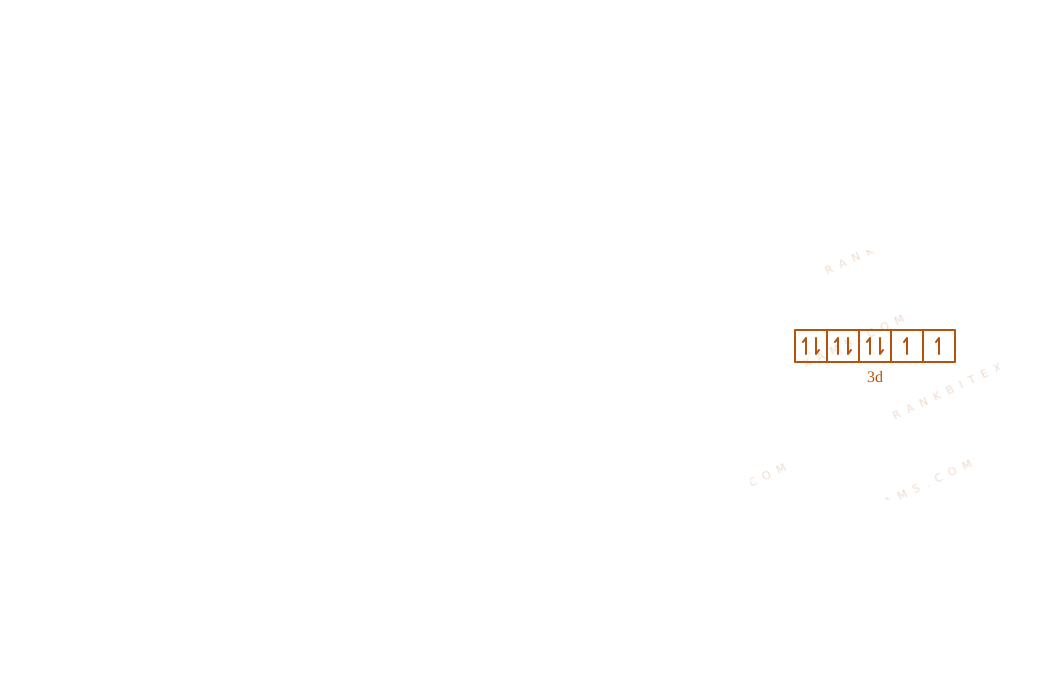
### Related Formula textCFSE evaluation for octahedral weak/strong arrangements ### Core Logic The stability profile tracks the magnitude of crystal field stabilization energy via Delta_0 values : * (I) [mathrmMn(mathrmCN)_6]^3-: mathrmMn^3+ (d^4, t_2g^4 e_g^0) ightarrow -1.6Delta_0 * (II) [mathrmCo(mathrmCN)_6]^4-: mathrmCo^2+ (d^7, t_2g^6 e_g^1) ightarrow -1.8Delta_0 * (IV) [mathrmFe(mathrmCN)_6]^3-: mathrmFe^3+ (d^5, t_2g^5 e_g^0) ightarrow -2.0Delta_0 * (III) [mathrmFe(mathrmCN)_6]^4-: mathrmFe^2+ (d^6, t_2g^6 e_g^0) ightarrow -2.4Delta_0 Thus, the correct increasing order of stability based on magnitude of CFSE values is: mathrmI < mathrmII < mathrmIV < mathrmIII ### Pattern Recognition For a strong field ligand like mathrmCN^-, maximum stability shifts towards filled or stable subshell profiles (d^6 completely fills the t_2g set providing -2.4Delta_0). ### Evaluation Rubric / Model Answer null ### Chapter Mix Class 12 Chemistry: Coordination Compounds
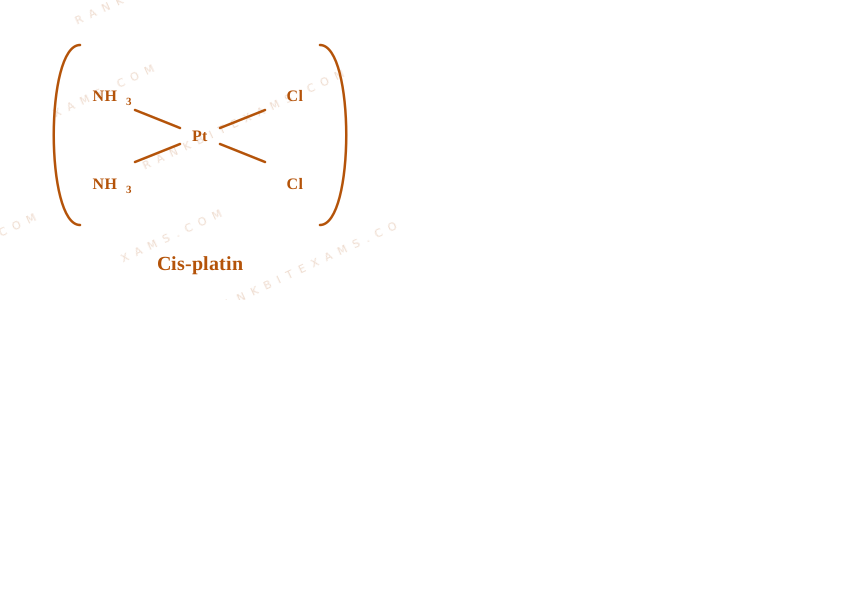
Reference Study Guides

More Coordination Compounds Previous-Year Questions — Page 6

Q49 2025 Magnetic Properties and Crystal Field Theory
The number of paramagnetic metal complex species among [textCo(textNH_3)_6]^3+, [textCo(textC_2textO_4)_3]^3-, [textMnCl_6]^3-, [textMn(textCN)_6]^3-, [textCoF_6]^3-, [textFe(textCN)_6]^3- and [textFeF_6]^3- with same number of unpaired electrons is dots.
Numerical Answer. Answer: 1.5 to 2.5

Solution

### Related Formula textParamagnetic species: Complexes with unpaired electron count (n) > 0 ### Core Logic Let's perform electron tracking across every entry using CFT parameters: 1. [textCo(textNH_3)_6]^3+: textCo^3+ (3d^6), textNH_3 is SFL implies t2g^6 e_g^0, unpaired electrons = 0 (Diamagnetic). 2. [textCo(textC_2textO_4)_3]^3-: textCo^3+ (3d^6), Oxalate acts as SFL here implies t_2g^6 e_g^0, unpaired electrons = 0 (Diamagnetic). 3. [textMnCl_6]^3-: textMn^3+ (3d^4), textCl^- is WFL implies t_2g^3 e_g^1, unpaired electrons = 4. 4. [textMn(textCN)_6]^3-: textMn^3+ (3d^4), textCN^- is SFL implies t_2g^4 e_g^0, unpaired electrons = 2. 5. [textCoF_6]^3-: textCo^3+ (3d^6), textF^- is WFL implies t_2g^4 e_g^2, unpaired electrons = 4. 6. [textFe(textCN)_6]^3-: textFe^3+ (3d^5), textCN^- is SFL implies t_2g^5 e_g^0, unpaired electrons = 1. 7. [textFeF_6]^3-: textFe^3+ (3d^5), textF^- is WFL implies t_2g^3 e_g^2, unpaired electrons = 5. ### Step 1: Finding Common Electronic Counts Reviewing unpaired counts among paramagnetic entities: - n=1: 1 complex ([textFe(textCN)_6]^3-) - n=2: 1 complex ([textMn(textCN)_6]^3-) - n=4: 2 complexes ([textMnCl_6]^3- and [textCoF_6]^3-) - n=5: 1 complex ([textFeF_6]^3-) The highest matching sub-group frequency has a count of 2. ### Pattern Recognition CFT Shortcut tracking: For 3d^4 weak field and 3d^6 weak field systems, the unpaired counts identically match (n=4). Spotting that textMn^3+text/WFL and textCo^3+text/WFL both leave 4 electrons unpaired immediately provides the pair answer. ### Evaluation Rubric / Model Answer null ### Chapter Mix Class 12 Chemistry: Coordination Compounds
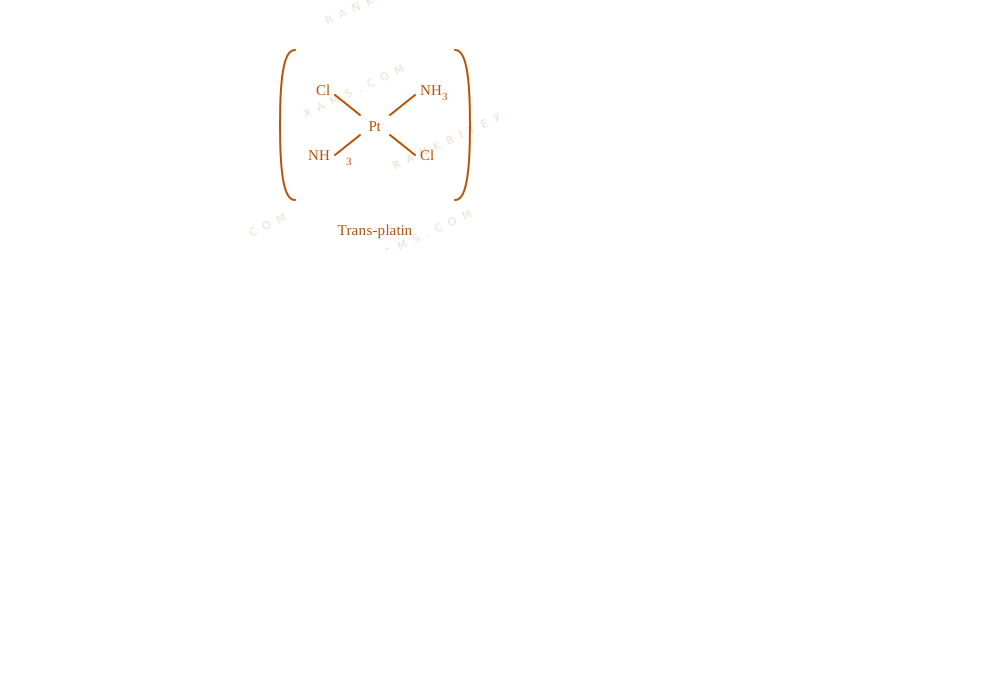
Q33 2025 Qualitative Analysis of Cations
Find the compound 'A' from the following reaction sequences. mathrmA xrightarrowtextaqua-regia mathrmB xrightarrowtext(1) mathrmKNO2 | mathrmNH4mathrmOH, text (2) mathrmAcOH textyellow ppt
  • A. \text{ZnS}
  • B. \text{CoS}
  • C. \text{MnS}
  • D. \text{NiS}

Solution

### Core Logic This pathway corresponds to the standard confirmatory test for cobalt (mathrmCo^2+) ions in qualitative inorganic analysis: 1. mathrmCoS dissolves in aqua regia to yield cobalt chloride (mathrmCoCl_2): mathrmCoS + textaqua regia ightarrow mathrmCoCl_2 2. Treating this solution with potassium nitrite (mathrmKNO_2) in the presence of acetic acid (mathrmAcOH) oxidizes mathrmCo^2+ to mathrmCo^3+, precipitating potassium cobaltinitrite as a characteristic yellow solid: mathrmCoCl_2 + 7mathrmKNO_2 + 2mathrmCH_3mathrmCOOH ightarrow mathrmK_3[mathrmCo(mathrmNO_2)_6]downarrow (textyellow) + 2mathrmNaCl + mathrmNO + 2mathrmCH_3mathrmCOOK + mathrmH_2mathrmO ### Pattern Recognition A yellow precipitate formed specifically upon adding mathrmKNO_2 and acetic acid is a definitive signature of potassium cobaltinitrite, mathrmK_3[mathrmCo(mathrmNO_2)_6]. This confirms the starting sulfide was mathrmCoS. ### Evaluation Rubric / Model Answer null ### Chapter Mix Class 12 Chemistry: Coordination Compounds Class 11 Chemistry: Qualitative Analysis
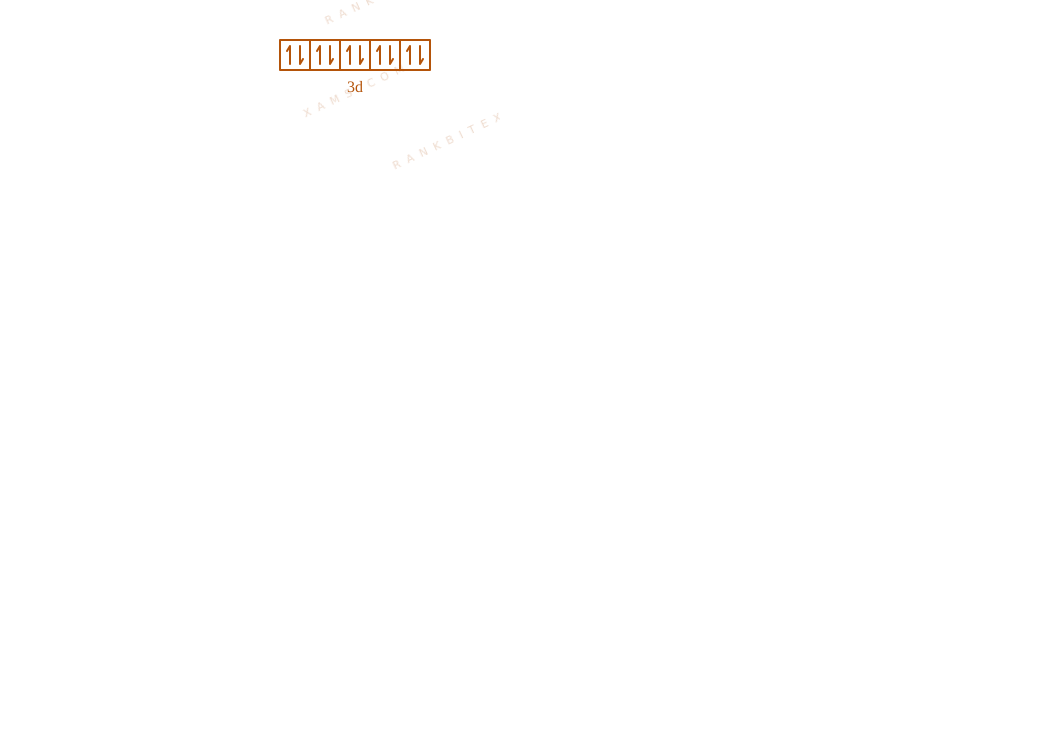
Q37 2025 Spectrochemical Series and Colour
When Ethane-1, 2-diamine is added progressively to an aqueous solution of Nickel (II) chloride, the sequence of colour change observed will be:
  • A. \text{Pale Blue } ightarrow \text{ Blue } ightarrow \text{ Green } ightarrow \text{ Violet}
  • B. \text{Pale Blue } ightarrow \text{ Blue } ightarrow \text{ Violet } ightarrow \text{ Green}
  • C. \text{Green } ightarrow \text{ Pale Blue } ightarrow \text{ Blue } ightarrow \text{ Violet}
  • D. \text{Violet } ightarrow \text{ Blue } ightarrow \text{ Pale Blue } ightarrow \text{ Green}

Solution

### Core Logic An aqueous nickel (II) chloride solution contains the green hexaquarickel(II) complex, [mathrmNi(mathrmH_2mathrmO)_6]^2+. Ethane-1,2-diamine ('en') is a bidentate ligand that binds more strongly than water, shifting the crystal field splitting parameter (Delta_o) to higher energies as it replaces water molecules: 1. Initial state: [mathrmNi(mathrmH_2mathrmO)_6]^2+text (Green) 2. Adding 1 equivalent of 'en' forms a mono-en complex: [mathrmNi(mathrmH_2mathrmO)_6]^2+ + mathrmen ightarrow [mathrmNi(mathrmH_2mathrmO)_4(mathrmen)]^2+text (Pale Blue) + 2mathrmH_2mathrmO 3. Adding a 2nd equivalent forms a bis-en complex: [mathrmNi(mathrmH_2mathrmO)_4(mathrmen)]^2+ + mathrmen ightarrow [mathrmNi(mathrmH_2mathrmO)_2(mathrmen)_2]^2+text (Blue / Purple) + 2mathrmH_2mathrmO 4. Adding a 3rd equivalent forms the tris-en complex: [mathrmNi(mathrmH_2mathrmO)_2(mathrmen)_2]^2+ + mathrmen ightarrow [mathrmNi(mathrmen)_3]^2+text (Violet) + 2mathrmH_2mathrmO This progressive ligand replacement shifts the absorption spectrum, changing the solution's visible color from Green ightarrow Pale Blue ightarrow Blue ightarrow Violet. ### Pattern Recognition Replacing weak-field ligands (like mathrmH_2mathrmO) with stronger bidentate chelating ligands (like 'en') increases crystal field splitting. For mathrmNi^2+, this ligand substitution always follows the specific chromatic progression: Green ightarrow Pale Blue ightarrow Blue ightarrow Violet. ### Evaluation Rubric / Model Answer null ### Chapter Mix Class 12 Chemistry: Coordination Compounds
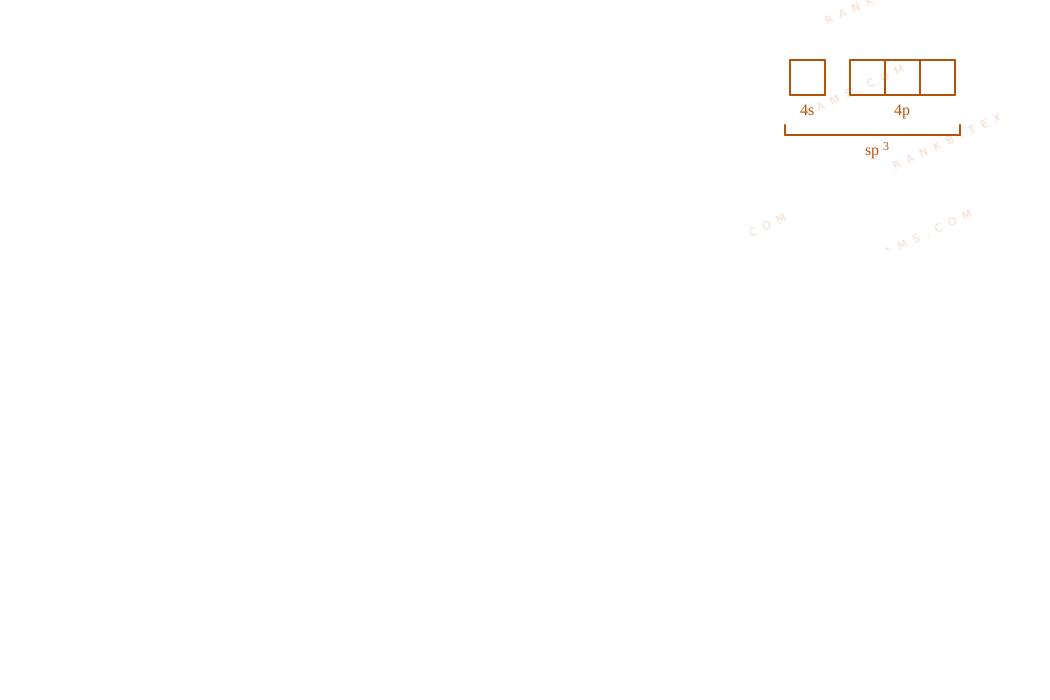
Q38 2025 Crystal Field Theory
The conditions and consequence that favours the t_2g^3 e_g^1 configuration in a metal complex are:
  • A. \text{weak field ligand, high spin complex}
  • B. \text{strong field ligand, high spin complex}
  • C. \text{strong field ligand, low spin complex}
  • D. \text{weak field ligand, low spin complex}

Solution

### Core Logic Consider an octahedral coordination environment for a d^4 transition metal ion configuration: * Weak Field Ligand (WFL): The crystal field splitting energy is smaller than the pairing energy (Delta_o < P). Consequently, electrons prefer to occupy the higher-energy e_g orbitals rather than pair up in the lower-energy t_2g orbitals. This leads to a high spin complex with the configuration: t_2g^3 e_g^1 * Strong Field Ligand (SFL): The splitting energy is larger than the pairing energy (Delta_o > P). Electrons pair up in the t_2g orbitals before occupying the e_g subshell, resulting in a low spin complex with the configuration: t_2g^4 e_g^0 ### Pattern Recognition An electron occupying an e_g orbital before the t_2g orbitals are fully paired requires a weak-field ligand. This configuration maximizes the number of unpaired electrons, which is the defining characteristic of a high-spin complex. ### Evaluation Rubric / Model Answer null ### Chapter Mix Class 12 Chemistry: Coordination Compounds
Q28 2025 Werner's Theory of Coordination Compounds
One mole of the octahedral complex compound Co(NH_3)_5Cl_3 gives 3 moles of ions on dissolution in water. One mole of the same complex reacts with excess of AgNO_3 solution to yield two moles of AgCl_(s). The structure of the complex is:
  • A. [Co(NH_3)_5Cl]Cl_2
  • B. [Co(NH_3)_4Cl].Cl_2.NH_3
  • C. [Co(NH_3)_4Cl_2]Cl.NH_3
  • D. [Co(NH_3)_3Cl_3].2NH_3

Solution

### Related Formula textMoles of AgCl text precipitated = textMoles of ionizable Cl^- text ions outside the coordination sphere ### Core Logic Since 1 mole of the complex yields 2 moles of AgCl_(s), there must be exactly 2 chloride ions outside the coordination sphere to undergo precipitation: [Co(NH_3)_5Cl]Cl_2 rightarrow [Co(NH_3)_5Cl]^2+(aq) + 2Cl^-(aq) This dissociation produces a total of 3 moles of ions per mole of the complex, perfectly consistent with the problem constraints. ### Pattern Recognition Number of precipitated AgCl moles directly equates to the count of counter-anions located outside the square brackets. ### Evaluation Rubric / Model Answer null ### Chapter Mix Class 12 Chemistry: Coordination Compounds
More Coordination Compounds Questions — jee_main_2025_29_jan_morning

Practice all Coordination Compounds previous-year questions →

YOUR FIRST PREP STEP STARTS HERE

We Map Every Repeating Question in Competitive Exams.

Say goodbye to generic mock test fatigue. RankBit uses smart analysis to group past exam questions into their foundational Repeating Question Types. Find chapter weightage, track repeating questions, and score higher with targeted practice.

Select Your Target Exam

Choose an exam track below to find formulas per chapter and patterns.

Syncing Exam Intelligence

Mapping formulas and patterns across all tracks…

PATH A — FULL LENGTH PRACTICE

Full Mock Test Hub

Simulate real NTA exam conditions with fully tracked mocks. Time yourself against past papers.

Under Development
PATH B — TARGETED PRACTICE

Topic-wise Practice Hub

Practice past-year questions one chapter at a time. Pick an exam → subject → chapter and get every PYQ for that topic — pulled together from all past papers — with the chapter's key formulas alongside.

Loading Questions... Browse Topics
Latest from the Blog
View all →

Loading articles...
