Q51
jee_main_2026_28_january_morning
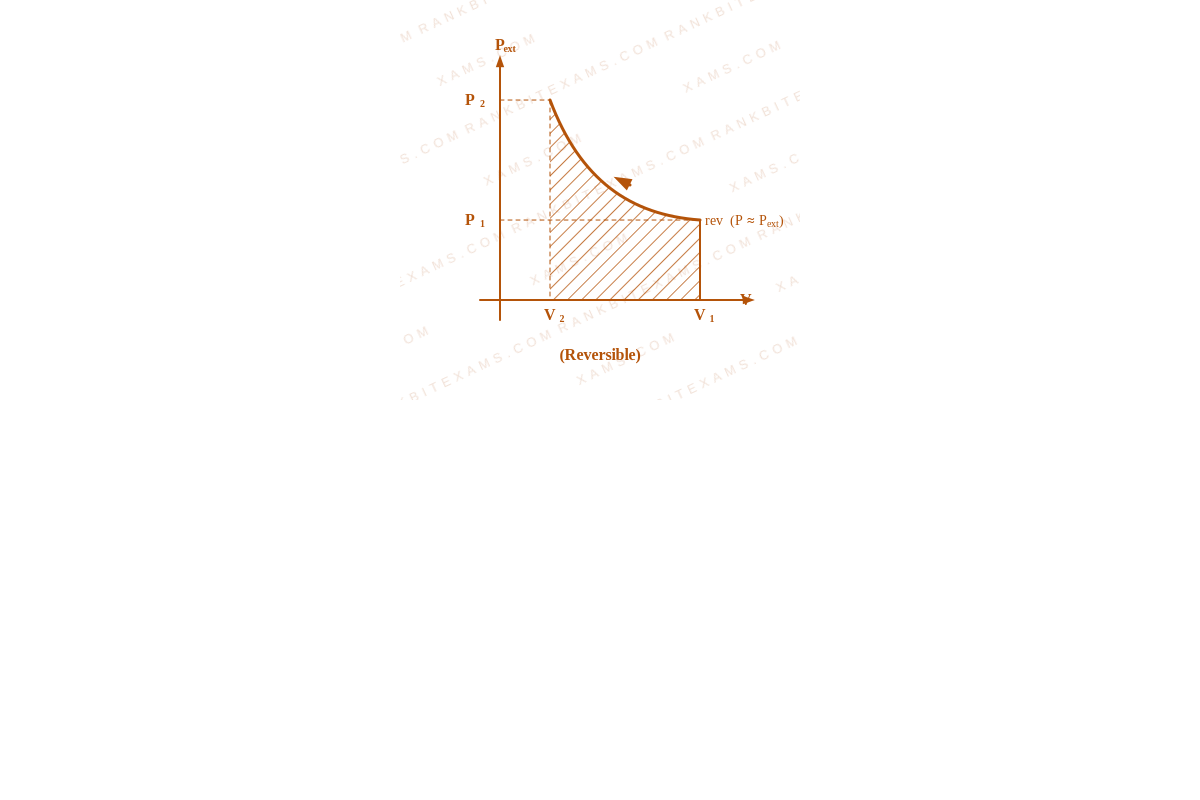
Isothermal Reversible Expansion
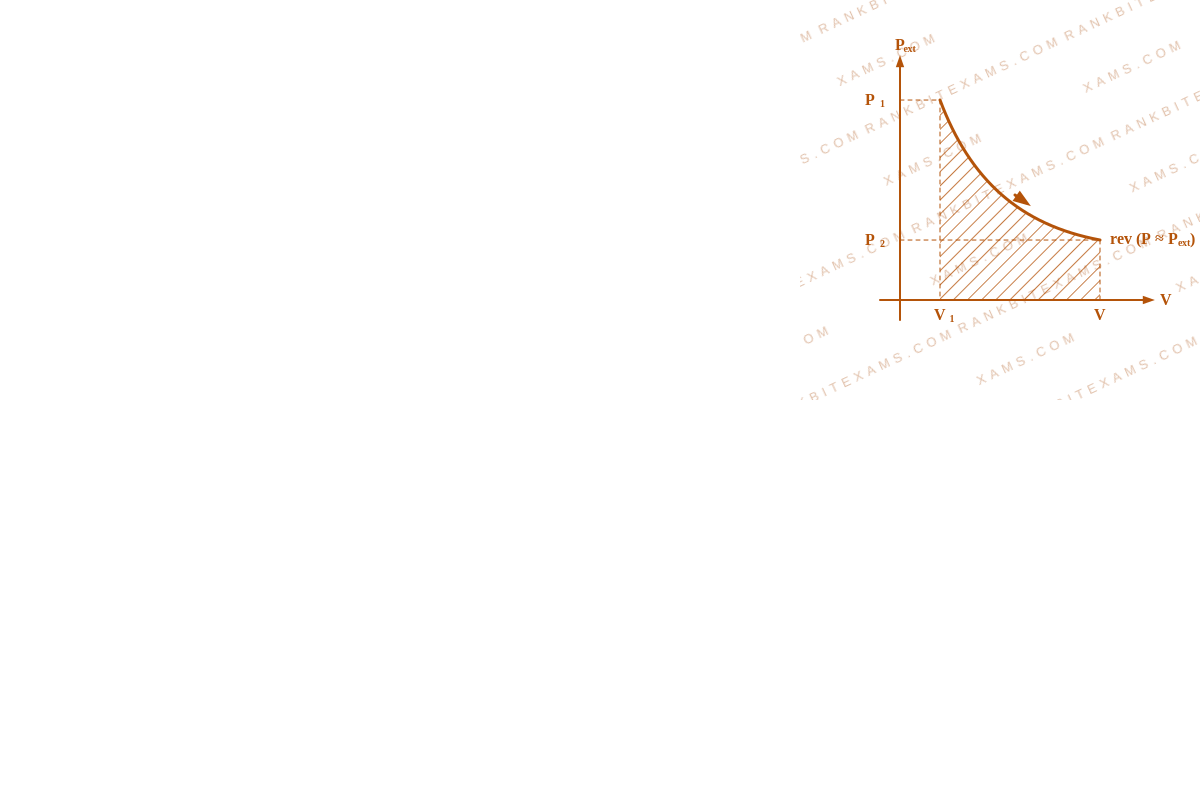
20.0~dm³ of an ideal gas 'X' at 600~K and 0.5~MPa undergoes isothermal reversible expansion until pressure of the gas is 0.2~MPa. Which of the following option is correct?
(Given: ~2=0.3010 and ~5=0.6989)
Solution
Related Formula
wᵢₛₒ = -nRT ln((P₁)/(P₂)) = -P₁ V₁ ln((P₁)/(P₂)) \n Δ U = 0 and Δ H = 0 (For isothermal process)Core Logic
For an isothermal reversible process involving an ideal gas, the change in internal energy (Δ U) and change in enthalpy (Δ H) are zero. By First Law of Thermodynamics, q = -w.
Step 1: Calculate Work Done
wᵢₛₒ = -0.5 × 10⁶ × 20 × 10⁻³ ln((0.5)/(0.2))\nwᵢₛₒ = -10⁴ × 2.303 × ( 5 - 2)\nwᵢₛₒ = -10⁴ × 2.303 × (0.6989 - 0.3010)\nwᵢₛₒ = -10⁴ × 2.303 × 0.3979\nw ≈ -9163 ~J = -9.1 ~kJStep 2: Calculate Heat
q = -w = -(-9.1 ~kJ) = 9.1 ~kJ
Pattern Recognition
Isothermal expansion of an ideal gas always yields w < 0, q > 0, and Δ U = Δ H = 0. Matching signs instantly eliminates non-conforming options.
Chapter Mix
Class 11 Chemistry: Thermodynamics