JEE Main · Chemistry ↑ Rising

Amines appeared 40 times across 3 years — 4.6% of Chemistry. This question is from Basic Character of Amines.

Year 2026 2025 2024 Total
Questions 16 14 10 40

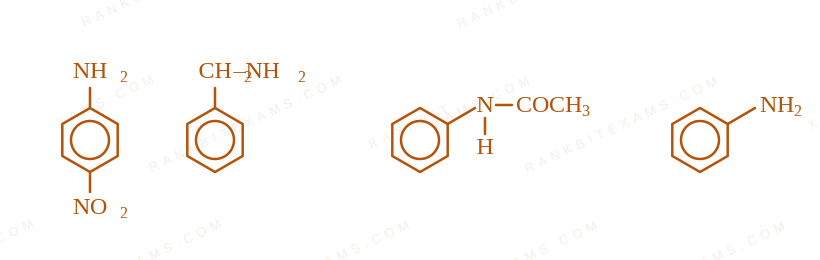
Given below are some nitrogen containing compounds.
Nitrogen containing compounds profiles for Q46 - JEE Main 2025 Morning
Four amine candidates are indexed to find the optimal basic compound for reaction calculations.
Each of them is treated with HCl separately. 1.0 g of the most basic compound will consume ________ mg of HCl. (Given molar mass in g mol ⁻¹ C:12, H : 1, O : 16, Cl : 35.5)

Nitrogen containing compounds profiles for Q46 - JEE Main 2025 Morning
Four amine candidates are indexed to find the optimal basic compound for reaction calculations.
Numerical Answer Type:
Enter a numerical value Answer: 341 to 341 +4 marks

Solution & Explanation

Related Formula
Moles = MassMolar Mass Mass of HCl consumed = namine · MHCl
Core Logic

Step 1: Identify the most basic amine Benzylamine (C₆H₅CH₂NH₂) is the most basic compound here because its nitrogen lone pair is localized and not involved in aromatic resonance. This stands in contrast to aniline or amides, which delocalize their lone pairs into the ring or carbonyl group .

Step 2: Neutralization Stoichiometry

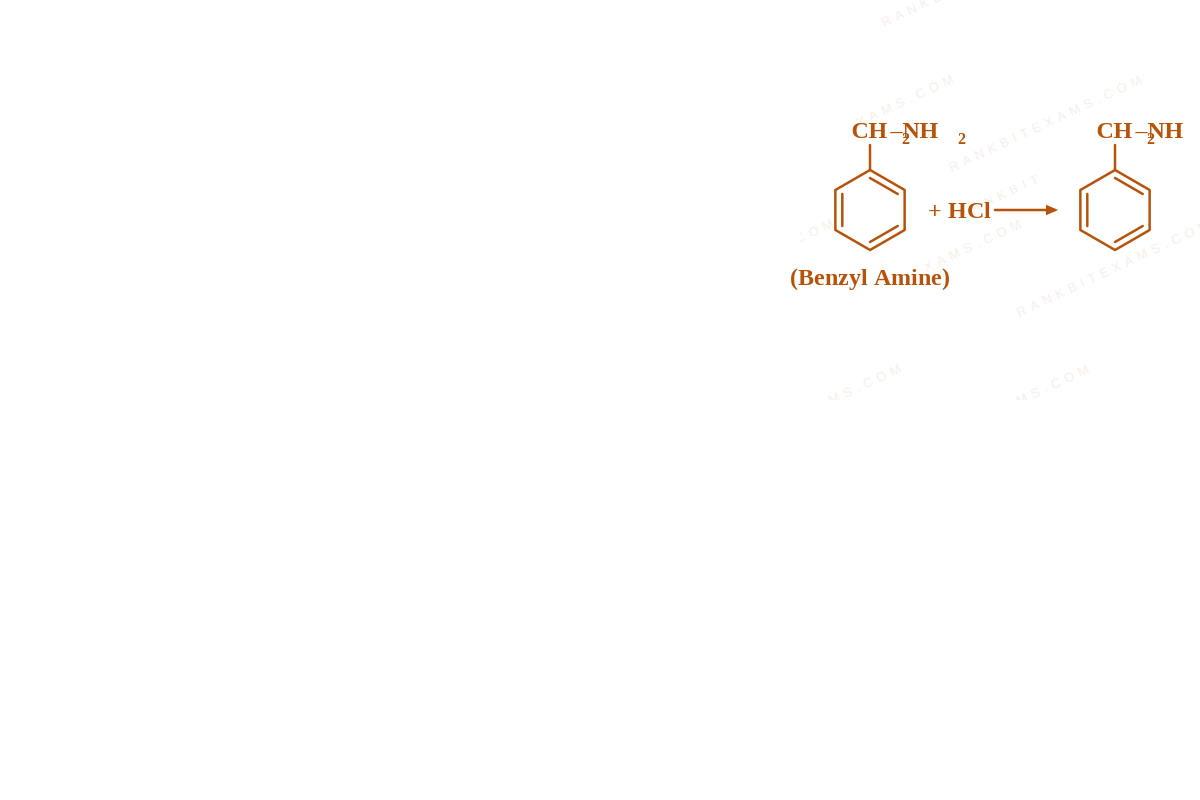
C₆H₅CH₂NH₂ + HCl arrow C₆H₅CH₂NH₃^+ Cl^-

Molar Mass of Benzylamine (C₇H₉N):

M = (7 · 12) + (9 · 1) + 14 = 84 + 9 + 14 = 107 g/mol

Moles of Benzylamine in 1.0 g :

n = (1.0)/(107) 0.009346 mol

Since 1 mole of benzylamine reacts with 1 mole of HCl :

Moles of HCl consumed = 0.009346 mol Mass of HCl = 0.009346 · 36.5 = 0.3411 g = 341.1 mg arrow 341
Pattern Recognition

Aliphatic localized clusters (like the -CH₂NH₂ segment in benzylamine) always show higher basicity than aromatic ring-conjugated arrays.

Chapter Mix

Class 12 Chemistry: Amines

Benzylamine reaction mechanism mapping
Four amine candidates are indexed to find the optimal basic compound for reaction calculations.

More Amines Previous-Year Questions — Page 7

Q70 jee_main_2024_01_february_morning Nomenclature of Amines
Given below are two statements: Statement (I) : Aminobenzene and aniline are same organic compounds. Statement (II) : Aminobenzene and aniline are different organic compounds. In the light of the above statements, choose the most appropriate answer from the options given below:
  • A. Both Statement I and Statement II are correct
  • B. Statement I is correct but Statement II is incorrect
  • C. Statement I is incorrect but Statement II is correct
  • D. Both Statement I and Statement II are incorrect

Solution

Core Logic

Aniline is the common name for the simplest aromatic amine, which consists of a phenyl group attached to an amino group (C₆H₅NH₂). According to IUPAC nomenclature, the amino group attached to a benzene ring can also be called aminobenzene.

Step 1: Statement Validation

Statement I: True. Aminobenzene is just the systematic IUPAC name for aniline. Statement II: False. They refer to the exact same molecule.

Pattern Recognition

Common names for simple aromatic compounds are often accepted as IUPAC names. Aniline = Benzenamine = Aminobenzene.

Chapter Mix

Class 12 Chemistry: Amines
Q80 jee_main_2024_01_february_morning Electrophilic Substitution
Given below are two statements: Statement (I): The NH₂ group in Aniline is ortho and para directing and a powerful activating group. Statement (II): Aniline does not undergo Friedel-Craft's reaction (alkylation and acylation). In the light of the above statements, choose the most appropriate answer from the options given below:
  • A. Both Statement I and Statement II are correct
  • B. Both Statement I and Statement II are incorrect
  • C. Statement I is incorrect but Statement II is correct.
  • D. Statement I is correct but Statement II is incorrect

Solution

Core Logic

Statement (I): The -NH₂ group has a lone pair of electrons on nitrogen, which undergoes resonance with the benzene ring (strong +M effect). This strongly activates the ring towards electrophilic substitution and directs incoming electrophiles to the ortho and para positions.

Statement (II): Friedel-Crafts alkylation and acylation require a Lewis acid catalyst like anhydrous AlCl₃. Aniline is a Lewis base (due to the lone pair on N) and reacts with the Lewis acid AlCl₃ to form a stable salt/complex (C₆H₅ +NH₂-AlCl₃^-). This removes the lone pair from resonance and converts the -NH₂ group into a strongly deactivating group, thereby halting the Friedel-Crafts reaction.

Step 1: Evaluate Statements

Statement I is correct. Statement II is correct.

Pattern Recognition

Aniline NEVER undergoes Friedel-Crafts because the base (NH₂) reacts with the catalyst (AlCl₃) before the reaction can proceed.

Chapter Mix

Class 12 Chemistry: Amines
Q jee_main_2024_29_january_evening Diazotization and Sandmeyer Reaction
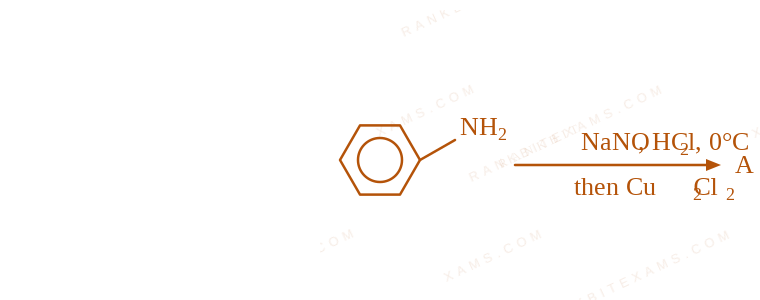
The product A formed in the following reaction is:
Diazotization and Sandmeyer Reaction diagram for Q71 - JEE Main 2024 Evening
The diagram details aniline undergoing diazotization with sodium nitrite and hydrochloric acid, followed by treatment with cuprous chloride.
  • A.
  • B.
  • C.
  • D.

Solution

Related Formula
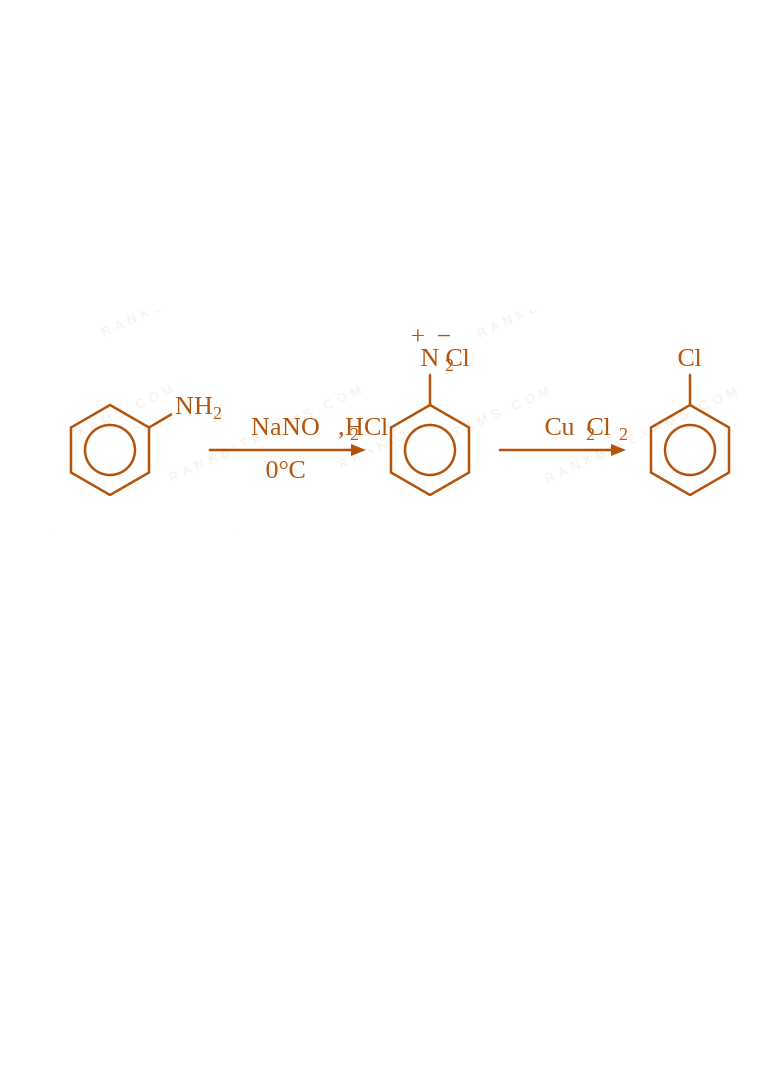
Ar-NH₂ NaNO₂ + HCl, 0^ Ar-N₂^+Cl^- Cu₂Cl₂ Ar-Cl
Core Logic

The schematic outlines a classic sequence:

  • Diazotization Step: Aniline reacts with nitrous acid generated in situ (NaNO₂ + HCl) at low temperature (0-5^) to form benzene diazonium chloride intermediate.
  • Sandmeyer Replacement Step: Treating the diazonium salt with cuprous chloride (Cu₂Cl₂) results in replacement of the diazo group by a chlorine atom.
Step 1: Visual Verification

Tracing structural shifts through intermediates validates the final outcome:

Diazotization and Sandmeyer Reaction solution diagram for Q71 - JEE Main 2024 Evening
The diagram details aniline undergoing diazotization with sodium nitrite and hydrochloric acid, followed by treatment with cuprous chloride.

Pattern Recognition

Aniline arrow Diazonium salt arrow Chlorobenzene via standard Sandmeyer synthesis protocols.

Chapter Mix

Class 12 Chemistry: Organic Compounds Containing Nitrogen

Q68 jee_main_2024_29_jan_morning Electrophilic Substitution in Amines
The arenium ion which is not involved in the bromination of Aniline is.
  • A. ""
  • B. ""
  • C. ""
  • D. ""

Solution

Core Logic

Aniline undergoes electrophilic aromatic substitution (like bromination). The -NH₂ group is a strongly activating group and directs incoming electrophiles to the ortho and para positions due to resonance electron donation (+M effect).

Step 1: Identifying Sigma Complexes (Arenium Ions)

When an electrophile (Br^+) attacks the ring, an intermediate arenium ion (sigma complex) is formed.

  • If attack occurs at the ortho or para position, the positive charge is delocalized onto the carbon atom bearing the -NH₂ group. The lone pair on nitrogen can then stabilize this positive charge via resonance, forming a highly stable resonance structure (an octet-complete intermediate).
  • If attack occurs at the meta position, the positive charge delocalizes only over the remaining ring carbons and never rests on the carbon bearing the -NH₂ group. Thus, it misses the extra stabilization provided by the nitrogen lone pair.
  • Because the meta attack intermediate is less stable compared to ortho/para attack, and the -NH₂ is strictly o/p directing, the meta-arenium ion is NOT a primary intermediate involved in standard bromination pathways of neutral aniline.

Step 2: Conclusion

Option 3 displays the arenium ion resulting from a meta-attack (positive charge skips the -NH₂ substituted carbon).

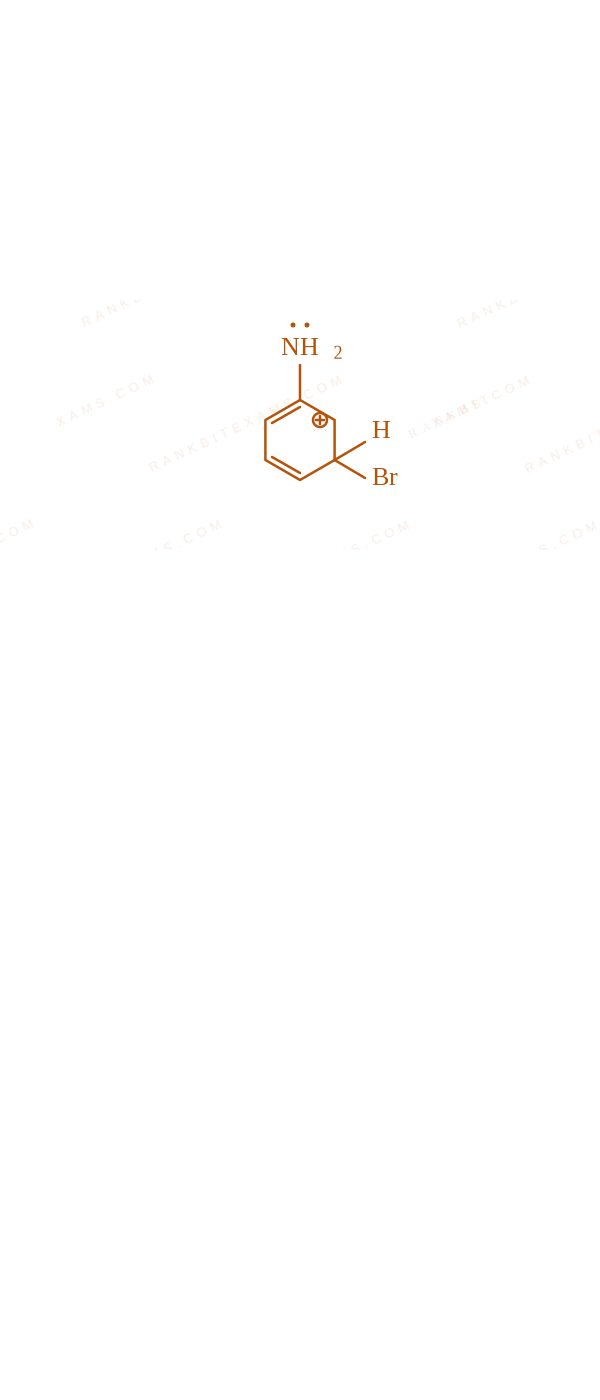
Electrophilic Substitution in Amines diagram for Q68 - JEE Main 2024 Morning

Since -NH₂ is ortho/para directing, the meta-arenium ion will not be formed.

Chapter Mix

Class 12 Chemistry: Amines
Q jee_main_2024_30_january_evening Diazonium Salts
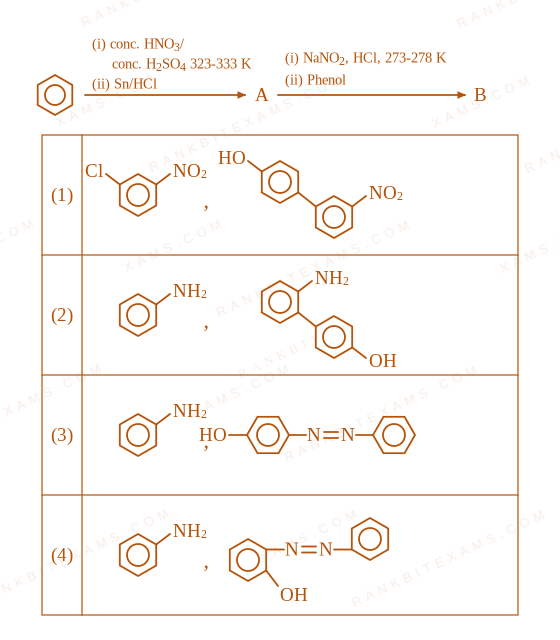
The products A and B formed in the following reaction scheme are respectively
Diazonium Salts diagram for Q68 - JEE Main 2024 Evening
The diagram shows a reaction pathway for synthesizing product A and B.
  • A.
  • B.
  • C.
  • D.

Solution

Core Logic

Step 1: Nitration of benzene using conc. HNO₃ and conc. H₂SO₄ gives nitrobenzene. Step 2: Reduction of nitrobenzene with Sn/HCl yields aniline. Step 3: Aniline reacts with NaNO₂/HCl at 0-5^° C to form benzene diazonium chloride (Product A). Step 4: Benzene diazonium chloride undergoes a coupling reaction with phenol (typically in a mildly alkaline medium) to form p-hydroxyazobenzene, an orange dye (Product B).

Reaction pathway for products A and B diagram for Q68 - JEE Main 2024 Evening
The diagram shows a reaction pathway for synthesizing product A and B.

Pattern Recognition

Nitration arrow Reduction arrow Diazotization arrow Coupling (Azo Dye Test).

Chapter Mix

Class 12 Chemistry: Amines
Rankbit System
JEE Physics: Waves (+15.5%) | Electrostatics: Concentric Shells (-29.7%) | Modern Physics: Photoelectric Clones (+34.2%) | Mathematics: Definite Integrals (+18.1%) | Chemistry: Coordination Splitting (-11.4%) | JEE Physics: Waves (+15.5%) | Electrostatics: Concentric Shells (-29.7%) | Modern Physics: Photoelectric Clones (+34.2%) | Mathematics: Definite Integrals (+18.1%) | Chemistry: Coordination Splitting (-11.4%)
