Aldehydes, Ketones and Carboxylic Acids appeared 46 times across 3 years — 5.3% of Chemistry.
This question is from Chemical Reactions of Carbonyl Compounds.
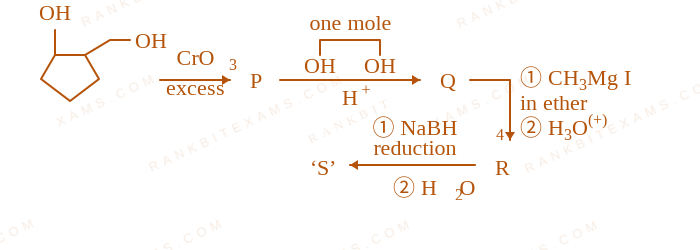
Based on the reaction sequence:
A structural flow charts the transformation of a cyclic dialcohol into final product S.
0.1 mole of compound 'S' will weigh ________ g.
(Given molar mass in g mol⁻¹$\mathrm{g \, mol^{-1}}$ C:12, H:1, O:16)
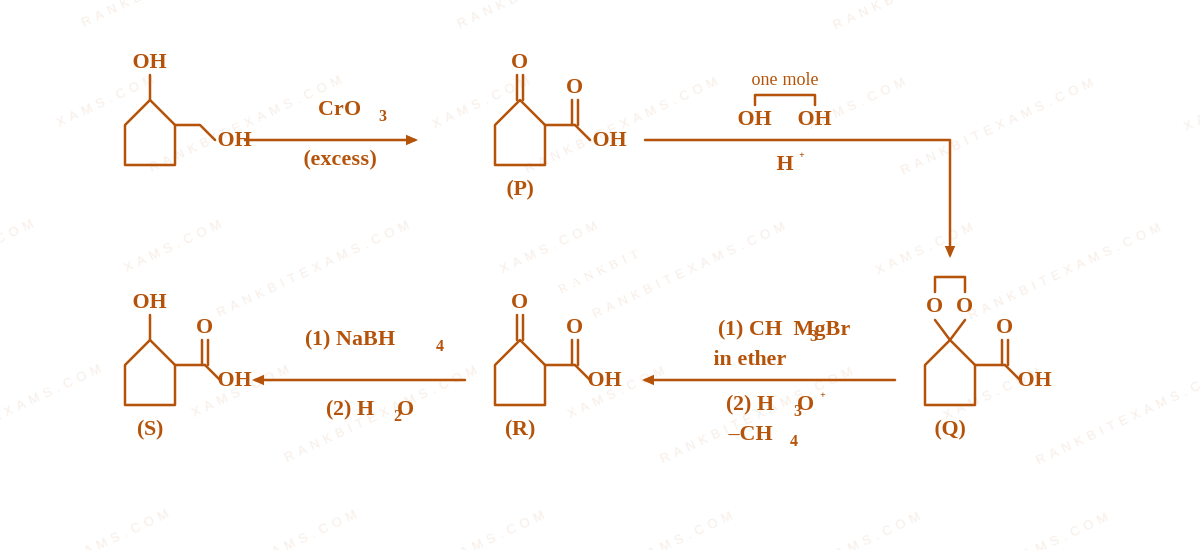
A structural flow charts the transformation of a cyclic dialcohol into final product S.
Reactant: 2-(hydroxymethyl)cyclopentan-1-ol.
Step 1: Excess CrO₃$\mathrm{CrO}_3$ (Jones oxidation) oxidizes the secondary alcohol to a ketone and the primary alcohol to a carboxylic acid arrow$\rightarrow$ Product P.
Step 2: Reaction with 1 mole of glycol protects the ketone selectively as a cyclic ketal arrow$\rightarrow$ Product Q.
Step 3: Treatment with CH₃MgI$\mathrm{CH}_3\mathrm{MgI}$ targets the free carboxylic acid (or ester equivalent) to form a methyl ketone after workup arrow$\rightarrow$ Product R.
Step 4: NaBH₄$\mathrm{NaBH}_4$ reduces the methyl ketone to a secondary alcohol, and acid workup deprotects the ketal back to the original ketone arrow$\rightarrow$ Compound S.
Chemical structural formula of S: 2-(1-hydroxyethyl)cyclopentan-1-one (C₇H₁₂O₂$\mathrm{C}_7\mathrm{H}_{12}\mathrm{O}_2$).
Molar mass of S (C₇H₁₂O₂$\mathrm{C}_7\mathrm{H}_{12}\mathrm{O}_2$):
Ketal groups serve as stable protective masks that shield ketones, allowing selective organometallic reactions to take place elsewhere on the molecule.
Chapter Mix
Class 12 Chemistry: Aldehydes, Ketones and Carboxylic Acids
Keywords:#Protection Pathway#Grignard Reaction#Molar Mass Analysis
More Aldehydes, Ketones and Carboxylic Acids Previous-Year Questions — Page 9
Qjee_main_2024_30_jan_morningPreparation of Aldehydes
This reduction reaction is known as:
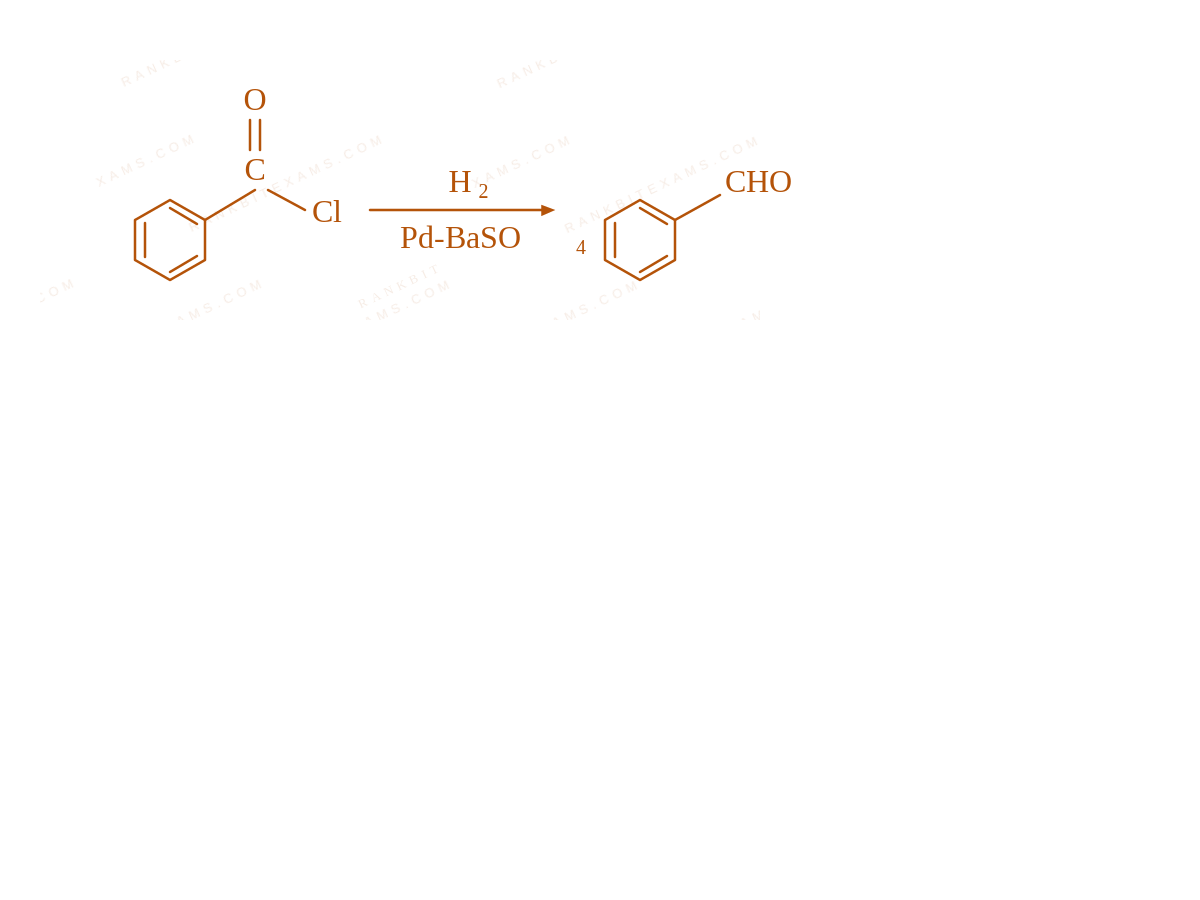
The image shows the catalytic hydrogenation of benzoyl chloride to benzaldehyde in the presence of Pd-BaSO4.
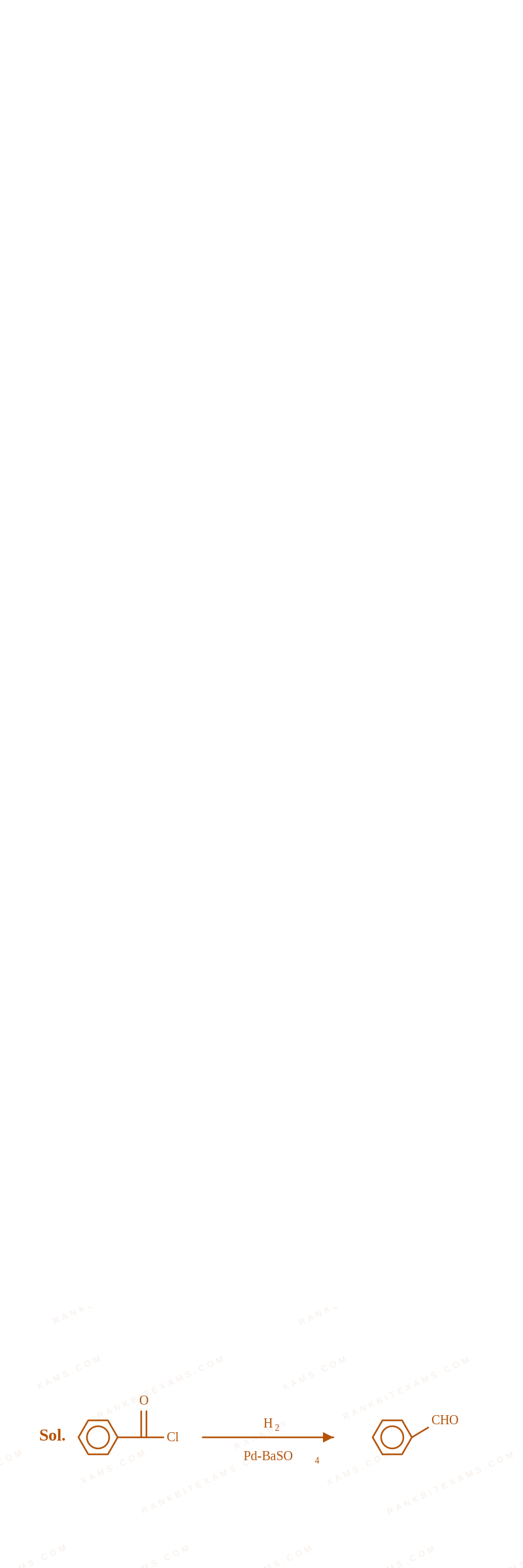
The reaction depicts the partial reduction of an acid chloride (benzoyl chloride) to an aldehyde (benzaldehyde) using hydrogen gas in the presence of a poisoned palladium catalyst (Pd supported on BaSO₄$BaSO_4$).
The image shows the catalytic hydrogenation of benzoyl chloride to benzaldehyde in the presence of Pd-BaSO4.
This specific reaction is known as the Rosenmund reduction.
Pattern Recognition
Acid Chloride + H₂, Pd/BaSO₄$H_2, Pd/BaSO_4$arrow$\rightarrow$ Aldehyde is strictly the Rosenmund reduction. The BaSO₄$BaSO_4$ poisons the catalyst to prevent over-reduction to an alcohol.
Chapter Mix
Class 12 Chemistry: Aldehydes, Ketones and Carboxylic Acids
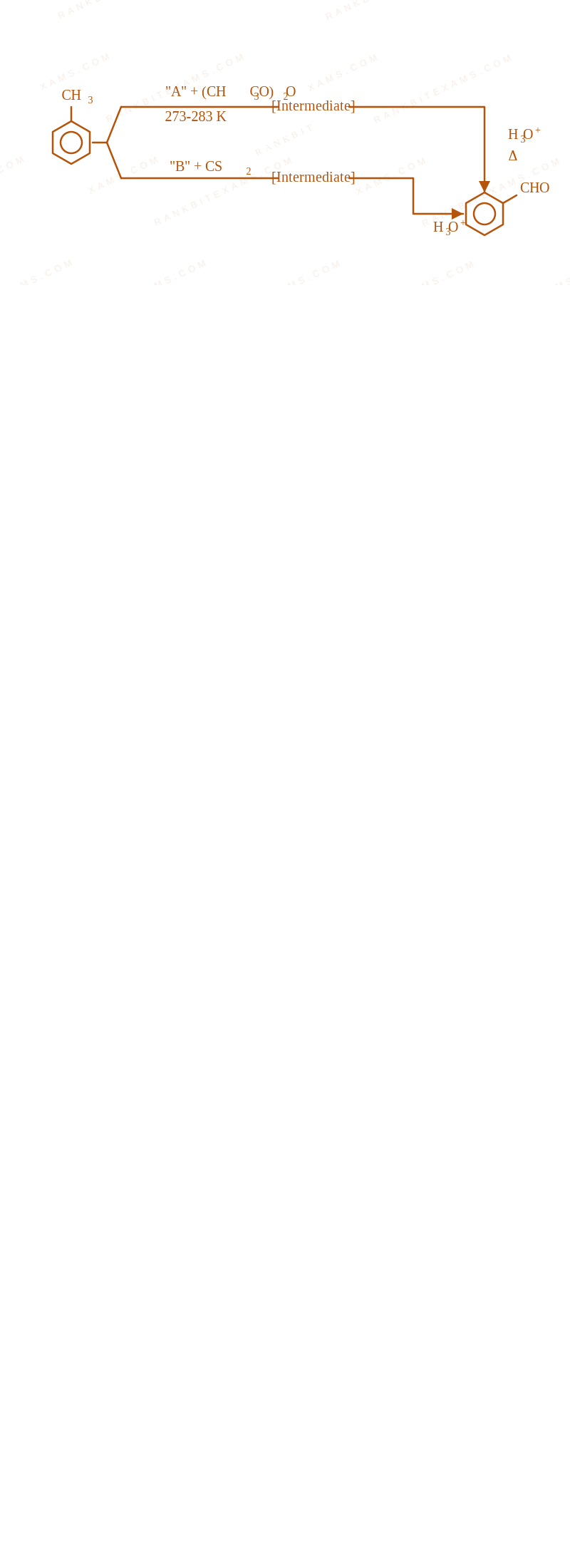
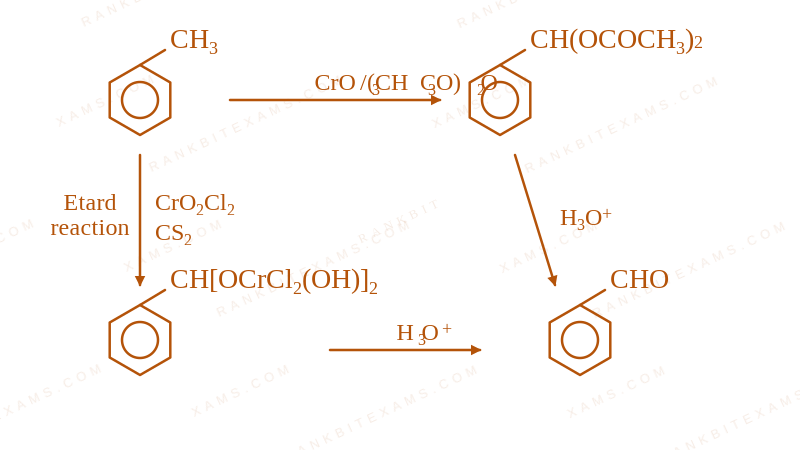
Pathway 1 (Upper): Toluene is treated with Reagent 'A' and acetic anhydride (CH₃CO)₂O$(CH_3CO)_2O$ to form an intermediate (benzylidene diacetate), which on hydrolysis gives benzaldehyde. The reagent used here is Chromic oxide (CrO₃$CrO_3$). Thus, A is CrO₃$CrO_3$.
Pathway 2 (Lower): Toluene is treated with Reagent 'B' in CS₂$CS_2$ to form a chromium complex intermediate, which on hydrolysis yields benzaldehyde. This is the Etard reaction, and the reagent used is Chromyl chloride (CrO₂Cl₂$CrO_2Cl_2$). Thus, B is CrO₂Cl₂$CrO_2Cl_2$.
The image shows the oxidation of toluene to benzaldehyde via two different pathways requiring reagents A and B.
Step 1: Selection
Therefore, A = CrO₃$CrO_3$ and B = CrO₂Cl₂$CrO_2Cl_2$.
Pattern Recognition
Etard reaction always uses Chromyl chloride (CrO₂Cl₂$CrO_2Cl_2$). Oxidation of toluene with acetic anhydride uses Chromic acid (CrO₃$CrO_3$). Both stop the oxidation at the aldehyde stage via intermediate formation.
Chapter Mix
Class 12 Chemistry: Aldehydes, Ketones and Carboxylic Acids
Ethanal (CH₃CHO$CH_3CHO$) reacts with semicarbazide (H₂N-NH-CO-NH₂$H_2N-NH-CO-NH_2$) via nucleophilic addition followed by elimination of water to form a semicarbazone.
Step 1: Product Analysis
The product is Ethanal semicarbazone: CH₃-CH=N-NH-CO-NH₂$CH_3-CH=N-NH-CO-NH_2$.
Counting the nitrogen atoms in this structure:
The imine nitrogen (=N-$=N-$)
The amine nitrogen (-NH-$-NH-$)
The amide nitrogen (-NH₂$-NH_2$)
Total = 3 Nitrogen atoms.
Chapter Mix
Class 12 Chemistry: Aldehydes, Ketones and Carboxylic Acids
Qjee_main_2024_31_jan_eveningPreparation of Aldehydes and Ketones
Identify the name reaction.
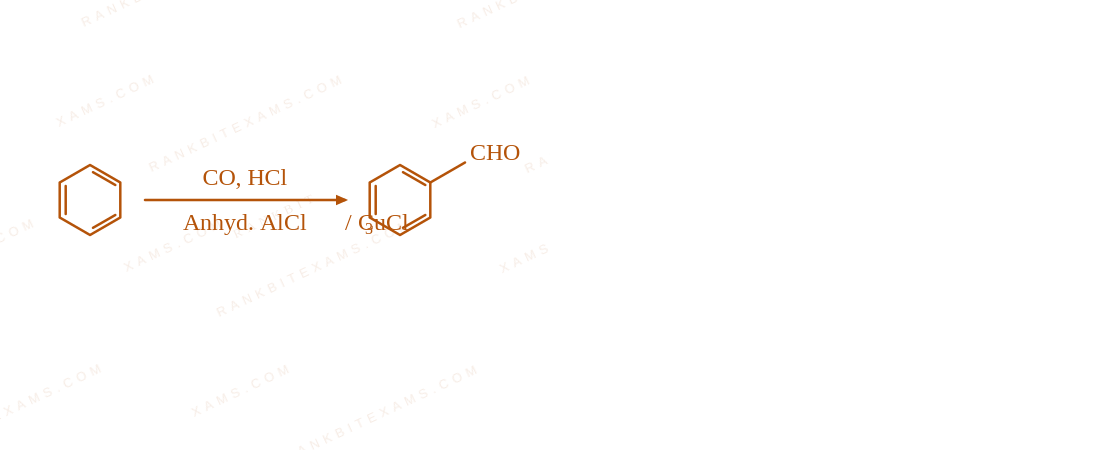
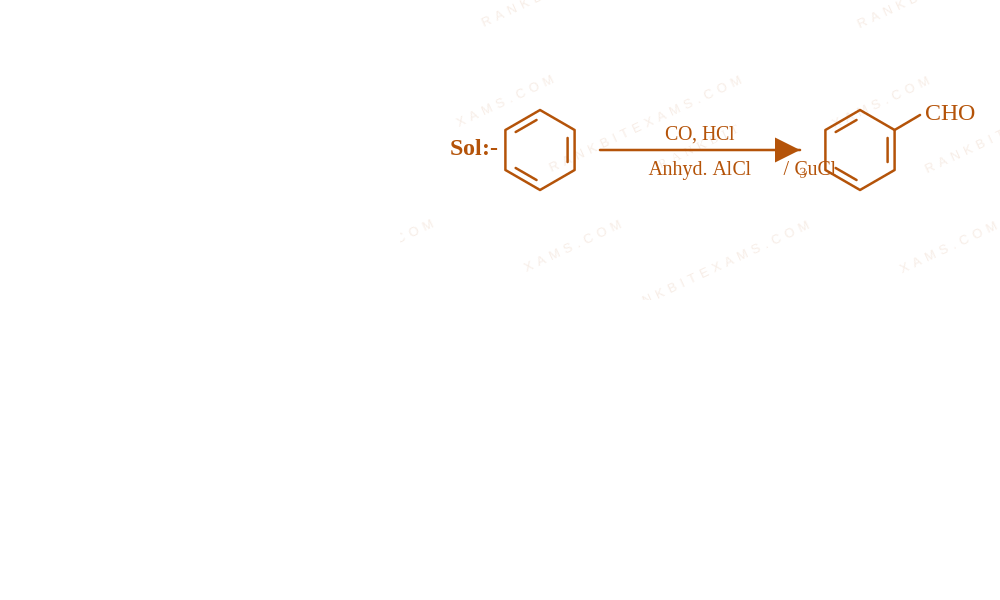
The image shows the conversion of benzene to benzaldehyde using CO, HCl, and Anhydrous AlCl3/CuCl.
The reaction of benzene with carbon monoxide (CO$CO$) and hydrogen chloride (HCl$HCl$) in the presence of anhydrous aluminium chloride (AlCl₃$AlCl_3$) and cuprous chloride (CuCl$CuCl$) to give benzaldehyde is known as the Gatterman-Koch reaction.
The image shows the conversion of benzene to benzaldehyde using CO, HCl, and Anhydrous AlCl3/CuCl.
Pattern Recognition
CO + HCl arrow$CO + HCl \rightarrow$ Formyl chloride intermediate (in situ) with Lewis acid arrow$\rightarrow$ formylation of benzene. This is definitively the Gatterman-Koch formylation.
Chapter Mix
Class 12 Chemistry: Aldehydes, Ketones and Carboxylic Acids
Practice past-year questions one chapter at a time. Pick an exam → subject → chapter and get every PYQ for that topic — pulled together from all past papers — with the chapter's key formulas alongside.