The product (P) formed in the following reaction is:
Clemmensen Reduction diagram for Q41 - JEE Main 2025 Morning
The structural flowchart indicates a multi-functional molecule treated with Zn-Hg/HCl.

Solution & Explanation

### Related Formula mathrmR-CO-R' xrightarrow[mathrmHCl]mathrmZn-Hg mathrmR-CH_2-R' ### Core Logic The provided reaction relies on classic Clemmensen Reduction reagent configurations (mathrmZn-Hg / mathrmHCl). This reagent explicitly selective targets ketone/aldehyde carbonyl centers (>mathrmC=mathrmO) and converts them cleanly into methylene units (-mathrmCH_2-). Any free aliphatic alcohol functionalities (-mathrmOH) located on the ring are preserved under these reductive conditions. Thus, the ketone group on the ring is cleanly converted to -mathrmCH_2-, yielding option (3):
Clemmensen Reduction solution diagram for Q41 - JEE Main 2025 Morning
The structural flowchart indicates a multi-functional molecule treated with Zn-Hg/HCl.
### Pattern Recognition Clemmensen routes deoxygenate carbonyl clusters selectively without compromising adjacent standalone cyclic alcohol structural components. ### Chapter Mix Class 12 Chemistry: Aldehydes, Ketones and Carboxylic Acids
Clemmensen Reduction solution diagram for Q41 - JEE Main 2025 Morning
The structural flowchart indicates a multi-functional molecule treated with Zn-Hg/HCl.

More Aldehydes, Ketones and Carboxylic Acids Previous-Year Questions — Page 7

Q87 jee_main_2024_30_jan_morning Nucleophilic Addition Reactions
The compound formed by the reaction of ethanal with semicarbazide contains ________ number of nitrogen atoms.
Numerical Answer. Answer: 3 to 3

Solution

### Related Formula CH_3-CHO + H_2N-NH-CO-NH_2 rightarrow CH_3-CH=N-NH-CO-NH_2 + H_2O ### Core Logic Ethanal (CH_3CHO) reacts with semicarbazide (H_2N-NH-CO-NH_2) via nucleophilic addition followed by elimination of water to form a semicarbazone. ### Step 1: Product Analysis The product is Ethanal semicarbazone: CH_3-CH=N-NH-CO-NH_2. Counting the nitrogen atoms in this structure: 1. The imine nitrogen (=N-) 2. The amine nitrogen (-NH-) 3. The amide nitrogen (-NH_2) Total = 3 Nitrogen atoms. ### Evaluation Rubric / Model Answer null ### Chapter Mix Class 12 Chemistry: Aldehydes, Ketones and Carboxylic Acids
Q73 jee_main_2024_31_jan_evening Preparation of Aldehydes and Ketones
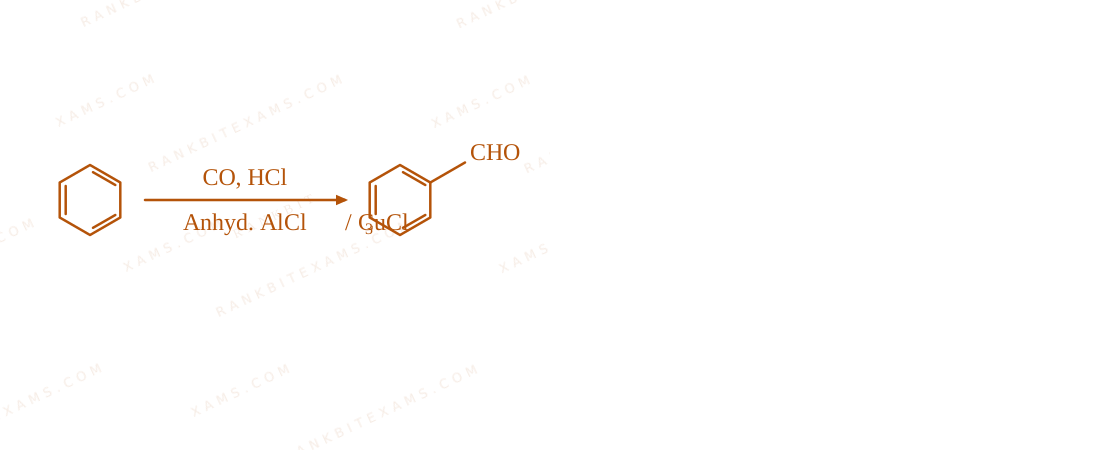
Identify the name reaction.
Preparation of Aldehydes and Ketones diagram for Q73 - JEE Main 2024 Evening
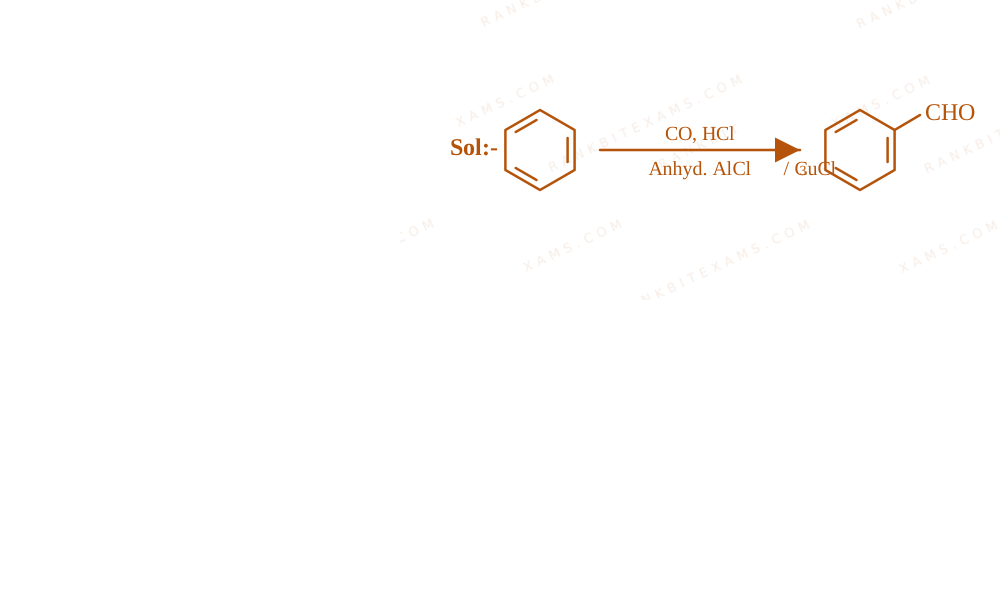
The image shows the conversion of benzene to benzaldehyde using CO, HCl, and Anhydrous AlCl3/CuCl.
  • A. text(1) Stephen reaction
  • B. text(2) Etard reaction
  • C. text(3) Gatterman-koch reaction
  • D. text(4) Rosenmund reduction

Solution

### Core Logic The reaction of benzene with carbon monoxide (CO) and hydrogen chloride (HCl) in the presence of anhydrous aluminium chloride (AlCl_3) and cuprous chloride (CuCl) to give benzaldehyde is known as the Gatterman-Koch reaction.
Preparation of Aldehydes and Ketones diagram for Q73 - JEE Main 2024 Evening
The image shows the conversion of benzene to benzaldehyde using CO, HCl, and Anhydrous AlCl3/CuCl.
### Pattern Recognition CO + HCl rightarrow Formyl chloride intermediate (in situ) with Lewis acid rightarrow formylation of benzene. This is definitively the Gatterman-Koch formylation. ### Evaluation Rubric / Model Answer null ### Chapter Mix Class 12 Chemistry: Aldehydes, Ketones and Carboxylic Acids
Q84 jee_main_2024_31_jan_morning Reactions with Grignard Reagent
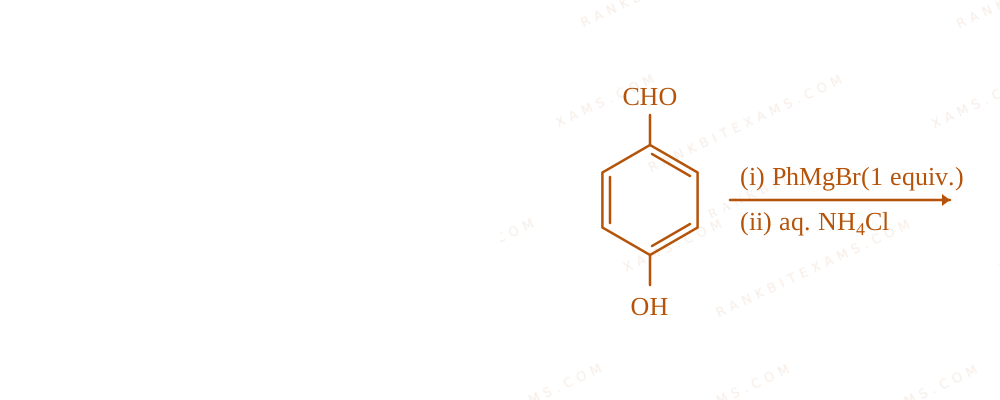
The product of the following reaction is P.
Reactions with Grignard Reagent diagram for Q84 - JEE Main 2024 Morning
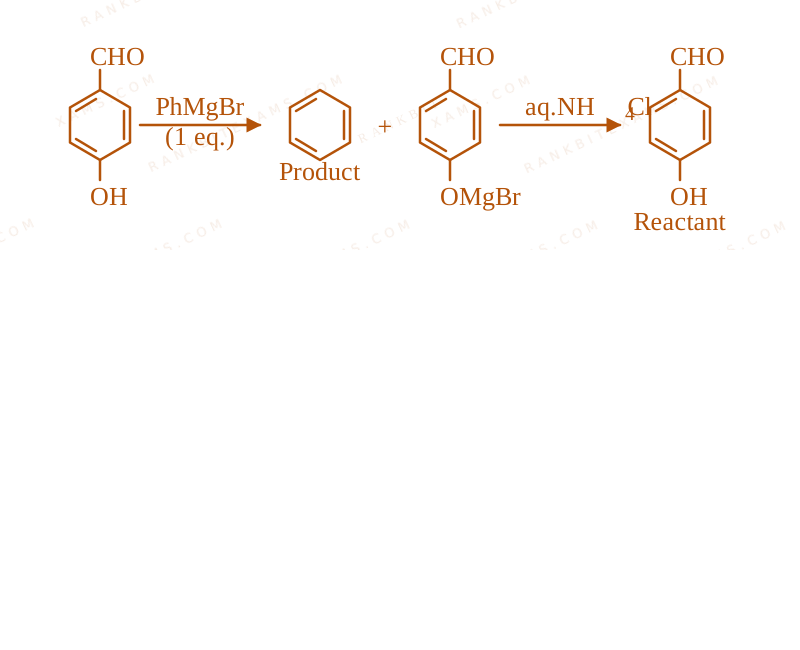
The image shows p-hydroxybenzaldehyde reacting with one equivalent of PhMgBr followed by aqueous ammonium chloride.
The number of hydroxyl groups present in the product P is
Numerical Answer. Answer: 0 to 0

Solution

### Core Logic The given reactant is p-hydroxybenzaldehyde, which contains both a phenolic -OH group (acidic) and an aldehyde group (electrophilic). When one equivalent of Grignard reagent (PhMgBr) is added, it behaves primarily as a strong base due to the presence of an acidic proton. Acid-base reactions are extremely fast compared to nucleophilic additions. The acidic phenolic -OH reacts with PhMgBr: PhMgBr + HO-C_6H_4-CHO rightarrow Ph-H (Benzene) + BrMg-O-C_6H_4-CHO Upon workup with aq. NH_4Cl, the phenoxide ion simply regenerates the starting p-hydroxybenzaldehyde. However, the question asks for the number of hydroxyl groups present in the formed product (Benzene).
Reactions with Grignard Reagent diagram for Q84 - JEE Main 2024 Morning
The image shows p-hydroxybenzaldehyde reacting with one equivalent of PhMgBr followed by aqueous ammonium chloride.
The distinct product formed in the reaction is Benzene. Benzene has 0 hydroxyl groups. ### Pattern Recognition Whenever a Grignard reagent encounters a molecule with an acidic hydrogen (alcohol, phenol, amine, alkyne), it will invariably act as a base first. If only 1 equivalent is used, nucleophilic addition to carbonyls will NOT happen. ### Evaluation Rubric / Model Answer null ### Chapter Mix Class 12 Chemistry: Aldehydes, Ketones and Carboxylic Acids Class 12 Chemistry: Alcohols, Phenols and Ethers
Rankbit System
JEE Physics: Waves (+15.5%) | Electrostatics: Concentric Shells (-29.7%) | Modern Physics: Photoelectric Clones (+34.2%) | Mathematics: Definite Integrals (+18.1%) | Chemistry: Coordination Splitting (-11.4%) | JEE Physics: Waves (+15.5%) | Electrostatics: Concentric Shells (-29.7%) | Modern Physics: Photoelectric Clones (+34.2%) | Mathematics: Definite Integrals (+18.1%) | Chemistry: Coordination Splitting (-11.4%)