JEE Main · Mathematics ↓ Falling

Probability appeared 35 times across 3 years — 4% of Mathematics. This question is from Total Probability Theorem.

Year 2026 2025 2024 Total
Questions 9 17 9 35

Bag 1 contains 4 white balls and 5 black balls, and Bag 2 contains n white balls and 3 black balls. One ball is drawn randomly from Bag 1 and transferred to Bag 2. A ball is then drawn randomly from Bag 2. If the probability, that the ball drawn is white, is 29/45, then n is equal to:

Solution & Explanation

Related Formula

Total Probability Law:

P(W) = P(W|B₁)P(B₁) + P(W|B₂)P(B₂)
Core Logic

Bag 1 contents: 4W, 5B (Total 9 balls). Bag 2 contents initially: nW, 3B (Total n+3 balls).

Case 1: Transferred ball is white (P = (4)/(9)): Bag 2 now has (n+1)W and 3B (Total n+4). Probability of drawing white = (n+1)/(n+4).

Case 2: Transferred ball is black (P = (5)/(9)): Bag 2 now has nW and 4B (Total n+4). Probability of drawing white = (n)/(n+4).

Step 1: Set up Equation and Solve

Aggregate components via Total Probability Formula:

((4)/(9) × (n+1)/(n+4)) + ((5)/(9) × (n)/(n+4)) = (29)/(45) (4(n+1) + 5n)/(9(n+4)) = (29)/(45) (9n + 4)/(n+4) = (29)/(5) 5(9n + 4) = 29(n + 4) 45n + 20 = 29n + 116 16n = 96 n = 6
Pattern Recognition

Notice how the denominators inside conditional stages match up identically (n+4). Clear constants before running fraction line conversions to speed up single-variable systems.

Chapter Mix

Class 12 Mathematics: Probability

Reference Study Guides

More Probability Previous-Year Questions — Page 4

Q jee_main_2025_28_jan_morning Probability Distribution and Variance
Three defective oranges are accidentally mixed with seven good ones and on looking at them, it is not possible to differentiate between them. Two oranges are drawn at random from the lot. If x denote the number of defective oranges, then the variance of x is :
  • A. 28/75
  • B. 14/25
  • C. 26/75
  • D. 18/25

Solution

Related Formula

Variance formula for discrete probability distributions:

σ² = Σ pᵢ xᵢ² - μ²
Core Logic

Construct the discrete probability distribution matrix for drawing 2 items out of 10 total items (3 defective, 7 good):
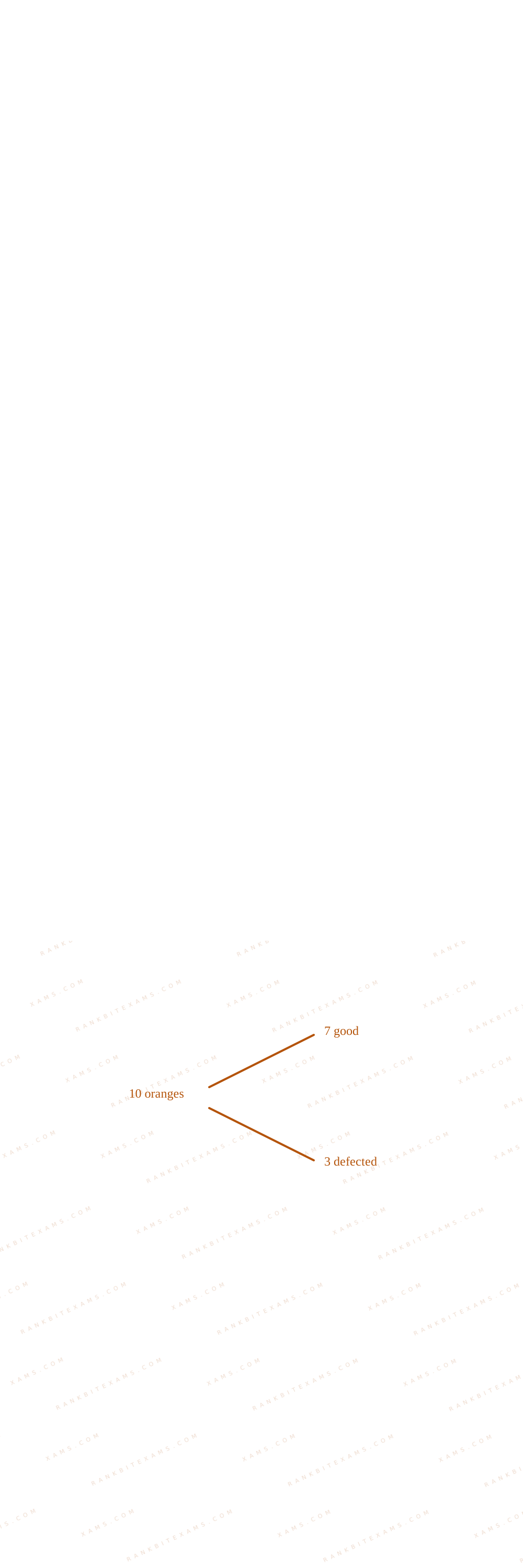
Probability Distribution and Variance diagram for Q69 - JEE Main 2025 Morning

xᵢpᵢ
x=0⁷C₂¹⁰C₂ = (42)/(90)
x=1⁷C₁ × ³C₁¹⁰C₂ = (42)/(90)
x=2³C₂¹⁰C₂ = (6)/(90)

Step 1: Calculating the Mean
μ = Σ xᵢ pᵢ = 0((42)/(90)) + 1((42)/(90)) + 2((6)/(90)) = (54)/(90) = (3)/(5)
Step 2: Evaluating the Variance Metric
σ² = Σ pᵢ xᵢ² - μ² = [0 + 1²((42)/(90)) + 2²((6)/(90))] - ((3)/(5))² σ² = (66)/(90) - (9)/(25) = (11)/(15) - (9)/(25) = (28)/(75)
Pattern Recognition

Discrete tables are best managed by computing component factor rows systematically before finalizing variance updates.

Chapter Mix

Class 12 Maths: Probability

Q71 jee_main_2025_03_april_morning Dictionary Rank with Geometrically Weighted Probabilities
All five letter words are made using all the letters A, B, C, D, E and arranged as in an English dictionary with serial numbers[cite: 666]. Let the word at serial number n be denoted by Wₙ[cite: 667]. Let the probability P(Wₙ) of choosing the word Wₙ satisfy P(Wₙ)=2P(Wₙ₋₁), n>1[cite: 667]. If P(CDBEA)= 2alpha2β-1, where α, β in N[cite: 687, 689], then α+β is equal to:
Numerical Answer. Answer: 183 to 183

Solution

Related Formula

Sum of geometric sequence series configuration:

SN = (a(r^N - 1))/(r - 1)

Total counts of permutations of 5 unique letter combinations = 5! = 120.

Core Logic

Set initial base state configuration parameter P(W₁) = x [cite: 1431]. Since probabilities escalate geometrically [cite: 1433]: Σi=1¹²⁰ P(Wᵢ) = x + 2x + 2²x + + 2¹¹⁹x = 1 [cite: 1432, 1433] x · 2¹²⁰ - 12 - 1 = 1 x = 12¹²⁰ - 1 [cite: 1434]

Step 1: Finding Dictionary Rank of CDBEA

Calculate alphabetical sequential position index values[cite: 1437]:

  • Words starting with A: 4! = 24 [cite: 1438]
  • Words starting with B: 4! = 24 [cite: 1438]
  • Words starting with CA: 3! = 6 [cite: 1438]
  • Words starting with CB: 3! = 6 [cite: 1439]
  • Words starting with CDA: 2! = 2 [cite: 1439]
  • Next word alphabetically: CDBAE (Rank 63) [cite: 1439]
  • Target word: CDBEA (Rank 64) [cite: 1440]
  • Thus, target word index is exactly n = 64[cite: 1442].

Step 2: Probabilistic coefficient calculation

Evaluate the specific targeted weighted entry value [cite: 1442]: P(W₆₄) = 2⁶³ · P(W₁) = 2⁶³2¹²⁰-1 [cite: 1442, 1443]

Matching structural values with expression flags [cite: 1443]: α = 63, β = 120 [cite: 1443] α + β = 63 + 120 = 183 [cite: 1443]

Pattern Recognition

When probability states map through clean binary power scale jumps, their total summation creates standard Mersenne number forms.

Chapter Mix

Class 11 Mathematics: Permutations and Combinations Class 12 Mathematics: Probability

Q73 jee_main_2025_04_april_evening Bayes Theorem
A card from a pack of 52 cards is lost. From the remaining 51 cards, n cards are drawn and are found to be spades. If the probability of the lost card to be a spade is (11)/(50), then n is equal to
Numerical Answer. Answer: 2 to 2

Solution

Core Logic

Let E₁ be the event that the lost card is a spade, and E₂ be the event that the lost card is not a spade.

P(E₁) = (13)/(52) = (1)/(4) and P(E₂) = (39)/(52) = (3)/(4)

Let A be the event that n cards drawn from the remaining 51 cards are all spades.

  • If the lost card was a spade (E₁), there are 12 spades left out of 51:
P(A|E₁) = 12n 51n
  • If the lost card was not a spade (E₂), there are 13 spades left out of 51:
P(A|E₂) = 13n 51n
Step 1: Applying Bayes Theorem

We are given the posterior probability that the lost card is a spade, P(E₁|A) = (11)/(50):

P(E₁|A) = (P(E₁)P(A|E₁))/(P(E₁)P(A|E₁) + P(E₂)P(A|E₂)) = (11)/(50) (1)/(4) · 12n 51n(1)/(4) · 12n 51n + (3)/(4) · 13n 51n = (11)/(50)

Canceling out the shared fractions (1)/(4) and 51n:

12n 12n + 3 13n = (11)/(50)
Step 2: Simplifying Binomial Coefficients

Express 13n in terms of 12n using the identity 13n = (13)/(13-n) 12n:

12n 12n + 3 · [ (13)/(13-n) 12n ] = (11)/(50)

Canceling 12n from numerator and denominator:

(1)/(1 + (39)/(13-n)) = (11)/(50) (13-n)/(13-n + 39) = (11)/(50) (13-n)/(52-n) = (11)/(50)

Cross-multiplying:

50(13 - n) = 11(52 - n) 650 - 50n = 572 - 11n 39n = 78 n = 2
Pattern Recognition

When expanding binomial dynamic ratios like An A+1n, always reduce the larger term fractionally using the absorption property to cancel out the factorial variables quickly.

Chapter Mix

Class 12 Mathematics: Probability

Q55 jee_main_2025_04_april_morning Classical Definition of Probability
The probability of forming a 12 persons committee from 4 engineers, 2 doctors and 10 professors containing at least 3 engineers and at least 1 doctor, is:
  • A. (129)/(182)
  • B. (103)/(182)
  • C. (17)/(26)
  • D. (19)/(26)

Solution

Related Formula

Classical Probability:

P(E) = Favorable CasesTotal Cases = (n(E))/(n(S))
Core Logic

Total pool size = 4 + 2 + 10 = 16 people. We choose 12. Total cases n(S) = ¹⁶C₁₂ = 1820.

List distinct combinations satisfying 'at least 3 engineers' and 'at least 1 doctor':

  • 3 Engineers, 1 Doctor, 8 Professors: ⁴C₃ × ²C₁ × ¹⁰C₈ = 4 × 2 × 45 = 360
  • 3 Engineers, 2 Doctors, 7 Professors: ⁴C₃ × ²C₂ × ¹⁰C₇ = 4 × 1 × 120 = 480
  • 4 Engineers, 1 Doctor, 7 Professors: ⁴C₄ × ²C₁ × ¹⁰C₇ = 1 × 2 × 120 = 240
  • 4 Engineers, 2 Doctors, 6 Professors: ⁴C₄ × ²C₂ × ¹⁰C₆ = 1 × 1 × 210 = 210
Step 1: Calculate Final Probability

Summing favorable cases:

n(E) = 360 + 480 + 240 + 210 = 1290 P(E) = (1290)/(1820) = (129)/(182)
Pattern Recognition

When constraints involve 'at least' for multiple groups simultaneously with a large committee size, creating structured exhaustive case distributions is safer and less error-prone than standard bijection/subtraction methods.

Chapter Mix

Class 11 Mathematics: Permutations and Combinations Class 12 Mathematics: Probability

Q69 jee_main_2025_04_april_morning Random Variables and Probability Distributions
A box contains 10 pens of which 3 are defective. A sample of 2 pens is drawn at random and let X denote the number of defective pens. Then the variance of X is
  • A. (11)/(15)
  • B. (28)/(75)
  • C. (2)/(15)
  • D. (3)/(5)

Solution

Related Formula

Variance formula for discrete random variables:

Var(X) = Σ xᵢ² P(xᵢ) - μ², μ = Σ xᵢ P(xᵢ)
Core Logic

Total selection size is ¹⁰C₂ = 45. X can take values 0, 1, 2. Set up probability distribution table:

xᵢx = 0x = 1x = 2
P(xᵢ)⁷C₂¹⁰C₂ = (21)/(45) = (7)/(15)⁷C₁ × ³C₁¹⁰C₂ = (21)/(45) = (7)/(15)³C₂¹⁰C₂ = (3)/(45) = (1)/(15)

Step 1: Calculate Mean
μ = 0((7)/(15)) + 1((7)/(15)) + 2((1)/(15)) = (9)/(15) = (3)/(5)
Step 2: Calculate Variance
Σ xᵢ² P(xᵢ) = 0²((7)/(15)) + 1²((7)/(15)) + 2²((1)/(15)) = (7 + 4)/(15) = (11)/(15) Var(X) = (11)/(15) - ((3)/(5))² = (11)/(15) - (9)/(25) = (55 - 27)/(75) = (28)/(75)
Pattern Recognition

This setup maps identically to a Hypergeometric Distribution. Checking fractions against a common denominator (15 or 45) helps avoid simple fractional reduction errors.

Chapter Mix

Class 12 Mathematics: Probability

More Probability Questions — jee_main_2025_29_jan_evening

Practice all Probability previous-year questions →

Rankbit System
JEE Physics: Waves (+15.5%) | Electrostatics: Concentric Shells (-29.7%) | Modern Physics: Photoelectric Clones (+34.2%) | Mathematics: Definite Integrals (+18.1%) | Chemistry: Coordination Splitting (-11.4%) | JEE Physics: Waves (+15.5%) | Electrostatics: Concentric Shells (-29.7%) | Modern Physics: Photoelectric Clones (+34.2%) | Mathematics: Definite Integrals (+18.1%) | Chemistry: Coordination Splitting (-11.4%)