If t→ 0(∫₀¹ (3x + 5)^t dx)(1)/(t) = (α)/(5e)((8)/(5))(2)/(3), then α is equal to

Numerical Answer Type:
Enter a numerical value Answer: 64 to 64 +4 marks

Solution & Explanation

Related Formula

Standard indeterminacy layout resolution rules for limits matching form 1^∞:

t → 0 [g(t)](1)/(t) = e^ t → 0 (g(t) - 1)/(t)
Core Logic

Evaluate structural integration base at boundary limit initialization state t → 0:

∫₀¹ 1 dx = 1

This confirms it matches an indeterminate form of type 1^∞.

Step 1: Apply Taylor Series or L'Hopital's Theorem

Compute limits of logarithmic integration properties inside exponential power indices:

Exponent Expression = t → 0 ∫₀¹ (3x+5)^t dx - 1t

Applying L'Hopital's theorem to differentiate the numerator with respect to t yields:

∫₀¹ (3x+5)^t ln(3x+5) dx

Evaluating this at t = 0 gives:

∫₀¹ ln(3x+5) dx
Step 2: Complete the Final Form Match

Integrating via parts results in logarithmic value updates:

[ ((3x+5)ln(3x+5) - (3x+5))/(3) ]₀¹ = (8ln 8 - 5ln 5 - 3)/(3)

Passing components back through exponential foundations transforms terms to:

e(8ln 8 - 5ln 5 - 3)/(3) = ((8)/(5))(2)/(3) · ((64)/(5e))

Comparing with the target expression (α)/(5e)((8)/(5))(2)/(3) isolates the numerical solution directly: α = 64

Pattern Recognition

Treating 1^∞ structural transformations using logarithmic derivatives allows managing complex functions containing multiple integral boundaries effectively.

Chapter Mix

Class 11 Mathematics: Limits Class 12 Mathematics: Definite Integration

Reference Study Guides

More Limits Previous-Year Questions — Page 3

Q5 jee_main_2026_28_january_evening Continuity of Functions at Specific Points
Let f(x) = θ → 0 ( π x - x((2)/(θ)) (x - 1)1 + x((2)/(θ))(x - 1) ), x in R. Consider the following two statements: (I) f(x) is discontinuous at x = 1. (II) f(x) is continuous at x = -1. Then,
  • A. Neither (I) nor (II) is True
  • B. Both (I) and (II) are True
  • C. Only (II) is True
  • D. Only (I) is True

Solution

Core Logic

Analyze the function limit as θ → 0: When |x| < 1, x2/θ → 0. When |x| > 1, x2/θ → ∞.

f(x) = cases π x & x → 1^- (- (x - 1))/(x - 1) & x → 1^+ cases
Step 1: Check Continuity at x = 1
RHL = x → 1^+ (- (x - 1))/(x - 1) = -1 LHL = x → 1^- π x = -1 f(1) = ( (π) - 1 · (0))/(1 + 1 · 0) = -1

Since LHL = RHL = f(1), f(x) is continuous at x = 1. Statement (I) is False.

Piecewise limits evaluation

Step 2: Check Continuity at x = -1

For x near -1:

f(x) = cases (- (x - 1))/(x - 1) & x → -1^- π x & x → -1^+ cases RHL = x → -1^+ π x = (-π) = -1 LHL = x → -1^- (- (x - 1))/(x - 1) = (- (-2))/(-2) = (- 2)/(2)

Since LHL ≠ RHL, f(x) is discontinuous at x = -1. Statement (II) is False.

Step 3: Final Conclusion

Both Statement I and Statement II are false.

Pattern Recognition

The expression x2/θ acts like a switch function similar to x²ⁿ as n → ∞. For |x|<1, the term drops out, and for |x|>1, the leading order terms with x2/θ dominate.

Chapter Mix

Class 12 Maths: Limits, Continuity and Differentiability
Q64 jee_main_2025_02_april_evening Limits
If x→ 0( (2x) + a (4x) - b)/(x⁴) is finite, then (a + b) is equal to:
  • A. (1)/(2)
  • B. 0
  • C. (3)/(4)
  • D. -1

Solution

Related Formula
Taylor Series expansion of u = 1 - (u²)/(2) + (u⁴)/(24) + O(u⁶)
Core Logic

Since the denominator has x⁴, we expand the numerator using Taylor series up to x⁴. For the limit to exist and be finite, the coefficients of lower powers of x (specifically x⁰ and x²) must be zero.

Step 1: Write down series expansions

Expand (2x) and (4x):

2x = 1 - (4x²)/(2) + (16x⁴)/(24) + O(x⁶) = 1 - 2x² + (2)/(3)x⁴ + O(x⁶) 4x = 1 - (16x²)/(2) + (256x⁴)/(24) + O(x⁶) = 1 - 8x² + (32)/(3)x⁴ + O(x⁶)
Step 2: Collect coefficients in the numerator

The numerator of the limit is:

(2x) + a (4x) - b = ( 1 - 2x² + (2)/(3)x⁴ ) + a( 1 - 8x² + (32)/(3)x⁴ ) - b = (1 + a - b) - x²(2 + 8a) + x⁴((2)/(3) + (32)/(3)a) + O(x⁶)
Step 3: Set lower order coefficients to zero

For the limit to be finite, the coefficients of x⁰ and x² must vanish:

  • From x² coefficient:
2 + 8a = 0 a = -(1)/(4)
  • From constant term:
1 + a - b = 0 b = a + 1 = -(1)/(4) + 1 = (3)/(4)

Now calculate the sum:

a + b = -(1)/(4) + (3)/(4) = (1)/(2)
Pattern Recognition

Finiteness condition: When a limit is finite with a denominator of xⁿ, it implies that the numerator is a function of order O(xⁿ) near zero. Taylor expansions allow you to quickly extract the necessary values of unknown coefficients.

Chapter Mix

Class 12 Mathematics: Limits, Continuity and Differentiability

Q jee_main_2025_02_april_morning Functional Equations and Derivatives
Let f R → R be a twice differentiable function such that ( x y)(f(2x+2y) - f(2x - 2y)) = ( x y)(f(2x+2y) + f(2x - 2y)), for all x, y in R. If f'(0) = (1)/(2), then the value of 24 f''((5π)/(3)) is:
  • A. 2
  • B. -3
  • C. 3
  • D. -2

Solution

Related Formula

Trigonometric Sine expansion difference:

(x-y) = x y - x y (x+y) = x y + x y
Core Logic

Rearrange the given expression to isolate the variables symmetrically:

f(2x+2y)( x y - x y) = f(2x-2y)( x y + x y) f(2x+2y) (x-y) = f(2x-2y) (x+y) (f(2x+2y))/( (x+y)) = (f(2x-2y))/( (x-y))
Step 1: Convert to Single Variable

Let 2x+2y = m and 2x-2y = n. Then x+y = (m)/(2) and x-y = (n)/(2).

(f(m))/( ((m)/(2))) = (f(n))/( ((n)/(2))) = K f(x) = K ((x)/(2))
Step 2: Find K using First Derivative

Differentiating f(x):

f'(x) = (K)/(2) ((x)/(2))

Given f'(0) = (1)/(2):

(1)/(2) = (K)/(2)(1) K = 1

Thus, f(x) = ((x)/(2)), f'(x) = (1)/(2) ((x)/(2)), and f''(x) = -(1)/(4) ((x)/(2)).

Step 3: Evaluate Second Derivative Value

For x = (5π)/(3):

f''((5π)/(3)) = -(1)/(4) ((5π)/(6)) = -(1)/(4) ((1)/(2)) = -(1)/(8)

Multiply by 24:

24 f''((5π)/(3)) = 24 (-(1)/(8)) = -3
Pattern Recognition

Grouping terms containing f(2x+2y) and f(2x-2y) directly creates standard sine difference/sum structures, simplifying the equation into a separable form matching a classic sine function template.

Chapter Mix

Class 12 Mathematics: Limits, Continuity and Differentiability Class 11 Mathematics: Trigonometric Functions

Q jee_main_2025_02_april_morning Limits by Expansion
For α, β, γ in R, if x → 0 x² α x + (γ - 1) ex² 2x - β x = 3, then β + γ - α is equal to:
  • A. 7
  • B. 4
  • C. 6
  • D. -1

Solution

Related Formula

Standard Taylor series expansions centered at x=0:

x = x - (x³)/(6) + e^x = 1 + x + (x²)/(2) +
Core Logic

Since the limit evaluates to a finite value (3) while the denominator goes to zero when x → 0 (if 2-β=0), the numerator coefficients of lower-degree terms must vanish to resolve the indetermination.

Step 1: Substitute Expansions

Substitute series expansions into numerator and denominator:

Numerator = x²(α x) + (γ - 1)(1 + x² + (x⁴)/(2) + ) Denominator = (2x - (8x³)/(6) + ) - β x = (2 - β)x - (4)/(3)x³ +
Step 2: Equate Coefficients to Avoid Infinity

Combine terms by degree:

x → 0 ((γ - 1) + (γ - 1)x² + α x³)/((2 - β)x - (4)/(3)x³) = 3

For a valid finite limit, the lowest power in the numerator cannot be smaller than the lowest power in the denominator.

  • Constraining constant term to zero: γ - 1 = 0 γ = 1
  • This also forces the x² coefficient to vanish: (γ - 1) = 0.
  • To balance the remaining leading x³ terms, the x term in the denominator must vanish: 2 - β = 0 β = 2.
Step 3: Evaluate Remaining Limit Value

Now compute the remaining simplified limit of x³ variables:

x → 0 (α x³)/(-(4)/(3)x³) = (-3α)/(4) = 3 α = -4
Step 4: Final Expression Calculation

Substitute the found parameters into β + γ - α:

β + γ - α = 2 + 1 - (-4) = 7
Pattern Recognition

Taylor expansions are far safer than consecutive L'Hopital iterations here because multiple variables are spread across distinct polynomial powers, isolating components explicitly by structural degree.

Chapter Mix

Class 12 Mathematics: Limits, Continuity and Differentiability

Q51 jee_main_2025_03_april_evening Differentiability and Extrema
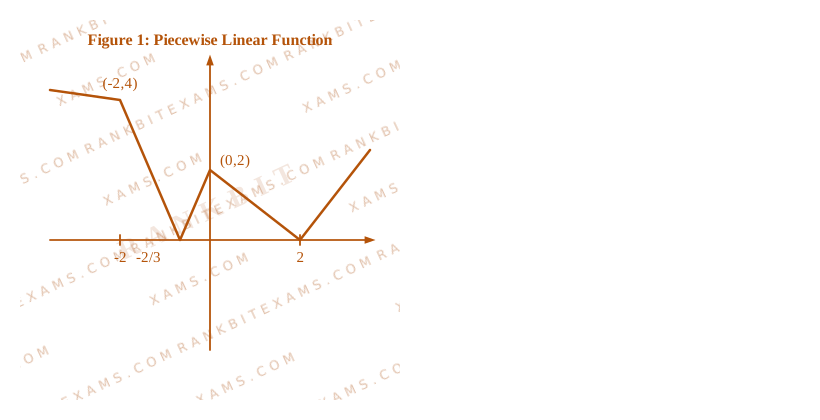
Let f: R → R be a function defined by f(x) = | |x + 2| - 2|x| |. If m is the number of points of local minima and n is the number of points of local maxima of f, then m + n is
  • A. 5
  • B. 3
  • C. 2
  • D. 4

Solution

Related Formula

For a continuous function f(x):

  • A point x = c is a local minimum if f(x) changes from decreasing to increasing as x passes through c (i.e., a trough in the graph).
  • A point x = c is a local maximum if f(x) changes from increasing to decreasing as x passes through c (i.e., a peak in the graph).
Core Logic

Let's analyze g(x) = |x+2| - 2|x| first to construct f(x) = |g(x)|.

  • If x ≤ -2:
g(x) = -(x+2) - 2(-x) = x - 2
  • If -2 < x ≤ 0:
g(x) = (x+2) - 2(-x) = 3x + 2
  • If x > 0:
g(x) = (x+2) - 2x = -x + 2

Now, we find the critical transition points where g(x) = 0:

  • x - 2 = 0 x = 2 (not in x ≤ -2)
  • 3x + 2 = 0 x = -2/3 (lies in -2 < x ≤ 0)
  • -x + 2 = 0 x = 2 (lies in x > 0)
  • Thus, the absolute value function f(x) = |g(x)| transitions at x = -2, x = -2/3, x = 0, and x = 2.

Step 1: Graph Reconstruction and Critical Points Analysis

Evaluating values at these boundaries:

  • f(-2) = | |-2+2| - 2|-2| | = |0 - 4| = 4
  • f(-2/3) = 0 (trough, local minimum)
  • f(0) = | |2| - 0 | = 2 (peak, local maximum)
  • f(2) = 0 (trough, local minimum)
  • Let's trace the graph:

  • For x < -2, f(x) = |x-2| = 2-x, which decreases towards 4 as x → -2.
  • At x = -2, there is a corner point (-2,4), but it is not an extremum because the function continues to decrease to 0 on the right.
  • At x = -2/3, it reaches 0 and turns upwards (local minimum).
  • At x = 0, it reaches a local peak of 2 and turns downwards (local maximum).
  • At x = 2, it reaches 0 and turns upwards (local minimum).
  • Extrema diagram for Q51 - JEE Main 2025 Evening Shift
    Extrema diagram for Q51 - JEE Main 2025 Evening Shift

Step 2: Calculating m + n

From the verified graph and transition behaviors:

  • Local minima points (m): x = -2/3 and x = 2 m = 2
  • Local maxima points (n): x = 0 n = 1
Sum m + n = 2 + 1 = 3
Pattern Recognition

Whenever you have f(x) = |g(x)| where g(x) is continuous:

  • Any point where g(x) = 0 becomes a local minimum with value 0 (unless it was a tangent point already, which still remains a minimum).
  • Corners of the original absolute segments like x=0, -2 must be checked sequentially for slope changes.
Chapter Mix

Class 12 Mathematics: Limits, Continuity and Differentiability Class 11 Mathematics: Relations and Functions

More Limits Questions — jee_main_2025_29_jan_evening

Practice all Limits previous-year questions →

Rankbit System
JEE Physics: Waves (+15.5%) | Electrostatics: Concentric Shells (-29.7%) | Modern Physics: Photoelectric Clones (+34.2%) | Mathematics: Definite Integrals (+18.1%) | Chemistry: Coordination Splitting (-11.4%) | JEE Physics: Waves (+15.5%) | Electrostatics: Concentric Shells (-29.7%) | Modern Physics: Photoelectric Clones (+34.2%) | Mathematics: Definite Integrals (+18.1%) | Chemistry: Coordination Splitting (-11.4%)