Consider the following low-spin complexes K_3[Co(NO_2)_6], K_4[Fe(CN)_6], K_3[Fe(CN)_6], Cu_2[Fe(CN)_6] and Zn_2[Fe(CN)_6]. The sum of the spin-only magnetic moment values of complexes having yellow colour is ________ B.M. (answer is nearest integer)

Numerical Answer Type:
Enter a numerical value Answer: 0 to 0 +4 marks

Solution & Explanation

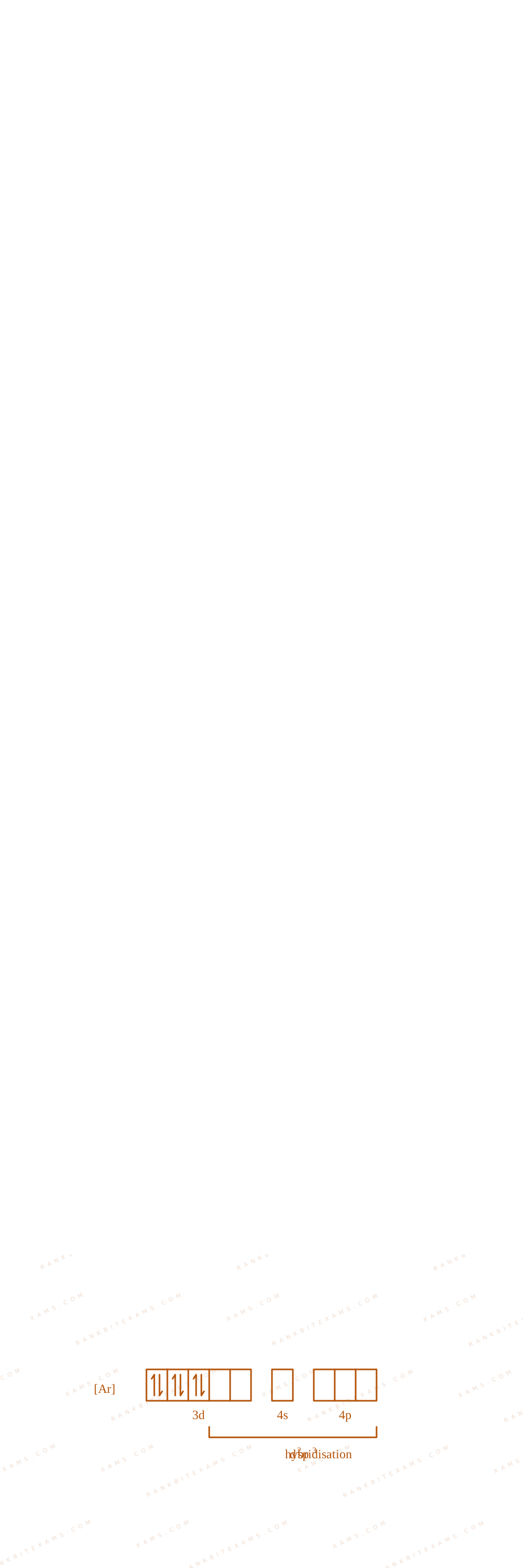
### Core Logic From the given list, the complexes exhibiting a distinct yellow color are K_3[Co(NO_2)_6] and K_4[Fe(CN)_6]. Let's calculate the spin-only magnetic moments for these low-spin configurations: 1) For K_3[Co(NO_2)_6], cobalt is in +3 oxidation state (Co^3+ = 3d^6). In the presence of the strong ligand field (NO_2^-), all six electrons pair up completely in the t_2g orbitals: t_2g^6 e_g^0 implies n = 0 text unpaired electrons implies mu = 0text BM
Crystal Field Theory and Colors of Complexes diagram for Q46 - JEE Main 2025 Evening
2) For K_4[Fe(CN)_6], iron is in +2 oxidation state (Fe^2+ = 3d^6). In the strong field of cyanide ligands (CN^-), pairing is complete: t_2g^6 e_g^0 implies n = 0 text unpaired electrons implies mu = 0text BM Therefore, the sum of their spin-only magnetic moments is 0 + 0 = 0. ### Pattern Recognition Low-spin d^6 octahedral complexes always yield a fully closed-shell t_2g^6 arrangement with zero unpaired electrons, leading deterministically to a magnetic moment of 0 BM. ### Evaluation Rubric / Model Answer null ### Chapter Mix Class 12 Chemistry: Coordination Compounds

Reference Study Guides

More Coordination Compounds Previous-Year Questions — Page 9

Q62 jee_main_2024_29_jan_morning Applications of Coordination Compounds
Match List I with List II
LIST-I (Substances)LIST-II (Element Present)
A. Ziegler catalystI. Rhodium
B. Blood PigmentII. Cobalt
C. Wilkinson catalystIII. Iron
D. Vitamin B_12IV. Titanium
Choose the correct answer from the options given below:
  • A. textA-II, B-IV, C-I, D-III
  • B. textA-II, B-III, C-IV, D-I
  • C. textA-III, B-II, C-IV, D-I
  • D. textA-IV, B-III, C-I, D-II

Solution

### Core Logic Let us identify the central metal atom/element present in each of the given coordination complexes or biological molecules: 1. **Ziegler-Natta catalyst**: Used for polymerization of alkenes. Its chemical composition involves TiCl_4 and (C_2H_5)_3Al. Hence, the transition metal present is Titanium (IV). 2. **Blood pigment (Haemoglobin)**: The oxygen-carrying metalloprotein in red blood cells. It contains an Iron (III) central atom coordinated to a porphyrin ring. 3. **Wilkinson's catalyst**: Used for the hydrogenation of alkenes. Its formula is [RhCl(PPh_3)_3], meaning it contains Rhodium (I). 4. **Vitamin B_12 (Cyanocobalamin)**: A biologically important coordination compound containing Cobalt (II) at the center of a corrin ring. ### Step 1: Final Mapping Matching the elements: (A) Ziegler catalyst rightarrow (IV) Titanium (B) Blood Pigment rightarrow (III) Iron (C) Wilkinson catalyst rightarrow (I) Rhodium (D) Vitamin B_12 rightarrow (II) Cobalt This strictly maps to sequence A-IV, B-III, C-I, D-II. ### Pattern Recognition Always memorize the central metal for famous catalysts and biomolecules: Chlorophyll (Mg), Haemoglobin (Fe), Vitamin B12 (Co), Wilkinson (Rh), Ziegler-Natta (Ti). ### Evaluation Rubric / Model Answer null ### Chapter Mix Class 12 Chemistry: Coordination Compounds Class 12 Chemistry: d and f Block Elements
Q75 jee_main_2024_29_jan_morning Metal Carbonyls
In which one of the following metal carbonyls, CO forms a bridge between metal atoms?
  • A. left[mathrmCo_2(mathrmCO)_8right]
  • B. [mathrmMn_2(mathrmCO)_10]
  • C. [mathrmOs_3(mathrmCO)_12]
  • D. [mathrmRu_3(mathrmCO)_12]

Solution

### Core Logic Let's examine the structure of each polynuclear metal carbonyl: 1. **[Co_2(CO)_8]**: Solid octacarbonyldicobalt(0) exists in a bridged structure. It has a Co-Co bond and two bridging CO ligands, along with three terminal CO ligands on each cobalt atom. So, it contains bridging CO groups. 2. **[Mn_2(CO)_10]**: Decacarbonyldimanganese(0) has a single Mn-Mn bond and all 10 CO ligands are terminal. It does NOT have any bridging carbonyls. 3. **[Os_3(CO)_12]**: Dodecacarbonyltriosmium(0) forms a triangular cluster of Os atoms with all 12 CO ligands being terminal. 4. **[Ru_3(CO)_12]**: Dodecacarbonyltriruthenium(0) similarly forms a triangular Ru_3 cluster where all 12 CO ligands are terminal. ### Step 1: Conclusion Only [Co_2(CO)_8] features CO forming a bridge between the metal atoms. ### Evaluation Rubric / Model Answer null ### Chapter Mix Class 12 Chemistry: Coordination Compounds
Q74 jee_main_2024_30_january_evening Metal Carbonyls
The coordination geometry around the manganese in decacarbonyldimanganese(0)
  • A. textOctahedral
  • B. textTrigonal bipyramidal
  • C. textSquare pyramidal
  • D. textSquare planar

Solution

### Core Logic Decacarbonyldimanganese(0) is Mn_2(CO)_10. In this binuclear carbonyl, there is one Mn-Mn bond. Each Mn atom is additionally bonded to five carbonyl (CO) ligands. Therefore, the coordination number of each Mn atom is 1 + 5 = 6. The arrangement of these 6 bonds around each Mn atom is octahedral.
Octahedral geometry around Mn diagram for Q74 - JEE Main 2024 Evening
### Evaluation Rubric / Model Answer null ### Chapter Mix Class 12 Chemistry: Coordination Compounds
Q81 jee_main_2024_30_january_evening Isomerism in Coordination Compounds
Number of complexes which show optical isomerism among the following is cis-[mathrmCr(ox)_2mathrmCl_2]^3-, [mathrmCo(en)_3]^3+ cis-[mathrmPt(en)_2mathrmCl_2]^2+, cis-[mathrmCo(en)_2mathrmCl_2]^+ trans-[mathrmPt(en)_2mathrmCl_2]^2+, trans-[mathrmCr(ox)_2mathrmCl_2]^3-
Numerical Answer. Answer: 4 to 4

Solution

### Core Logic Optical isomerism is shown by complexes that are chiral, meaning they lack both a plane of symmetry (POS) and a center of symmetry (COS). 1. cis-[mathrmCr(ox)_2mathrmCl_2]^3-: Cis configuration with bidentate ligands lacks a POS/COS. rightarrow Shows optical isomerism. 2. [mathrmCo(en)_3]^3+: Tris(bidentate) complex lacks POS/COS. rightarrow Shows optical isomerism (exists as Delta and Lambda enantiomers). 3. cis-[mathrmPt(en)_2mathrmCl_2]^2+: Cis configuration lacks POS/COS. rightarrow Shows optical isomerism. 4. cis-[mathrmCo(en)_2mathrmCl_2]^+: Cis configuration lacks POS/COS. rightarrow Shows optical isomerism. 5. trans-[mathrmPt(en)_2mathrmCl_2]^2+: Trans configuration is highly symmetric and contains a POS (along the square plane). rightarrow Cannot show optical isomerism. 6. trans-[mathrmCr(ox)_2mathrmCl_2]^3-: Trans configuration contains a POS/COS. rightarrow Cannot show optical isomerism. ### Step 1: Final Tally Out of the 6 complexes, 4 can show optical isomerism. The answer is 4. ### Pattern Recognition For octahedral complexes with bidentate ligands: cis isomers generally show optical isomerism, whereas trans isomers have a plane of symmetry and are optically inactive. [M(L-L)_3] types are always chiral. ### Evaluation Rubric / Model Answer null ### Chapter Mix Class 12 Chemistry: Coordination Compounds
Q67 jee_main_2024_30_jan_morning Coordination Geometry
Aluminium chloride in acidified aqueous solution forms an ion having geometry
  • A. textOctahedral
  • B. textSquare Planar
  • C. textTetrahedral
  • D. textTrigonal bipyramidal

Solution

### Core Logic AlCl_3 dissolves in acidified water to form the hexaquaaluminium(III) complex ion. The reaction can be represented as: AlCl_3 + 6H_2O rightarrow [Al(H_2O)_6]^3+ + 3Cl^- ### Step 1: Analyzing Geometry The central aluminium atom coordinates with 6 water molecules, giving a coordination number of 6. A coordination number of 6 results in an octahedral geometry (sp^3d^2 hybridization). ### Evaluation Rubric / Model Answer null ### Chapter Mix Class 12 Chemistry: Coordination Compounds Class 11 Chemistry: The p-Block Elements

More Coordination Compounds Questions — jee_main_2025_29_jan_evening

Practice all Coordination Compounds previous-year questions →

Rankbit System
JEE Physics: Waves (+15.5%) | Electrostatics: Concentric Shells (-29.7%) | Modern Physics: Photoelectric Clones (+34.2%) | Mathematics: Definite Integrals (+18.1%) | Chemistry: Coordination Splitting (-11.4%) | JEE Physics: Waves (+15.5%) | Electrostatics: Concentric Shells (-29.7%) | Modern Physics: Photoelectric Clones (+34.2%) | Mathematics: Definite Integrals (+18.1%) | Chemistry: Coordination Splitting (-11.4%)
