JEE Main · Chemistry ↓ Falling

Coordination Compounds appeared 68 times across 3 years — 7.9% of Chemistry. This question is from Crystal Field Theory and Colors of Complexes.

Year 2026 2025 2024 Total
Questions 19 34 15 68

Consider the following low-spin complexes K₃[Co(NO₂)₆], K₄[Fe(CN)₆], K₃[Fe(CN)₆], Cu₂[Fe(CN)₆] and Zn₂[Fe(CN)₆]. The sum of the spin-only magnetic moment values of complexes having yellow colour is ________ B.M. (answer is nearest integer)

Numerical Answer Type:
Enter a numerical value Answer: 0 to 0 +4 marks

Solution & Explanation

Core Logic

From the given list, the complexes exhibiting a distinct yellow color are K₃[Co(NO₂)₆] and K₄[Fe(CN)₆].

Let's calculate the spin-only magnetic moments for these low-spin configurations:

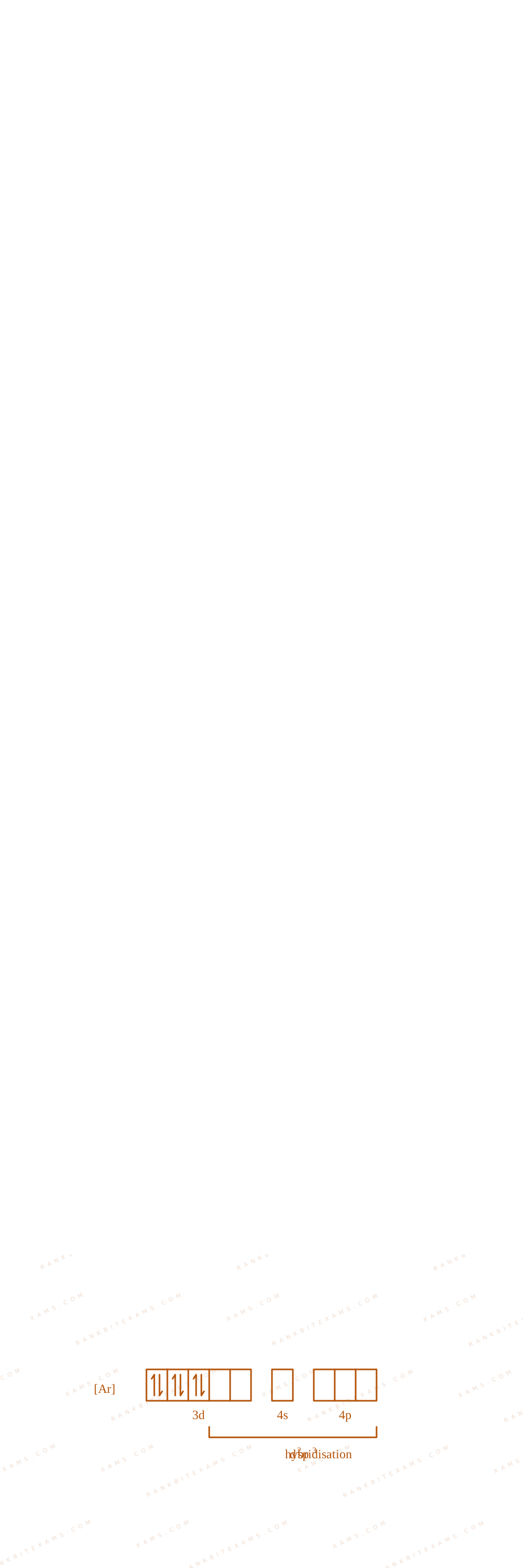
  • For K₃[Co(NO₂)₆], cobalt is in +3 oxidation state (Co³⁺ = 3d⁶).
  • In the presence of the strong ligand field (NO₂^-), all six electrons pair up completely in the t2g orbitals:

t2g⁶ eg⁰ implies n = 0 unpaired electrons implies mu = 0 BM

Crystal Field Theory and Colors of Complexes diagram for Q46 - JEE Main 2025 Evening

  • For K₄[Fe(CN)₆], iron is in +2 oxidation state (Fe²⁺ = 3d⁶).
  • In the strong field of cyanide ligands (CN^-), pairing is complete:

t2g⁶ eg⁰ implies n = 0 unpaired electrons implies mu = 0 BM

Therefore, the sum of their spin-only magnetic moments is 0 + 0 = 0.

Pattern Recognition

Low-spin d⁶ octahedral complexes always yield a fully closed-shell t2g⁶ arrangement with zero unpaired electrons, leading deterministically to a magnetic moment of 0 BM.

Chapter Mix

Class 12 Chemistry: Coordination Compounds

Reference Study Guides

More Coordination Compounds Previous-Year Questions — Page 3

Q51 jee_main_2026_24_january_morning Magnetic Properties and Shapes
Given below are two statements : Statement-I Hybridisation, shape and spin only magnetic moment of K₃[Co(CO₃)₃] is sp³d², octahedral and 4.9 BM respectively. Statement-II Geometry, hybridisation and spin only magnetic moment values (BM) of the ions [Ni(CN)₄]²⁻, [MnBr₄]²⁻ and [CoF₆]³⁻ respectively are square planar, tetrahedral, octahedral : dsp², sp³, sp³d² and 0, 5.9, 4.9. In the light of the above statements, choose the correct answer from the options given below
  • A. Both statement-I and statement-II are false
  • B. Statement I is false but statement-II is true
  • C. Both statement-I and statement-II are true
  • D. Statement-I is true but statement-II is false

Solution

Core Logic

In K₃[Co(CO₃)₃], the oxidation state of Co is +3 (3d⁶ configuration). Since carbonate is a weak field ligand, electrons do not pair up. Hybrdisation is sp³d² (octahedral), with 4 unpaired electrons.

μ = √(4(4+2)) = √(24) ≈ 4.9 B.M.

Thus, Statement I is true.

For Statement II: [Ni(CN)₄]²⁻: Ni²⁺ (3d⁸). CN^- is a strong field ligand. Pairing occurs. Hybridisation is dsp² (square planar), 0 unpaired electrons, μ = 0 B.M. [MnBr₄]²⁻: Mn²⁺ (3d⁵). Br^- is a weak field ligand. sp³ hybridised (tetrahedral), 5 unpaired electrons, μ = 5.9 B.M. [CoF₆]³⁻: Co³⁺ (3d⁶). F^- is a weak field ligand. sp³d² hybridised (octahedral), 4 unpaired electrons, μ = 4.9 B.M. Thus, Statement II is also true.

Step 1: Final Conclusion

Both Statement I and Statement II are true.

Pattern Recognition

Check the ligand strength: CO₃²⁻ and Halogens are WFL (outer orbital complexes, high spin), while CN^- is SFL (inner orbital, low spin). Calculate unpaired electrons n, then use √(n(n+2)).

Chapter Mix

Class 12 Chemistry: Coordination Compounds

Q58 jee_main_2026_24_january_morning Ionization Isomerism and Precipitation Reactions
Consider a mixture 'X' which is made by dissolving 0.4 mol of [Co(NH₃)₅SO₄]Br and 0.4 mol of [Co(NH₃)₅Br]SO₄ in water to make 4 L of solution. When 2 L of mixture 'X' is allowed to react with excess of AgNO₃, it forms precipitate 'Y'. The rest 2 L of mixture 'X' reacts with excess BaCl₂ to form precipitate 'Z'. Which of the following statements is CORRECT.
  • A. 0.2 mol of 'Z' is formed
  • B. 'Y' is BaSO₄ and 'Z' is AgBr
  • C. 0.4 mol of 'Z' is formed
  • D. 0.1 mol of 'Y' is formed

Solution

Core Logic

The 4 L solution contains: 0.4 mol of [Co(NH₃)₅SO₄]Br Gives 0.4 mol Br^- in solution. 0.4 mol of [Co(NH₃)₅Br]SO₄ Gives 0.4 mol SO₄²⁻ in solution.

The solution is divided into two 2 L portions. Each 2 L portion will contain exactly half the moles of each species: Moles of Br^- in 2 L = 0.2 mol Moles of SO₄²⁻ in 2 L = 0.2 mol

Step 1: Reaction with Silver Nitrate

When the first 2 L of the mixture reacts with excess AgNO₃:

Ag^+ + Br^- arrow AgBr (Precipitate 'Y')

Since there are 0.2 mol of free Br^- ions, 0.2 mol of AgBr (Y) will be formed.

Step 2: Reaction with Barium Chloride

When the remaining 2 L of the mixture reacts with excess BaCl₂:

Ba²⁺ + SO₄²⁻ arrow BaSO₄ (Precipitate 'Z')

Since there are 0.2 mol of free SO₄²⁻ ions, 0.2 mol of BaSO₄ (Z) will be formed.

Step 3: Final Conclusion

Checking the options: (1) 0.2 mol of 'Z' is formed True. (2) 'Y' is BaSO₄ and 'Z' is AgBr False, they are reversed. (3) 0.4 mol of 'Z' is formed False, it's 0.2 mol. (4) 0.1 mol of 'Y' is formed False, it's 0.2 mol.

Pattern Recognition

Only the counter-ions (outside the coordination sphere) ionize in water and participate in precipitation reactions. Always account for volume fractions when a solution is split.

Chapter Mix

Class 12 Chemistry: Coordination Compounds Class 11 Chemistry: Some Basic Concepts of Chemistry

Q59 jee_main_2026_24_january_morning Paramagnetism and Unpaired Electrons
Given below are two statements Statements-I: The number of paramagnetic species among [CoF₆]³⁻, [TiF₆]³⁻, V₂O₅ and [Fe(CN)₆]³⁻ is 3. Statement-II: K₄[Fe(CN)₆] < K₃[Fe(CN)₆] < [Fe(H₂O)₆]SO₄ · H₂O < [Fe(H₂O)₆]Cl₃ is the correct order in terms of number of unpaired electron(s) in the complexes. In the light of the above statements, choose the correct answer from the options given below.
  • A. Both statement-I and statement-II are true
  • B. Both statement-I and statement-II are false
  • C. Statement-I is true but statement-II is false
  • D. Statement-I is false but statement-II is true

Solution

Core Logic

Analyzing Statement I: [CoF₆]³⁻: Co³⁺ is 3d⁶. F is WFL high spin, 4 unpaired electrons (paramagnetic). [TiF₆]³⁻: Ti³⁺ is 3d¹. 1 unpaired electron (paramagnetic). V₂O₅: V⁵⁺ is 3d⁰. 0 unpaired electrons (diamagnetic). [Fe(CN)₆]³⁻: Fe³⁺ is 3d⁵. CN is SFL low spin, 1 unpaired electron (paramagnetic). Total paramagnetic species = 3. Statement I is true.

Analyzing Statement II: K₄[Fe(CN)₆]: Fe²⁺ is 3d⁶. SFL t2g⁶ eg⁰, 0 unpaired electrons. K₃[Fe(CN)₆]: Fe³⁺ is 3d⁵. SFL t2g⁵ eg⁰, 1 unpaired electron. [Fe(H₂O)₆]SO₄ · H₂O: Fe²⁺ is 3d⁶. H₂O is WFL t2g⁴ eg², 4 unpaired electrons. [Fe(H₂O)₆]Cl₃: Fe³⁺ is 3d⁵. H₂O is WFL t2g³ eg², 5 unpaired electrons. The order 0 < 1 < 4 < 5 is correct. Statement II is true.

Step 1: Final Conclusion

Both Statement I and Statement II are true.

Pattern Recognition

Identify the oxidation state, count d-electrons, apply spectrochemical series to determine pairing, then count unpaired electrons to establish diamagnetic (n=0) vs paramagnetic (n>0).

Chapter Mix

Class 12 Chemistry: Coordination Compounds Class 12 Chemistry: The d- and f-Block Elements

Q57 jee_main_2026_24_january_evening Crystal Field Theory
The wavelength of light absorbed for the following complexes are in the order. I: [Co(NH₃)₆]³⁺ II: [Co(H₂O)₆]³⁺ III: [Co(CN)₆]³⁻ IV: [Co(NH₃)₅(H₂O)]³⁺ V: [CoF₆]³⁻
  • A. III < I < II < IV < V
  • B. III < I < IV < V < II
  • C. III < IV < I < II < V
  • D. III < I < IV < II < V

Solution

Related Formula
E = (hc)/(λ) λ ∝ (1)/(Δₒ)
Core Logic

Wavelength of light absorbed increases as the Crystal Field Splitting Energy (C.F.S.E, Δₒ) of the complex decreases. According to the spectrochemical series, the ligand field strength follows the order: CN^- > NH₃ > H₂O > F^-

Based on this: Ligand field strength ; C.F.S.E ; Absorbed wavelength (λ)

[Co(CN)₆]³⁻ (III) has the strongest ligand, so maximum CFSE and minimum λ. [CoF₆]³⁻ (V) has the weakest ligand, so least CFSE and maximum λ.

Comparing (NH₃)₆ (I) vs (NH₃)₅(H₂O) (IV) vs (H₂O)₆ (II): Since NH₃ > H₂O, the field strength decreases as we replace NH₃ with H₂O. Thus, field strength order: III > I > IV > II > V Correct absorbed wavelength (λ) order will be the reverse: III < I < IV < II < V

Pattern Recognition

Strong field ligands cause high splitting (large Δ), meaning they absorb higher energy photons, which correspond to shorter wavelengths. Remember: λ ∝ 1/field strength.

Chapter Mix

Class 12 Chemistry: Coordination Compounds

Q73 jee_main_2026_24_january_evening Werner's Theory and Isomerism
A chromium complex with a formula CrCl₃·6H₂O has a spin only magnetic moment value of 3.87 BM and its solution conductivity corresponds to 1:2 electrolyte. 2.75 g of the complex solution was initially passed through a cation exchanger. The solution obtained after the process was reacted with excess of AgNO₃ . The amount of AgCl formed in the above process is ____ g. (Nearest integer) [Given : Molar mass in g mol ⁻¹ Cr : 52; Cl : 35.5, Ag : 108, O : 16, H : 1]
Numerical Answer. Answer: 3 to 3

Solution

Core Logic

Since the complex behaves as a 1:2 electrolyte, it must dissociate into 3 ions: 1 complex cation and 2 counter anions. This means two chloride ions (Cl^-) must reside outside the coordination sphere. The structural formula is: [Cr(H₂O)₅Cl]Cl₂ ₂O. Reaction with silver nitrate: [Cr(H₂O)₅Cl]Cl₂ ₂O + 2AgNO₃ arrow 2AgCl + complex nitrate

Step 1: Calculate Moles of Complex

Molar mass of CrCl₃· 6H₂O = 52 + 3(35.5) + 6(18) = 52 + 106.5 + 108 = 266.5 g/mol. Moles of the complex = (2.75)/(266.5) 0.01031 moles.

Step 2: Calculate Mass of Precipitate

Since each mole of complex gives 2 moles of AgCl: Moles of AgCl formed = 2 × 0.01031 = 0.02063 moles. Molar mass of AgCl = 108 + 35.5 = 143.5 g/mol. Mass of AgCl = 0.02063 × 143.5 2.96 gm. Rounding to the nearest integer yields 3.

Pattern Recognition

A 1:2 electrolyte contains 3 total ions. For CrCl₃ · 6H₂O, this strictly dictates 2 Cl^- are outside the coordination sphere. Hence n factor for chloride precipitation is exactly 2.

Chapter Mix

Class 12 Chemistry: Coordination Compounds Class 11 Chemistry: Some Basic Concepts of Chemistry

More Coordination Compounds Questions — jee_main_2025_29_jan_evening

Practice all Coordination Compounds previous-year questions →

Rankbit System
JEE Physics: Waves (+15.5%) | Electrostatics: Concentric Shells (-29.7%) | Modern Physics: Photoelectric Clones (+34.2%) | Mathematics: Definite Integrals (+18.1%) | Chemistry: Coordination Splitting (-11.4%) | JEE Physics: Waves (+15.5%) | Electrostatics: Concentric Shells (-29.7%) | Modern Physics: Photoelectric Clones (+34.2%) | Mathematics: Definite Integrals (+18.1%) | Chemistry: Coordination Splitting (-11.4%)