In the Claisen-Schmidt reaction to prepare dibenzalacetone from 5.3 g$5.3\text{ g}$ of benzaldehyde, a total of 3.51 g$3.51\text{ g}$ of product was obtained.
The percentage yield in this reaction was __%.
Numerical Answer Type:
Enter a numerical valueAnswer: 60 to 60+4 marks
Solution & Explanation
Core Logic
The balanced chemical equation for the synthesis of dibenzalacetone is:
Molar mass of benzaldehyde (PhCHO) = 106 g/mol$$\text{Molar mass of benzaldehyde } (PhCHO) = 106\text{ g/mol}$$Moles of benzaldehyde used = (5.3)/(106) = 0.05 mol = (1)/(20) mol$$\text{Moles of benzaldehyde used} = \frac{5.3}{106} = 0.05\text{ mol} = \frac{1}{20}\text{ mol}$$
Claisen-Schmidt Condensation diagram for Q48 - JEE Main 2025 Evening
According to the reaction stoichiometry, 2 moles of PhCHO$2\text{ moles of } PhCHO$ yield 1 mole of dibenzalacetone$1\text{ mole of dibenzalacetone}$.
Theoretical moles of product = (0.05)/(2) = 0.025 mol$$\text{Theoretical moles of product} = \frac{0.05}{2} = 0.025\text{ mol}$$
Step 1: Yield Evaluation
$Molar mass of dibenzalacetone (C17H14O) = 234 g/mol$$$\text{Molar mass of dibenzalacetone } (C{17}H{14}O) = 234\text{ g/mol}$$Theoretical mass = 0.025 × 234 = 5.85 g$$\text{Theoretical mass} = 0.025 \times 234 = 5.85\text{ g}$$Percentage yield = Actual massTheoretical mass × 100 = (3.51)/(5.85) × 100 = 60%$$\text{Percentage yield} = \frac{\text{Actual mass}}{\text{Theoretical mass}} \times 100 = \frac{3.51}{5.85} \times 100 = 60%$$
Pattern Recognition
Always remember the stoichiometric ratio: It takes 2 moles of benzaldehyde to condense with 1 mole of acetone to form the symmetrical dibenzalacetone product.
Chapter Mix
Class 12 Chemistry: Aldehydes, Ketones and Carboxylic Acids
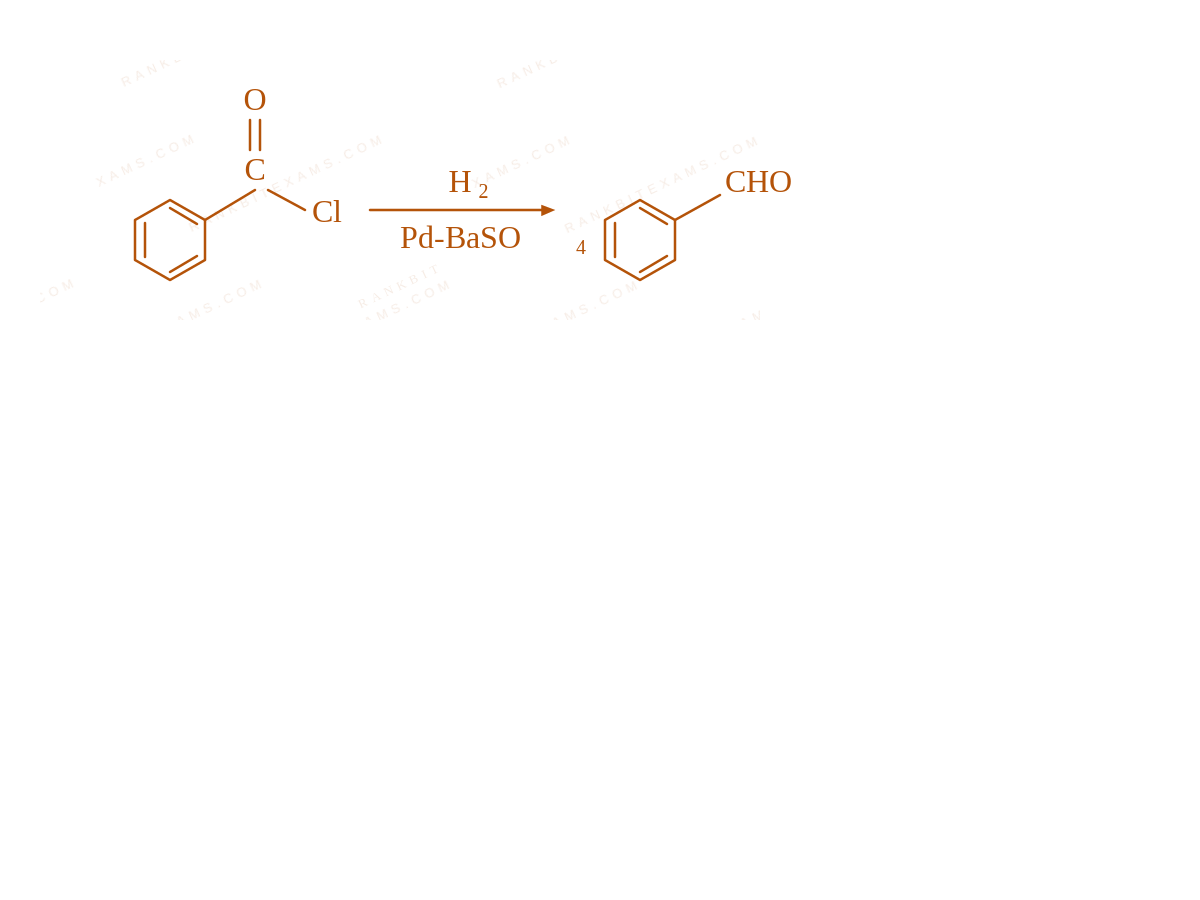
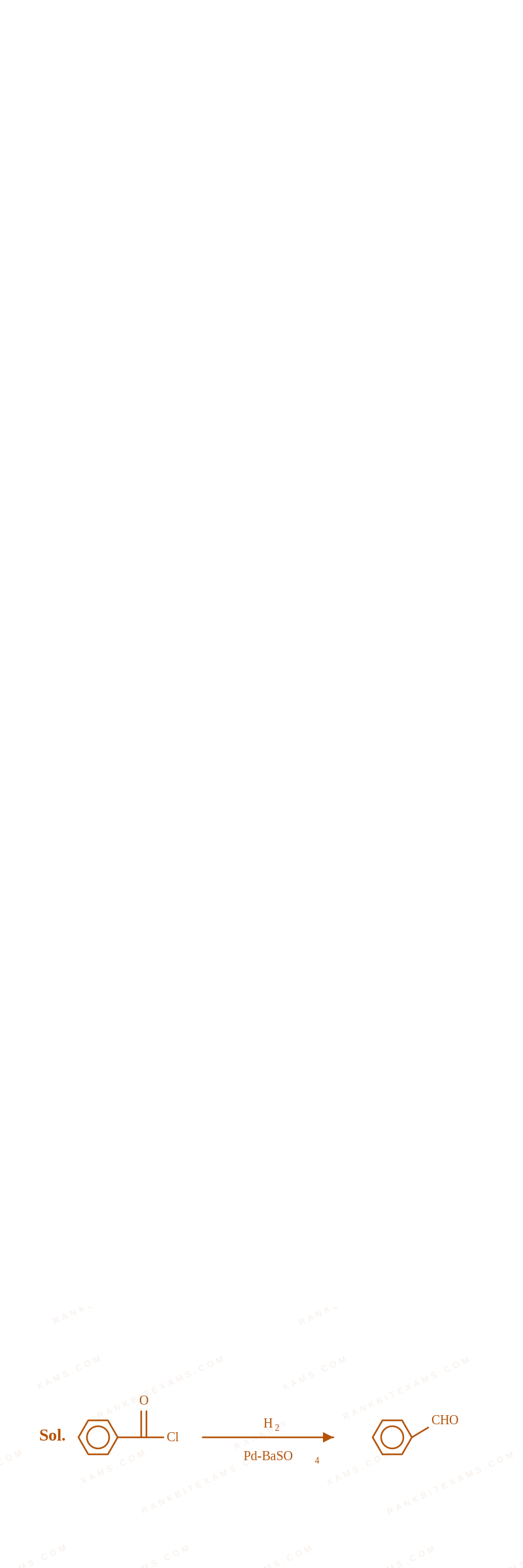
The reaction depicts the partial reduction of an acid chloride (benzoyl chloride) to an aldehyde (benzaldehyde) using hydrogen gas in the presence of a poisoned palladium catalyst (Pd supported on BaSO₄$BaSO_4$).
The image shows the catalytic hydrogenation of benzoyl chloride to benzaldehyde in the presence of Pd-BaSO4.
This specific reaction is known as the Rosenmund reduction.
Pattern Recognition
Acid Chloride + H₂, Pd/BaSO₄$H_2, Pd/BaSO_4$arrow$\rightarrow$ Aldehyde is strictly the Rosenmund reduction. The BaSO₄$BaSO_4$ poisons the catalyst to prevent over-reduction to an alcohol.
Chapter Mix
Class 12 Chemistry: Aldehydes, Ketones and Carboxylic Acids
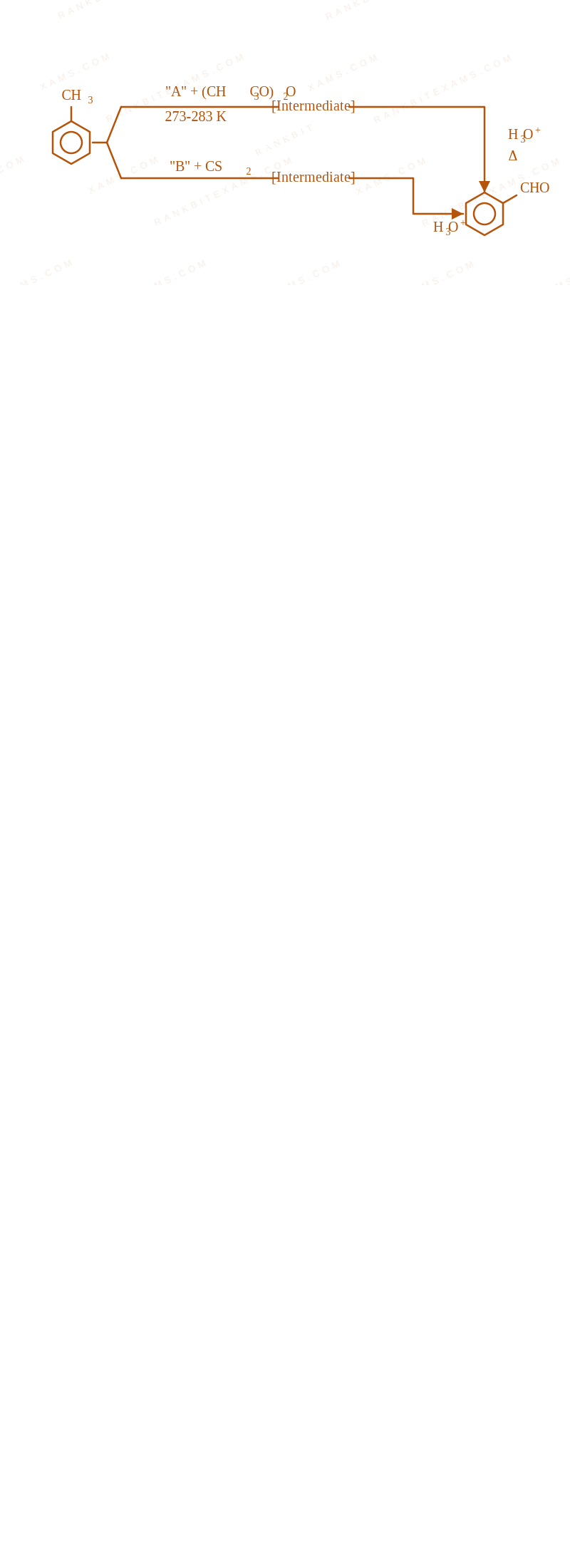
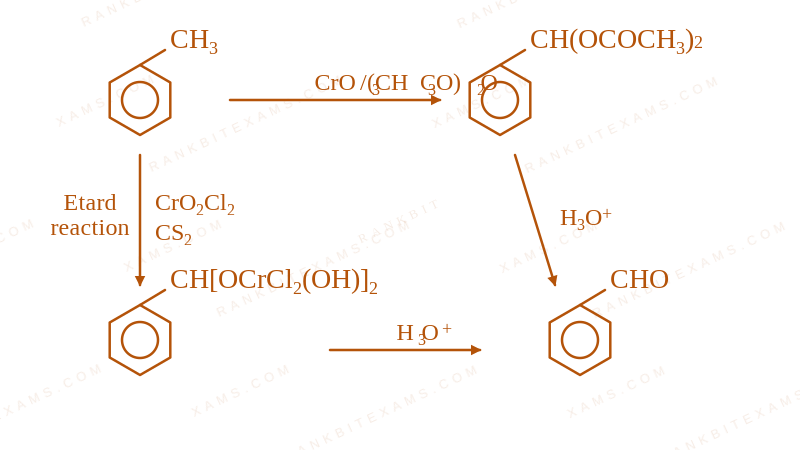
Pathway 1 (Upper): Toluene is treated with Reagent 'A' and acetic anhydride (CH₃CO)₂O$(CH_3CO)_2O$ to form an intermediate (benzylidene diacetate), which on hydrolysis gives benzaldehyde. The reagent used here is Chromic oxide (CrO₃$CrO_3$). Thus, A is CrO₃$CrO_3$.
Pathway 2 (Lower): Toluene is treated with Reagent 'B' in CS₂$CS_2$ to form a chromium complex intermediate, which on hydrolysis yields benzaldehyde. This is the Etard reaction, and the reagent used is Chromyl chloride (CrO₂Cl₂$CrO_2Cl_2$). Thus, B is CrO₂Cl₂$CrO_2Cl_2$.
The image shows the oxidation of toluene to benzaldehyde via two different pathways requiring reagents A and B.
Step 1: Selection
Therefore, A = CrO₃$CrO_3$ and B = CrO₂Cl₂$CrO_2Cl_2$.
Pattern Recognition
Etard reaction always uses Chromyl chloride (CrO₂Cl₂$CrO_2Cl_2$). Oxidation of toluene with acetic anhydride uses Chromic acid (CrO₃$CrO_3$). Both stop the oxidation at the aldehyde stage via intermediate formation.
Chapter Mix
Class 12 Chemistry: Aldehydes, Ketones and Carboxylic Acids
Ethanal (CH₃CHO$CH_3CHO$) reacts with semicarbazide (H₂N-NH-CO-NH₂$H_2N-NH-CO-NH_2$) via nucleophilic addition followed by elimination of water to form a semicarbazone.
Step 1: Product Analysis
The product is Ethanal semicarbazone: CH₃-CH=N-NH-CO-NH₂$CH_3-CH=N-NH-CO-NH_2$.
Counting the nitrogen atoms in this structure:
The imine nitrogen (=N-$=N-$)
The amine nitrogen (-NH-$-NH-$)
The amide nitrogen (-NH₂$-NH_2$)
Total = 3 Nitrogen atoms.
Chapter Mix
Class 12 Chemistry: Aldehydes, Ketones and Carboxylic Acids
Qjee_main_2024_31_jan_eveningPreparation of Aldehydes and Ketones
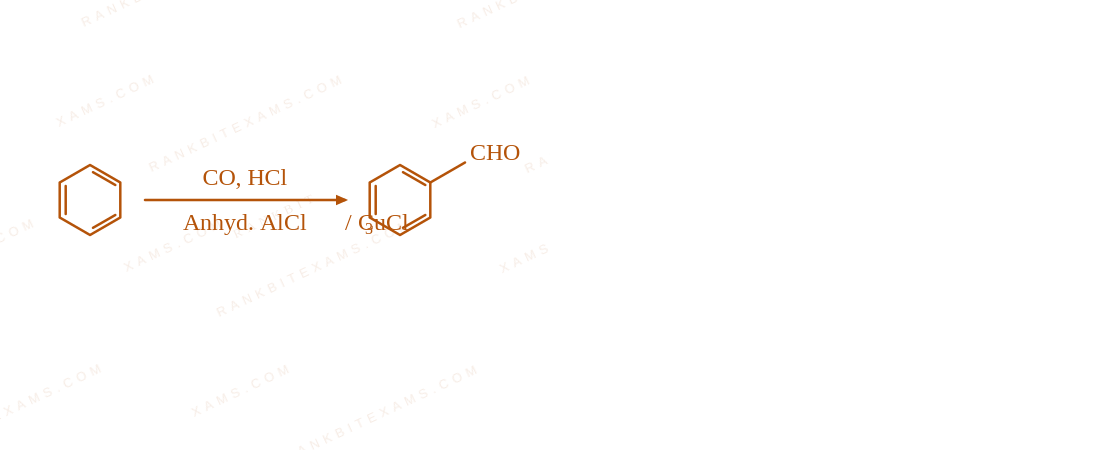
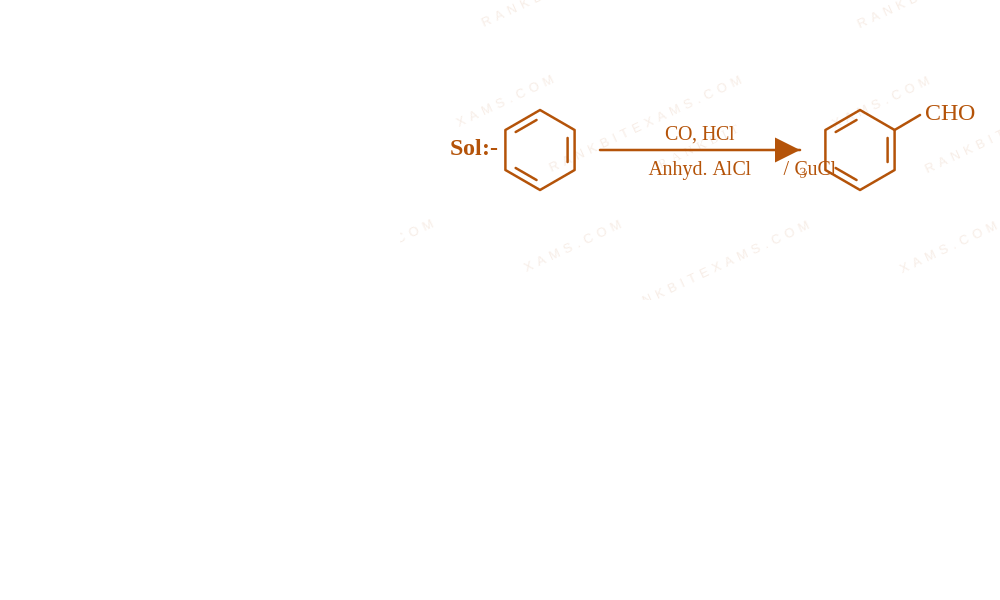
Identify the name reaction.
The image shows the conversion of benzene to benzaldehyde using CO, HCl, and Anhydrous AlCl3/CuCl.
The reaction of benzene with carbon monoxide (CO$CO$) and hydrogen chloride (HCl$HCl$) in the presence of anhydrous aluminium chloride (AlCl₃$AlCl_3$) and cuprous chloride (CuCl$CuCl$) to give benzaldehyde is known as the Gatterman-Koch reaction.
The image shows the conversion of benzene to benzaldehyde using CO, HCl, and Anhydrous AlCl3/CuCl.
Pattern Recognition
CO + HCl arrow$CO + HCl \rightarrow$ Formyl chloride intermediate (in situ) with Lewis acid arrow$\rightarrow$ formylation of benzene. This is definitively the Gatterman-Koch formylation.
Chapter Mix
Class 12 Chemistry: Aldehydes, Ketones and Carboxylic Acids
More Aldehydes, Ketones and Carboxylic Acids Questions — jee_main_2025_29_jan_evening
Practice past-year questions one chapter at a time. Pick an exam → subject → chapter and get every PYQ for that topic — pulled together from all past papers — with the chapter's key formulas alongside.
)