JEE Main · Physics → Steady

Thermodynamics appeared 36 times across 3 years — 4.2% of Physics. This question is from Carnot Engine and Efficiency.

Year 2026 2025 2024 Total
Questions 11 19 6 36

A Carnot engine (E) is working between two temperatures 473K and 273K. In a new system two engines - engine E₁ works between 473K to 373K and engine E₂ works between 373K to 273K. If η₁₂ , η₁ and η₂ are the efficiencies of the engines E, E₁ and E₂ , respectively, then

Solution & Explanation

Related Formula
η = 1 - TLTH
Core Logic

Let's compute the efficiency parameters explicitly:

η₁₂ = 1 - (273)/(473) = (200)/(473) ≈ 0.423 η₁ = 1 - (373)/(473) = (100)/(473) ≈ 0.211 η₂ = 1 - (273)/(373) = (100)/(373) ≈ 0.268

Evaluating the linear sum of fractional bounds:

η₁ + η₂ = 0.211 + 0.268 = 0.479

Comparing the outputs clearly demonstrates:

η₁₂ < η₁ + η₂
Step 1: Final Conclusion

Thus, the inequality satisfies option (1).

Pattern Recognition

The joint efficiency of cascading perfect thermodynamic steps is bounded multiplicatively as (1-η₁₂) = (1-η₁)(1-η₂), which algebraically forces η₁₂ = η₁ + η₂ - η₁η₂ < η₁ + η₂.

Chapter Mix

Class 11 Physics: Thermodynamics

Reference Study Guides

More Thermodynamics Previous-Year Questions — Page 2

Q39 jee_main_2026_23_january_evening Isothermal and Adiabatic Processes
One mole of an ideal diatomic gas expands from volume V to 2V isothermally at a temperature 27° C and does W joule of work. If the gas undergoes same magnitude of expansion adiabatically from 27° C doing the same amount of work W, then its final temperature will be (close to) ____ ° C.
  • A. -189
  • B. -56
  • C. -30
  • D. -117

Solution

Related Formula
Wisothermal = nRT ln ((V₂)/(V₁)) Wadiabatic = (nR(T₁ - T₂))/(γ - 1)
Core Logic

For a diatomic gas, γ = 1.4. Given initial temperature T = 27°C = 300 K. Since Wisothermal = Wadiabatic, we equate the two expressions.

Step 1: Compute Work Done in Isothermal Expansion
Wisothermal = (1) · R · 300 · ln(2) Wisothermal = 300R(0.693) --- (1)
Step 2: Equate and Solve for Final Temperature
Wadiabatic = (nR(T₁ - T₂))/(γ - 1)

Equating (1) to adiabatic work:

((1)R(300 - Tf))/(1.4 - 1) = 300R(0.693) (300 - Tf)/(0.4) = 300(0.693) 300 - Tf = 0.4 × 300 × 0.693 300 - Tf = 120 × 0.693 = 83.16 Tf = 300 - 83.16 = 216.84 K
Step 3: Convert to Celsius
Tf (in °C) = 216.84 - 273.15 = -56.31°C

Closest option is -56.

Pattern Recognition

Equating the work of two different processes links the log expansion to the temperature drop. Recognize diatomic gas instantly means γ = 1.4, providing the 0.4 divisor.

Chapter Mix

Class 11 Physics: Thermodynamics
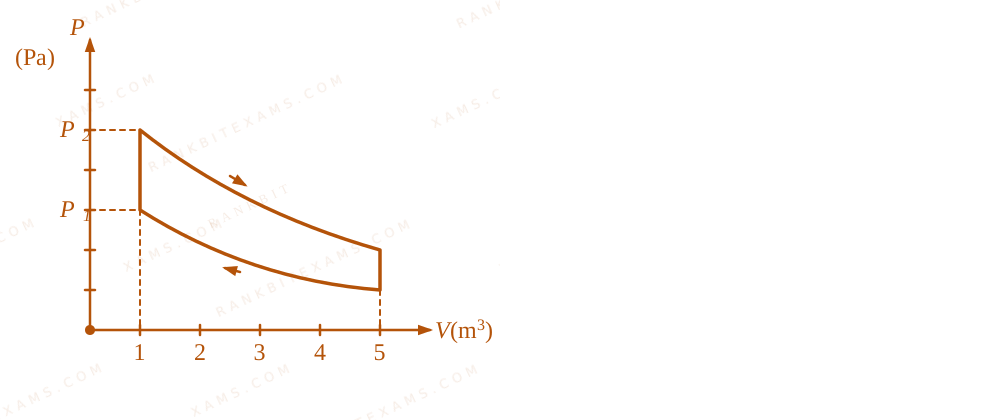
Q29 jee_main_2026_24_january_morning First Law of Thermodynamics
Density of water at 4° C and 20° C are 1000 kg/m³ and 998 kg/m³ respectively. The increase in internal energy of 4 kg water when it is heated from 4° C to 20° C is ____J. (Specific heat capacity of water = 4.2 J/g°C and 1 atmospheric pressure = 10⁵ Pa)
  • A. 315826.2
  • B. 234699.2
  • C. 258700.8
  • D. 268799.2

Solution

Related Formula
Δ Q = mcΔ T

W = P Δ V

Δ U = Δ Q - W
Core Logic

First, calculate the heat supplied Δ Q:

Q = mSΔ T = 4 × 4200 × 16 = 268800 J

Next, calculate the work done W against atmospheric pressure due to volume change: W = P Δ V

Δ V = ( (m)/(ρf) - (m)/(ρᵢ) ) = 4 [ (1)/(998) - (1)/(1000) ]

Given P = 10⁵ Pa:

W = 10⁵ × 4 × [ (1000 - 998)/(998 × 1000) ] = (8 × 10⁵)/(998 × 10³) ≈ 0.8 J
Step 1: Internal Energy Calculation

Using the First Law of Thermodynamics:

Δ U = Q - W Δ U = 268800 - 0.8 = 268799.2 J
Pattern Recognition

When heating solids or liquids, the expansion is so small that Δ V is negligible, meaning W ≈ 0, making Δ U ≈ Δ Q. Subtracting the exact 0.8J provides the highly precise answer required here.

Chapter Mix

Class 11 Physics: Thermodynamics Class 11 Physics: Thermal Properties of Matter
Q43 jee_main_2026_24_january_evening Isochoric Process and Heat Transfer
10 mole of an ideal gas is undergoing the process shown in the figure. The heat involved in the process from P₁ to P₂ is α Joule ( P₁ = 21.7Pa and P₂ = 30Pa , Cv = 21J / K.mol , R = 8.3J / mol.K ). The value of α is ____.
Isochoric Process and Heat Transfer diagram for Q43 - JEE Main 2026 Evening
A Pressure-Volume graph displaying an isochoric rise from P1 to P2 at constant V=1.
  • A. 24
  • B. 15
  • C. 21
  • D. 28

Solution

Related Formula
Δ Q = n Cv Δ T

From Ideal Gas Law for Isochoric Process:

n R Δ T = Δ P · V
Core Logic

From the P-V graph, the process from P₁ to P₂ takes place at a constant volume V = 1 m³.

Step 1: Calculate Heat Involved
Δ Q = n Cv Δ T

Multiply and divide by R:

Δ Q = (Cv)/(R) · (nRΔ T) = (Cv)/(R) · (P₂ - P₁)V
Step 2: Substitution

Given Cv = 21 J/K· mol, R = 8.3 J/mol· K, P₂ = 30, P₁ = 21.7, and V = 1:

Δ Q = (21)/(8.3) × (30 - 21.7) × 1 Δ Q = (21)/(8.3) × 8.3 = 21 J
Pattern Recognition

For constant volume processes, Δ Q strictly scales with Δ P. Re-writing n Δ T as V Δ P / R circumvents calculating absolute temperatures entirely.

Chapter Mix

Class 11 Physics: Thermodynamics

Q46 jee_main_2026_24_january_evening Specific Heat of Gases
When 300 J of heat given to an ideal gas with Cₚ=(7)/(2)R its temperature raises from 20 °C to 50 °C keeping its volume constant. The mass of the gas is (approximately) ____ g. (R = 8.314 J/mol.K).
Numerical Answer. Answer: 481 to 481

Solution

Related Formula

Cv = CP - R

Δ Q = n CV Δ T
Core Logic
Cv = (7)/(2)R - R = (5)/(2)R

For an isochoric process (constant volume), the heat given is strictly equal to internal energy change:

300 = n × (5)/(2) × 8.314 × (50 - 20)
Step 1: Find moles (n)
300 = n × (5)/(2) × 8.314 × 30 300 = n × 75 × 8.314 n = 0.48 moles (m)/(M) = 0.48
Step 2: Evaluating the output

Our Ans. (Bonus) We cannot definitively find the mass (m) in grams because the molar mass (M) of the specific ideal gas is not given in the problem statement. (Note: NTA official answer is 481. This implies assuming M ≈ 1000 or an error in problem specification).

Pattern Recognition

Always extract Cv from Cₚ using Mayer's relation for constant volume heat transfers. If an exam sets a numerical without giving molar mass, it relies on partial contextual hints or is marked as bonus.

Chapter Mix

Class 11 Physics: Thermodynamics

Q37 jee_main_2026_28_january_morning Work Done in Thermodynamic Processes
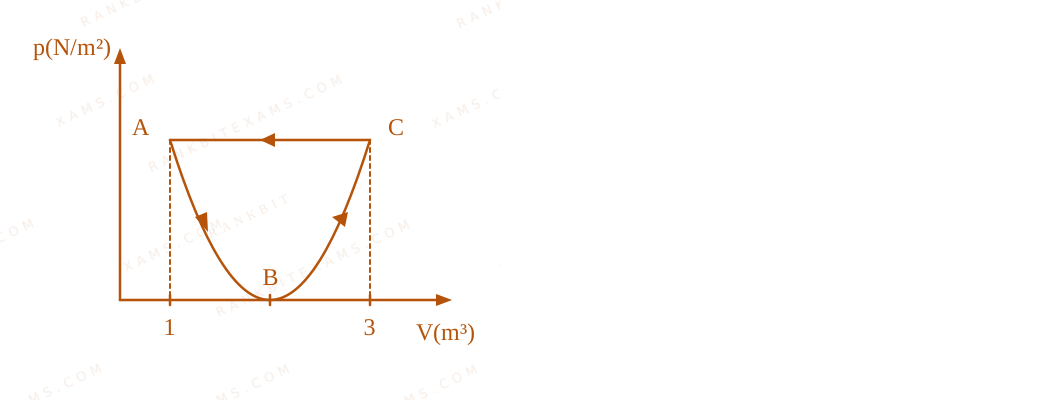
In the following p - V diagram the equation of state along the curved path is given by (V - 2)² = 4ap where a is a constant. The total work done in the closed path is
p-V diagram showing a cyclic process with a parabolic path
A p-V graph indicating a cyclic process clockwise with points A at V=1, C at V=3 and a parabolic curve below.
  • A. -(1)/(a)
  • B. +(1)/(3a)
  • C. (1)/(2a)
  • D. -(1)/(3a)

Solution

Related Formula
W = ∫ p dV
Core Logic

The total work done in a cyclic process is the enclosed area. The cycle is clockwise, but wait—the arrows in the diagram point anti-clockwise (A to B to C and back to A via horizontal top line). Anti-clockwise cycle means negative work. The enclosed area is bounded by a parabola.

Step 1: Identifying the Parabola Parameters

Equation of curve: (V - 2)² = 4ap This is an upward-opening parabola with vertex at V = 2, p = 0 (assuming a>0). Let's check points A (V=1) and C (V=3). At V=1: (1 - 2)² = 4ap ⇒ 1 = 4ap₀ ⇒ p₀ = (1)/(4a) At V=3: (3 - 2)² = 4ap ⇒ 1 = 4ap₀ ⇒ p₀ = (1)/(4a) So the top horizontal line is at p₀ = (1)/(4a).

Step 2: Area Calculation

The enclosed shape is bounded by the line p = p₀ and the parabola p = ((V - 2)²)/(4a). The area of a parabolic segment (bounded by a chord) is (2)/(3) × Area of enclosing rectangle. Rectangle width = Δ V = 3 - 1 = 2. Rectangle height = p₀ - 0 = p₀. Area = (2)/(3) × (p₀) × (2) = (4p₀)/(3).

Step 3: Substitute and Determine Sign

Substitute p₀ = (1)/(4a):

|W| = (4)/(3) ((1)/(4a)) = (1)/(3a)

The cycle is counter-clockwise, so the net work done by the gas is negative.

Wgas = -(1)/(3a)
Pattern Recognition

For parabolic curves y = kx², the area inside the 'bowl' up to a chord is 2/3 of the bounding rectangle. Direction of arrows dictates the sign: clockwise = positive, anti-clockwise = negative.

Chapter Mix

Class 11 Physics: Thermodynamics

More Thermodynamics Questions — jee_main_2025_28_jan_morning

Practice all Thermodynamics previous-year questions →

Rankbit System
JEE Physics: Waves (+15.5%) | Electrostatics: Concentric Shells (-29.7%) | Modern Physics: Photoelectric Clones (+34.2%) | Mathematics: Definite Integrals (+18.1%) | Chemistry: Coordination Splitting (-11.4%) | JEE Physics: Waves (+15.5%) | Electrostatics: Concentric Shells (-29.7%) | Modern Physics: Photoelectric Clones (+34.2%) | Mathematics: Definite Integrals (+18.1%) | Chemistry: Coordination Splitting (-11.4%)