A proton of mass mₚ$\mathrm{m_p}$ has same energy as that of a photon of wavelength λ$\lambda$ . If the proton is moving at non-relativistic speed, then ratio of its de Broglie wavelength to the wavelength of photon is.
Combine the core formulas: λmatter = h 2mE$\lambda_{\text{matter}} = \frac{\mathrm{h}}{\sqrt{2\mathrm{mE}}}$ and λlight = hcmathrmE$\lambda_{\text{light}} = \frac{\mathrm{hc}}{mathrm{E}}$. Dividing them smoothly yields the standard non-relativistic scaling ratio.
Chapter Mix
Class 12 Physics: Dual Nature of Radiation and Matter
Keywords:#ratio of de broglie wavelength to photon wavelength#JEE Main 2025 Morning Q18#Dual Nature of Radiation and Matter JEE Main 2025#de Broglie Wavelength JEE Main 2025
More Dual Nature of Radiation and Matter Previous-Year Questions — Page 3
Q4jee_main_2025_29_jan_eveningPhotoelectric Effect and Stopping Potential
A.increases with increase in the wavelength of the incident light$\text{increases with increase in the wavelength of the incident light}$
B.increases with increase in the intensity of the incident light$\text{increases with increase in the intensity of the incident light}$
C.is ( 1e) times the maximum kinetic energy of the emitted photoelectrons$\text{is } \left(\frac{1}{\mathrm{e}}\right) \text{ times the maximum kinetic energy of the emitted photoelectrons}$
D.decreases with increase in the intensity of the incident light$\text{decreases with increase in the intensity of the incident light}$
Solution
Related Formula
K = hν - φ = eVₛ$$K_{\max} = h\nu - \phi = eV_s$$
where,
K$K_{\max}$ = maximum kinetic energy of photoelectrons
Vₛ$V_s$ = stopping potential
e$e$ = fundamental electronic charge
Core Logic
By definition, the stopping potential Vₛ$V_s$ is the negative potential applied to stop the most energetic photoelectrons from reaching the collector electrode.
Thus, the stopping potential is exactly (1)/(e)$\frac{1}{e}$ times the maximum kinetic energy of the emitted photoelectrons. It does not depend on the intensity of light.
Pattern Recognition
Remember the primary features of the photoelectric effect:
Stopping potential depends linearly on frequency, and inversely on wavelength.
Intensity changes current, but has zero effect on stopping potential.
Chapter Mix
Class 12 Physics: Dual Nature of Radiation and Matter
Q15jee_main_2025_03_april_morningPhotoelectric Effect and Work Function
The work function of a metal is 3~eV$3\mathrm{~eV}$. The color of the visible light that is required to cause emission of photoelectrons is:
Blue: 450 - 495~nm$450 - 495\mathrm{~nm}$ (At lower end, approaching violet down to 380~nm$380\mathrm{~nm}$; Energy ≈ 2.5 - 3.3~eV$\approx 2.5 - 3.3\mathrm{~eV}$)
Only Blue light contains wavelengths extending below 413.3~nm$413.3\mathrm{~nm}$ (high enough photon energy to surpass 3~eV$3\mathrm{~eV}$). Therefore, blue light is required to cause photoelectric emission from this metal.
Pattern Recognition
Remember standard photon energies of visible colors: Blue/Violet photons have higher energy (typically > 2.8~eV$> 2.8\mathrm{~eV}$), while Red/Yellow photons have much lower energy (< 2.2~eV$< 2.2\mathrm{~eV}$). For a higher work function like 3~eV$3\mathrm{~eV}$, only highly energetic blue/violet light can succeed.
Chapter Mix
Class 12 Physics: Dual Nature of Radiation and Matter
Qjee_main_2025_04_april_morningRadiation Pressure and Momentum
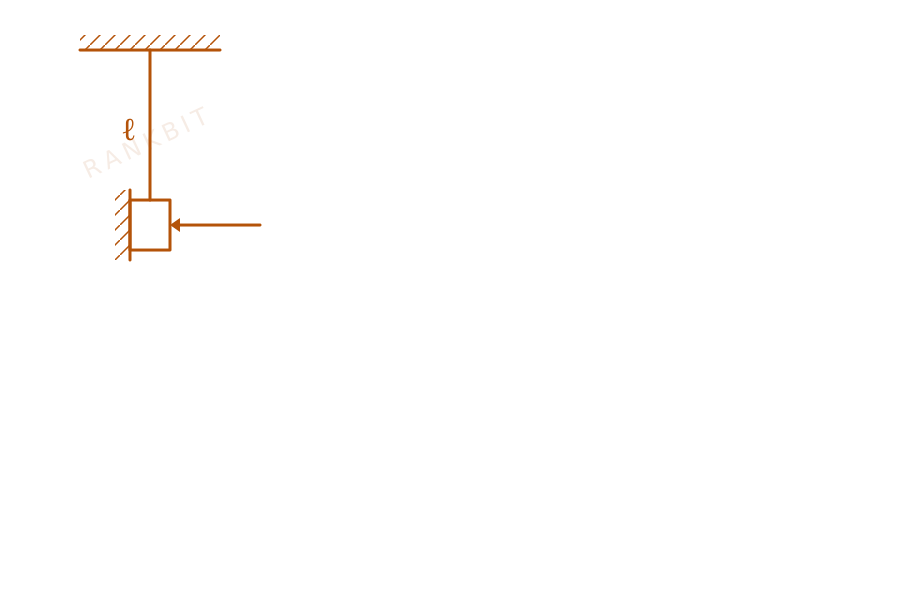
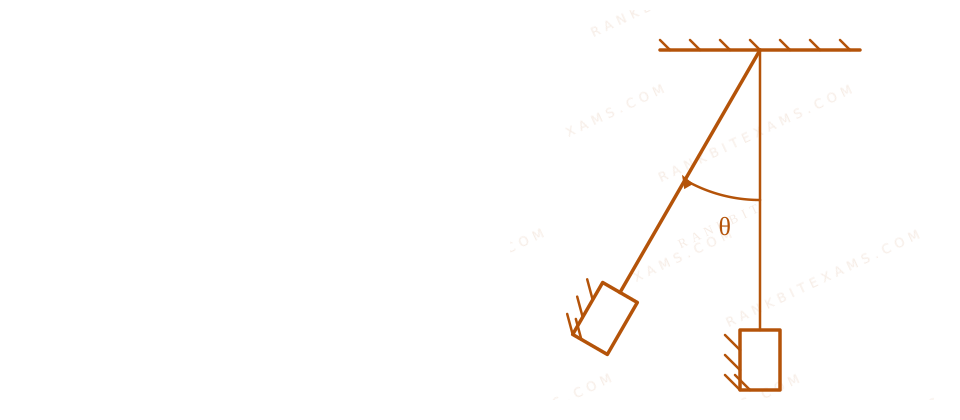
A small mirror of mass m$m$ is suspended by a massless thread of length l$l$. Then the small angle through which the thread will be deflected when a short pulse of laser of energy E$E$ falls normal on the mirror (c =$c = $ speed of light in vacuum and g =$g = $ acceleration due to gravity)
For small angles (θ)/(2) ≈ (θ)/(2)$\sin\frac{\theta}{2} \approx \frac{\theta}{2}$.
Core Logic
Assuming perfect normal reflection from the mirror surface, the pulse imparts a momentum impulse of (2E)/(c)$\frac{2E}{c}$ to the mass. This provides an initial velocity v$v$ to the mirror. The mirror then swings up to a maximum angle θ$\theta$ where kinetic energy converts entirely to gravitational potential energy.
Deflection of suspended mirror via laser pulse diagram for Q2 - JEE Main 2025 Morning
Step 1: Calculate Initial Velocity
From momentum change:
m(v - 0) = (2E)/(c) v = (2E)/(mc)$$m(v - 0) = \frac{2E}{c} \implies v = \frac{2E}{mc}$$
Deflection of suspended mirror via laser pulse diagram for Q2 - JEE Main 2025 Morning
This is a standard ballistic pendulum problem where the impulse is delivered by radiation pressure. Perfect reflection means momentum transfer is double the incident momentum (2· (E)/(c))$\left(2\cdot \frac{E}{c}\right)$.
Chapter Mix
Class 12 Physics: Dual Nature of Radiation and Matter
Class 11 Physics: System of Particles and Rotational Motion
Q10jee_main_2025_04_april_morningPhotoelectric Effect and Intensity
Given below are two statements: one is labelled as Assertion A and the other is labelled as Reason R.
Assertion A: In photoelectric effect, on increasing the intensity of incident light the stopping potential increases.
Reason R: Increase in intensity of light increases the rate of photoelectrons emitted, provided the frequency of incident light is greater than threshold frequency.
In the light of the above statements, choose the correct answer from the options given below
A. Both A and R are true but R is NOT the correct explanation of A
B. A is false but R is true
C. A is true but R is false
D. Both A and R are true and R is the correct explanation of A
Solution
Related Formula
Einstein's photoelectric equation:
eVₛ = h u - φ$$
eV_s = h
u - \phi$$
where:
Vₛ$V_s$ = stopping potential
u$
u$
= frequency of light
φ$\phi$ = work function
Intensity formula: I = (n h
u)/(A · t)$I = \frac{n h
u}{A \cdot t}$
(where n$n$ is rate of photons).
Core Logic
Assertion Analysis: Stopping potential Vₛ$V_s$ depends strictly linearly on frequency
u$
u$
and work function φ$\phi$. It is completely independent of the beam intensity. Therefore, Assertion A is false.
Reason Analysis: Intensity tracks the flux counts of photons per second. Increasing intensity drives up the quantum count of ejected charges, given
Practice past-year questions one chapter at a time. Pick an exam → subject → chapter and get every PYQ for that topic — pulled together from all past papers — with the chapter's key formulas alongside.