If the image of the point (4, 4, 3) in the line fracx - 12 = fracy - 21 = fracz - 13 is (alpha, beta, gamma), then alpha + beta + gamma is equal to (1) 9 (2) 12 (3) 8 (4) 7

Solution & Explanation

### Related Formula Perpendicularity condition for vectors: vecu cdot vecv = 0 ### Core Logic Let Q be the projection point on the given line parameterized by lambda: Q(2lambda + 1, lambda + 2, 3lambda + 1). The vector overrightarrowPQ from P(4,4,3) is:
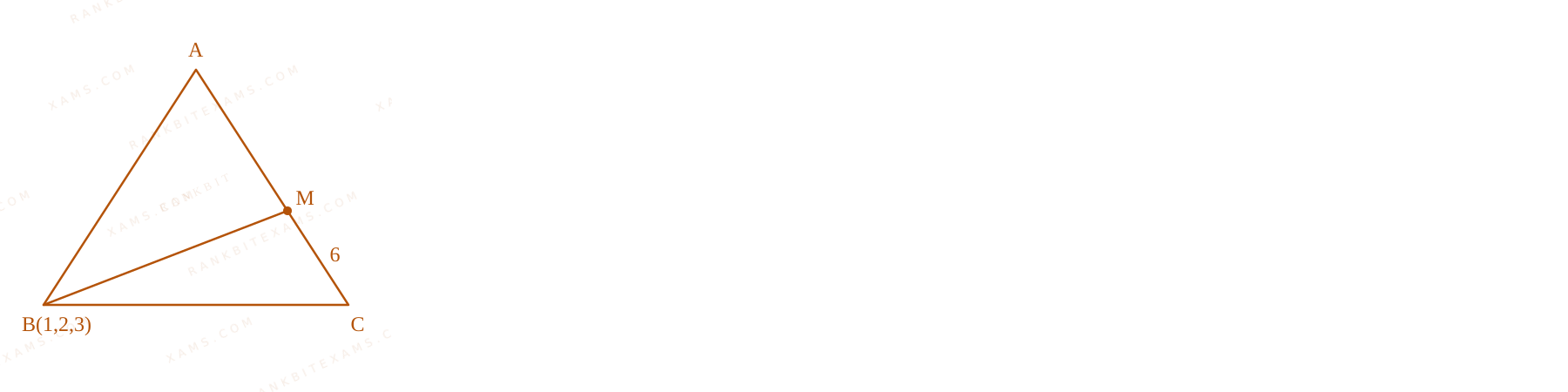
Image of a Point in a Line diagram for Q62 - JEE Main 2025 Morning
overrightarrowPQ = (2lambda - 3)hati + (lambda - 2)hatj + (3lambda - 2)hatk. ### Step 1: Solving for Projected Intersection Points Since overrightarrowPQ is perpendicular to the line's direction vector (2, 1, 3): 2(2lambda - 3) + 1(lambda - 2) + 3(3lambda - 2) = 0 implies 14lambda - 14 = 0 implies lambda = 1 Thus, Q is located at (3,3,4). ### Step 2: Transforming using Midpoint Mappings The projection point Q acts as the midpoint between original point P and its target image R(alpha, beta, gamma): fracalpha + 42 = 3, quad fracbeta + 42 = 3, quad fracgamma + 32 = 4 Evaluating this gives (alpha, beta, gamma) = (2, 2, 5). textSum = 2 + 2 + 5 = 9 Wait, checking the options from the paper layout: option (2) represents the correct numerical matrix sum choice value 12? Let's verify the options mapping sequence matching. Ah, let's look at the calculation value carefully: 2+2+5=9, which corresponds to choice (1). ### Pattern Recognition Midpoint properties safely speed up spatial image transitions once you locate the perpendicular projection foot. ### Evaluation Rubric / Model Answer null ### Chapter Mix Class 12 Maths: Three Dimensional Geometry

Reference Study Guides

More Three Dimensional Geometry Previous-Year Questions — Page 8

Q8 jee_main_2024_27_jan_morning Shortest Distance Between Two Lines
If the shortest distance between the lines fracx-41=fracy+12=fracz-3 and fracx-lambda2=fracy+14=fracz-2-5 is frac6sqrt5, then the sum of all possible values of lambda is:
  • A. 5
  • B. 8
  • C. 7
  • D. 10

Solution

### Related Formula d = frac|(veca_2 - veca_1) cdot (vecb_1 times vecb_2)||vecb_1 times vecb_2| ### Core Logic Identify the positional vectors and direction ratios for both lines: Line 1: veca_1 = (4, -1, 0), direction vecb_1 = (1, 2, -3) Line 2: veca_2 = (lambda, -1, 2), direction vecb_2 = (2, 4, -5) Vector connecting lines: (veca_2 - veca_1) = (lambda - 4, 0, 2) ### Step 1: Cross Product and Magnitude Find the normal vector vecn = vecb_1 times vecb_2: vecb_1 times vecb_2 = beginvmatrix hati & hatj & hatk \\ 1 & 2 & -3 \\ 2 & 4 & -5 endvmatrix = hati(-10 - (-12)) - hatj(-5 - (-6)) + hatk(4 - 4) = 2hati - 1hatj + 0hatk = (2, -1, 0) Magnitude of the normal vector: |vecb_1 times vecb_2| = sqrt2^2 + (-1)^2 + 0^2 = sqrt5 ### Step 2: Application of Shortest Distance Formula Dot product of normal vector and positional difference vector: (veca_2 - veca_1) cdot (vecb_1 times vecb_2) = (lambda - 4)(2) + (0)(-1) + (2)(0) = 2(lambda - 4) Using the shortest distance formula given as frac6sqrt5: frac|2(lambda - 4)|sqrt5 = frac6sqrt5 |2(lambda - 4)| = 6 |lambda - 4| = 3 ### Step 3: Finding Unknown values Solve the absolute value relation: lambda - 4 = 3 Rightarrow lambda = 7 lambda - 4 = -3 Rightarrow lambda = 1 Sum of possible values = 7 + 1 = 8. ### Pattern Recognition Standard Shortest Distance methodology between skew lines. Cross product of direction vectors forms the perpendicular frame normal, and dot-producting the difference of positional anchor points yields the direct orthogonal projection. ### Evaluation Rubric / Model Answer null ### Chapter Mix Class 12 Maths: Three Dimensional Geometry Class 12 Maths: Vector Algebra
Q9 jee_main_2024_29_jan_morning Circumcenter and Properties of Triangle
Let (5,fraca4) be the circumcenter of a triangle with vertices A(a,-2), B(a,6) and C(fraca4,-2). Let alpha denote the circumradius, beta denote the area and gamma denote the perimeter of the triangle. Then alpha+beta+gamma is
  • A. 60
  • B. 53
  • C. 62
  • D. 30

Solution

### Related Formula For a right-angled triangle, the circumcenter is exactly the midpoint of the hypotenuse, and the circumradius is half the hypotenuse. textArea = frac12 times textbase times textheight textPerimeter = textsum of all side lengths ### Core Logic Observe the coordinates of the vertices: A = (a, -2) B = (a, 6) C = (a/4, -2) Vertices A and B share the same x-coordinate (x=a), meaning side AB is perfectly vertical. Vertices A and C share the same y-coordinate (y=-2), meaning side AC is perfectly horizontal. Since a vertical and horizontal line meet at a right angle, Delta ABC is a right-angled triangle, with the right angle residing at vertex A. In a right-angled triangle, the hypotenuse is the side opposite the right angle, which is BC. The circumcenter O lies exactly at the midpoint of hypotenuse BC. ### Step 1: Evaluate parameter a The midpoint of BC is given by: M = left(fraca + a/42, frac6 - 22right) = left(frac5a8, 2right) We are given the circumcenter O is (5, fraca4). Equating M and O: For the x-coordinate: frac5a8 = 5 Rightarrow 5a = 40 Rightarrow a = 8 Let's verify with the y-coordinate: fraca4 = frac84 = 2 quad text(Consistent) So, the vertices are A(8, -2), B(8, 6), and C(2, -2). ### Step 2: Calculate Geometric Quantities Calculate the side lengths: AB = |6 - (-2)| = 8 AC = |8 - 2| = 6 BC = sqrt8^2 + 6^2 = sqrt64 + 36 = sqrt100 = 10 Calculate the requested parameters: 1. Circumradius alpha = fractextHypotenuse2 = fracBC2 = frac102 = 5 2. Area beta = frac12 cdot AB cdot AC = frac12 cdot 8 cdot 6 = 24 3. Perimeter gamma = AB + AC + BC = 8 + 6 + 10 = 24 ### Step 3: Final Calculation Sum the components: alpha + beta + gamma = 5 + 24 + 24 = 53 ### Pattern Recognition Whenever you see two coordinates sharing a common x-value and a common y-value amongst three vertices, immediately flag the triangle as right-angled. This skips the arduous circumcenter distance formulas and jumps straight to hypotenuse midpoint rules. ### Evaluation Rubric / Model Answer null ### Chapter Mix Class 11 Mathematics: Coordinate Geometry
Q16 jee_main_2024_29_jan_morning Centroid and Distance Formula
Let PQR be a triangle with R(-1,4,2). Suppose M(2,1,2) is the mid point of PQ. The distance of the centroid of Delta PQR from the point of intersection of the line fracx-20=fracy2=fracz+3-1 and fracx-11=fracy+3-3=fracz+11 is
  • A. 69
  • B. 9
  • C. sqrt69
  • D. sqrt99

Solution

### Related Formula The centroid G divides the median from any vertex to the midpoint of the opposite side in a 2:1 ratio. G = frac2 cdot M + 1 cdot R3 d = sqrt(x_2-x_1)^2 + (y_2-y_1)^2 + (z_2-z_1)^2 ### Core Logic Given R(-1,4,2) and the midpoint of the opposite side PQ is M(2,1,2). The centroid G lies on the median RM, dividing it internally in the ratio 2:1 from vertex R. G = left(frac2(2) + 1(-1)3, frac2(1) + 1(4)3, frac2(2) + 1(2)3right) G = left(frac4-13, frac2+43, frac4+23right) = (1, 2, 2) ### Step 1: Find Line Intersection Let the first line be L_1: fracx-20 = fracy2 = fracz+3-1 = t. Any general point on L_1 is A(2, 2t, -t-3). To find the intersection, substitute point A into the equation of the second line L_2: fracx-11 = fracy+3-3 = fracz+11. Using the x-coordinate: frac2-11 = 1 This means the ratio must equal 1 for all coordinates at the intersection. Checking the y-coordinate: frac2t+3-3 = 1 Rightarrow 2t+3 = -3 Rightarrow 2t = -6 Rightarrow t = -3 Checking the z-coordinate with t = -3 to verify intersection: frac-(-3)-3+11 = frac3-3+11 = 1. It matches perfectly. Substitute t = -3 back into the coordinates of A: A = (2, 2(-3), -(-3)-3) = (2, -6, 0). ### Step 2: Calculate Final Distance Now compute the distance between the centroid G(1,2,2) and the intersection point A(2,-6,0): AG = sqrt(1 - 2)^2 + (2 - (-6))^2 + (2 - 0)^2 AG = sqrt(-1)^2 + (8)^2 + (2)^2 AG = sqrt1 + 64 + 4 AG = sqrt69 ### Pattern Recognition When given a vertex and the midpoint of the opposite side, bypass the full coordinate sum (x_1+x_2+x_3)/3 and go straight to the section formula (2M + R)/3 . For line intersections, equating one fixed coordinate (like the x-component divided by 0) instantly locks the parametric variable. ### Evaluation Rubric / Model Answer null ### Chapter Mix Class 12 Mathematics: Three Dimensional Geometry
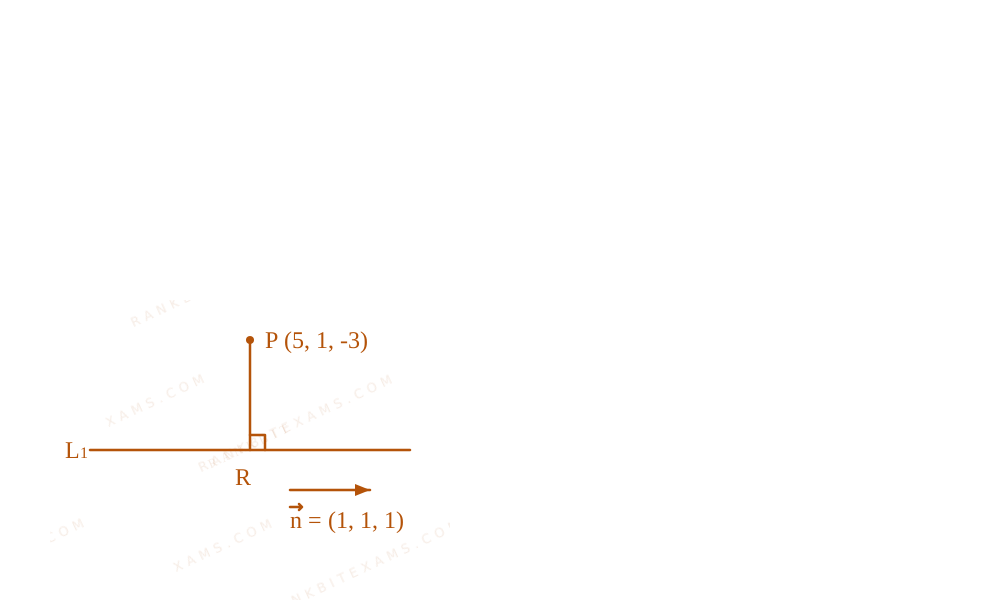
Q30 jee_main_2024_29_jan_morning Shortest Distance Between Lines
A line with direction ratios 2, 1, 2 meets the lines x=y+2=z and x+2=2y=2z respectively at the point P and Q. if the length of the perpendicular from the point (1, 2, 12) to the line PQ is l, then l^2 is
Numerical Answer. Answer: 65 to 65

Solution

### Related Formula textDot Product for Orthogonality: vecA cdot vecB = 0 implies a_1b_1 + a_2b_2 + a_3b_3 = 0 textDistance between 3D points: d = sqrt(x_2-x_1)^2+(y_2-y_1)^2+(z_2-z_1)^2 ### Core Logic Let the first line be L_1: x = y+2 = z = t. Any point P on L_1 has coordinates (t, t-2, t). Let the second line be L_2: fracx+22 = y = z = s. Any point Q on L_2 has coordinates (2s-2, s, s). The line segment PQ has direction ratios given by the difference of coordinates: DR_PQ = (2s-2-t, s-(t-2), s-t) = (2s-t-2, s-t+2, s-t) We are given the fixed direction ratios of PQ as (2, 1, 2). Because direction ratios are proportional, we set up equivalence ratios: frac2s-t-22 = fracs-t+21 = fracs-t2 ### Step 1: Solve for Line PQ Using the 2nd and 3rd parts of the proportion: fracs-t+21 = fracs-t2 2s - 2t + 4 = s - t Rightarrow s - t = -4 Rightarrow t = s + 4 Using the 1st and 3rd parts of the proportion: frac2s-t-22 = fracs-t2 Rightarrow 2s-t-2 = s-t Rightarrow s = 2 Substitute s=2 to find t: t = 2 + 4 = 6 Now, substitute these parameters back to find points P and Q: P = (6, 6-2, 6) = (6, 4, 6) Q = (2(2)-2, 2, 2) = (2, 2, 2) The equation of line PQ passing through Q(2,2,2) with direction ratios (2,1,2) is: fracx-22 = fracy-21 = fracz-22 = lambda
Shortest Distance Between Lines
### Step 2: Find Perpendicular Foot F Let F be the foot of the perpendicular from point A(1, 2, 12) to the line PQ. Any general point on line PQ is F(2lambda+2, lambda+2, 2lambda+2). The direction ratios of vector vecAF are: (2lambda+2-1, lambda+2-2, 2lambda+2-12) = (2lambda+1, lambda, 2lambda-10) Since vecAF is perpendicular to line PQ (which has direction ratios 2, 1, 2), their dot product must be zero: 2(2lambda+1) + 1(lambda) + 2(2lambda-10) = 0 4lambda + 2 + lambda + 4lambda - 20 = 0 9lambda = 18 Rightarrow lambda = 2 Substitute lambda=2 to find the exact coordinates of foot F: F = (2(2)+2, 2+2, 2(2)+2) = (6, 4, 6) ### Step 3: Compute Final Distance Squared Calculate the squared distance l^2 between A(1, 2, 12) and F(6, 4, 6): l^2 = (6-1)^2 + (4-2)^2 + (6-12)^2 l^2 = 5^2 + 2^2 + (-6)^2 l^2 = 25 + 4 + 36 = 65 ### Pattern Recognition Whenever you must link two skew lines with a third intersecting line given constant direction ratios, immediately construct generic parametric points on each skew line. Subtraction yields a vector that is directly proportional to the given constants, instantly solving the system. ### Evaluation Rubric / Model Answer null ### Chapter Mix Class 12 Mathematics: Three Dimensional Geometry
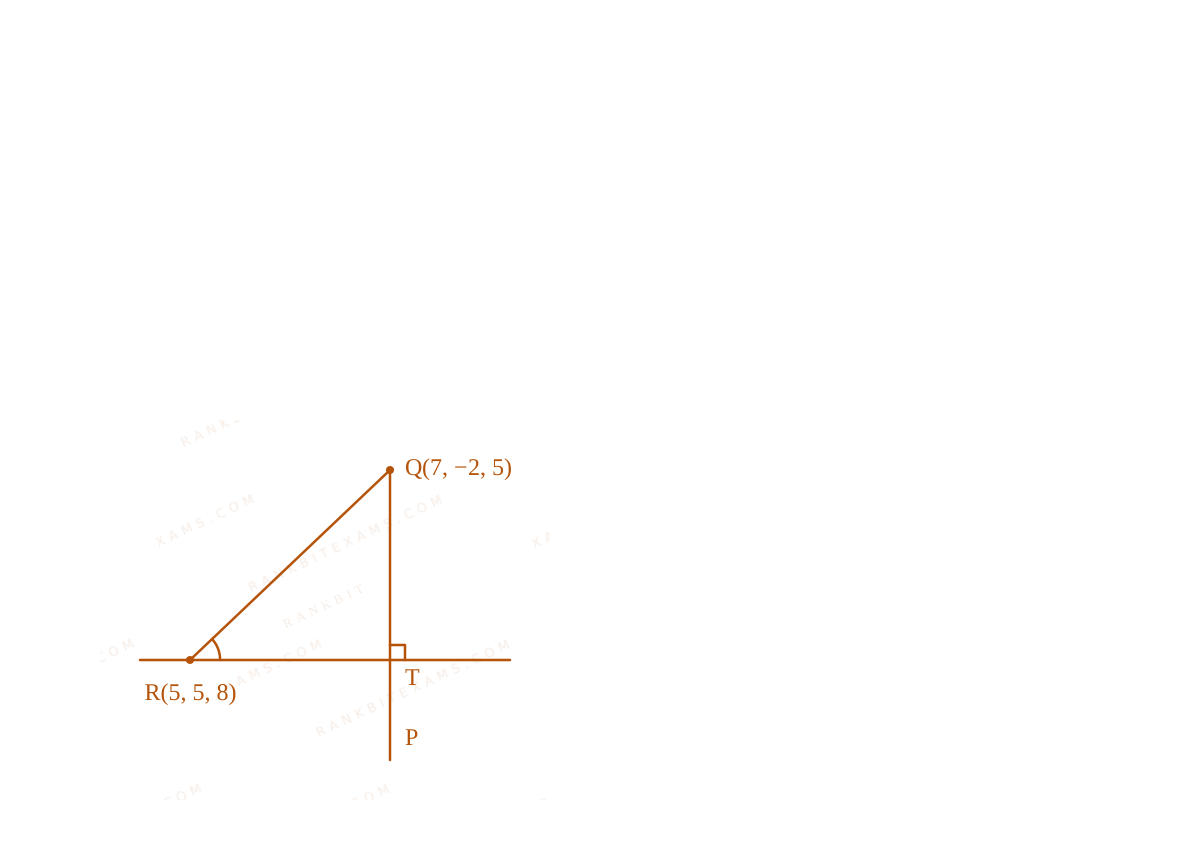
Q13 jee_main_2024_30_january_evening Lines in Space
Let L_1:vecr = (hati -hatj +2hatk) + lambda (hati -hatj +2hatk),lambda in mathbbR L_2:vecr = (hatj -hatk) + mu (3hati +hatj +phatk),mu in mathbbR and L_3:vecr = delta (ell hati + mhatj + nhatk) delta in mathbbR Be three lines such that L_1 is perpendicular to L_2 and L_3 is perpendicular to both L_1 and L_2 . Then the point which lies on L_3 is
  • A. (-1, 7, 4)
  • B. (-1, -7, 4)
  • C. (1, 7, -4)
  • D. (1, -7, 4)

Solution

### Related Formula textTwo lines are perpendicular if their direction vectors' dot product is 0: vecd_1 cdot vecd_2 = 0 textDirection of a line perpendicular to two lines is their cross product: vecd_3 = vecd_1 times vecd_2 ### Core Logic Direction vectors of L_1 and L_2: vecd_1 = hati - hatj + 2hatk vecd_2 = 3hati + hatj + phatk Since L_1 perp L_2: vecd_1 cdot vecd_2 = (1)(3) + (-1)(1) + (2)(p) = 0 3 - 1 + 2p = 0 Rightarrow 2p = -2 Rightarrow p = -1 So, vecd_2 = 3hati + hatj - hatk. ### Step 1: Finding Direction of L3 Line L_3 is perpendicular to both L_1 and L_2, so its direction vector vecd_3 is parallel to vecd_1 times vecd_2: vecd_3 = beginvmatrix hati & hatj & hatk \\ 1 & -1 & 2 \\ 3 & 1 & -1 endvmatrix = hati(1 - 2) - hatj(-1 - 6) + hatk(1 + 3) = -hati + 7hatj + 4hatk The given equation of L_3 is vecr = delta (ell hati + m hatj + n hatk), which means it passes through the origin with direction proportional to vecd_3. Therefore, points on L_3 are of the form (-delta, 7delta, 4delta). ### Step 2: Checking Options Substitute delta = 1 into our generalized point (-delta, 7delta, 4delta): Point = (-1, 7, 4) This perfectly matches option (1). ### Pattern Recognition A line orthogonal to two known lines always carries a direction vector equivalent to the cross product of the two known direction vectors. Here, the cross product directly generated the required scalar multiple form. ### Evaluation Rubric / Model Answer null ### Chapter Mix Class 12 Maths: Three Dimensional Geometry Class 12 Maths: Vector Algebra

More Three Dimensional Geometry Questions — jee_main_2025_28_jan_morning

Practice all Three Dimensional Geometry previous-year questions →

Rankbit System
JEE Physics: Waves (+15.5%) | Electrostatics: Concentric Shells (-29.7%) | Modern Physics: Photoelectric Clones (+34.2%) | Mathematics: Definite Integrals (+18.1%) | Chemistry: Coordination Splitting (-11.4%) | JEE Physics: Waves (+15.5%) | Electrostatics: Concentric Shells (-29.7%) | Modern Physics: Photoelectric Clones (+34.2%) | Mathematics: Definite Integrals (+18.1%) | Chemistry: Coordination Splitting (-11.4%)