
If the image of the point (4, 4, 3) in the line fracx - 12 = fracy - 21 = fracz - 13 is (alpha, beta, gamma), then alpha + beta + gamma is equal to (1) 9 (2) 12 (3) 8 (4) 7

Solution & Explanation

### Related Formula Perpendicularity condition for vectors: vecu cdot vecv = 0 ### Core Logic Let Q be the projection point on the given line parameterized by lambda: Q(2lambda + 1, lambda + 2, 3lambda + 1). The vector overrightarrowPQ from P(4,4,3) is:
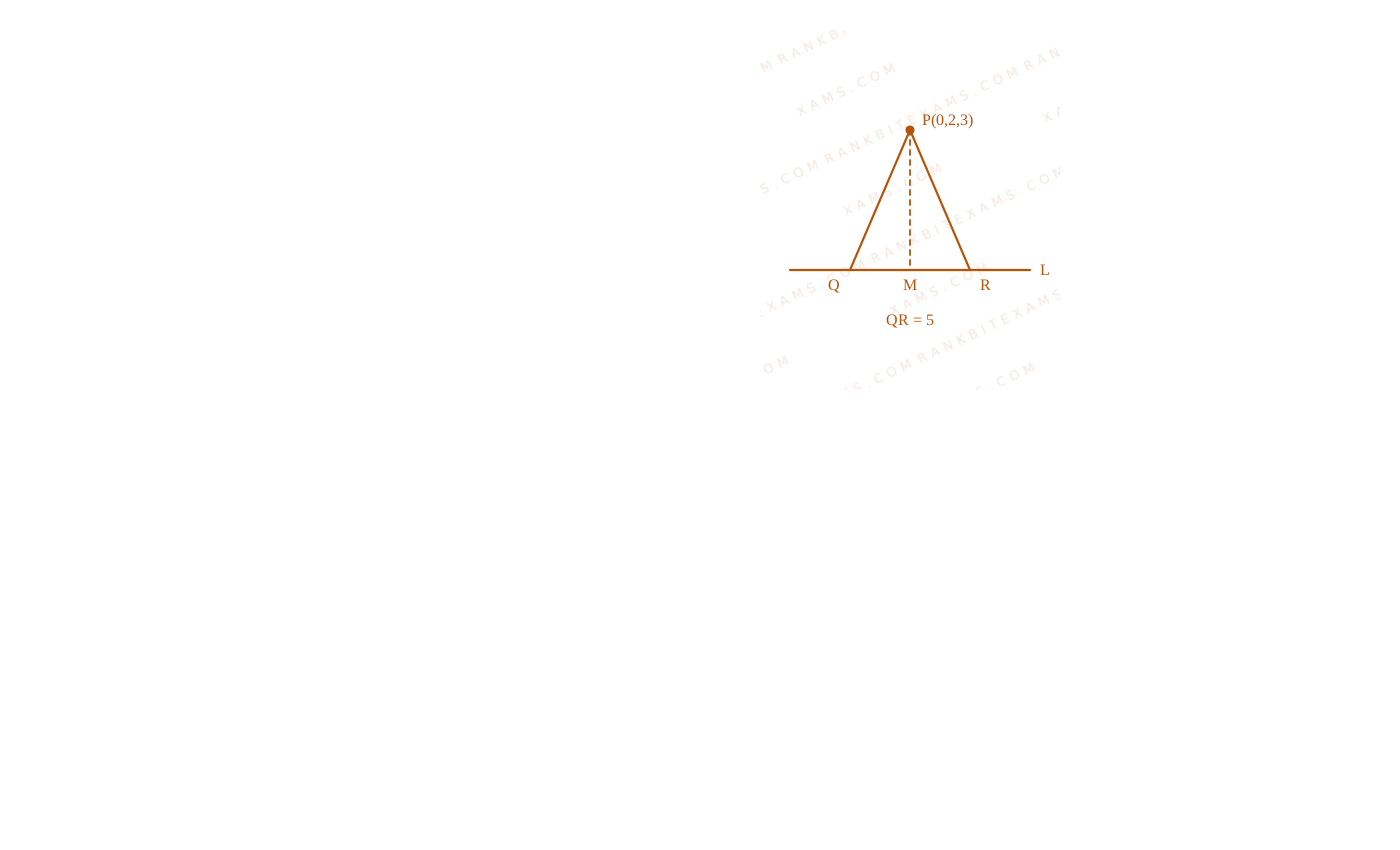
Image of a Point in a Line diagram for Q62 - JEE Main 2025 Morning
overrightarrowPQ = (2lambda - 3)hati + (lambda - 2)hatj + (3lambda - 2)hatk. ### Step 1: Solving for Projected Intersection Points Since overrightarrowPQ is perpendicular to the line's direction vector (2, 1, 3): 2(2lambda - 3) + 1(lambda - 2) + 3(3lambda - 2) = 0 implies 14lambda - 14 = 0 implies lambda = 1 Thus, Q is located at (3,3,4). ### Step 2: Transforming using Midpoint Mappings The projection point Q acts as the midpoint between original point P and its target image R(alpha, beta, gamma): fracalpha + 42 = 3, quad fracbeta + 42 = 3, quad fracgamma + 32 = 4 Evaluating this gives (alpha, beta, gamma) = (2, 2, 5). textSum = 2 + 2 + 5 = 9 Wait, checking the options from the paper layout: option (2) represents the correct numerical matrix sum choice value 12? Let's verify the options mapping sequence matching. Ah, let's look at the calculation value carefully: 2+2+5=9, which corresponds to choice (1). ### Pattern Recognition Midpoint properties safely speed up spatial image transitions once you locate the perpendicular projection foot. ### Evaluation Rubric / Model Answer null ### Chapter Mix Class 12 Maths: Three Dimensional Geometry

Reference Study Guides

More Three Dimensional Geometry Previous-Year Questions — Page 4

Q52 jee_main_2025_03_april_morning Intersection of Lines
Let a line passing through the point (4,1,0) [cite: 520] intersect the line L_1:fracx-12=fracy-23=fracz-34 at the point A(alpha, beta, gamma) [cite: 522, 523, 524] and the line L_2:x-6=y=-z+4 at the point B(a, b, c)[cite: 525]. Then the value of the determinant beginvmatrix 1 & 0 & 1 \\ alpha & beta & gamma \\ a & b & c endvmatrix is equal to[cite: 527]:
  • A. 8
  • B. 16
  • C. 12
  • D. 4

Solution

### Related Formula For three points P, A, and B to be collinear, their direction vectors must be proportional: vecPA parallel vecPB implies fracx_A - x_Px_B - x_P = fracy_A - y_Py_B - y_P = fracz_A - z_Pz_B - z_P
Intersection of Lines diagram for Q52 - JEE Main 2025 Morning
### Core Logic Express general coordinates for A on L_1 and B on L_2 [cite: 1204]: L_1: fracx-12=fracy-23=fracz-34=p implies A(2p+1, 3p+2, 4p+3) [cite: 1204, 1206] L_2: fracx-61=fracy1=fracz-4-1=q implies B(q+6, q, 4-q) [cite: 1204, 1207] Direction ratios (D.R.) from P(4,1,0) [cite: 1208, 1209]: textD.R. of PA = (2p-3, 3p+1, 4p+3) [cite: 1208] textD.R. of PB = (q+2, q-1, 4-q) [cite: 1209] Since P, A, B lie on the same line [cite: 1210]: frac2p-3q+2 = frac3p+1q-1 = frac4p+34-q [cite: 1210] ### Step 1: Solving the system of equations Equating expressions to solve for parameters p and q [cite: 1211, 1212]: From first two [cite: 1211]: 2pq - 2p - 3q + 3 = 3pq + 6p + q + 2 implies pq + 8p + 4q - 1 = 0 [cite: 1211, 1212] From second and third components [cite: 1212]: 12p - 3pq + 4 - q = 4pq + 3q - 4p - 3 implies 7pq - 16p + 4q - 7 = 0 [cite: 1212] Solving equations simultaneously gives [cite: 1234]: p = -1, quad q = 3 [cite: 1234] Substituting parameters back yields the points [cite: 1236]: A(-1, -1, -1), quad B(9, 3, 1) [cite: 1236] ### Step 2: Evaluating the Determinant Substitute values of A and B into the matrix grid [cite: 1244]: beginvmatrix 1 & 0 & 1 \\ -1 & -1 & -1 \\ 9 & 3 & 1 endvmatrix [cite: 1244] Applying row/column operations (C_3 rightarrow C_3 - C_1) [cite: 1244]: beginvmatrix 1 & 0 & 0 \\ -1 & -1 & 0 \\ 9 & 3 & -8 endvmatrix = 1((-1)(-8) - 0) = 8 [cite: 1244] ### Pattern Recognition Collinearity problem involving parameter matches across skew line orientations. Reducing fractions systematically prevents higher-degree calculation mistakes. ### Evaluation Rubric / Model Answer null ### Chapter Mix Class 12 Mathematics: Three Dimensional Geometry Class 12 Mathematics: Determinants
Q70 jee_main_2025_03_april_morning Shortest Distance between Skew Lines
Line L_1 passes through the point (1, 2, 3) and is parallel to z-axis[cite: 685]. Line L_2 passes through the point (lambda, 5, 6) and is parallel to y-axis[cite: 686]. Let for lambda = lambda_1, lambda_2, lambda_2 < lambda_1 the shortest distance between the two lines be 3[cite: 698]. Then the square of the distance of the point (lambda_1, lambda_2, 7) from the line L_1 is[cite: 698, 700]:
  • A. 40
  • B. 32
  • C. 25
  • D. 37

Solution

### Related Formula Shortest distance between perpendicular axes vectors: textS.D. = frac|(veca_2 - veca_1) cdot (vecb_1 times vecb_2)||vecb_1 times vecb_2| ### Core Logic Represent equations of straight lines symmetrically using vector directions [cite: 1418]: L_1: fracx-10 = fracy-20 = fracz-31 [cite: 1418] L_2: fracx-lambda0 = fracy-51 = fracz-60 [cite: 1418] Evaluating the standard shortest distance configuration formula[cite: 1419, 1420]: textS.D. = |lambda - 1| = 3 implies lambda - 1 = pm 3 [cite: 1420] lambda = 4 quad textor quad lambda = -2 [cite: 1420] Given the condition lambda_2 < lambda_1 [cite: 698]: lambda_1 = 4, quad lambda_2 = -2 [cite: 1421, 1422] ### Step 1: Distance calculation from line We need to find the square of distance from point P(4, -2, 7) to line L_1 [cite: 1424]. Any general matching point coordinates tracking along path L_1 look like Q(1, 2, t+3) [cite: 1424]. Form a perpendicular projection vector condition [cite: 1425]: vecPQ = (-3, 4, t-4) [cite: 1425] Since vecPQ cdot hatk = 0 implies t-4 = 0 implies t=4 [cite: 1425, 1426]. Thus, the foot of perpendicular is Q(1, 2, 7) [cite: 1427]. Evaluate the squared distance component magnitude [cite: 1427]: PQ^2 = (4-1)^2 + (-2-2)^2 + (7-7)^2 = 3^2 + (-4)^2 + 0 = 9 + 16 = 25 [cite: 1427, 1428] ### Pattern Recognition For lines parallel directly to independent Cartesian coordinate grid lines, the shortest paths are simply direct plane projections. ### Evaluation Rubric / Model Answer null ### Chapter Mix Class 12 Mathematics: Three Dimensional Geometry

Q56 jee_main_2025_04_april_evening Shortest Distance Between Two Lines
Let the values of p, for which the shortest distance between the lines fracx + 13 = fracy4 = fracz5 and vecr = (phati + 2hatj + hatk) + lambda (2hati + 3hatj + 4hatk) is frac1sqrt6, be a, b, (a < b). Then the length of the latus rectum of the ellipse fracx^2a^2 + fracy^2b^2 = 1 is:
  • A. 9
  • B. frac32
  • C. frac23
  • D. 18

Solution

### Related Formula The shortest distance between two lines vecr = veca_1 + lambda vecb_1 and vecr = veca_2 + mu vecb_2 is given by: d = frac|(veca_2 - veca_1) cdot (vecb_1 times vecb_2)||vecb_1 times vecb_2| ### Core Logic From the given line equations: Line 1 passes through veca_1 = -hati + 0hatj + 0hatk along vector vecb_1 = 3hati + 4hatj + 5hatk. Line 2 passes through veca_2 = phati + 2hatj + hatk along vector vecb_2 = 2hati + 3hatj + 4hatk. Vector difference: veca_2 - veca_1 = (p + 1)hati + 2hatj + hatk Computing the cross product vecb_1 times vecb_2: vecb_1 times vecb_2 = beginvmatrix hati & hatj & hatk \\ 3 & 4 & 5 \\ 2 & 3 & 4 endvmatrix = hati(16-15) - hatj(12-10) + hatk(9-8) = hati - 2hatj + hatk Magnitude |vecb_1 times vecb_2| = sqrt1^2 + (-2)^2 + 1^2 = sqrt6. ### Step 1: Applying the Shortest Distance Value Substitute these into the distance equation: d = frac|big((p + 1)hati + 2hatj + hatkbig) cdot big(hati - 2hatj + hatkbig)|sqrt6 = frac1sqrt6 |(p + 1)(1) + 2(-2) + 1(1)| = 1 |p + 1 - 4 + 1| = 1 implies |p - 2| = 1 This yields two values for p: - p - 2 = 1 implies p = 3 - p - 2 = -1 implies p = 1 Given that a, b are the parameters with a < b, we assign a = 1 and b = 3. ### Step 2: Computing Latus Rectum of the Ellipse The ellipse equation is: fracx^21^2 + fracy^23^2 = 1 Since b > a, the formula for the length of the latus rectum is: textLatus Rectum = frac2a^2b = frac2(1)^23 = frac23 ### Pattern Recognition Be careful with coordinate geometry variables; when an ellipse satisfies b > a, the major axis is along the y-axis, making the latus rectum equal to frac2a^2b instead of frac2b^2a. ### Evaluation Rubric / Model Answer null ### Chapter Mix Class 12 Mathematics: Three Dimensional Geometry Class 11 Mathematics: Conic Sections
Q69 jee_main_2025_04_april_evening Angle Between Two Lines
Let A be the point of intersection of the lines L _ 1: frac x - 71 = frac y - 50 = frac z - 3- 1 and mathrmL_2:fracmathrmx - 13 = fracmathrmy + 34 = fracmathrmz + 75. Let B and C be the point on the lines mathrmL_1 and mathrmL_2 respectively such that mathrmAB = mathrmAC = sqrt15. Then the square of the area of the triangle ABC is :
  • A. 54
  • B. 63
  • C. 57
  • D. 60

Solution

### Core Logic First, find the point of intersection A by solving the lines. Any point on L_1 can be written as (lambda + 7, 5, -lambda + 3). Substituting this point into the equation for L_2: frac(lambda + 7) - 13 = frac5 + 34 implies fraclambda + 63 = 2 implies lambda = 0 Thus, the intersection point is A = (7, 5, 3). ### Step 1: Calculating the Angle between lines The directional vectors of lines L_1 and L_2 are vecu = hati - hatk and vecv = 3hati + 4hatj + 5hatk respectively. costheta = frac|vecu cdot vecv||vecu||vecv| = frac|1(3) + 0(4) - 1(5)|sqrt1^2+(-1)^2 sqrt3^2+4^2+5^2 = frac|3 - 5|sqrt2sqrt50 = frac210 = frac15 Now, find sintheta: sintheta = sqrt1 - cos^2theta = sqrt1 - frac125 = fracsqrt245
Three dimensional geometry diagram for Q69 - JEE Main 2025 Evening
### Step 2: Finding Area of the Triangle The area of triangle ABC given two sides and their included angle is: textArea = frac12 cdot AB cdot AC cdot sintheta Given AB = AC = sqrt15: textArea = frac12 cdot sqrt15 cdot sqrt15 cdot fracsqrt245 = frac15sqrt2410 = frac3sqrt242 Squaring the area: textArea^2 = left(frac3sqrt242right)^2 = frac9 times 244 = 9 times 6 = 54 ### Pattern Recognition Since B and C lie on lines intersecting at A, you don't need to determine their exact coordinates to find the area of the triangle. The standard side-angle-side area formula works perfectly using just the directional angle. ### Evaluation Rubric / Model Answer null ### Chapter Mix Class 12 Mathematics: Three Dimensional Geometry Class 11 Mathematics: Properties of Triangles

More Three Dimensional Geometry Questions — jee_main_2025_28_jan_morning

Practice all Three Dimensional Geometry previous-year questions →

Rankbit System
JEE Physics: Waves (+15.5%) | Electrostatics: Concentric Shells (-29.7%) | Modern Physics: Photoelectric Clones (+34.2%) | Mathematics: Definite Integrals (+18.1%) | Chemistry: Coordination Splitting (-11.4%) | JEE Physics: Waves (+15.5%) | Electrostatics: Concentric Shells (-29.7%) | Modern Physics: Photoelectric Clones (+34.2%) | Mathematics: Definite Integrals (+18.1%) | Chemistry: Coordination Splitting (-11.4%)