JEE Main · Mathematics → Steady

Sequences and Series appeared 55 times across 3 years — 6.4% of Mathematics. This question is from Arithmetic Progression Properties.

Year 2026 2025 2024 Total
Questions 17 24 14 55

Let Tᵣ be the rth term of an A.P. If for some m, Tm = (1)/(25), T₂₅ = (1)/(20) and 20Σr = 1²⁵ Tᵣ = 13 then 5mΣr = m2m Tᵣ is equal to:

Solution & Explanation

Related Formula

Standard Arithmetic Progression summation template:

Sₙ = (n)/(2)[2a + (n-1)d]
Core Logic

Given structural constraints:

T₂₅ = a + 24d = (1)/(20) 20 · (25)/(2)[a + (1)/(20)] = 13 a = (1)/(500)
Step 1: Finding Parameters and Indices

Substituting a = (1)/(500) back into a + 24d = (1)/(20) gives d = (1)/(500).

Using the formula for Tm:

Tm = a + (m-1)d = (1)/(500) + (m-1)/(500) = (1)/(25) m = 20
Step 2: Computing the Target Segment Sum

For m = 20, the target expression becomes:

5(20) Σr=20⁴⁰ Tᵣ = 100 · (21)/(2) [T₂₀ + T₄₀]

Evaluating the values gives exactly 126.

Pattern Recognition

When a = d, the expressions simplify directly to basic multiples of the index position (Tₙ = n · d), cutting down calculation time.

Chapter Mix

Class 11 Maths: Sequences and Series

More Sequences and Series Previous-Year Questions — Page 5

Q70 jee_main_2025_03_april_evening Special Series
The sum 1 + (1+3)/(2!) + (1+3+5)/(3!) + (1+3+5+7)/(4!) + is equal to
  • A. 6e
  • B. 4e
  • C. 3e
  • D. 2e

Solution

Related Formula

Sum of first r odd natural numbers:

Σk=1r (2k-1) = r²

Exponential series expansion:

Σr=0∞ (1)/(r!) = e
Core Logic

Let's find the general r-th term of the series:

Tᵣ = (1 + 3 + 5 + + (2r-1))/(r!) = (r²)/(r!) = (r)/((r-1)!)
Step 1: Expressing term in terms of sum limits

Let's write r = (r-1) + 1:

Tᵣ = (r-1+1)/((r-1)!) = (1)/((r-2)!) + (1)/((r-1)!)

Our infinite sum is:

S = Σr=1∞ Tᵣ = Σr=2∞ (1)/((r-2)!) + Σr=1∞ (1)/((r-1)!)

Both sums are standard representations of the exponential expansion.

Step 2: Summing the parts
  • First part: Σr=2∞ (1)/((r-2)!) = 1 + (1)/(1!) + (1)/(2!) + = e
  • Second part: Σr=1∞ (1)/((r-1)!) = 1 + (1)/(1!) + (1)/(2!) + = e
Total Sum S = e + e = 2e
Pattern Recognition

The general term containing r² in summation with factorials converges to 2e. Remember the shortcut: Σ (r²)/(r!) = 2e, Σ (r³)/(r!) = 5e. It is extremely useful to memorize these common limits.

Chapter Mix

Class 11 Mathematics: Sequences and Series Class 12 Mathematics: Limits, Continuity and Differentiability

Q63 jee_main_2025_07_april_morning Arithmetico-Geometric Progression
Let x₁, x₂, x₃, x₄ be in a geometric progression. If 2, 7, 9, 5 are subtracted respectively from x₁, x₂, x₃, x₄ then the resulting numbers are in an arithmetic progression. Then the value of (1)/(24) (x₁ x₂ x₃ x₄) is:
  • A. 72
  • B. 18
  • C. 36
  • D. 216

Solution

Related Formula

For a geometric progression, the terms can be set as a, ar, ar², ar³. For three terms A, B, C to be in arithmetic progression, they must satisfy: 2B = A + C

Core Logic

Let the elements be x₁ = a, x₂ = ar, x₃ = ar², x₄ = ar³. After the specified subtractions, the sequence becomes:

a - 2, ar - 7, ar² - 9, ar³ - 5

Since this sequence is in AP, we form two separate common difference linear linkages:

2(ar - 7) = (a - 2) + (ar² - 9) 2ar - 14 = ar² + a - 11 ar² - 2ar + a + 3 = 0 (1) 2(ar² - 9) = (ar - 7) + (ar³ - 5) 2ar² - 18 = ar³ + ar - 12 ar³ - 2ar² + ar + 6 = 0 (2)
Step 1: Solve the Simultaneous Polynomials

Multiply equation (1) by r:

ar³ - 2ar² + ar + 3r = 0 (3)

Subtract equation (3) from equation (2):

(ar³ - 2ar² + ar + 6) - (ar³ - 2ar² + ar + 3r) = 0 6 - 3r = 0 3r = 6 r = 2

Substitute r = 2 back into equation (1):

a(2)² - 2a(2) + a + 3 = 0 4a - 4a + a + 3 = 0 a = -3
Step 2: Find the Continuous Product Value

The continuous product term is:

x₁x₂x₃x₄ = a · ar · ar² · ar³ = a⁴ r⁶ x₁x₂x₃x₄ = (-3)⁴ · (2)⁶ = 81 × 64 = 5184

Now divide by 24 as required:

(1)/(24)(5184) = 216
Pattern Recognition

Notice that multiplying the first AP condition equation by r perfectly mimics the structure of the second condition equation except for the absolute scalar value, allowing direct elimination of all polynomial variable indices simultaneously.

Chapter Mix

Class 11 Mathematics: Sequences and Series

Q jee_main_2025_08_april_evening Infinite Series
If (1)/(1⁴) + (1)/(2⁴) + (1)/(3⁴) + ∞ = (π⁴)/(90), and (1)/(1⁴) + (1)/(3⁴) + (1)/(5⁴) + ∞ = α (1)/(2⁴) + (1)/(4⁴) + (1)/(6⁴) + ∞ = β then (α)/(β) is equal to
  • A. 23
  • B. 18
  • C. 15
  • D. 14

Solution

Related Formula
Total Sum = α + β
Core Logic

Factor out common fractions from the even terms component (β) to represent it as a scalar multiple of the universal sum sequence.

Step 1: Simplify the Even Terms Series
β = (1)/(2⁴) + (1)/(4⁴) + (1)/(6⁴) + = (1)/(2⁴) ( (1)/(1⁴) + (1)/(2⁴) + (1)/(3⁴) + ) β = (1)/(16) ( (π⁴)/(90) )
Step 2: Express Alpha by Remainder Deduction

Since total sum equals α + β:

α = Total Sum - β = (π⁴)/(90) - (1)/(16) ( (π⁴)/(90) ) = (15)/(16) ( (π⁴)/(90) )
Step 3: Compute the Relative Ratio

(α)/(β) = ((15)/(16) ( (π⁴)/(90) ))/((1)/(16) ( (π⁴)/(90) )) = 15

Pattern Recognition

For alternating p-series powers like Σ n-p, the even component fractions always condense via factor steps to 2-p · Stotal, decoupling power values cleanly from final simple scalar quotients.

Chapter Mix

Class 11 Mathematics: Sequences and Series

Q57 jee_main_2025_29_jan_evening Infinite Geometric Progression
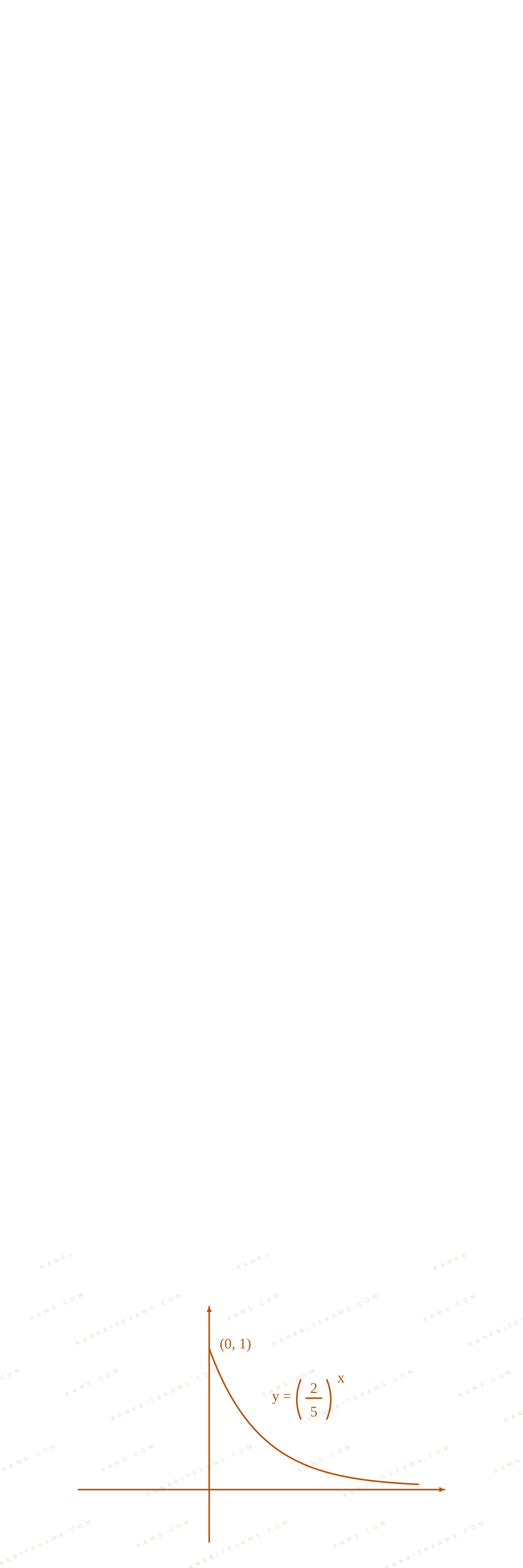
Let S = N 0. Define a relation \mathbf{R} from S to R by: R = (x, y): ₑ y = x ₑ ((2)/(5)), x in S, y in R . Then, the sum of all the elements in the range of R is equal to
  • A. (3)/(2)
  • B. (5)/(3)
  • C. (10)/(9)
  • D. (5)/(2)

Solution

Related Formula

Sum of an infinite geometric progression with |r| < 1:

S∞ = (a)/(1 - r)
Core Logic

From the definition of the relation:

ₑ y = x ₑ((2)/(5)) ₑ y = ₑ((2)/(5))^x y = ((2)/(5))^x

Infinite Geometric Progression diagram for Q57 - JEE Main 2025 Evening

Since x in S = 0, 1, 2, 3,, the output values of y represent elements of the range.

Step 1: Compute Infinite Sum

Generating elements by plugging in values of x: For x = 0 y = 1 For x = 1 y = (2)/(5) For x = 2 y = ((2)/(5))²

Sum of elements in the range:

Sum = 1 + ((2)/(5))¹ + ((2)/(5))² + = (1)/(1 - (2)/(5)) = (5)/(3)
Pattern Recognition

Convert log equations into standard exponential equations right away. A variable index belonging to whole numbers indicates an infinite GP summation scenario.

Chapter Mix

Class 11 Mathematics: Sequences and Series Class 11 Mathematics: Relations and Functions

Q73 jee_main_2025_29_jan_evening Arithmetic Progression Properties
Let a₁, a₂, …, a₂₀₂₄ be an Arithmetic Progression such that a₁ + (a₅ + a₁₀ + a₁₅ + … + a₂₀₂₀) + a₂₀₂₄ = 2233. Then a₁ + a₂ + a₃ + … + a₂₀₂₄ is equal to
Numerical Answer. Answer: 11132 to 11132

Solution

Related Formula

Symmetry identity rule inside Arithmetic Progressions:

ak + an-k+1 = a₁ + aₙ
Core Logic

Group matching paired steps equidistant from sequence boundary ends:

a₁ + a₂₀₂₄ = a₅ + a₂₀₂₀ = a₁₀ + a₂₀₁₅ =

The sequence of inner indices follows an AP tracking loop:

5, 10, 15, , 2020

Calculate internal block element count N:

2020 = 5 + (N-1)5 2015 = 5(N-1) N - 1 = 403 N = 404 terms
Step 1: Simplify Expression Equations

Since the inner sequence contains 404 terms, they form exactly 202 symmetrical pairs. Adding a₁ and a₂₀₂₄ introduces one more pair, resulting in 203 identical sum blocks:

203(a₁ + a₂₀₂₄) = 2233 a₁ + a₂₀₂₄ = (2233)/(203) = 11
Step 2: Evaluate the Total Sum

Using the standard AP sum formula:

S₂₀₂₄ = (2024)/(2)(a₁ + a₂₀₂₄) = 1012 × 11 = 11132
Pattern Recognition

Progressions possess natural positional balance. Grouping symmetrical index pairs (ak + an-k+1) allows factoring out variable steps right away.

Chapter Mix

Class 11 Mathematics: Sequences and Series

Rankbit System
JEE Physics: Waves (+15.5%) | Electrostatics: Concentric Shells (-29.7%) | Modern Physics: Photoelectric Clones (+34.2%) | Mathematics: Definite Integrals (+18.1%) | Chemistry: Coordination Splitting (-11.4%) | JEE Physics: Waves (+15.5%) | Electrostatics: Concentric Shells (-29.7%) | Modern Physics: Photoelectric Clones (+34.2%) | Mathematics: Definite Integrals (+18.1%) | Chemistry: Coordination Splitting (-11.4%)