JEE Main · Mathematics ↓ Falling

Limits, Continuity and Differentiability appeared 52 times across 3 years — 6% of Mathematics. This question is from Continuity and Differentiability of Piecewise Functions.

Year 2026 2025 2024 Total
Questions 12 24 16 52

Let f(x) = cases 3x, & x < 0 1 + x + [ x ], x + 2 [ x ] , & 0 ≤ x ≤ 2 5, & x > 2 cases where [.] denotes greatest integer function. If α and β are the number of points, where f is not continuous and is not differentiable, respectively, then α + β equals....

Numerical Answer Type:
Enter a numerical value Answer: 5 to 5 +4 marks

Solution & Explanation

Related Formula

A function is discontinuous if left-hand and right-hand limits mismatch at boundary transitions. Non-differentiability occurs at discontinuities or sharp turns.

Core Logic

Simplify the greatest integer component [x] by expanding over integer intervals:

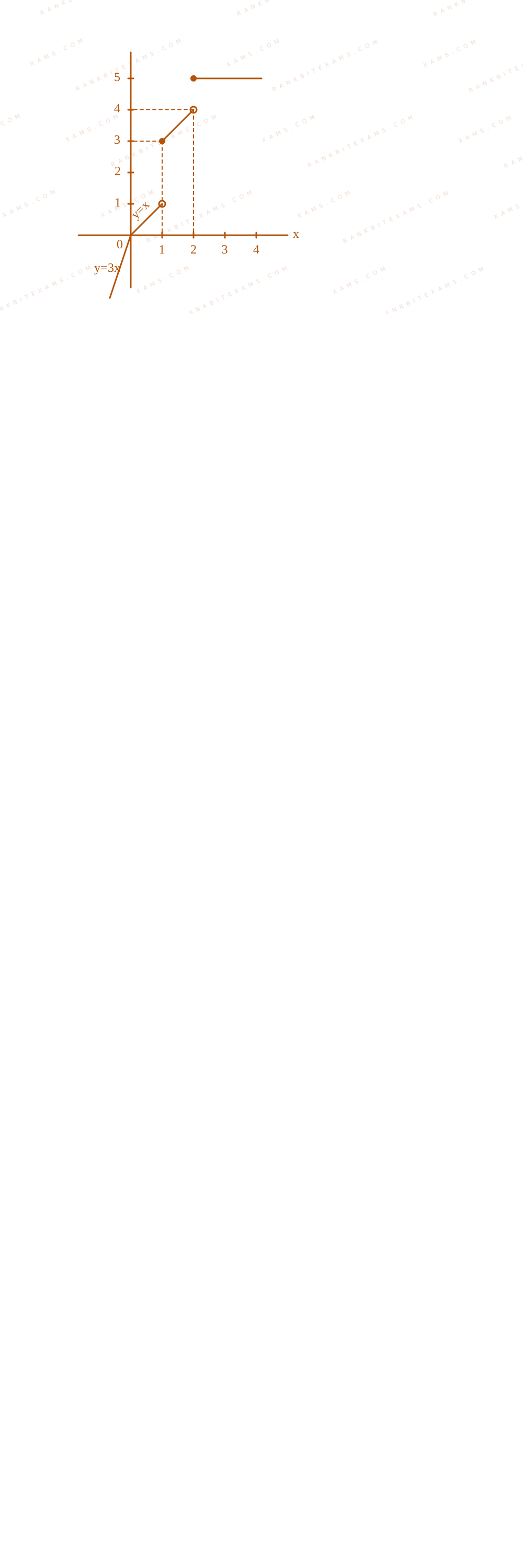
Continuity and Differentiability of Piecewise Functions diagram for Q74 - JEE Main 2025 Morning

f(x) = cases 3x, & x < 0 x, & 0 ≤ x < 1 x + 2, & 1 ≤ x < 2 5, & x > 2 cases
Step 1: Testing Continuity Limits

Check continuity at structural boundaries: At x = 0: LHM = 0, RHM = 0 Continuous. At x = 1: LHM = 1, RHM = 3 Discontinuous. At x = 2: LHM = 4, RHM = 5 Discontinuous.

Thus, α = 2 points of discontinuity (x in 1, 2).

Step 2: Testing Differentiability Parameters

Discontinuities automatically introduce non-differentiability. Now check smooth corners at the remaining continuous transition x = 0:

f^ (0^-) = 3, f^ (0^+) = 1 Not differentiable at x=0.

Thus, β = 3 points of non-differentiability (x in 0, 1, 2).

α + β = 2 + 3 = 5
Pattern Recognition

Discontinuities automatically break differentiability. Always count them first before checking derivatives at smooth corner points.

Chapter Mix

Class 12 Maths: Limits, Continuity and Differentiability

Reference Study Guides

More Limits, Continuity and Differentiability Previous-Year Questions — Page 4

Q51 jee_main_2025_03_april_evening Differentiability and Extrema
Let f: R → R be a function defined by f(x) = | |x + 2| - 2|x| |. If m is the number of points of local minima and n is the number of points of local maxima of f, then m + n is
  • A. 5
  • B. 3
  • C. 2
  • D. 4

Solution

Related Formula

For a continuous function f(x):

  • A point x = c is a local minimum if f(x) changes from decreasing to increasing as x passes through c (i.e., a trough in the graph).
  • A point x = c is a local maximum if f(x) changes from increasing to decreasing as x passes through c (i.e., a peak in the graph).
Core Logic

Let's analyze g(x) = |x+2| - 2|x| first to construct f(x) = |g(x)|.

  • If x ≤ -2:
g(x) = -(x+2) - 2(-x) = x - 2
  • If -2 < x ≤ 0:
g(x) = (x+2) - 2(-x) = 3x + 2
  • If x > 0:
g(x) = (x+2) - 2x = -x + 2

Now, we find the critical transition points where g(x) = 0:

  • x - 2 = 0 x = 2 (not in x ≤ -2)
  • 3x + 2 = 0 x = -2/3 (lies in -2 < x ≤ 0)
  • -x + 2 = 0 x = 2 (lies in x > 0)
  • Thus, the absolute value function f(x) = |g(x)| transitions at x = -2, x = -2/3, x = 0, and x = 2.

Step 1: Graph Reconstruction and Critical Points Analysis

Evaluating values at these boundaries:

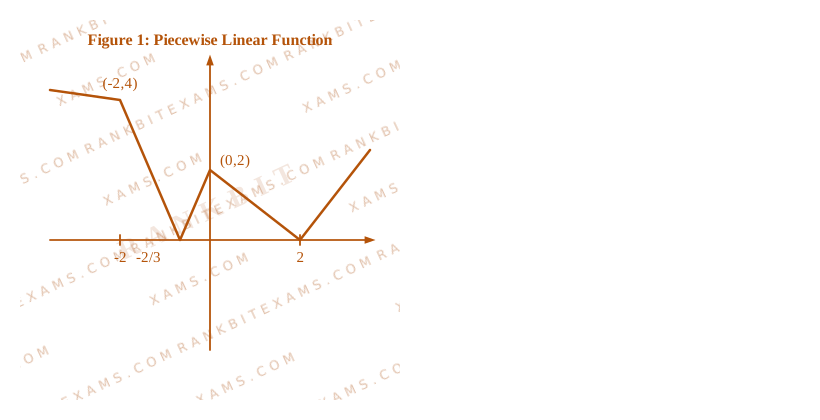
  • f(-2) = | |-2+2| - 2|-2| | = |0 - 4| = 4
  • f(-2/3) = 0 (trough, local minimum)
  • f(0) = | |2| - 0 | = 2 (peak, local maximum)
  • f(2) = 0 (trough, local minimum)
  • Let's trace the graph:

  • For x < -2, f(x) = |x-2| = 2-x, which decreases towards 4 as x → -2.
  • At x = -2, there is a corner point (-2,4), but it is not an extremum because the function continues to decrease to 0 on the right.
  • At x = -2/3, it reaches 0 and turns upwards (local minimum).
  • At x = 0, it reaches a local peak of 2 and turns downwards (local maximum).
  • At x = 2, it reaches 0 and turns upwards (local minimum).
  • Extrema diagram for Q51 - JEE Main 2025 Evening Shift
    Extrema diagram for Q51 - JEE Main 2025 Evening Shift

Step 2: Calculating m + n

From the verified graph and transition behaviors:

  • Local minima points (m): x = -2/3 and x = 2 m = 2
  • Local maxima points (n): x = 0 n = 1
Sum m + n = 2 + 1 = 3
Pattern Recognition

Whenever you have f(x) = |g(x)| where g(x) is continuous:

  • Any point where g(x) = 0 becomes a local minimum with value 0 (unless it was a tangent point already, which still remains a minimum).
  • Corners of the original absolute segments like x=0, -2 must be checked sequentially for slope changes.
Chapter Mix

Class 12 Mathematics: Limits, Continuity and Differentiability Class 11 Mathematics: Relations and Functions

Q73 jee_main_2025_03_april_evening Evaluation of Limits
If x → 0 ( ( x)/(x) )(1)/(x²) = p, then 96 ₑ p is equal to
Numerical Answer. Answer: 32 to 32

Solution

Related Formula

For a limit of 1∞ form, where f(x) = 1 and g(x) = ∞:

[f(x)]g(x) = eg(x)(f(x) - 1)

Taylor expansion of x:

x = x + (x³)/(3) + (2x⁵)/(15) +
Core Logic

Here, x → 0 ( x)/(x) = 1 and x → 0 (1)/(x²) = ∞.

p = e^ x → 0 (1)/(x²)(( x)/(x) - 1) = e^ x → 0 ( x - x)/(x³)
Step 1: Finding limit exponent

Using expansion of x:

x → 0 ((x + (x³)/(3) + ) - x)/(x³) = x → 0 ((x³)/(3) + O(x⁵))/(x³) = (1)/(3)

Thus: p = e1/3

96 ₑ p = 96((1)/(3)) = 32
Pattern Recognition

Limits of forms like 1∞ always boil down to evaluating standard polynomials in the exponent. Using Taylor series expansion rather than L'Hopital's rule directly avoids taking multiple heavy derivatives.

Chapter Mix

Class 12 Mathematics: Limits, Continuity and Differentiability

Q jee_main_2025_07_april_morning Evaluation of Limits
x→ 0⁺ (5(x)(1)/(3)) ₑ(1 + 3x²)( ⁻¹3√(x))²(e^5(x)(4)/(3) - 1) is equal to
  • A. (1)/(15)
  • B. 1
  • C. (1)/(3)
  • D. (5)/(3)

Solution

Related Formula

Standard limits commands:

f(x)→ 0 ( (f(x)))/(f(x)) = 1 f(x)→ 0 (ln(1+f(x)))/(f(x)) = 1 f(x)→ 0 ⁻¹(f(x))f(x) = 1 f(x)→ 0 ef(x)-1f(x) = 1
Core Logic

We can rewrite the limit by grouping each term with its standard balancing factor:

x→ 0⁺ ( (5x1/3)5x1/3) · ( 3√(x) ⁻¹3√(x))² · ( ₑ(1 + 3x²)3x²) · ( 5x4/3e^5x4/3 - 1) × 5x1/3 · 3x²(3√(x))² · 5x4/3
Step 1: Simplify the Compensating Factor

Evaluate the remaining algebraic factor:

5x1/3 · 3x²9x · 5x4/3 = 15x7/345x7/3 = (15)/(45) = (1)/(3)

Since all individual standard limit terms approach 1, the value of the limit is exactly:

1 · 1² · 1 · 1 · (1)/(3) = (1)/(3)
Pattern Recognition

Shortcut: For standard limits involving (u), ln(1+u), ⁻¹(u), and e^u-1 as u → 0, replace each function directly with its argument:

(5x1/3)(3x²)(3√(x))²(5x4/3) = 15x7/345x7/3 = (1)/(3)
Chapter Mix

Class 11 Mathematics: Limits and Derivatives Class 12 Mathematics: Limits, Continuity and Differentiability

Q71 jee_main_2025_07_april_morning Points of Discontinuity
The number of points of discontinuity of the function f(x) = [(x²)/(2)] - [√(x)], x in [0,4] , where [·] denotes the greatest integer function is
Numerical Answer. Answer: 8 to 8

Solution

Related Formula

The greatest integer function [u] changes value and experiences a step discontinuity at any point where its inner argument u takes on an integer value.

Core Logic

Analyze the potential points where either component function argument changes into an integer within the interval x in [0, 4].

  • For [(x²)/(2)]:
  • (x²)/(2) can range from (0)/(2) = 0 up to (16)/(2) = 8. Integer values are reached at (x²)/(2) = 0, 1, 2, 3, 4, 5, 6, 7, 8, which means critical test locations are:

x = 0, √(2), 2, √(6), √(8), √(10), √(12), √(14), 4
  • For [√(x)]:
  • √(x) can range from √(0) = 0 to √(4) = 2. Integer values are reached at √(x) = 0, 1, 2, which means critical test locations are:

x = 0, 1, 4
Step 1: Audit Each Critical Point

Combine the set of test points within domain boundaries (0, 4):

x in 1, √(2), 2, √(6), √(8), √(10), √(12), √(14)

Let's evaluate the left and right hand limits at these specific values:

  • At x = 1: [√(x)] steps up while [(x²)/(2)] is constant Discontinuous.
  • At x = √(2): [(x²)/(2)] steps up while [√(x)] is constant Discontinuous.
  • At x = 2: Both functions experience an simultaneous integer step. Let's inspect:
  • f(2) = [2] - [√(2)] = 2 - 1 = 1
  • f(2^-) = [1.99] - [1.41] = 1 - 1 = 0
  • Since LHL ≠ value at point, it is Discontinuous. Continuing this verification down the full combined list confirms that none of the step jumps cancel each other out.

Step 2: Sum the Discontinuity Points

Counting all isolated inner points within (0, 4) yields exactly 8 locations:

Total Points = 8
Pattern Recognition

When two greatest integer functions drop steps simultaneously at the same point (like at x=2), always write out the explicit left and right limits manually, as simultaneous steps occasionally step in matching directions and maintain unexpected continuity.

Chapter Mix

Class 12 Mathematics: Limits, Continuity and Differentiability

Q70 jee_main_2025_08_april_evening Standard Limits and Expansion
Given below are two statements : Statement I : _ x arrow 0 ( ^ - 1 x + _ e 1 + x1 - x - 2 xx ^ 5) = (2)/(5) Statement II: x→ 1(x(2)/(1 - x)) = 1e² In the light of the above statements, choose the correct answer from the options given below:
  • A. Statement I is false but Statement II is true
  • B. Statement I is true but Statement II is false
  • C. Both Statement I and Statement II are false.
  • D. Both Statement I and Statement II are true.

Solution

Related Formula
(1+x) = x - (x²)/(2) + (x³)/(3) - x → a u^v = e(u-1)v
Core Logic

Verify Statement I via high-order Taylor polynomial series tracking, and determine Statement II values by resolving standard exponential limit properties.

Step 1: Expand Statement I Sequence Polynomials
⁻¹x = x - (x³)/(3) + (x⁵)/(5) - (1)/(2)[ln(1+x) - ln(1-x)] = x + (x³)/(3) + (x⁵)/(5) +

Summing terms together and subtracting 2x leaves:

x → 0 (2x⁵/5 + )/(x⁵) = (2)/(5) (Statement I is true)
Step 2: Verify Statement II Limit Power Structure

Evaluating the 1^∞ form configuration style:

e^ x → 1 ((2)/(1-x))(x-1) = e⁻² = (1)/(e²) (Statement II is true)
Step 3: State Conclusion

Both statements are correct.

Pattern Recognition

When a limit features a power factor of 5 in the denominator, you must track expansion variables through the 5th degree term to guarantee accuracy.

Chapter Mix

Class 11 Mathematics: Limits

More Limits, Continuity and Differentiability Questions — jee_main_2025_28_jan_morning

Practice all Limits, Continuity and Differentiability previous-year questions →

Rankbit System
JEE Physics: Waves (+15.5%) | Electrostatics: Concentric Shells (-29.7%) | Modern Physics: Photoelectric Clones (+34.2%) | Mathematics: Definite Integrals (+18.1%) | Chemistry: Coordination Splitting (-11.4%) | JEE Physics: Waves (+15.5%) | Electrostatics: Concentric Shells (-29.7%) | Modern Physics: Photoelectric Clones (+34.2%) | Mathematics: Definite Integrals (+18.1%) | Chemistry: Coordination Splitting (-11.4%)