If f(x) = 2^x2^x + √(2), x in R, then Σk=1⁸¹ f((k)/(82)) is equal to:

Solution & Explanation

Related Formula

Symmetric identity wrapper for matching indices:

f(x) + f(1-x) = 1
Core Logic

Let's evaluate f(x) + f(1-x):

f(x) + f(1-x) = 2^x2^x + √(2) + 21-x21-x + √(2) = 2^x2^x + √(2) + 22 + √(2)· 2^x = 2^x + √(2)2^x + √(2) = 1
Step 1: Expanding the Series

Pairing matching terms from opposite ends of the summation:

Σk=1⁸¹ f((k)/(82)) = [f((1)/(82)) + f((81)/(82))] + + f((41)/(82))

There are 40 complete pairs matching the f(x) + f(1-x) = 1 identity, plus one lone center term f((1)/(2)).

Step 2: Computing Final Valuation
Sum = 40 + f((1)/(2)) = 40 + √(2)√(2) + √(2) = 40 + (1)/(2) = (81)/(2)
Pattern Recognition

When encountering fractional summation bounds, always check the sum of components x + (1-x) to find linear reduction templates.

Chapter Mix

Class 11 Maths: Sequences and Series Class 12 Maths: Relations and Functions

More Functions Previous-Year Questions — Page 9

Q54 jee_main_2025_07_april_evening Range of Rational Functions
If the range of the function f(x) = (5 - x)/(x² - 3x + 2), x ≠ 1, 2, is (-∞ , α ] [ β , ∞), then α² +β² is equal to :
  • A. 190
  • B. 192
  • C. 188
  • D. 194

Solution

Related Formula

For a quadratic equation Ax² + Bx + C = 0 to yield real roots, its discriminant must satisfy:

D = B² - 4AC ≥ 0
Core Logic

Set y = (5 - x)/(x² - 3x + 2):

y(x² - 3x + 2) = 5 - x yx² - 3xy + 2y + x - 5 = 0

Rearranging into a standard quadratic equation in terms of x:

yx² + (1 - 3y)x + (2y - 5) = 0
Step 1: Discriminant Method

Case I: If y = 0, the equation simplifies to x - 5 = 0 x = 5, which is a valid part of the domain. Thus, 0 belongs to the range.

Case II: If y ≠ 0, for x to be real, D ≥ 0:

(1 - 3y)² - 4(y)(2y - 5) ≥ 0 9y² + 1 - 6y - 8y² + 20y ≥ 0 y² + 14y + 1 ≥ 0
Step 2: Solving the Inequality

Completing the square for y² + 14y + 1 ≥ 0:

(y + 7)² - 48 ≥ 0 (y + 7)² ≥ (4√(3))²

This gives:

y ≤ -7 - 4√(3) or y ≥ -7 + 4√(3)

Comparing with the interval (-∞ , α ] [ β , ∞):

α = -7 - 4√(3) β = -7 + 4√(3)
Step 3: Finding alpha^2 + beta^2

Using algebraic identities:

α² + β² = (-7 - 4√(3))² + (-7 + 4√(3))² = 2(7² + (4√(3))²) = 2(49 + 48) = 2(97) = 194
Pattern Recognition

For rational expressions of the form LinearQuadratic, converting to a quadratic in x and forcing D ≥ 0 establishes the range boundaries elegantly.

Chapter Mix

Class 11 Mathematics: Sets, Relations and Functions

Q52 jee_main_2025_24_jan_evening One-One and Onto Functions
The function f:(-∞,∞)arrow(-∞,1), defined by f(x)= 2x-2-x2x+2-x is:
  • A. One-one but not onto
  • B. Onto but not one-one
  • C. Both one-one and onto
  • D. Neither one-one nor onto

Solution

Related Formula

A function is one-one if its derivative is strictly monotonic (always positive or always negative) across its domain. It is onto if its range equals its co-domain.

Core Logic

Rewrite the function by multiplying the numerator and denominator by 2^x:

f(x) = 22x - 122x + 1 = 1 - 222x + 1
Step 1: Check One-One property

Differentiating f(x) with respect to x :

f'(x) = 2(22x + 1)² · 2 · 22x · ln 2 = 4 · 22x · ln 2(22x + 1)²

Since 22x > 0 and ln 2 > 0, f'(x) > 0 always. Thus, f(x) is strictly increasing, confirming it is a one-one function.

Step 2: Check Onto property

Analyze the limits at boundaries:

x → -∞ f(x) = 1 - (2)/(0 + 1) = -1 x → ∞ f(x) = 1 - 0 = 1

Thus, the range of the function is (-1, 1). Since the given co-domain is (-∞, 1) and Range ≠ Co-domain , the function is not onto.

Pattern Recognition

The expression given is a shifted form of the hyperbolic tangent function (x ln 2). Hyperbolic tangent always maps to (-1, 1), making its restriction against (-∞, 1) non-surjective (not onto).

Chapter Mix

Class 12 Mathematics: Relations and Functions

Q58 jee_main_2025_24_jan_evening Linear Programming and Inequalities in Two Variables
Let the points ((11)/(2),α) lie on or inside the with sides x+y=11, x+2y=16 and 2x+3y=29 Then the product of the smallest and the largest values of a is equal to:
  • A. 22
  • B. 44
  • C. 33
  • D. 55

Solution

Related Formula

For a vertical line x = x₀ crossing a bounded region, the valid coordinates of y sit between the boundary lines intersecting that specific line vertical plane.

Core Logic

The point given is fixed at x = (11)/(2) = 5.5. We evaluate the values of y along this vertical line segment across each boundary edge.

Linear Programming region graph for Q58 - JEE Main 2025 Evening

Step 1: Evaluate Intersections

Substitute x = (11)/(2) into the three linear constraints:

  • From x + y = 11:
(11)/(2) + y = 11 ⇒ y = 11 - 5.5 = 5.5
  • From x + 2y = 16:
(11)/(2) + 2y = 16 ⇒ 2y = 16 - 5.5 = 10.5 ⇒ y = 5.25
  • From 2x + 3y = 29:
2((11)/(2)) + 3y = 29 ⇒ 11 + 3y = 29 ⇒ 3y = 18 ⇒ y = 6
Step 2: Define Extrema and Multiply

Checking the internal region of the bounded by these lines, the valid range for α along the section line is delimited by y = 5.5 and y = 6:

α = (11)/(2) = 5.5 α = 6

The product of the limits is :

α · α = (11)/(2) × 6 = 33
Pattern Recognition

Instead of drawing full coordinate diagrams or computing all three vertex points, evaluating values directly at the fixed coordinate constraint x = 5.5 saves time during multi-line area problems.

Chapter Mix

Class 11 Mathematics: Linear Inequalities Class 11 Mathematics: Straight Lines

Q71 jee_main_2025_24_jan_evening Number of Functions under Constraints
Number of functions f:1,2, ,100arrow0,1, that assign 1 to exactly one of the positive integers less than or equal to 98, is equal to \_\_\_\_.
Numerical Answer. Answer: 392

Solution

Related Formula

Fundamental Counting Principle: If an operation can be performed in n₁ ways, followed by a second operation in n₂ ways, the total configurations equal n₁ × n₂.

Core Logic

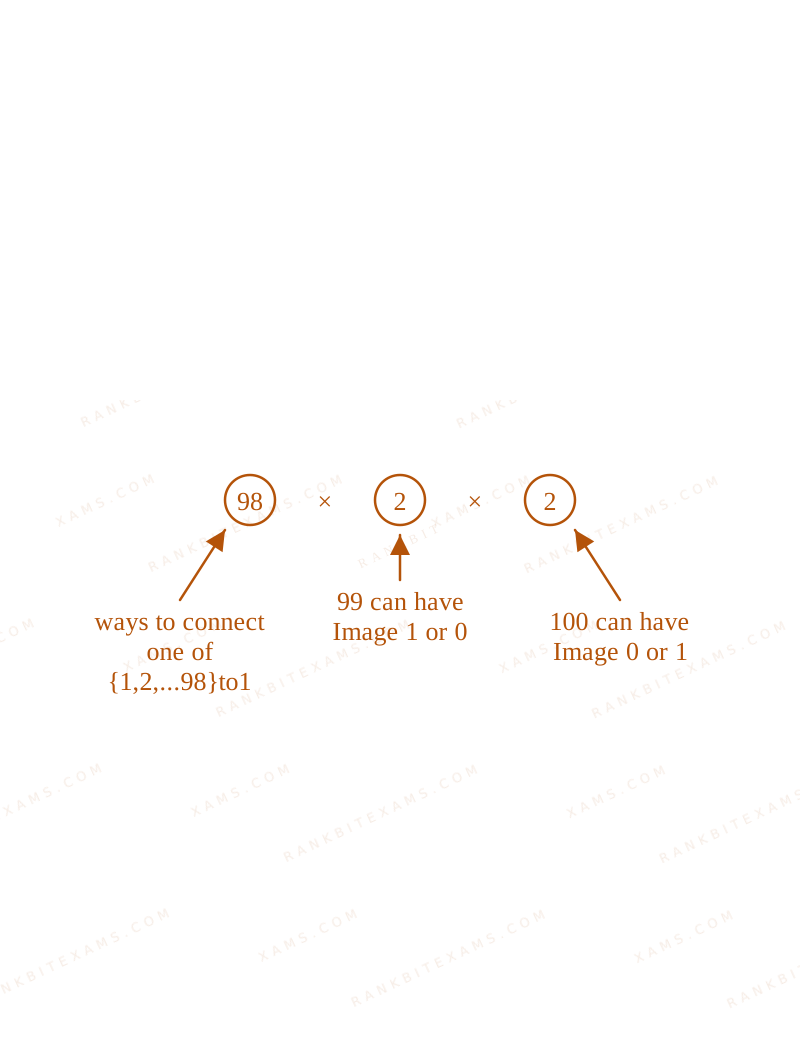
The domain set contains integers from 1 to 100. We divide the mapping requirements across distinct subsets of this domain.

Function mapping grid for Q71 - JEE Main 2025 Evening

Step 1: Choose the single element from 1, 2, , 98

We must assign the image value 1 to exactly one positive integer from the subset 1, 2, , 98. The number of ways to pick this single element is :

981 = 98 ways
Step 2: Mapping remaining elements

The remaining 97 elements in the 1, 2, , 98 subset cannot map to 1, so they must map to 0. This leaves exactly 1 choice per remaining element.

For the final two elements in the domain, 99 and 100, there are no structural constraints:

  • Element 99 can map to either 0 or 1 (2 options) .
  • Element 100 can map to either 0 or 1 (2 options).
Step 3: Total functions combination

Multiply the independent choices together :

Total functions = 98 × 2 × 2 = 392
Pattern Recognition

Separate domains tightly into restricted blocks vs completely free components. Realizing that elements 99 and 100 behave independently with full co-domain targets leaves a clear product formulation.

Chapter Mix

Class 12 Mathematics: Relations and Functions Class 11 Mathematics: Permutations and Combinations

Q jee_main_2025_24_jan_morning Symmetric Property of Functions
Let f(x) = 2x + 2 + 1622x + 1 + 2x + 4 + 32. Then the value of 8(f((1)/(15)) + f((2)/(15)) + … + f((59)/(15))) is equal to:
  • A. 118
  • B. 92
  • C. 102
  • D. 108

Solution

Related Formula

Many finite fractional sum questions involving functional terms rely on identifying an underlying symmetric summation invariant, typically of the form f(x) + f(k-x) = constant.

Core Logic

First simplify the expression for f(x) algebraically:

f(x) = (4 · 2^x + 16)/(2 · (2^x)² + 16 · 2^x + 32)

Factor out 4 from the numerator and 2 from the denominator:

f(x) = (4(2^x + 4))/(2[(2^x)² + 8 · 2^x + 16]) = (2(2^x + 4))/((2^x + 4)²) = (2)/(2^x + 4)
Step 1: Establish Symmetry Pairings

Let's check the value of f(x) + f(4-x):

f(4-x) = 224-x + 4 = (2)/((16)/(2^x) + 4) = (2 · 2^x)/(16 + 4 · 2^x) = (2 · 2^x)/(4(2^x + 4)) = (2^x)/(2(2^x + 4))

Now compute the sum directly:

f(x) + f(4-x) = (2)/(2^x + 4) + (2^x)/(2(2^x + 4)) = (4 + 2^x)/(2(2^x + 4)) = (1)/(2)

Hence, whenever two input arguments sum up to 4, the sum of their functional values is exactly (1)/(2).

Step 2: Group the Finite Series Terms

Consider the terms inside the requested sequence:

(1)/(15) + (59)/(15) = (60)/(15) = 4 f((1)/(15)) + f((59)/(15)) = (1)/(2) (2)/(15) + (58)/(15) = (60)/(15) = 4 f((2)/(15)) + f((58)/(15)) = (1)/(2)

This complementary pairing continues up to:

f((29)/(15)) + f((31)/(15)) = (1)/(2)

This yields exactly 29 distinct pairs. The single middle term left unpaired corresponds to:

Middle Term = f((30)/(15)) = f(2) = (2)/(2² + 4) = (2)/(8) = (1)/(4)
Step 3: Evaluate Final Expression

Compute the total value by multiplying the grouped sum by 8:

Total = 8 · [ 29 · ((1)/(2)) + (1)/(4) ] Total = 8 · (29)/(2) + 8 · (1)/(4) = 116 + 2 = 118
Pattern Recognition

Whenever a symmetric set of arguments is presented inside a summation matching (k)/(n) + (N-k)/(n) = constant, look for an algebraic reduction of f(x) that yields a uniform constant sum for symmetric pairs.

Chapter Mix

Class 11 Mathematics: Functions

Rankbit System
JEE Physics: Waves (+15.5%) | Electrostatics: Concentric Shells (-29.7%) | Modern Physics: Photoelectric Clones (+34.2%) | Mathematics: Definite Integrals (+18.1%) | Chemistry: Coordination Splitting (-11.4%) | JEE Physics: Waves (+15.5%) | Electrostatics: Concentric Shells (-29.7%) | Modern Physics: Photoelectric Clones (+34.2%) | Mathematics: Definite Integrals (+18.1%) | Chemistry: Coordination Splitting (-11.4%)