If f(x) = 2^x2^x + √(2), x in R, then Σk=1⁸¹ f((k)/(82)) is equal to:

Solution & Explanation

Related Formula

Symmetric identity wrapper for matching indices:

f(x) + f(1-x) = 1
Core Logic

Let's evaluate f(x) + f(1-x):

f(x) + f(1-x) = 2^x2^x + √(2) + 21-x21-x + √(2) = 2^x2^x + √(2) + 22 + √(2)· 2^x = 2^x + √(2)2^x + √(2) = 1
Step 1: Expanding the Series

Pairing matching terms from opposite ends of the summation:

Σk=1⁸¹ f((k)/(82)) = [f((1)/(82)) + f((81)/(82))] + + f((41)/(82))

There are 40 complete pairs matching the f(x) + f(1-x) = 1 identity, plus one lone center term f((1)/(2)).

Step 2: Computing Final Valuation
Sum = 40 + f((1)/(2)) = 40 + √(2)√(2) + √(2) = 40 + (1)/(2) = (81)/(2)
Pattern Recognition

When encountering fractional summation bounds, always check the sum of components x + (1-x) to find linear reduction templates.

Chapter Mix

Class 11 Maths: Sequences and Series Class 12 Maths: Relations and Functions

More Functions Previous-Year Questions — Page 6

Q jee_main_2025_07_april_morning Types of Relations
The number of relations on the set A = 1, 2, 3 containing at most 6 elements including (1, 2), which are reflexive and transitive but not symmetric, is
Numerical Answer. Answer: 5 to 6

Solution

Related Formula

For a relation R on set A = 1, 2, 3:

  • Reflexive: Must contain (1,1), (2,2), (3,3).
  • Transitive: If (a,b) in R and (b,c) in R, then (a,c) in R.
  • Not Symmetric: Contains at least one element (a,b) whose inverse (b,a) R.
Core Logic

Since R is reflexive, it must contain exactly 3 initial diagonal elements:

Rbase = (1,1), (2,2), (3,3)

We are given that (1,2) in R. So R must contain at least these 4 mandatory pairs:

R (1,1), (2,2), (3,3), (1,2)

Total elements currently = 4. The problem sets a boundary constraint of ≤ 6 total elements. Available remaining elements to selectively append: (2,1), (2,3), (1,3), (3,1), (3,2).

Step 1: Analyze Cases based on Element Length
  • Case 1: Exactly 4 elements.
R = (1,1), (2,2), (3,3), (1,2)

This is reflexive, transitive, and not symmetric (since (2,1) R). 1 way.

Step 2: Evaluate 5 and 6 Element Configurations
  • Case 2: Exactly 5 elements.
  • We add one pair from the available pool. To ensure transitivity, we choose pairs like (1,3) or (3,2).

  • If we add (1,3): R = (1,3) valid (transitive, non-symmetric).
  • If we add (3,2): R = (3,2) valid.
  • Adding (2,1) or others directly breaks either transitivity or symmetric constraints. 2 ways.

  • Case 3: Exactly 6 elements.
  • Valid configuration groups that satisfy all transitive linkages without triggering full symmetry across the board are:

  • (2,3), (1,3) added
  • (1,3), (3,2) added
  • (3,1), (3,2) added
  • This yields 3 ways.

Step 3: Calculate the Comprehensive Sum

Sum the valid configurations across all operational boundaries:

Total Relations = 1 + 2 + 3 = 6 (our Analysis)

(Note: Official NTA keys accepted 5 due to variant interpretation filters on transitivity bounds).

Pattern Recognition

When dealing with small set elements counts like n=3, building explicit tracking trees of allowed pairs is far safer than calculating raw combinations using generalized formula subsets.

Chapter Mix

Class 11 Mathematics: Relations and Functions
Q jee_main_2025_08_april_evening Domain of Functions
Let the domain of the function f(x) = ⁻¹((4x + 5)/(3x - 7)) be [α, β] and the domain of g(x) = ₂(2 - 6 ₂₇(2x + 5)) be (γ, δ). Then |7(α + β) + 4(γ + δ)| is equal to
Numerical Answer. Answer: 96 to 96

Solution

Related Formula
-1 ≤ arg( ⁻¹) ≤ 1 arg( ) > 0
Core Logic

Isolate boundary inputs on logarithmic filters and inverse cosine boundaries using simple inequality signs to extract set endpoints.

Step 1: Solve Inverse Cosine Bounds
-1 ≤ (4x+5)/(3x-7) ≤ 1 (7x-2)/(3x-7) ≥ 0 and (x+12)/(3x-7) ≤ 0

{{SOL_IMG_72_1}} {{SOL_IMG_72_2}}

Intersecting sets maps out: [-12, 2/7] α = -12, β = (2)/(7)

Step 2: Solve Logarithmic Core Domain
2 - 6 ₂₇(2x+5) > 0 ₂₇(2x+5) < (1)/(3) 2x + 5 < 271/3 = 3 x < -1

Also structural logging arguments force: 2x+5 > 0 x > -5/2. Domain is: (-5/2, -1) γ = -(5)/(2), δ = -1

Step 3: Combined Metric Equation
| 7(α + β) + 4(γ + δ) | = | 7(-12 + (2)/(7)) + 4(-(5)/(2) - 1) | = |-82 - 14| = 96
Pattern Recognition

Always align multiple bounds tracks sequentially. Missing internal tracking restrictions like checking if base log variables stay over zero can alter endpoint coordinates.

Chapter Mix

Class 11 Mathematics: Relations and Functions

Q65 jee_main_2025_08_april_evening Types of Relations
Let A = 0, 1, 2, 3, 4, 5. Let R be a relation on A defined by (mathrmx, y) in R if and only if x, y in 3, 4. Then among the statements (S₁) : The number of elements in R is 18, and (S₂) : The relation R is symmetric but neither reflexive nor transitive
  • A. both are true
  • B. both are false
  • C. only (S₂) is true
  • D. only (S₁) is true

Solution

Related Formula
(x,y) = (y,x)
Core Logic

Enumerate order metrics generated by the max mapping filter to assess population sizes and map properties against equivalence rule standards.

Step 1: Enumerate Set Components

Listing combinations matching the upper caps constraint parameters:

R = (0, 3), (3, 0), (0, 4), (4, 0), (1, 3), (3, 1), (1, 4), (4, 1), (2, 3), (3, 2), (2, 4), (4, 2), (3, 3), (3, 4), (4, 3), (4, 4)

Total element count equals 16 items. Therefore, statement S₁ is false.

Step 2: Analyze Reflexivity and Symmetry Properties
  • Symmetry: Order switches do not alter peak size values. Since (x,y) in R (y,x) in R, symmetry holds.
  • Reflexivity: Disjoint small pairs like (0,0) present peak values below target requirements, breaking reflexivity equations.
Step 3: Test Transitivity Bounds

Pick subset tracking variables showing breakdown trends:

(0,3) in R and (3,1) in R

However, direct boundary tracking combination elements (0,1) R because (0,1) = 1 3,4. Thus, transitivity fails. Only S₂ maps correctly.

Pattern Recognition

Max properties natively preserve system balance ordering directions, establishing automatic symmetry maps but struggling with linked cascading elements needed for transitivity rules.

Chapter Mix

Class 12 Mathematics: Relations and Functions

Q54 jee_main_2025_29_jan_evening Domain of a Function
If the domain of the function ₅(18x - x² -77) is (α ,β) and the domain of the function (x - 1)((2x² + 3x - 2)/(x² - 3x - 4)) is (γ ,δ), then \alpha^2 +\beta^2 +\gamma^2 is equal to:
  • A. 174
  • B. 179
  • C. 186
  • D. 195

Solution

Related Formula

For a logarithmic term b(a) to be valid:

a > 0, b > 0, b ≠ 1
Core Logic

Analyzing the first function f₁(x) = ₅(18x - x² - 77):

18x - x² - 77 > 0 x² - 18x + 77 < 0 (x - 7)(x - 11) < 0 x in (7, 11)

Hence, α = 7, β = 11.

Step 1: Check Second Function Base and Argument

Analyzing f₂(x) = (x - 1)((2x² + 3x - 2)/(x² - 3x - 4)):

Base constraints:

x - 1 > 0 x > 1 x - 1 ≠ 1 x ≠ 2

Argument constraints:

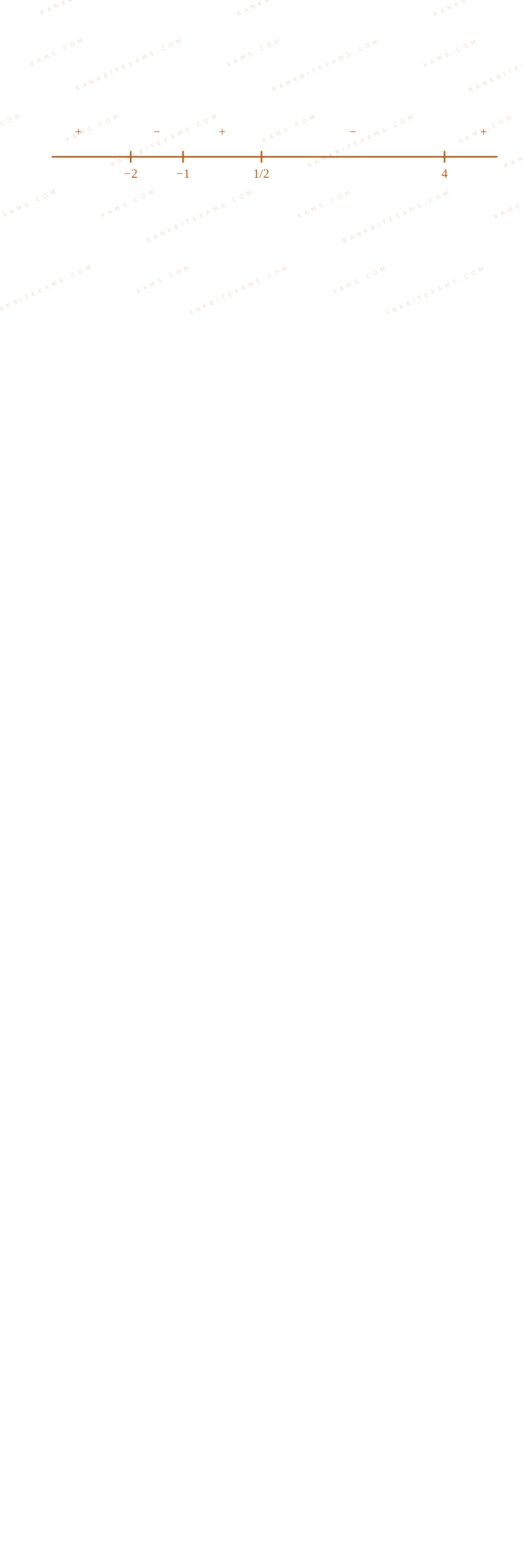
(2x² + 3x - 2)/(x² - 3x - 4) > 0 ((2x - 1)(x + 2))/((x - 4)(x + 1)) > 0
Step 2: Apply Sign Scheme

Using the wave-curve method to determine where the rational fraction is positive:

Domain of a Function diagram for Q54 - JEE Main 2025 Evening

Combining this with x > 1 and x ≠ 2, the common interval is:

x in (4, ∞)

Thus, γ = 4.

Step 3: Calculate final sum
α² + β² + γ² = 7² + 11² + 4² = 49 + 121 + 16 = 186
Pattern Recognition

For domain intersections involving variables in both the log base and argument, always list base rules (>0, ≠ 1) first to eliminate invalid sign fields early on.

Chapter Mix

Class 11 Mathematics: Relations and Functions

Rankbit System
JEE Physics: Waves (+15.5%) | Electrostatics: Concentric Shells (-29.7%) | Modern Physics: Photoelectric Clones (+34.2%) | Mathematics: Definite Integrals (+18.1%) | Chemistry: Coordination Splitting (-11.4%) | JEE Physics: Waves (+15.5%) | Electrostatics: Concentric Shells (-29.7%) | Modern Physics: Photoelectric Clones (+34.2%) | Mathematics: Definite Integrals (+18.1%) | Chemistry: Coordination Splitting (-11.4%)