If f(x) = 2^x2^x + √(2), x in R, then Σk=1⁸¹ f((k)/(82)) is equal to:

Solution & Explanation

Related Formula

Symmetric identity wrapper for matching indices:

f(x) + f(1-x) = 1
Core Logic

Let's evaluate f(x) + f(1-x):

f(x) + f(1-x) = 2^x2^x + √(2) + 21-x21-x + √(2) = 2^x2^x + √(2) + 22 + √(2)· 2^x = 2^x + √(2)2^x + √(2) = 1
Step 1: Expanding the Series

Pairing matching terms from opposite ends of the summation:

Σk=1⁸¹ f((k)/(82)) = [f((1)/(82)) + f((81)/(82))] + + f((41)/(82))

There are 40 complete pairs matching the f(x) + f(1-x) = 1 identity, plus one lone center term f((1)/(2)).

Step 2: Computing Final Valuation
Sum = 40 + f((1)/(2)) = 40 + √(2)√(2) + √(2) = 40 + (1)/(2) = (81)/(2)
Pattern Recognition

When encountering fractional summation bounds, always check the sum of components x + (1-x) to find linear reduction templates.

Chapter Mix

Class 11 Maths: Sequences and Series Class 12 Maths: Relations and Functions

More Functions Previous-Year Questions — Page 4

Q17 jee_main_2026_24_january_evening Functional Equations
Let f be a function such that 3f(x) + 2f((m)/(19x)) = 5x, x ≠ 0, where m = Σi=1⁹ (i)². Then f(5) - f(2) is equal to
  • A. -9
  • B. 36
  • C. 18
  • D. 9

Solution

Related Formula
Sum of squares: Σi=1ⁿ i² = (n(n+1)(2n+1))/(6)
Core Logic

First, evaluate the constant m:

m = Σi=1⁹ i² = (9 × 10 × 19)/(6) = 15 × 19

The given functional equation is:

3f(x) + 2f((15 × 19)/(19x)) = 5x 3f(x) + 2f((15)/(x)) = 5x (1)
Step 1: Forming System of Equations

To eliminate f((15)/(x)), replace x with (15)/(x) in equation (1):

3f((15)/(x)) + 2f(x) = 5((15)/(x)) = (75)/(x) (2)
Step 2: Solving for f(x)

Multiply equation (1) by 3 and equation (2) by 2:

9f(x) + 6f((15)/(x)) = 15x 4f(x) + 6f((15)/(x)) = (150)/(x)

Subtract the second from the first:

9f(x) - 4f(x) = 15x - (150)/(x) 5f(x) = 15x - (150)/(x) f(x) = 3x - (30)/(x)
Step 3: Calculating Final Values

Evaluate f(5) and f(2):

f(5) = 3(5) - (30)/(5) = 15 - 6 = 9 f(2) = 3(2) - (30)/(2) = 6 - 15 = -9

Finally:

f(5) - f(2) = 9 - (-9) = 18
Pattern Recognition

Functional equations of the form af(x) + bf((k)/(x)) = g(x) strictly require the classic substitution x → (k)/(x) to create a straightforward 2 × 2 algebraic system of equations.

Chapter Mix

Class 11 Maths: Functions Class 11 Maths: Sequences and Series
Q1 jee_main_2026_28_january_morning Composite Functions
If g(x)=3x²+2x-3, f(0)=-3 and 4g(f(x))=3x²-32x+72, then f(g(2)) is equal to:
  • A. (25)/(6)
  • B. -(25)/(6)
  • C. (7)/(2)
  • D. -(7)/(2)

Solution

Related Formula
g(f(x)) = 3(f(x))² + 2f(x) - 3
Core Logic

First, evaluate g(2):

g(2) = 3(2)² + 2(2) - 3 = 12 + 4 - 3 = 13

We need to find f(g(2)) = f(13).

Given the composite function relation:

4g(f(x)) = 3x² - 32x + 72

Substitute g(t) expansion:

4[3(f(x))² + 2f(x) - 3] = 3x² - 32x + 72

Let f(x) = t:

12t² + 8t - 12 = 3x² - 32x + 72 12t² + 8t - (3x² - 32x + 84) = 0
Step 1: Solve for f(x)

Using the quadratic formula for t:

t = f(x) = -8 ± √(64 - 4(12)(-(3x² - 32x + 84)))24 f(x) = -8 ± √(64 + 48(3x² - 32x + 84))24 f(x) = (-8 ± 4(3x - 16))/(24)

Since f(0) = -3:

f(0) = (-8 ± 4(-16))/(24) = (-8 ± (-64))/(24)

Choosing the positive sign gives (-8 - 64)/(24) = -3, so we take the positive sign branch (where the inner term was 3x-16, wait, +4(3x-16) with x=0 is -64. So + sign works).

f(x) = (-8 + 4(3x - 16))/(24)
Step 2: Final Calculation

Evaluate f(13):

f(13) = (-8 + 4(3(13) - 16))/(24) = (-8 + 4(23))/(24) f(13) = (-8 + 92)/(24) = (84)/(24) = (7)/(2)
Pattern Recognition

Composite equations resolving to quadratics in f(x) typically require boundary conditions (like f(0)=-3) to eliminate the ± ambiguity from the quadratic formula.

Chapter Mix

Class 11 Mathematics: Functions Class 11 Mathematics: Quadratic Equations

Q8 jee_main_2026_28_january_evening One-One and Many-One Functions
Given below are two statements: Statement I: The function f: R arrow R defined by f(x) = (x)/(1 + |x|) is one-one. Statement II: The function f: R arrow R defined by f(x) = x² + 4x - 30x² - 8x + 18 is many-one. In the light of the above statements, choose the correct answer from the options given below :
  • A. Both Statement I and Statement II are false.
  • B. Both Statement I and Statement II are true.
  • C. Statement I is false but Statement II is true.
  • D. Statement I is true but Statement II is false.

Solution

Core Logic

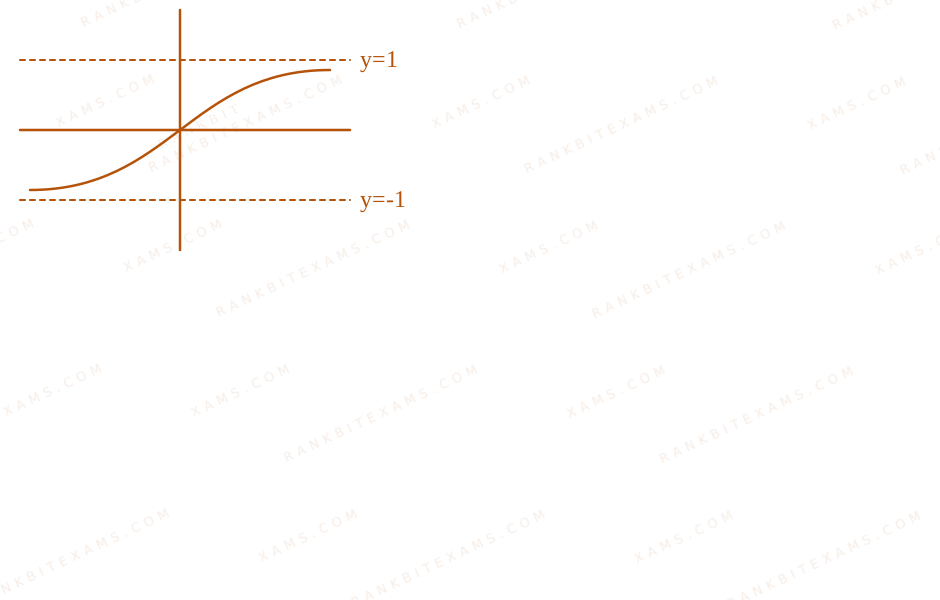
Statement I: f(x) = (x)/(1+|x|).

f(x) = cases (x)/(1+x) & x ≥ 0 (x)/(1-x) & x < 0 cases

The derivative f'(x) = (1)/((1+|x|)²) > 0 for all x. Since it is strictly increasing, f(x) is one-one. Statement I is true.

Graph of bounded rational function

Execution

Statement II: f(x) = (x² + 4x - 30)/(x² - 8x + 18). Let's evaluate f(0):

f(0) = (-30)/(18) = -(5)/(3)

Set f(x) = -(5)/(3) to find if there are other roots:

(x² + 4x - 30)/(x² - 8x + 18) = -(5)/(3) 3x² + 12x - 90 = -5x² + 40x - 90 8x² - 28x = 0 ⇒ 4x(2x - 7) = 0

x = 0 or x = (7)/(2) (Note: the PDF says on solving x=0, -1, but algebraic check shows x=0, 7/2. Regardless, it maps to multiple points). Since f(0) = f(7/2) = -(5)/(3), the function maps distinct inputs to the same output. It is many-one. Statement II is true.

Step 1: Final Conclusion

Both Statement I and Statement II are true.

Pattern Recognition

Checking x=0 in a rational function y = P(x)/Q(x) provides a quick horizontal line test benchmark. Equating the function to f(0) immediately reveals if it's many-one without computing full derivatives.

Chapter Mix

Class 12 Maths: Relations and Functions

Q15 jee_main_2026_28_january_evening Signum Function Properties
The sum of all the elements in the range of f(x) = Sgn( x) + Sgn( x) + Sgn( x) + Sgn( x), x ≠ (nπ)/(2), n in Z, where Sgn(t) = cases 1, & if t > 0 -1 & if t < 0 cases, is
  • A. 4
  • B. 2
  • C. -2
  • D. 0

Solution

Core Logic

Analyze the signs of trigonometric functions in each quadrant: Quadrant I: x in (0, π/2). , , , are all positive. y = 1 + 1 + 1 + 1 = 4

Quadrant II: x in (π/2, π). positive; , , negative. y = 1 - 1 - 1 - 1 = -2

Quadrant III: x in (π, 3π/2). , positive; , negative. y = -1 - 1 + 1 + 1 = 0

Quadrant IV: x in (3π/2, 2π). positive; , , negative. y = -1 + 1 - 1 - 1 = -2

Execution

The set of unique values produced by f(x) represents its range. Range = -2, 0, 4

The sum of all elements in the range is: -2 + 0 + 4 = 2

Pattern Recognition

When applying signum to all four base trigonometric identities, simply count the number of positive mappings per quadrant (all positive = 4, sine only = -2, tan/cot only = 0, cos only = -2).

Chapter Mix

Class 11 Maths: Trigonometric Functions Class 12 Maths: Relations and Functions

Q54 jee_main_2025_02_april_evening Relations
Let A = 1, 2, 3, , 100 and R be a relation on A such that R = (a, b) : a = 2b + 1. Let (a₁, a₂), (a₂, a₃), (a₃, a₄), , (ak, ak+1) be a sequence of k elements of R such that the second entry of an ordered pair is equal to the first entry of the next ordered pair. Then the largest integer k, for which such a sequence exists, is equal to:
  • A. 6
  • B. 7
  • C. 5
  • D. 8

Solution

Related Formula
Chain definition: aᵢ = 2 aᵢ₊₁ + 1 for i = 1, 2, , k
Core Logic

To find the longest sequence of connected pairs, we trace the relation backward starting from the smallest elements in A.

Step 1: Trace the relations backward

To maximize k, we want the chain of elements to go down as low as possible. Let the final element in the chain be ak+1 in A. Since ak = 2 ak+1 + 1:

  • If ak+1 = 1 ak = 3
  • If ak+1 = 2 ak = 5
  • Let's test the chain starting with ak+1 = 1:

  • ak = 2(1) + 1 = 3
  • ak-1 = 2(3) + 1 = 7
  • ak-2 = 2(7) + 1 = 15
  • ak-3 = 2(15) + 1 = 31
  • ak-4 = 2(31) + 1 = 63
  • ak-5 = 2(63) + 1 = 127 (but 127 A!)
  • Thus, the longest chain within the set A has 6 elements:

63, 31, 15, 7, 3, 1

This chain corresponds to exactly 5 ordered pairs:

(63, 31), (31, 15), (15, 7), (7, 3), (3, 1)

So the maximum number of pairs in the sequence is k = 5.

Step 2: Check alternative chains

If we start with ak+1 = 2:

  • ak+1 = 2
  • ak = 5
  • ak-1 = 11
  • ak-2 = 23
  • ak-3 = 47
  • ak-4 = 95
  • ak-5 = 191 > 100
  • Again, the maximum number of pairs is k = 5. Thus, the largest integer k is 5.

Pattern Recognition

Recursive scaling: Tracing exponential chains of the form xₙ₊₁ = c xₙ + d shows that the elements grow very quickly. Calculating the limits of growth determines the maximum possible depth of the sequence.

Chapter Mix

Class 11 Mathematics: Relations and Functions

Rankbit System
JEE Physics: Waves (+15.5%) | Electrostatics: Concentric Shells (-29.7%) | Modern Physics: Photoelectric Clones (+34.2%) | Mathematics: Definite Integrals (+18.1%) | Chemistry: Coordination Splitting (-11.4%) | JEE Physics: Waves (+15.5%) | Electrostatics: Concentric Shells (-29.7%) | Modern Physics: Photoelectric Clones (+34.2%) | Mathematics: Definite Integrals (+18.1%) | Chemistry: Coordination Splitting (-11.4%)
