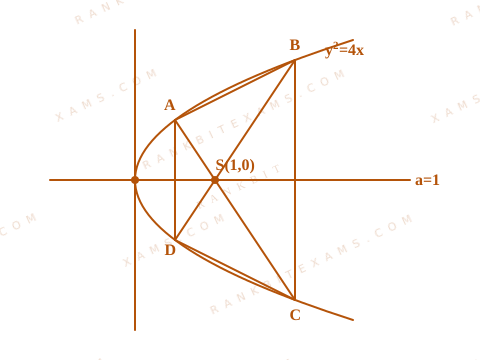
Let ABCD be a trapezium whose vertices lie on the parabola y² = 4x$y^2 = 4x$. Let the sides AD and BC of the trapezium be parallel to y-axis. If the diagonal AC is of length (25)/(4)$\frac{25}{4}$ and it passes through the point (1,0)$(1,0)$, then the area of ABCD is:
A.(75)/(4)$\frac{75}{4}$
B.(25)/(2)$\frac{25}{2}$
C.(125)/(8)$\frac{125}{8}$
D.(75)/(8)$\frac{75}{8}$
Solution & Explanation
Related Formula
Area of a trapezium is given by:
Area = (1)/(2) × (sum of parallel sides) × (distance between them)$$\text{Area} = \frac{1}{2} \times (\text{sum of parallel sides}) \times (\text{distance between them})$$
Core Logic
Let the coordinates of the vertices be parameterized on the parabola y² = 4x$y^2 = 4x$. Since AD$AD$ and BC$BC$ are parallel to the y-axis, the coordinates take the form:
A(at₁², 2at₁)$A(at_1^2, 2at_1)$ and D(at₁², -2at₁)$D(at_1^2, -2at_1)$B(at₂², 2at₂)$B(at_2^2, 2at_2)$ and C(at₂², -2at₂)$C(at_2^2, -2at_2)$
Given a=1$a=1$, the points simplify accordingly. Parabola and Trapezium Properties diagram for Q52 - JEE Main 2025 Morning
Step 1: Using Diagonal Properties
The length of diagonal AC$AC$ passing through focal point (1,0)$(1,0)$ implies focal chord properties:
Focal chords of parabolas always satisfy t₁ t₂ = -1$t_1 t_2 = -1$. Recognizing the passage through (1,0)$(1,0)$ unlocks quick parametric simplifications.
Chapter Mix
Class 11 Maths: Conic Sections

More Conic Sections Previous-Year Questions — Page 5
Q9jee_main_2026_28_january_eveningEllipse Parameters and Latus Rectum
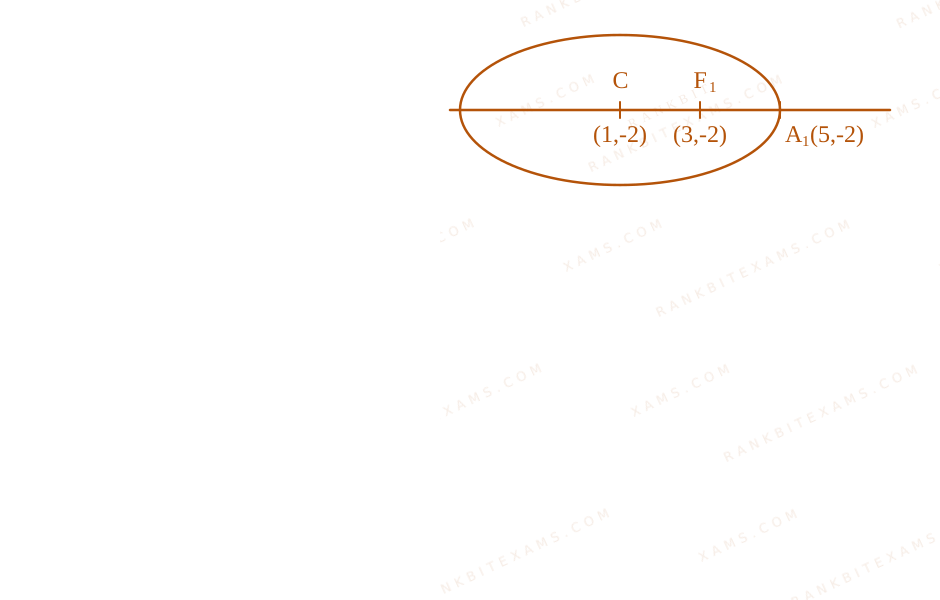
An ellipse has its center at (1,-2)$(1,-2)$, one focus at (3,-2)$(3,-2)$ and one vertex at (5, - 2)$(5, - 2)$. Then the length of its latus rectum is :
From the given coordinates on the major axis (y = -2$y = -2$):
Center C(1, -2)$C(1, -2)$, Focus F₁(3, -2)$F_1(3, -2)$, Vertex A₁(5, -2)$A_1(5, -2)$.
Distance from center to vertex, CA₁ = a = 5 - 1 = 4$CA_1 = a = 5 - 1 = 4$.
Distance from center to focus, CF₁ = ae = 3 - 1 = 2$CF_1 = ae = 3 - 1 = 2$.
Ellipse dimensions mapped to coordinates
Execution
Calculate eccentricity e$e$:
ae = 2 ⇒ 4e = 2 ⇒ e = (1)/(2)$$ae = 2 \Rightarrow 4e = 2 \Rightarrow e = \frac{1}{2}$$
Aligning focus, center, and vertex along a constant y-axis implies a standard shifted ellipse where absolute differences in x-coordinates yield standard parameters (a$a$ and ae$ae$) directly.
Chapter Mix
Class 11 Maths: Conic Sections
Q10jee_main_2026_28_january_eveningConfocal Ellipse and Hyperbola
Let the ellipse E: x²144 + y²169 = 1$E: \frac{x^{2}}{144} + \frac{y^{2}}{169} = 1$ and the hyperbola H: x²16 - y²λ² = -1$H: \frac{x^{2}}{16} - \frac{y^{2}}{\lambda^{2}} = -1$have the same foci. If e$e$ and L$L$ respectively denote the eccentricity and the length of the latus rectum of H$H$, then the value of 24(e + L)$24(e + L)$ is:
Eccentricity of hyperbola, e = (5)/(3)$e = \frac{5}{3}$.
Length of latus rectum of hyperbola, L = (2(16))/(λ) = (32)/(3)$L = \frac{2(16)}{\lambda} = \frac{32}{3}$.
Confocal conics usually align along the same major axis. Notice the -1$-1$ on the RHS of the hyperbola equation indicates a conjugate hyperbola orienting it vertically to match the b>a$b>a$ ellipse.
Chapter Mix
Class 11 Maths: Conic Sections
Q55jee_main_2025_02_april_eveningEllipse
If the length of the minor axis of an ellipse is equal to one fourth of the distance between the foci, then the eccentricity of the ellipse is :
A.4√(17)$\frac{4}{\sqrt{17}}$
B.√(3)16$\frac{\sqrt{3}}{16}$
C.3√(19)$\frac{3}{\sqrt{19}}$
D.√(5)7$\frac{\sqrt{5}}{7}$
Solution
Related Formula
Length of minor axis = 2b$$\text{Length of minor axis} = 2b$$Distance between foci = 2ae$$\text{Distance between foci} = 2ae$$Eccentricity: e = √(1 - (b²)/(a²))$$\text{Eccentricity: } e = \sqrt{1 - \frac{b^2}{a^2}}$$
Core Logic
We set up an algebraic equation relating b$b$, a$a$, and e$e$ from the given geometric condition, then substitute it into the eccentricity identity.
Step 1: Set up the geometric relation
Given that 2b = (1)/(4) (2ae)$2b = \frac{1}{4} (2ae)$:
Standard Ellipse relations: For standard ellipses, the ratio of axes and the eccentricity are coupled quadratic equations. Expressing b/a$b/a$ as a function of e$e$ allows direct solving of the eccentricity.
Chapter Mix
Class 11 Mathematics: Conic Sections
Q67jee_main_2025_02_april_eveningParabola
Let the point P$\mathrm{P}$ of the focal chord PQ$\mathrm{PQ}$ of the parabola y² = 16x$\mathrm{y}^2 = 16\mathrm{x}$ be (1, -4)$(1, -4)$. If the focus of the parabola divides the chord PQ$\mathrm{PQ}$ in the ratio m : n$\mathrm{m} : \mathrm{n}$, (m, n) = 1$\gcd(\mathrm{m}, \mathrm{n}) = 1$, then m² + n²$\mathrm{m}^2 + \mathrm{n}^2$ is equal to:
We find the parametric parameters of coordinates P$P$ and Q$Q$, obtain their Cartesian values, and then apply the section formula with the focus S$S$ to calculate the splitting ratio.
Step 1: Find coordinates of P and Q
For parabola y² = 16x$y^2 = 16x$, the focal parameter is a = 4$a = 4$.
Focus is S(4, 0)$S(4, 0)$.
Let P$P$ be (a t₁², 2a t₁) = (1, -4)$(a t_1^2, 2a t_1) = (1, -4)$:
Q ≡ (a t₂², 2 a t₂) = (4(4), 2(4)(2)) = (16, 16)$$Q \equiv (a t_2^2, \, 2 a t_2) = (4(4), \, 2(4)(2)) = (16, \, 16)$$
Step 2: Solve for the dividing ratio
Let the focus S(4, 0)$S(4, 0)$ divide the line segment PQ$PQ$ internally in the ratio λ : 1$\lambda : 1$.
Using the y$y$-coordinate of the section formula:
Harmonic Mean Shortcut: In any parabola, the focus divides a focal chord internally into segments of lengths SP$SP$ and SQ$SQ$ such that the semi-latus rectum 2a$2a$ is the harmonic mean of these segments: (1)/(SP) + (1)/(SQ) = (1)/(a)$\frac{1}{SP} + \frac{1}{SQ} = \frac{1}{a}$.
Chapter Mix
Class 11 Mathematics: Conic Sections
Qjee_main_2025_02_april_morningProperties of Hyperbola
Let one focus of the hyperbola H: (x²)/(a²) - (y²)/(b²) = 1$H: \frac{x^2}{a^2} - \frac{y^2}{b^2} = 1$ be at (√(10), 0)$(\sqrt{10}, 0)$ and the corresponding directrix be x = 9√(10)$x = \frac{9}{\sqrt{10}}$. If e$e$ and l$l$ respectively are the eccentricity and the length of the latus rectum of H$H$, then 9(e² + l)$9(e^2 + l)$ is equal to:
A.14$14$
B.15$15$
C.16$16$
D.12$12$
Solution
Related Formula
For a standard hyperbola:
Focus: (± ae, 0)$(\pm ae, 0)$
Directrix: x = ± (a)/(e)$x = \pm \frac{a}{e}$
Eccentricity relation: (ae)² = a² + b²$(ae)^2 = a^2 + b^2$
Length of latus rectum: l = (2b²)/(a)$l = \frac{2b^2}{a}$
Core Logic
Given ae = √(10)$ae = \sqrt{10}$ and (a)/(e) = 9√(10)$\frac{a}{e} = \frac{9}{\sqrt{10}}$. Multiplying these gives a²$a^2$, which determines both parameters.
Practice past-year questions one chapter at a time. Pick an exam → subject → chapter and get every PYQ for that topic — pulled together from all past papers — with the chapter's key formulas alongside.