
JEE Main · Mathematics ↓ Falling

Application of Derivatives appeared 25 times across 3 years — 2.9% of Mathematics. This question is from Local Maxima and Minima.

Year 2026 2025 2024 Total
Questions 5 8 12 25

The sum of all local minimum values of the function f(x) = cases 1 - 2x, & x < -1 (1)/(3)(7 + 2|x|), & -1 ≤ x ≤ 2 (11)/(18)(x - 4)(x - 5), & x > 2 cases is:

Solution & Explanation

Related Formula

Local minima occur at points where the derivative changes sign from negative to positive, or at sharp corners where the function reaches a local low point.

Core Logic

Analyze the piecewise sections across all transition domains:

Local Maxima and Minima diagram for Q64 - JEE Main 2025 Morning
For x in [-1, 2], f(x) = (1)/(3)(7 + 2|x|). This curve has a sharp structural minimum at x = 0 since |x| decreases then increases. Value at x = 0 f(0) = (7)/(3).

Step 1: Analyzing the Quadratic Domain Boundaries

For x > 2, f(x) = (11)/(18)(x² - 9x + 20). Finding the vertex point by setting the derivative to zero:

f^ (x) = (11)/(18)(2x - 9) = 0 x = (9)/(2) = 4.5

Since 4.5 > 2, this vertex is within the valid domain and represents a local minimum. Value at x = 4.5 f((9)/(2)) = (11)/(18)((1)/(2))(-(1)/(2)) = -(11)/(72).

Step 2: Calculating Final Combined Summation

Summing both local minima:

Total Minima Sum = (7)/(3) + (-(11)/(72)) = (168 - 11)/(72) = (157)/(72)
Pattern Recognition

For piecewise function systems, always verify if the quadratic vertices fall inside their restricted intervals before adding them to your solution path.

Chapter Mix

Class 12 Maths: Application of Derivatives

More Application of Derivatives Previous-Year Questions — Page 5

Q5 jee_main_2024_30_january_evening Maxima and Minima
Let f(x) = (x + 3)² (x - 2)³, x in [-4, 4] . If M and m are the maximum and minimum values of f , respectively in [-4, 4] , then the value of M - m is:
  • A. 600
  • B. 392
  • C. 608
  • D. 108

Solution

Related Formula
To find absolute extrema, evaluate f(x) at critical points and domain boundaries.
Core Logic

Calculate the derivative of f(x) using the product rule:

f'(x) = (d)/(dx) [(x + 3)²] · (x - 2)³ + (x + 3)² · (d)/(dx) [(x - 2)³] f'(x) = 2(x + 3)(x - 2)³ + 3(x + 3)²(x - 2)²

Factor out the common terms (x+3)(x-2)²:

f'(x) = (x + 3)(x - 2)² [2(x - 2) + 3(x + 3)] f'(x) = (x + 3)(x - 2)² [2x - 4 + 3x + 9] f'(x) = 5(x + 3)(x - 2)² (x + 1)

Setting f'(x) = 0 gives the critical points: x = -3, -1, 2

Step 1: Evaluating at Critical Points and Boundaries

Evaluate f(x) at x = -4, -3, -1, 2, 4:

Maxima and Minima diagram for Q5 - JEE Main 2024 Evening
For x = -4: f(-4) = (-4 + 3)²(-4 - 2)³ = (1)(-216) = -216 For x = -3: f(-3) = 0 For x = -1: f(-1) = (-1 + 3)²(-1 - 2)³ = (4)(-27) = -108 For x = 2: f(2) = 0 For x = 4: f(4) = (4 + 3)²(4 - 2)³ = 49 × 8 = 392

Step 2: Finding M and m

From the evaluated values, the maximum M = 392 and the minimum m = -216.

M - m = 392 - (-216) = 392 + 216 = 608
Pattern Recognition

For polynomials on a closed interval, critical points combined with boundary values reliably expose the absolute max and min.

Chapter Mix

Class 12 Maths: Application of Derivatives
Q5 jee_main_2024_30_jan_morning Maxima and Minima
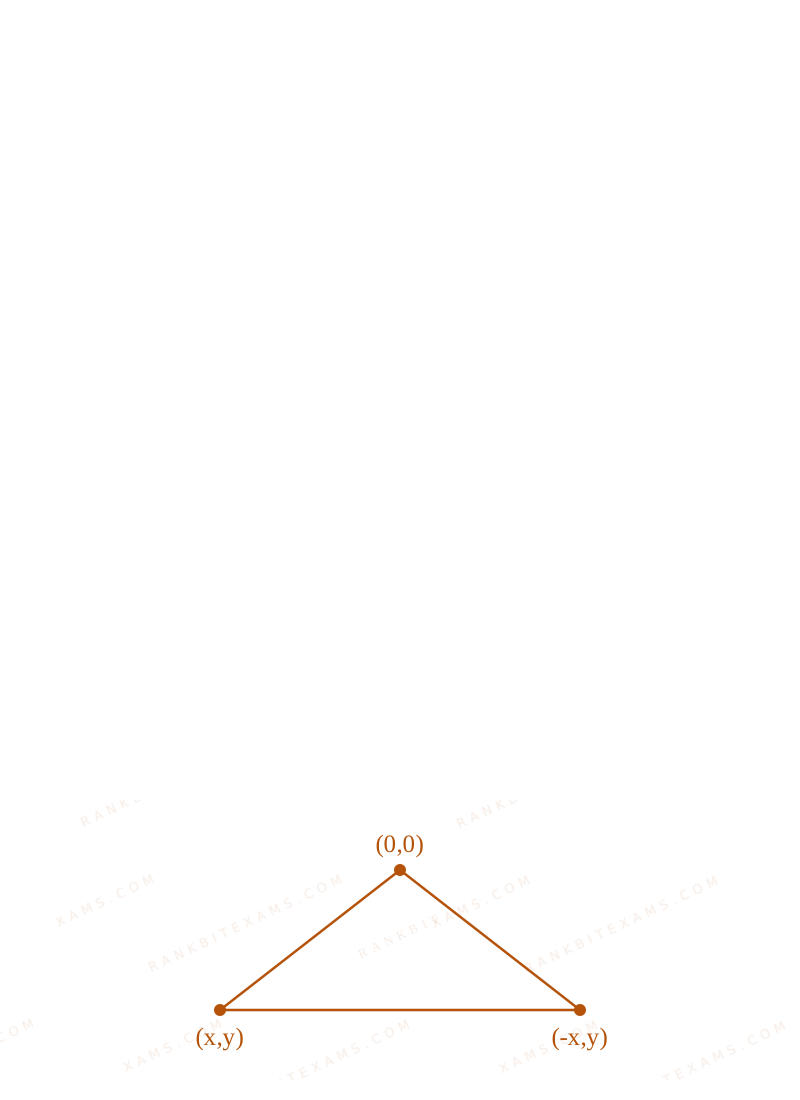
The maximum area of a triangle whose one vertex is at (0, 0) and the other two vertices lie on the curve y = -2x² + 54 at points (x, y) and (-x, y) where y > 0 is:
  • A. 88
  • B. 122
  • C. 92
  • D. 108

Solution

Related Formula
Area of Δ = (1)/(2) × base × height
Core Logic

Maxima and Minima diagram for Q5 - JEE Main 2024 Morning

The vertices of the triangle are (0, 0), (x, y), and (-x, y). The base of the triangle lies along the horizontal line segment joining (-x, y) and (x, y). Length of base = 2x. The height of the triangle from (0,0) to the line segment is y. So, Area Δ = (1)/(2) (2x) (y) = xy (Assuming x > 0).

Step 1: Setting up the area function

Substitute y = -2x² + 54 into the area function:

Area(Δ) = A(x) = x(-2x² + 54) = -2x³ + 54x
Step 2: Differentiating to find maximum area

To find the maximum area, take the derivative with respect to x and set it to zero:

A'(x) = (dA)/(dx) = -6x² + 54

Setting A'(x) = 0:

-6x² + 54 = 0 ⇒ 6x² = 54 ⇒ x² = 9

Since x represents half the base length, x = 3.

Step 3: Calculating maximum area

Substitute x = 3 back into the area function:

Amax = 3(-2(3)² + 54) = 3(-18 + 54) = 3(36) = 108
Pattern Recognition

For symmetric figures inscribed under a parabolic arch, the area function A(x) = x · y(x) is standard. Differentiate and find the critical point directly.

Chapter Mix

Class 12 Maths: Application of Derivatives
Q7 jee_main_2024_30_jan_morning Mean Value Theorems
Let g : R → R be a non-constant twice differentiable such that g'((1)/(2)) = g'((3)/(2)). If a real valued function f is defined as f(x) = (1)/(2)[g(x) + g(2 - x)], then
  • A. f'(x) = 0 for at least two x in (0,2)
  • B. f'(x) = 0 for exactly one x in (0,1)
  • C. f'(x) = 0 for no x in (0,1)
  • D. f((3)/(2)) + f((1)/(2)) = 1

Solution

Related Formula

Rolle's Theorem: If f(x) is continuous on [a, b], differentiable on (a, b), and f(a) = f(b), then there exists at least one c in (a, b) such that f'(c) = 0.

Core Logic

Given f(x) = (1)/(2)[g(x) + g(2 - x)]. Differentiating f(x) with respect to x:

f'(x) = (g'(x) - g'(2 - x))/(2)
Step 1: Evaluating the derivative at given points

Evaluate f'((3)/(2)):

f'((3)/(2)) = (g'((3)/(2)) - g'((1)/(2)))/(2)

Since g'((1)/(2)) = g'((3)/(2)), we get:

f'((3)/(2)) = 0

Also evaluate f'((1)/(2)):

f'((1)/(2)) = (g'((1)/(2)) - g'((3)/(2)))/(2) = 0

Additionally, observe that f'(1) = (g'(1) - g'(1))/(2) = 0.

Step 2: Applying Rolle's Theorem

We have f'((1)/(2)) = 0, f'(1) = 0, and f'((3)/(2)) = 0. By Rolle's Theorem on f'(x) (though we are asked about f'(x)=0 directly), we already found three distinct roots for f'(x) = 0: x = (1)/(2), 1, (3)/(2). Notice that x = 1/2 and x=1 are in (0, 2), and x=3/2 is in (0, 2). Thus f'(x) = 0 for at least three values in (0, 2), which satisfies the condition "at least two x in (0, 2)".

Pattern Recognition

Symmetry in function definition g(x) + g(a-x) guarantees a critical point at x = a/2. Additional critical points arise due to the given condition on g'(x), creating a scenario perfectly suited for Rolle's implications.

Chapter Mix

Class 12 Maths: Application of Derivatives
Q13 jee_main_2024_31_jan_evening Monotonicity and Distances
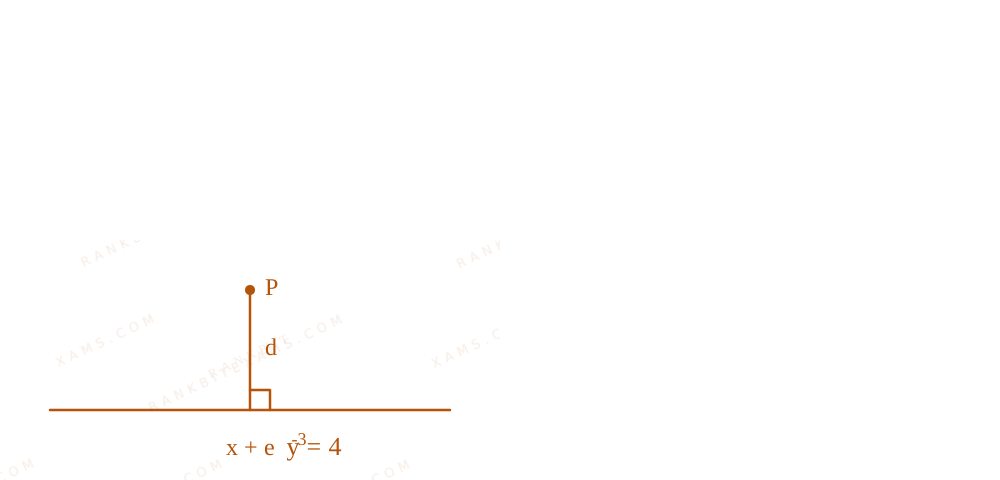
If the function f: (-∞, -1] → (a, b] defined by f(x) = ex³ - 3x + 1 is one-one and onto, then the distance of the point P(2b + 4, a + 2) from the line x + e⁻³y = 4 is :
  • A. 2 1 + e⁶
  • B. 4 1 + e⁶
  • C. 3 1 + e⁶
  • D. 1 + e⁶

Solution

Related Formula
Distance of point (x₁, y₁) from line Ax+By+C=0 is d = |Ax₁ + By₁ + C|√(A² + B²)
Core Logic

Monotonicity and Distances diagram for Q13 - JEE Main 2024 Evening

Given f(x) = ex³ - 3x + 1. Check monotonicity on (-∞, -1]:

f'(x) = ex³ - 3x + 1 · (3x² - 3) = 3(x-1)(x+1)ex³ - 3x + 1

For x ≤ -1, (x+1) ≤ 0 and (x-1) < 0, making f'(x) ≥ 0. Hence f(x) is strictly increasing. Since f is onto (a,b], the range is dictated by the domain boundaries:

a = x→-∞ f(x) = e-∞ = 0 b = f(-1) = e-1 + 3 + 1 = e³

Point P(2b + 4, a + 2) ≡ P(2e³ + 4, 2). Find distance from line x + e⁻³y - 4 = 0:

d = |2e³ + 4 + e⁻³(2) - 4| 1² + (e⁻³)² = 2e³ + 2e⁻³ 1 + e⁻⁶ d = 2e³(1 + e⁻⁶) 1 + e⁻⁶ = 2e³ 1 + e⁻⁶ = 2√(e⁶ + 1)
Chapter Mix

Class 12 Maths: Applications of Derivatives Class 11 Maths: Straight Lines

Q22 jee_main_2024_31_jan_morning Maxima and Minima
Let S = (-1, ∞) and f : S → R be defined as f(x) = ∫₋₁x (e^t - 1)¹¹ (2t - 1)⁵ (t - 2)⁷ (t - 3)¹² (2t - 10)⁶¹ dt. Let p = Sum of square of the values of x, where f(x) attains local maxima on S and q = Sum of the values of x, where f(x) attains local minima on S. Then, the value of p² + 2q is
Numerical Answer. Answer: 27 to 27

Solution

Related Formula
f'(x) = 0 for critical points. Change from + → - means local maxima, - → + means local minima.
Core Logic

Using Newton-Leibniz formula:

f'(x) = (e^x - 1)¹¹ (2x - 1)⁵ (x - 2)⁷ (x - 3)¹² (2x - 10)⁶¹

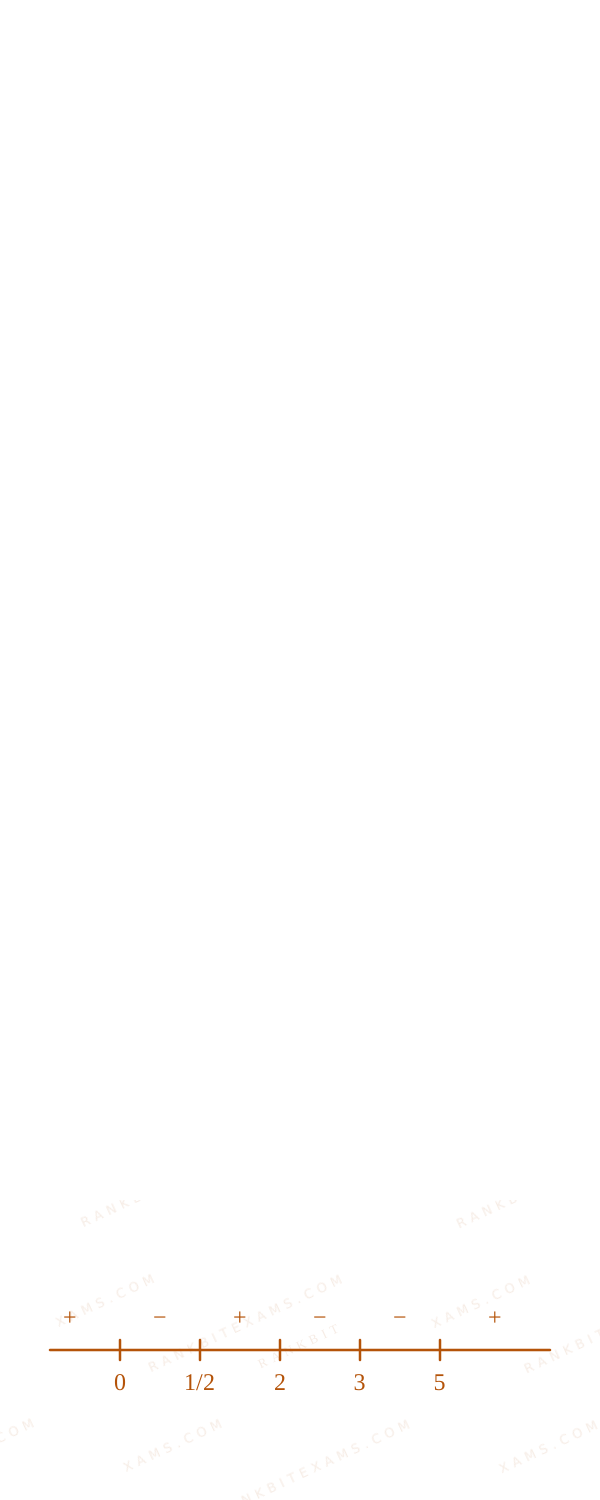
The critical points are roots of f'(x) = 0: x = 0, (1)/(2), 2, 3, 5.

Maxima and Minima diagram for Q22 - JEE Main 2024 Morning

Step 1: Sign Change Analysis

Perform the Wavy Curve Method for x in (-1, ∞): At x=5 (odd power 61): sign changes - → + (Local Minima) At x=3 (even power 12): sign doesn't change (Neither) At x=2 (odd power 7): sign changes + → - (Local Maxima) At x=1/2 (odd power 5): sign changes - → + (Local Minima) At x=0 (from e^x - 1, odd power 11): sign changes + → - (Local Maxima)

Step 2: Compute p and q

Local minima at x = 5, (1)/(2). Local maxima at x = 2, 0.

p = 0² + 2² = 4 q = 5 + (1)/(2) = (11)/(2)
Step 3: Final Computation
p² + 2q = 16 + 2((11)/(2)) = 16 + 11 = 27
Chapter Mix

Class 12 Maths: Application of Derivatives Class 12 Maths: Integrals

Rankbit System
JEE Physics: Waves (+15.5%) | Electrostatics: Concentric Shells (-29.7%) | Modern Physics: Photoelectric Clones (+34.2%) | Mathematics: Definite Integrals (+18.1%) | Chemistry: Coordination Splitting (-11.4%) | JEE Physics: Waves (+15.5%) | Electrostatics: Concentric Shells (-29.7%) | Modern Physics: Photoelectric Clones (+34.2%) | Mathematics: Definite Integrals (+18.1%) | Chemistry: Coordination Splitting (-11.4%)