
JEE Main · Mathematics ↓ Falling

Application of Derivatives appeared 25 times across 3 years — 2.9% of Mathematics. This question is from Local Maxima and Minima.

Year 2026 2025 2024 Total
Questions 5 8 12 25

The sum of all local minimum values of the function f(x) = cases 1 - 2x, & x < -1 (1)/(3)(7 + 2|x|), & -1 ≤ x ≤ 2 (11)/(18)(x - 4)(x - 5), & x > 2 cases is:

Solution & Explanation

Related Formula

Local minima occur at points where the derivative changes sign from negative to positive, or at sharp corners where the function reaches a local low point.

Core Logic

Analyze the piecewise sections across all transition domains:

Local Maxima and Minima diagram for Q64 - JEE Main 2025 Morning
For x in [-1, 2], f(x) = (1)/(3)(7 + 2|x|). This curve has a sharp structural minimum at x = 0 since |x| decreases then increases. Value at x = 0 f(0) = (7)/(3).

Step 1: Analyzing the Quadratic Domain Boundaries

For x > 2, f(x) = (11)/(18)(x² - 9x + 20). Finding the vertex point by setting the derivative to zero:

f^ (x) = (11)/(18)(2x - 9) = 0 x = (9)/(2) = 4.5

Since 4.5 > 2, this vertex is within the valid domain and represents a local minimum. Value at x = 4.5 f((9)/(2)) = (11)/(18)((1)/(2))(-(1)/(2)) = -(11)/(72).

Step 2: Calculating Final Combined Summation

Summing both local minima:

Total Minima Sum = (7)/(3) + (-(11)/(72)) = (168 - 11)/(72) = (157)/(72)
Pattern Recognition

For piecewise function systems, always verify if the quadratic vertices fall inside their restricted intervals before adding them to your solution path.

Chapter Mix

Class 12 Maths: Application of Derivatives

More Application of Derivatives Previous-Year Questions — Page 3

Q51 jee_main_2025_04_april_evening Maxima and Minima
Let a > 0. If the function f(x) = 6x³ - 45ax² + 108a²x + 1 attains its local maximum and minimum values at the points x₁ and x₂ respectively such that x₁x₂ = 54, then a + x₁ + x₂ is equal to :-
  • A. 15
  • B. 18
  • C. 24
  • D. 13

Solution

Related Formula

For a function f(x) to have a local maximum or minimum at a point, its first derivative must vanish at that point:

f'(x) = 0

Core Logic

Differentiating the given function f(x) = 6x³ - 45ax² + 108a²x + 1 with respect to x:

f'(x) = 18x² - 90ax + 108a² = 0

Dividing the entire equation by 18:

x² - 5ax + 6a² = 0

Factoring the quadratic equation:

(x - 2a)(x - 3a) = 0

Thus, the critical points are x = 2a and x = 3a. Since a > 0, we assign x₁ = 2a and x₂ = 3a.

Step 1: Finding the value of a

Given that the product of the roots x₁x₂ = 54:

(2a)(3a) = 54

6a² = 54 a² = 9

Since a > 0, we have a = 3.

Step 2: Calculating the final expression

Substituting a = 3 back to find x₁ and x₂:

x₁ = 2(3) = 6

x₂ = 3(3) = 9

Now, evaluating a + x₁ + x₂:

a + x₁ + x₂ = 3 + 6 + 9 = 18
Pattern Recognition

When critical points are expressed in terms of a parameter, relate the given root condition (x₁x₂ = 54) directly to the product of roots formula ((c)/(a)) of the simplified quadratic equation to save factoring time.

Chapter Mix

Class 12 Mathematics: Application of Derivatives
Q62 jee_main_2025_24_jan_evening Increasing and Decreasing Functions
Let (2, 3) be the largest open interval in which the function f(x)=2 ₑ(x-2)-x²+ax+1 is strictly increasing and (b, c) be the largest open interval, in which the function g(x)=(x-1)³(x+2-a)² is strictly decreasing. Then 100(a+b-c) is equal to:
  • A. 280
  • B. 360
  • C. 420
  • D. 160

Solution

Related Formula

A differentiable function is strictly increasing where its first derivative is positive (f'(x) ≥ 0) and strictly decreasing where its first derivative is negative (g'(x) ≤ 0).

Step 1: Differentiate f(x) to solve for a

Find f'(x) :

f'(x) = (2)/(x-2) - 2x + a ≥ 0

Since (2,3) is the largest open interval of increasing behavior, the transition root occurs at the upper boundary x=3 :

f'(3) = 0 ⇒ (2)/(3-2) - 2(3) + a = 0 ⇒ 2 - 6 + a = 0 ⇒ a = 4
Step 2: Differentiate g(x) to solve for interval (b, c)

Substitute a = 4 into g(x):

g(x) = (x-1)³(x + 2 - 4)² = (x-1)³(x-2)²

Compute g'(x) using the product rule :

g'(x) = 3(x-1)²(x-2)² + (x-1)³ · 2(x-2) g'(x) = (x-1)²(x-2)[3(x-2) + 2(x-1)] = (x-1)²(x-2)(5x - 8)

For g(x) to be strictly decreasing, set g'(x) < 0 :

Since (x-1)² ≥ 0, we require (x-2)(5x-8) < 0 ⇒ x in ((8)/(5), 2).

Thus, the interval is (b, c) = ((8)/(5), 2), yielding b = (8)/(5) = 1.6 and c = 2.

Step 3: Compute Target Value

Evaluate the objective expression:

100(a + b - c) = 100(4 + (8)/(5) - 2) = 100(3.6) = 360
Pattern Recognition

Boundary parameters of maximal monotonic intervals are always the exact zero-crossings of the derivative function. Setting f'(3) = 0 immediately establishes a=4 without secondary algebraic transformations.

Chapter Mix

Class 12 Mathematics: Application of Derivatives
Q jee_main_2025_24_jan_morning Maxima and Minima
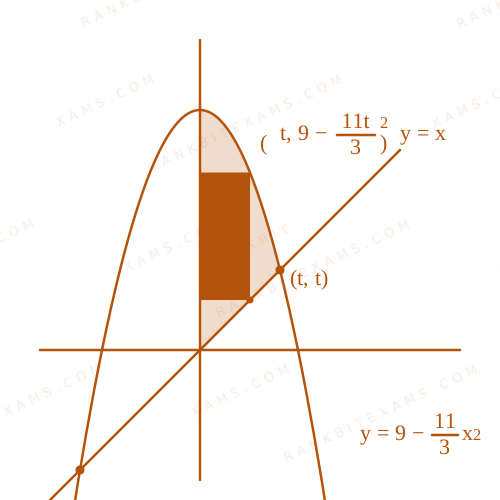
Consider the region R = (x,y) x ≤ y ≤ 9 - (11)/(3)x², x ≥ 0. The area of the largest rectangle with sides parallel to the coordinate axes inscribed in R is :
  • A. (625)/(111)
  • B. (730)/(119)
  • C. (567)/(121)
  • D. (821)/(123)

Solution

Related Formula

The area of a rectangle bounded between an upper function curve y₂(x) and lower function curve y₁(x) spanning width x = t is formulated as:

A(t) = t · [y₂(t) - y₁(t)]
Core Logic

The region is bounded below by the line y = x and above by the downward opening parabola y = 9 - (11)/(3)x² in the first quadrant:

Maxima and Minima
Maxima and Minima

Let a vertex of the rectangle lie on the upper parabolic boundary at x = t. The corresponding height span of the rectangle is bounded by the line y = t at the base:

Maxima and Minima
Maxima and Minima

Thus, the area equation as a function of variable parameter t is:

A(t) = t · ( 9 - (11)/(3)t² - t ) = 9t - t² - (11)/(3)t³
Step 1: Differentiate to Identify Critical Values

Differentiate the area function with respect to t and equate to zero:

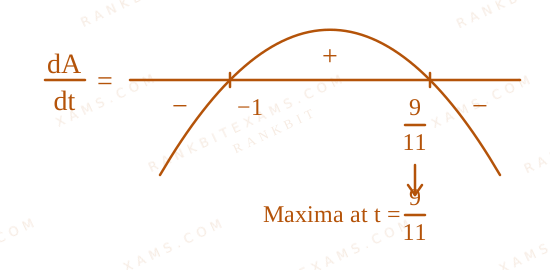
(dA)/(dt) = 9 - 2t - 11t² = 0 11t² + 2t - 9 = 0 11t² + 11t - 9t - 9 = 0 (11t - 9)(t + 1) = 0

Since x ≥ 0, we reject the negative root t = -1. This isolates the physical critical point at:

t = (9)/(11)
Step 2: Evaluate Maximum Inscribed Area

Substitute t = (9)/(11) back into the factored area equation formulation:

A = (9)/(11) · ( 9 - (9)/(11) - (11)/(3)((9)/(11))² ) A = (9)/(11) · ( 9 - (9)/(11) - (27)/(11) ) A = (9)/(11) · ( 9 - (36)/(11) ) = (9)/(11) · (63)/(11) = (567)/(121)
Pattern Recognition

For optimized area allocation inside custom functional borders, setting the optimization parameter strictly to the horizontal coordinates simplifies high-degree polynomials down to standard derivative templates.

Chapter Mix

Class 12 Mathematics: Application of Derivatives

Q19 jee_main_2024_01_february_morning Monotonicity of Functions
If 5f(x)+4f((1)/(x))=x²-2, x≠0 and y=9x²f(x), then y is strictly increasing in:
  • A. (0, 1√(5)) ( 1√(5),∞)
  • B. (- 1√(5),0) ( 1√(5),∞)
  • C. (- 1√(5),0) (0, 1√(5))
  • D. (-∞,- 1√(5)) (0, 1√(5))

Solution

Related Formula
  • Functional equations containing x and (1)/(x) can be solved by substituting x → (1)/(x) to create a system of simultaneous equations.
  • A function is strictly increasing in intervals where its first derivative is positive: (dy)/(dx) > 0.
Core Logic

Given the functional equation equation:

5f(x) + 4f((1)/(x)) = x² - 2 (1)

Substitute x → (1)/(x):

5f((1)/(x)) + 4f(x) = (1)/(x²) - 2 (2)
Step 1: Solve for f(x)

To eliminate f((1)/(x)), multiply equation (1) by 5 and equation (2) by 4:

25f(x) + 20f((1)/(x)) = 5x² - 10 16f(x) + 20f((1)/(x)) = (4)/(x²) - 8

Subtract the second equation from the first:

9f(x) = 5x² - (4)/(x²) - 2
Step 2: Differentiate the Target Equation

We are given y = 9x² f(x) = x² [9f(x)]. Substituting our equation for 9f(x):

y = x² ( 5x² - (4)/(x²) - 2 ) y = 5x⁴ - 2x² - 4

Differentiating with respect to x:

(dy)/(dx) = 20x³ - 4x = 4x(5x² - 1)
Step 3: Analyze the Monotonicity Intervals

For the function to be strictly increasing, set (dy)/(dx) > 0:

4x(5x² - 1) > 0 x(x - 1√(5))(x + 1√(5)) > 0

Using the wavy curve method with critical roots - 1√(5), 0, 1√(5):

  • Positive regions occur where x in (- 1√(5), 0) ( 1√(5), ∞).
Pattern Recognition

Sees: Symmetric reciprocal arguments inside a functional format. Shortcut: Recognizing that y = 9x² f(x) simplifies directly to an even polynomial (5x⁴ - 2x² - 4) means the final derivative will be odd, ensuring a symmetric layout across the origin.

Chapter Mix

Class 12 Mathematics: Application of Derivatives Class 11 Mathematics: Relations and Functions

Q5 jee_main_2024_29_january_evening Maxima and Minima
The function f(x) = 2x + 3(x)(2)/(3), x in R, has
  • A. exactly one point of local minima and no point of local maxima
  • B. exactly one point of local maxima and no point of local minima
  • C. exactly one point of local maxima and exactly one point of local minima
  • D. exactly two points of local maxima and exactly one point of local minima

Solution

Related Formula

For local maxima or minima, check the sign flip of f'(x) across critical points.

Core Logic

Given f(x) = 2x + 3x2/3. Differentiating with respect to x:

f'(x) = 2 + 3 · (2)/(3) x-1/3 = 2 + 2x-1/3 = 2 (1 + 1x1/3) = 2 ( x1/3 + 1x1/3)

Critical points occur where f'(x) = 0 or where f'(x) is undefined:

  • f'(x) = 0 x1/3 + 1 = 0 x = -1
  • f'(x) is undefined at x = 0
Step 1: Sign Scheme Analysis

Let us check the sign changes of f'(x):

  • For x < -1: x1/3+1 < 0 and x1/3 < 0 f'(x) > 0 (+)
  • For -1 < x < 0: x1/3+1 > 0 and x1/3 < 0 f'(x) < 0 (-)
  • For x > 0: x1/3+1 > 0 and x1/3 > 0 f'(x) > 0 (+)
  • Sign changes:

  • At x = -1: positive to negative arrow Local Maxima
  • At x = 0: negative to positive arrow Local Minima
  • Thus, there is exactly one point of local maxima and exactly one point of local minima.

Pattern Recognition

Points where the derivative is undefined (cusps or vertical tangents) are equally valid critical point candidates for local extrema. Always include them in your sign scheme layout.

Chapter Mix

Class 12 Mathematics: Application of Derivatives

Rankbit System
JEE Physics: Waves (+15.5%) | Electrostatics: Concentric Shells (-29.7%) | Modern Physics: Photoelectric Clones (+34.2%) | Mathematics: Definite Integrals (+18.1%) | Chemistry: Coordination Splitting (-11.4%) | JEE Physics: Waves (+15.5%) | Electrostatics: Concentric Shells (-29.7%) | Modern Physics: Photoelectric Clones (+34.2%) | Mathematics: Definite Integrals (+18.1%) | Chemistry: Coordination Splitting (-11.4%)