Which of the following oxidation reactions are carried out by both K₂Cr₂O₇$\mathrm{K}_2\mathrm{Cr}_2\mathrm{O}_7$ and KMnO₄$\mathrm{KMnO}_4$ in acidic medium?
A. I^- arrow I₂$\mathrm{I}^- \rightarrow \mathrm{I}_2$
B. S²⁻ arrow S$\mathrm{S}^{2-} \rightarrow \mathrm{S}$
C. Fe²⁺ arrow Fe³⁺$\mathrm{Fe}^{2+} \rightarrow \mathrm{Fe}^{3+}$
D. I⁻ arrow IO₃⁻$\mathrm{I}^{-} \rightarrow \mathrm{IO}_{3}^{-}$
E. S₂O₃²⁻ arrow SO₄²⁻$\mathrm{S}_2\mathrm{O}_3^{2-} \rightarrow \mathrm{SO}_4^{2-}$
Choose the correct answer from the options given below:
A.B, C and D only$\text{B, C and D only}$
B.A, D and E only$\text{A, D and E only}$
C.A, B and C only$\text{A, B and C only}$
D.C, D and E only$\text{C, D and E only}$
Solution & Explanation
Core Logic
In an acidic medium, both K₂Cr₂O₇$\mathrm{K}_2\mathrm{Cr}_2\mathrm{O}_7$ and KMnO₄$\mathrm{KMnO}_4$ act as strong oxidizing agents and carry out the following transformations:
A: Oxidize iodide to iodine: I^- arrow I₂$\mathrm{I}^- \rightarrow \mathrm{I}_2$
Iodide is oxidized to iodate (IO₃^-$\mathrm{IO}_3^-$) by KMnO₄$\mathrm{KMnO}_4$ primarily in a neutral or faintly alkaline medium, not acidic.
Thiosulfate (S₂O₃²⁻$\mathrm{S}_2\mathrm{O}_3^{2-}$) undergoes a disproportionation/precipitation reaction in acid rather than clean oxidation to sulfate by dichromate.
Thus, statements A, B, and C are valid for both under acidic conditions.
Pattern Recognition
Sees: Shared oxidation products in an acidic environment.
Shortcut: Remember that I^- arrow IO₃^-$\mathrm{I}^- \rightarrow \mathrm{IO}_3^-$ is the signature reaction for alkaline permanganate, allowing quick elimination of choices containing D.
Keywords:#oxidation reactions carried out by both K2Cr2O7 and KMnO4#JEE Main 2025 Morning Q44#Inorganic Oxidations JEE Main 2025#d-Block Reagents JEE Main 2025
More The d-and f-Block Elements Previous-Year Questions — Page 7
Q75jee_main_2024_27_jan_morningQualitative Analysis of Lead
Yellow compound of lead chromate gets dissolved on treatment with hot NaOH$\text{NaOH}$ solution. The product of lead formed is a :
A. Tetraanionic complex with coordination number six
B. Neutral complex with coordination number four
C. Dianionic complex with coordination number six
D. Dianionic complex with coordination number four
The reaction yields sodium tetrahydroxoplumbate(II), [Pb(OH)₄]²⁻$[\text{Pb(OH)}_4]^{2-}$. The charge of the complex species is -2$-2$ (dianionic), and it binds 4 hydroxo coordination ligands, matching a coordination number of four.
Chapter Mix
Class 12 Chemistry: d-and f-Block Elements
Class 12 Chemistry: Coordination Compounds
Q78jee_main_2024_27_jan_morningChromyl Chloride Test
NaCl$\text{NaCl}$ reacts with conc. H₂SO₄$H_2SO_4$ and K₂Cr₂O₇$K_2Cr_2O_7$ to give reddish fumes (B), which react with NaOH$\text{NaOH}$ to give yellow solution (C). (B) and (C) respectively are;
The electronic configuration for Neodymium is:
[Atomic Number for Neodymium 60]
A.[Xe] 4f⁴ 6s²$\text{[Xe]} 4f^4 6s^2$
B.[Xe] 5f⁴ 7s²$\text{[Xe]} 5f^4 7s^2$
C.[Xe] 4f⁶ 6s²$\text{[Xe]} 4f^6 6s^2$
D.[Xe] 4f¹ 5d¹ 6s²$\text{[Xe]} 4f^1 5d^1 6s^2$
Solution
Core Logic
The noble gas configuration of Xenon (Z=54$Z=54$) provides the primary core layout. For Neodymium (Z=60$Z=60$), the 6 remaining valence electrons distribute into the inner 4f$4\text{f}$ orbital subshell rather than filling the 5d$5\text{d}$ subshell due to shielding effects. This results in an absolute atomic ground state electronic configuration of [Xe] 4f⁴ 6s²$\text{[Xe]} 4\text{f}^4 6\text{s}^2$.
Pattern Recognition
Lanthanide filling sequences generally bypass 5d$5d$ progression except for specific exceptions (La, Gd, Lu).
Potassium permanganate (KMnO₄$KMnO_4$) is a strong oxidizing agent. When heated to 513K$513\mathrm{K}$, it undergoes thermal decomposition to give potassium manganate (K₂MnO₄$K_2MnO_4$), manganese dioxide (MnO₂$MnO_2$), and oxygen gas (O₂$O_2$).
The products formed along with O₂$O_2$ are K₂MnO₄$K_2MnO_4$ (green) and MnO₂$MnO_2$ (black).
Chapter Mix
Class 12 Chemistry: d and f Block Elements
Q63jee_main_2024_29_jan_morningPotassium Dichromate and Chromyl Chloride Test
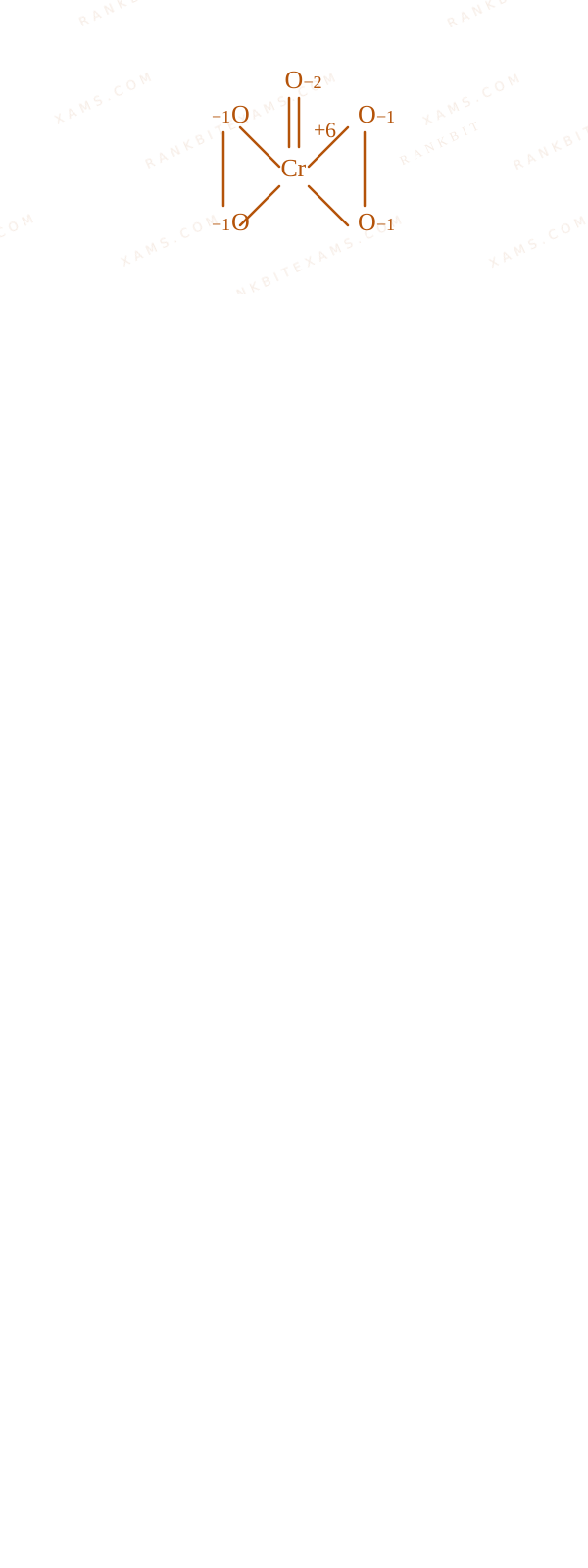
In chromyl chloride test for confirmation of Cl^-$Cl^-$ ion, a yellow solution is obtained. Acidification of the solution and addition of amyl alcohol and 10%$10\%$H₂O₂$H_2O_2$ turns organic layer blue indicating formation of chromium pentoxide. The oxidation state of chromium in that is
Acidification of the yellow CrO₄²⁻$CrO_4^{2-}$ solution followed by the addition of H₂O₂$H_2O_2$ and amyl alcohol yields a blue-colored organic layer due to the formation of chromium pentoxide (CrO₅$CrO_5$).
Potassium Dichromate and Chromyl Chloride Test diagram for Q63 - JEE Main 2024 Morning
The structure of chromium pentoxide (CrO₅$CrO_5$) features a distinctive "butterfly" arrangement. It contains one double-bonded oxide oxygen (O²⁻$O^{2-}$) and four peroxide oxygens (O₂²⁻$O_2^{2-}$). Therefore, there are 2 peroxo linkages.
Let the oxidation state of Chromium be x$x$.
x + 1(-2) + 4(-1) = 0$$x + 1(-2) + 4(-1) = 0$$
x - 2 - 4 = 0$x - 2 - 4 = 0$x = +6$x = +6$
Thus, the oxidation state of Cr in CrO₅$CrO_5$ is +6$+6$.
Pattern Recognition
A classic oxidation state trap. Calculating simply via formula CrO₅$CrO_5$ yields x - 10 = 0 x = +10$x - 10 = 0 \implies x = +10$, which is impossible for Chromium (max +6). Whenever calculation exceeds the maximum group valency, peroxide bonds are present.
Chapter Mix
Class 12 Chemistry: d and f Block Elements
Class 11 Chemistry: Redox Reactions
More The d-and f-Block Elements Questions — jee_main_2025_28_jan_morning
Practice past-year questions one chapter at a time. Pick an exam → subject → chapter and get every PYQ for that topic — pulled together from all past papers — with the chapter's key formulas alongside.