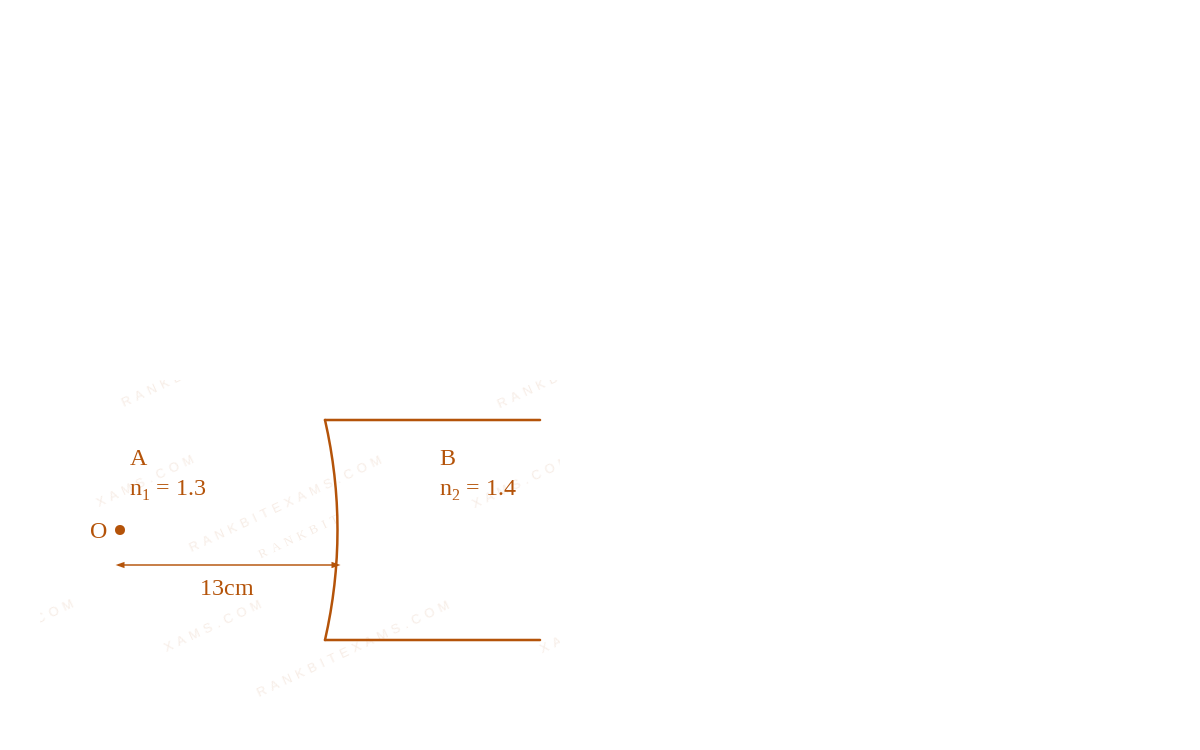
In a long glass tube, mixture of two liquids A and B with refractive indices 1.3 and 1.4 respectively, forms a convex refractive meniscus towards A. If an object placed at 13cm$13\mathrm{cm}$ from the vertex of the meniscus in A forms an image with a magnification of -2$-2$ then the radius of curvature of meniscus is :
A.1 cm$1 \, \text{cm}$
B.(1)/(3)cm$\frac{1}{3}\mathrm{cm}$
C.(2)/(3) ~cm$\frac{2}{3} \mathrm{~cm}$
D.(4)/(3) ~cm$\frac{4}{3} \mathrm{~cm}$
Solution & Explanation
Related Formula
For refraction at a single spherical surface separating two mediums :
The visual system configuration of the refracting interface is tracked here:
Refraction at Spherical Surfaces diagram for Q6 - JEE Main 2025 Evening
Pattern Recognition
Keep precise track of sign conventions for single spherical surfaces. A convex meniscus towards A means the center of curvature lies inside medium B, meaning
$
Step 1: Visual Context
The visual system configuration of the refracting interface is tracked here:
Refraction at Spherical Surfaces diagram for Q6 - JEE Main 2025 Evening
Pattern Recognition
Keep precise track of sign conventions for single spherical surfaces. A convex meniscus towards A means the center of curvature lies inside medium B, meaning $
R$ will mathematically return as a positive parameter.
Keywords:#refraction at spherical surface formula#JEE Main 2025 Evening Q6#Ray Optics JEE Main 2025#radius of curvature of meniscus
More Ray Optics Previous-Year Questions — Page 8
Q20jee_main_2025_28_jan_morningPrism and Dispersion
A thin prism P₁$\mathrm{P_1}$ with angle 4°$4^{\circ}$ made of glass having refractive index 1.54, is combined with another thin prism P₂$\mathrm{P_2}$ made of glass having refractive index 1.72 to get dispersion without deviation. The angle of the prism P₂$\mathrm{P_2}$ in degrees is
A. 4
B. 3
C. 16/3
D. 1.5
Solution
Related Formula
δ = (μ - 1)A$$\delta = (\mu - 1)\mathrm{A}$$
Core Logic
To achieve dispersion without deviation, the net deviation produced by the prism combination must be zero:
The required angle for the second thin prism is 3°$3^{\circ}$, which matches option (2).
Pattern Recognition
For zero deviation conditions using thin components, balance the deviation equations directly: (μ-1)A = (μ'-1)A'$(\mu-1)\mathrm{A} = (\mu'-1)\mathrm{A}'$.
Chapter Mix
Class 12 Physics: Ray Optics and Optical Instruments

Q18jee_main_2025_03_april_morningLens Maker's Formula
The radii of curvature for a thin convex lens are 10~cm$10\mathrm{~cm}$ and 15~cm$15\mathrm{~cm}$ respectively. The focal length of the lens is 12~cm$12\mathrm{~cm}$. The refractive index of the lens material is:
where,
f$f$ = focal length of the lens,
μ$\mu$ = refractive index of the material,
R₁, R₂$R_1, R_2$ = radii of curvature with standard Cartesian sign convention.
Core Logic
For a thin bi-convex lens, using standard coordinate conventions:
R₁ = +10~cm$R_1 = +10\mathrm{~cm}$ (positive since first surface centers to the right of light trajectory),
R₂ = -15~cm$R_2 = -15\mathrm{~cm}$ (negative since second surface centers to the left),
Convex lenses always have opposite signs for R₁$R_1$ and R₂$R_2$. The term ((1)/(R₁) - (1)/(R₂))$\left(\frac{1}{R_1} - \frac{1}{R_2}\right)$ is additive: ((1)/(|R₁|) + (1)/(|R₂|))$\left(\frac{1}{|R_1|} + \frac{1}{|R_2|}\right)$.
Chapter Mix
Class 12 Physics: Ray Optics and Optical Instruments
Q20jee_main_2025_03_april_morningMinimum Deviation in Prism
Consider following statements for refraction of light through prism, when angle of deviation is minimum.
(A) The refracted ray inside prism becomes parallel to the base.
(B) Larger angle prisms provide smaller angle of minimum deviation.
(C) Angle of incidence and angle of emergence becomes equal.
(D) There are always two sets of angle of incidence for which deviation will be same except at minimum deviation setting.
(E) Angle of refraction becomes double of prism angle.
Choose the correct answer from the options given below.
As A$A$ increases, δmin$\delta_{\text{min}}$ generally increases, not decreases. (False)
Statement (C): Angle of incidence i$i$ and angle of emergence e$e$ become equal (i = e$i = e$) during the minimum deviation state. (True)
Statement (D): The δ-i$\delta-i$ curve is asymmetric and parabolic-like; for any deviation δ > δmin$\delta > \delta_{\text{min}}$, there are always exactly two different incident angles (i$i$ and e$e$) that yield the same deviation, except at the minimum deviation point (which has a single unique value). (True)
Statement (E): Angle of refraction r = A/2$r = A/2$, which is half of the prism angle, not double. (False)
Step 1: Conclusion
Since statements A, C, and D are true, the correct option is (1).
Pattern Recognition
Review the classic parabolic shape of the deviation vs. angle of incidence (δ-i$\delta-i$) graph. Notice that any horizontal line above the minimum point intersects twice (representing i$i$ and e$e$ for that deviation). Minimum deviation is the unique local minimum, where i = e$i = e$ and r₁ = r₂ = A/2$r_1 = r_2 = A/2$.
Chapter Mix
Class 12 Physics: Ray Optics and Optical Instruments: Refraction through Prism
A finite size object is placed normal to the principal axis at a distance of 30 cm from a convex mirror of focal length 30 cm. A plane mirror is now placed in such a way that the image produced by both the mirrors coincide with each other. The distance between the two mirrors is :
So, the convex mirror forms a virtual image 15 cm behind its surface.
Step 1: Align Plane Mirror Image
The total distance from the object to the image location is 30 + 15 = 45 cm$30 + 15 = 45\text{ cm}$.
For a plane mirror to create an image at this same exact location, it must be placed precisely midway between the object and the image.
Distance from object to plane mirror:
Coinciding images imply identical coordinate endpoints. Calculate the convex position explicitly, find the total path length from the real source object, and slice it in half for the plane mirror location.
Chapter Mix
Class 12 Physics: Ray Optics and Optical Instruments
Qjee_main_2025_04_april_morningSpherical Mirrors and Magnification
When an object is placed 40~cm$40\mathrm{~cm}$ away from a spherical mirror an image of magnification (1)/(2)$\frac{1}{2}$ is produced. To obtain an image with magnification of (1)/(3)$\frac{1}{3}$, the object is to be moved:
A. 40 cm away from the mirror.
B. 80 cm away from the mirror.
C. 20 cm towards the mirror.
D. 20 cm away from the mirror.
Solution
Related Formula
Magnification formula for a spherical mirror in terms of focal length f$f$ and object distance u$u$:
m = (f)/(f - u)$$m = \frac{f}{f - u}$$
Core Logic
Case 1: Given u₁ = -40~cm$u_1 = -40\mathrm{~cm}$ and m₁ = (1)/(2)$m_1 = \frac{1}{2}$:
(1)/(2) = (f)/(f - (-40)) f + 40 = 2f f = +40~cm$$\frac{1}{2} = \frac{f}{f - (-40)} \implies f + 40 = 2f \implies f = +40\mathrm{~cm}$$
Since f > 0$f > 0$, the optical element is a convex mirror forming a virtual, erect, and diminished image (0 < m < 1$0 < m < 1$).
Step 1: Calculate New Object Position
Case 2: To achieve a magnification of m₂ = (1)/(3)$m_2 = \frac{1}{3}$:
Final object position: u₂ = -80~cm$u_2 = -80\mathrm{~cm}$
Shift = |u₂| - |u₁| = 80 - 40 = 40~cm away from the mirror$$\text{Shift} = |u_2| - |u_1| = 80 - 40 = 40\mathrm{~cm}\text{ away from the mirror}$$
Pattern Recognition
For a convex mirror, images are always virtual, erect, and diminished. As the object is shifted farther away from the mirror (u → -∞$u \to -\infty$), the magnification decreases toward zero.
Chapter Mix
Class 12 Physics: Ray Optics and Optical Instruments
More Ray Optics Questions — jee_main_2025_28_jan_evening
Practice past-year questions one chapter at a time. Pick an exam → subject → chapter and get every PYQ for that topic — pulled together from all past papers — with the chapter's key formulas alongside.