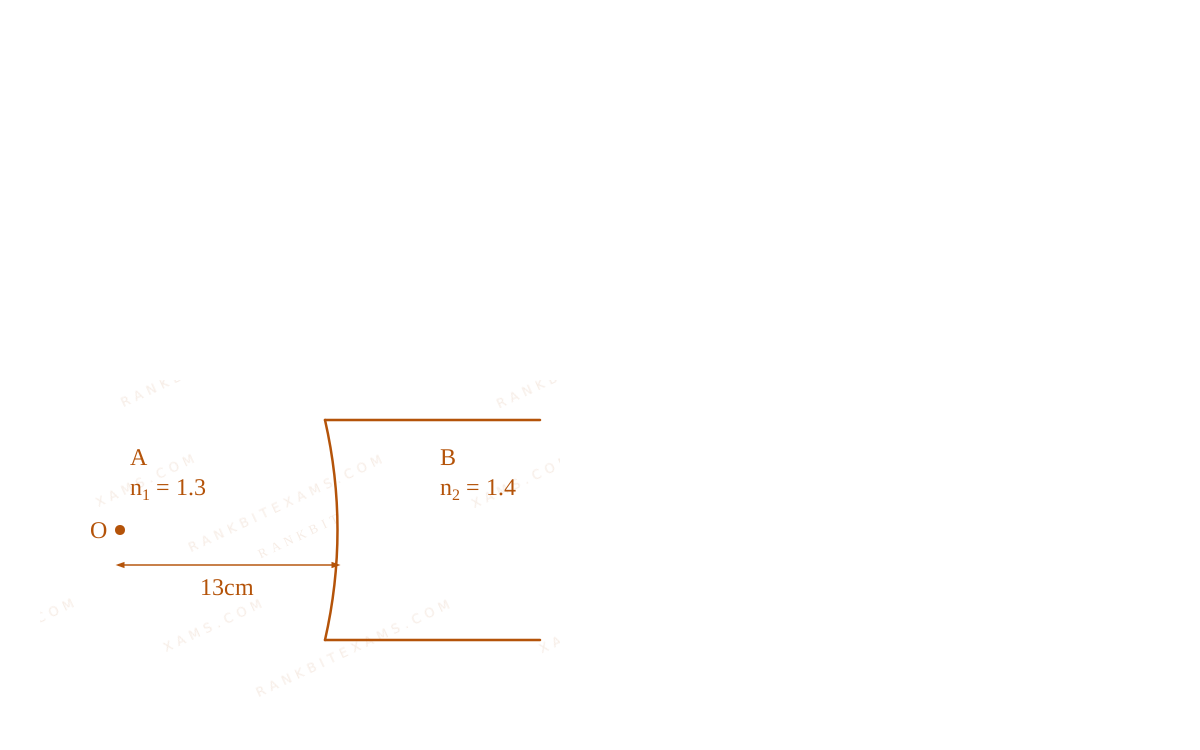
In a long glass tube, mixture of two liquids A and B with refractive indices 1.3 and 1.4 respectively, forms a convex refractive meniscus towards A. If an object placed at 13mathrmcm from the vertex of the meniscus in A forms an image with a magnification of -2 then the radius of curvature of meniscus is :

Solution & Explanation

### Related Formula For refraction at a single spherical surface separating two mediums : fracn_2v - fracn_1u = fracn_2 - n_1R Linear magnification for a spherical refracting boundary is given by: m = fracv / n_2u / n_1 = fracv cdot n_1u cdot n_2$ ### Core Logic Given parameters from the text [cite: 17, 651, 654]: * Refractive index of Medium A, $n_1 = 1.3$ * Refractive index of Medium B, $n_2 = 1.4$ * Object distance, $u = -13 text cm$ * Magnification, $m = -2$ Using the magnification formula to locate image position $v$ : -2 = \frac{v \cdot 1.3}{(-13) \cdot 1.4} -2 = \frac{1.3 \cdot v}{-18.2} \implies 1.3 v = 36.4 \implies v = 28 \text{ cm} Now substitute $u = -13$, $v = 28$, $n_1 = 1.3$, $n_2 = 1.4$ into the boundary equation: \frac{1.4}{28} - \frac{1.3}{-13} = \frac{1.4 - 1.3}{R} \frac{1}{20} + \frac{1}{10} = \frac{0.1}{R} \frac{1 + 2}{20} = \frac{0.1}{R} \implies \frac{3}{20} = \frac{1}{10R} 30 R = 20 \implies R = \frac{2}{3} \text{ cm}$ ### Step 1: Visual Context The visual system configuration of the refracting interface is tracked here:
Refraction at Spherical Surfaces diagram for Q6 - JEE Main 2025 Evening
### Pattern Recognition Keep precise track of sign conventions for single spherical surfaces. A convex meniscus towards A means the center of curvature lies inside medium B, meaning
R$ will mathematically return as a positive parameter. ### Evaluation Rubric / Model Answer null ### Chapter Mix Class 12 Physics: Ray Optics

Reference Study Guides

More Ray Optics Previous-Year Questions — Page 10

Q34 jee_main_2024_31_jan_morning Prism Deviation
The refractive index of a prism with apex angle A is cot(A/2). The angle of minimum deviation is :
  • A. delta_mathrmm = 180^circ - A
  • B. delta_mathrmm = 180^circ - 3A
  • C. delta_mathrmm = 180^circ - 4A
  • D. delta_mathrmm = 180^circ - 2A

Solution

### Related Formula mu = fracsinleft(fracA + delta_m2right)sinleft(fracA2right) ### Core Logic Given that the refractive index mu = cotleft(fracA2right). Substituting this into the prism formula: cotleft(fracA2right) = fracsinleft(fracA + delta_m2right)sinleft(fracA2right) fraccosleft(fracA2right)sinleft(fracA2right) = fracsinleft(fracA + delta_m2right)sinleft(fracA2right) Equating the numerators: cosleft(fracA2right) = sinleft(fracA + delta_m2right) We can rewrite cosine in terms of sine: sinleft(fracpi2 - fracA2right) = sinleft(fracA + delta_m2right) ### Step 2: Solve for Deviation Comparing the angles inside the sine functions: fracpi2 - fracA2 = fracA2 + fracdelta_m2 Multiply the entire equation by 2: pi - A = A + delta_m delta_m = pi - 2A Converting radians to degrees: delta_m = 180^circ - 2A ### Pattern Recognition Whenever refractive index mu = cot(A/2), the relation sin(90^circ - A/2) strictly matches the prism sine equation, meaning minimum deviation delta_m is always 180^circ - 2A. ### Evaluation Rubric / Model Answer null ### Chapter Mix Class 12 Physics: Ray Optics And Optical Instruments

More Ray Optics Questions — jee_main_2025_28_jan_evening

Practice all Ray Optics previous-year questions →

Rankbit System
JEE Physics: Waves (+15.5%) | Electrostatics: Concentric Shells (-29.7%) | Modern Physics: Photoelectric Clones (+34.2%) | Mathematics: Definite Integrals (+18.1%) | Chemistry: Coordination Splitting (-11.4%) | JEE Physics: Waves (+15.5%) | Electrostatics: Concentric Shells (-29.7%) | Modern Physics: Photoelectric Clones (+34.2%) | Mathematics: Definite Integrals (+18.1%) | Chemistry: Coordination Splitting (-11.4%)