The volume contraction of a solid copper cube of edge length 10cm$10\mathrm{cm}$ , when subjected to a hydraulic pressure of 7 × 10⁶Pa$7 \times 10^{6}\mathrm{Pa}$ , would be ____________ mm³$mm^3$ .
(Given bulk modulus of copper = 1.4 × 10¹¹ Nm⁻²$= 1.4 \times 10^{11} \mathrm{Nm}^{-2}$ )
Numerical Answer Type:
Enter a numerical valueAnswer: 50+4 marks
Solution & Explanation
Related Formula
Bulk modulus B$B$ measures a material's resistance to uniform compression and is defined as the ratio of hydraulic pressure to volumetric strain:
B = (Δ P)/(((Δ V)/(V))) Δ V = (Δ P · V)/(B)$$B = \frac{\Delta P}{\left(\frac{\Delta V}{V}\right)} \implies \Delta V = \frac{\Delta P \cdot V}{B}$$
Core Logic
Given parameters [cite: 192, 193]:
Edge length of the cube, a = 10 cm = 0.1 m$a = 10 \text{ cm} = 0.1 \text{ m}$
Always perform unit conversions carefully at the final step to avoid handling complex decimals during calculations. Converting 1 m³ = 10⁹ mm³$1 \text{ m}^3 = 10^9 \text{ mm}^3$ ensures a clean, error-free conversion.
Keywords:#volume contraction bulk modulus formula#JEE Main 2025 Evening Q23#Mechanical Properties of Solids JEE Main 2025#hydraulic compression volumetric strain
More Mechanical Properties of Solids Previous-Year Questions — Page 4
Q51jee_main_2024_29_january_eveningElasticity and Hooke's Law
Two metallic wires P$P$ and Q$Q$ have same volume and are made up of same material. If their area of cross sections are in the ratio 4:1$4:1$ and force F₁$F_1$ is applied to P$P$, an extension of Δ l$\Delta l$ is produced. The force which is required to produce same extension in Q$Q$ is F₂$F_2$. The value of (F₁)/(F₂)$\frac{F_1}{F_2}$ is:
Numerical Answer.Answer: 16 to 16
Solution
Related Formula
The Young's modulus Y$Y$ is:
Y = StressStrain = (F / A)/(Δ l / l) = (F l)/(A Δ l)$$Y = \frac{\text{Stress}}{\text{Strain}} = \frac{F / A}{\Delta l / l} = \frac{F l}{A \Delta l}$$
Solving for extension Δ l$\Delta l$:
Δ l = (F l)/(A Y)$$\Delta l = \frac{F l}{A Y}$$
Since volume V = A l$V = A l$, we substitute l = (V)/(A)$l = \frac{V}{A}$:
Δ l = (F V)/(A² Y)$$\Delta l = \frac{F V}{A^2 Y}$$
Core Logic
We are given that the wires are made of the same material (Y$Y$ is constant) and have the same volume (V$V$ is constant). Also, we want to achieve the same extension (Δ l$\Delta l$ is constant).
Thus, from the formula:
Δ l ∝ (F)/(A²) F ∝ A²$$\Delta l \propto \frac{F}{A^2} \implies F \propto A^2$$
For a constant volume and material, extension Δ l ∝ (F)/(A²)$\Delta l \propto \frac{F}{A^2}$. Since area ratio is 4$4$, the required force ratio is 4² = 16$4^2 = 16$.
Chapter Mix
Class 11 Physics: Mechanical Properties of Solids
Qjee_main_2024_27_jan_morningBulk Modulus and Compressibility
If the average depth of an ocean is 4000 m$4000\text{ m}$ and the bulk modulus of water is 2 × 10⁹ N ⁻²$2 \times 10^{9}\text{ N}\cdot\text{m}^{-2}$, then the fractional compression (Δ V)/(V)$\frac{\Delta V}{V}$ of water at the bottom of the ocean is α × 10⁻²$\alpha \times 10^{-2}$. The value of α$\alpha$ is ______.
(Given, g = 10 m⋯⁻²$g = 10\text{ m}\cdot\text{s}^{-2}$, ρ = 1000 kg ⁻³$\rho = 1000\text{ kg}\cdot\text{m}^{-3}$).
Hydrostatic scaling expressions yield precise decade cancellations when tracked directly relative to high exponent elastic constants like Bulk Moduli.
Chapter Mix
Class 11 Physics: Mechanical Properties of Solids / Fluids
Qjee_main_2024_30_jan_morningLongitudinal Strain on Moving Wires
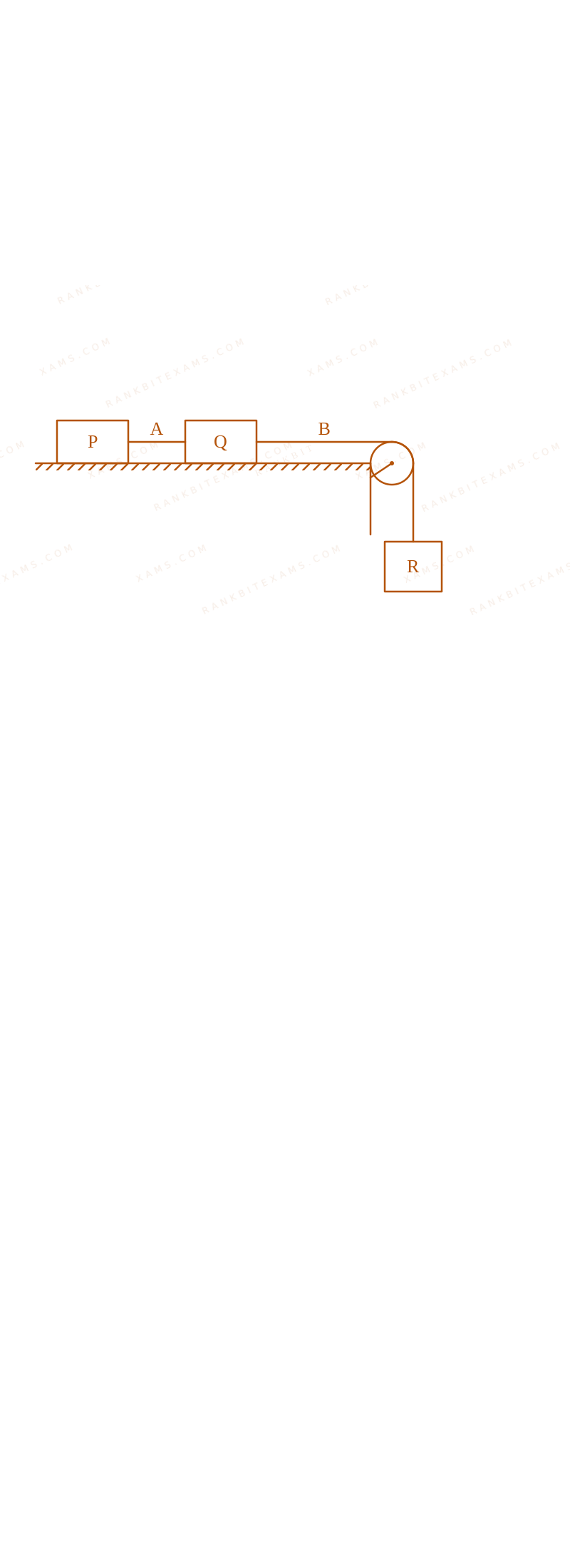
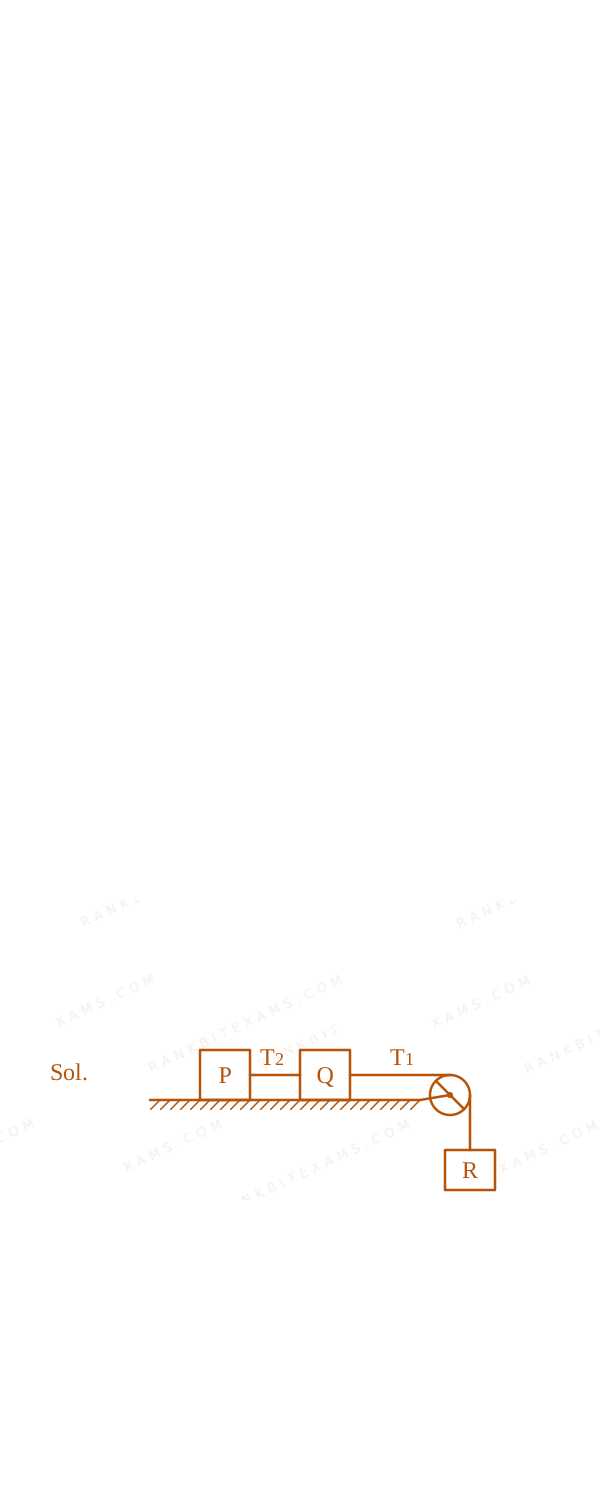
Each of three blocks P, Q and R shown in figure has a mass of 3 ~kg$3 \mathrm{~kg}$. Each of the wire A and B has cross-sectional area 0.005 ~cm²$0.005 \mathrm{~cm}^2$ and Young's modulus 2 × 10¹¹ Nm⁻²$2 \times 10^{11} \mathrm{Nm}^{-2}$. Neglecting friction, the longitudinal strain on wire B is _ _ _ _ × 10⁻⁴$\_ \_ \_ \_ \times 10^{-4}$. (Take g = 10 m / s²$g = 10 \mathrm{m / s^2}$)
Three 3kg blocks hanging and resting on table attached via wires A and B through a pulley.
Numerical Answer.Answer: 2 to 2
Solution
Related Formula
a = Net Pulling ForceTotal Mass$$a = \frac{\text{Net Pulling Force}}{\text{Total Mass}}$$Strain = StressY = (T)/(AY)$$\text{Strain} = \frac{\text{Stress}}{Y} = \frac{T}{AY}$$
Core Logic
Three 3kg blocks hanging and resting on table attached via wires A and B through a pulley.
First, calculate the common acceleration of the system of three blocks. Block R provides the driving gravitational force (3g$3g$), pulling blocks P and Q. Then isolate the tension in wire B (T₁$T_1$) pulling block P. Finally, apply Young's modulus to find the strain.
Step 1: Find Acceleration
Total driving force = Weight of block R = 3 × 10 = 30 ~N$3 \times 10 = 30 \mathrm{~N}$.
Total mass being accelerated = mP + mQ + mR = 3 + 3 + 3 = 9 ~kg$m_P + m_Q + m_R = 3 + 3 + 3 = 9 \mathrm{~kg}$.
(Wait, the pdf solution says 30 - T₁ = 3 × a ⇒ T₁ = 20 ~N$30 - T_1 = 3 \times a \Rightarrow T_1 = 20 \mathrm{~N}$. Let's examine the arrangement from the image context. If block R hangs, wire A connects R to Q, and wire B connects Q to P. If B connects R and Q, it bears more tension. Let's trust the PDF calculation: The solution implies block P is the hanging block driving it? No, if 30 - T₁ = 3a$30 - T_1 = 3a$, then T₁$T_1$ is the tension supporting a hanging block. That means wire B is supporting a 3kg hanging block against gravity, or wire B connects Q and R. According to PDF logic: 30 - T₁ = 3 × (10/3) ⇒ T₁ = 20 N$30 - T_1 = 3 \times (10/3) \Rightarrow T_1 = 20 \mathrm{N}$. This means wire B is the vertical wire supporting block R.)
In multi-block connected systems, always find common 'a' first using Σ F / Σ m$\Sigma F / \Sigma m$. Then isolate the single block the wire directly pulls to find tension. Strain acts statically under that tension.
Chapter Mix
Class 11 Physics: Mechanical Properties of Solids
Class 11 Physics: Laws of Motion
Q34jee_main_2024_30_jan_morningElasticity and Young's Modulus
Young's modulus of material of a wire of length 'L' and cross-sectional area A is Y. If the length of the wire is doubled and cross-sectional area is halved then Young's modulus will be :
A.(Y)/(4)$\frac{Y}{4}$
B.4Y$4Y$
C.Y$Y$
D.2Y$2Y$
Solution
Related Formula
Y = StressStrain$$Y = \frac{\text{Stress}}{\text{Strain}}$$
(However, Y is an intrinsic property of the material.)
Core Logic
Young's modulus (Y$Y$) is a fundamental material property (intensive property). It depends exclusively on the nature of the material and its temperature, not on the macroscopic physical dimensions such as length or cross-sectional area of the specific specimen.
Step 1: Final Conclusion
Since the material remains unchanged, the Young's modulus remains the same.
Therefore, Ynew = Y$Y_{new} = Y$.
Pattern Recognition
Whenever dimensions (length, area, radius) change but the material is constant, intrinsic properties like density, resistivity, and elastic moduli remain strictly invariant.
Chapter Mix
Class 11 Physics: Mechanical Properties of Solids
Q54jee_main_2024_31_jan_eveningYoung's Modulus and Strain
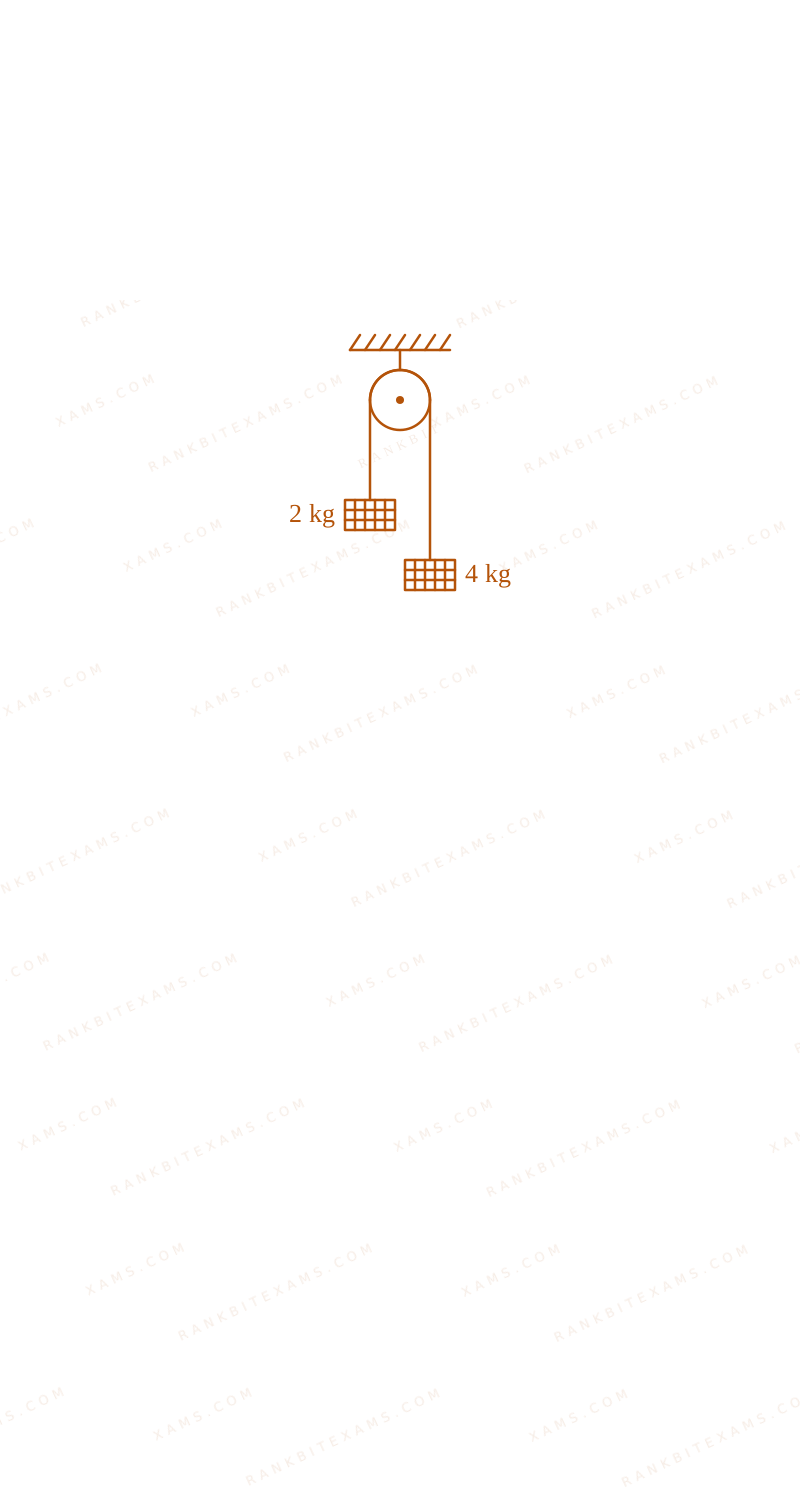
Two blocks of mass 2 kg$2 \text{ kg}$ and 4 kg$4 \text{ kg}$ are connected by a metal wire going over a smooth pulley as shown in figure. The radius of wire is 4.0 × 10⁻⁵ m$4.0 \times 10^{-5} \text{ m}$ and Young's modulus of the metal is 2.0 × 10¹¹ N/m²$2.0 \times 10^{11} \text{ N/m}^2$. The longitudinal strain developed in the wire is (1)/(α π)$\frac{1}{\alpha \pi}$. The value of α$\alpha$ is _______. [Use g = 10 m/s²$g = 10 \text{ m/s}^2$]
The image shows a standard Atwood machine with a wire holding 2 kg and 4 kg masses.
First, determine the tension T$T$ in the wire produced by the accelerating system (Atwood machine). Then, apply the formula for longitudinal strain using the calculated tension, cross-sectional area, and Young's Modulus.
Practice past-year questions one chapter at a time. Pick an exam → subject → chapter and get every PYQ for that topic — pulled together from all past papers — with the chapter's key formulas alongside.