JEE Main · Physics ↓ Falling

Magnetism and Matter appeared 9 times across 3 years — 1% of Physics. This question is from Magnetic Field of a Bar Magnet.

Year 2026 2025 2024 Total
Questions 2 6 1 9

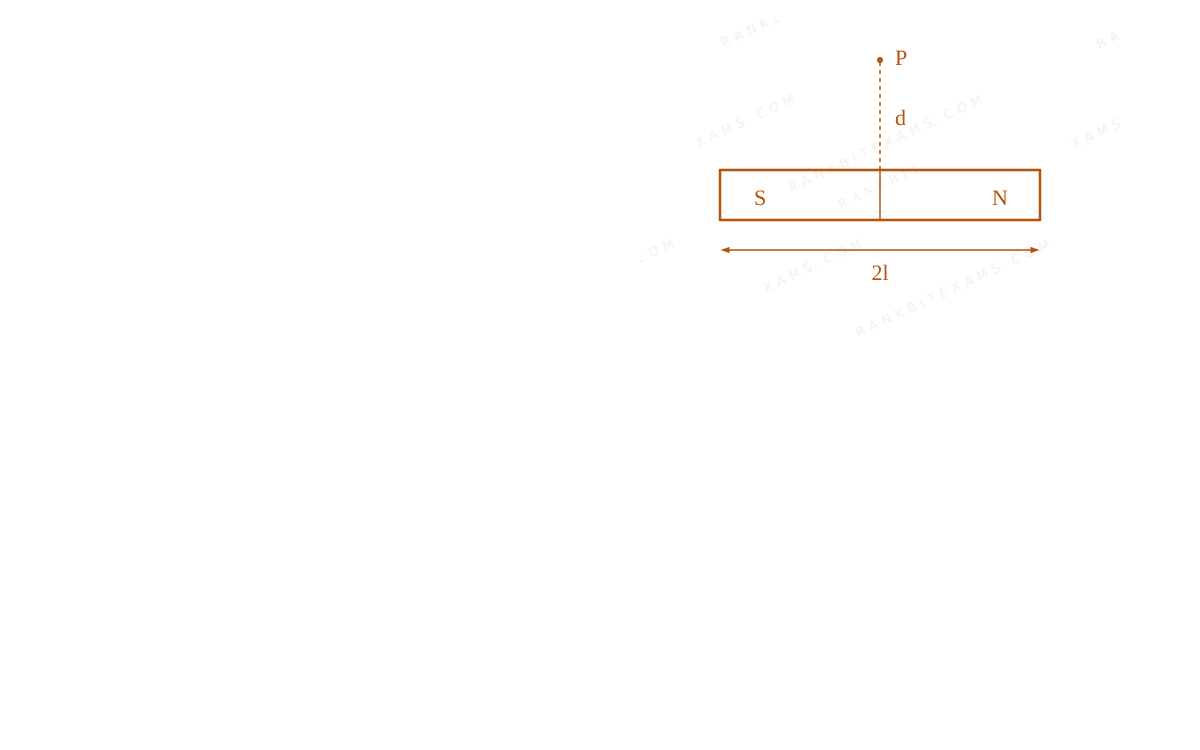
A \bar magnet has total length 2l = 20 units and the field point P is at a distance d = 10 units from the centre of the magnet. If the relative uncertainty of length measurement is 1% , then uncertainty of the magnetic field at point P is:
Magnetic Field of a Bar Magnet diagram for Q10 - JEE Main 2025 Evening
A schematic mapping out the total \bar magnet layout alongside position coordinate node P.

Solution & Explanation

Related Formula

The standard expression for the magnetic field B on the axial path at distance r from the magnetic center is given by :

B ∝ (1)/(r³)

Through logarithmic error differentiation:

(Δ B)/(B) = 3 · ((Δ r)/(r))
Core Logic

Depending on how the evaluation tracks parameter variables, two interpretations arise:

Method 1 (Approximating without considering variations in independently) [cite: 708, 709]: If the spatial uncertainty is tied entirely to the radial component variable r :

(Δ B)/(B) = 3 × 1% = 3%

Method 2 (Accounting comprehensively for dimensional dependencies) [cite: 714, 715]: If the error accumulation bounds combine tracking lengths alongside parameters:

(Δ B)/(B) = (Δ )/( ) + 3((Δ r)/(r)) = 1% + 3(1%) = 4%

Both paths offer distinct structural insights depending on assumptions. The official valuation matrix accepts options reflecting both interpretations.

Pattern Recognition

In general engineering error evaluations, always look at power exponents. If an expression depends inversely on a cubed distance variable, fractional variation scales up by three \times the independent tracking variance.

Chapter Mix

Class 11 Physics: Units and Measurements Class 12 Physics: Magnetism and Matter

Reference Study Guides

More Magnetism and Matter Previous-Year Questions

Q45 jee_main_2026_23_january_morning Magnetic Properties of Materials
Given below are two statements: one is labelled as Assertion (A) and the other is labelled as Reason (R). Consider a ferromagnetic material: Assertion (A) : The individual atoms in a ferromagnetic material possess a magnetic dipole moment and interact with one another in such a way that they spontaneously align themselves forming domains. Reason (R) : At high enough temperature, the domain structure of ferromagnetic material disintegrates. Thus, magnetization will disappear at high enough temperature known as Curie temperature. In the light of the above statements, choose the correct answer from the options given below :
  • A. (A) is true but (R) is false
  • B. Both (A) and (R) are true but (R) is not the correct explanation of (A)
  • C. Both (A) and (R) are true and (R) is the correct explanation of (A)
  • D. (A) is false but (R) is true

Solution

Core Logic

Assertion (A) describes the fundamental microscopic origin of ferromagnetism, which is the spontaneous alignment of atomic dipoles into magnetic domains due to quantum exchange interactions. This is a factually correct statement.

Reason (R) describes the macroscopic thermal breakdown of this alignment. At the Curie temperature, thermal agitation overcomes the exchange coupling, causing the domains to scramble and the material transitions from ferromagnetic to paramagnetic. This is also a factually correct statement.

Step 1: Final Conclusion

While both statements are true descriptions of ferromagnetic behavior, Reason (R) (thermal destruction of domains) is not the cause of Assertion (A) (the formation of domains). They describe opposite phenomena (ordering vs. disordering). Therefore, (R) does not explain (A).

Pattern Recognition

Sees: Assertion about "cause of property X" and Reason about "destruction of property X" → They are disconnected causally. Both true, but R is not the correct explanation for A.

Chapter Mix

Class 12 Physics: Magnetism and Matter

Q46 jee_main_2026_24_january_morning Magnetic Dipole in a Magnetic Field
A short bar magnet placed with its axis at 30° with an external field of 800 Gauss, experiences a torque of 0.016 N.m. The work done in moving it from most stable to most unstable position is α × 10⁻³ J. The value of α is ____.
Numerical Answer. Answer: 64 to 64

Solution

Related Formula
τ = M B θ W = Δ U = M B ( θ₁ - θ₂)
Core Logic

First, find the magnetic moment M using the given torque condition:

0.016 = M B 30° 0.016 = M × B × (1)/(2) M = (0.032)/(B)
Step 1: Calculate Work Done

Work done moving from the most stable position (θ₁ = 0°) to the most unstable position (θ₂ = 180°) is:

W = Uf - Uᵢ = (+MB) - (-MB) = 2MB

Substitute M = (0.032)/(B):

W = 2 ((0.032)/(B)) B = 0.064 J W = 64 × 10⁻³ J

Comparing with α × 10⁻³ J, we get α = 64.

Pattern Recognition

Flipping a dipole from strictly aligned (0^°) to anti-aligned (180^°) always requires exactly 2MB of work. Use the initial torque to isolate the MB product, rendering the explicit B-field value (800 Gauss) computationally irrelevant.

Chapter Mix

Class 12 Physics: Magnetism and Matter

Q10 jee_main_2025_02_april_morning Magnetic Intensity and Susceptibility
The relationship between the magnetic susceptibility (χ) and the magnetic permeability (μ) is given by: (μ₀ is the permeability of free space and μᵣ is relative permeability)
  • A. χ = (μ)/(μ₀) - 1
  • B. χ = μᵣμ₀ + 1
  • C. χ = μᵣ + 1
  • D. χ = 1 - (μ)/(μ₀)

Solution

Related Formula
μᵣ = 1 + χ μ = μ₀ μᵣ
Core Logic

The relative magnetic permeability μᵣ of a magnetic material is related to its susceptibility χ by the basic relation:

μᵣ = 1 + χ χ = μᵣ - 1

Since relative permeability μᵣ is the ratio of absolute permeability μ to the permeability of free space μ₀:

μᵣ = (μ)/(μ₀)

Substituting this into the susceptibility relation yields:

χ = (μ)/(μ₀) - 1
Step 1: Final Conclusion

The correct option is χ = (μ)/(μ₀) - 1.

Pattern Recognition

Relative permeability μᵣ represents total magnetic response (vacuum background + material response), while susceptibility χ represents the material's specific response alone. Hence they always differ by exactly 1: μᵣ = 1 + χ.

Chapter Mix

Class 12 Physics: Magnetic Properties of Matter

Q1 jee_main_2025_03_april_evening Magnetic Dipole in a Uniform Magnetic Field
A magnetic dipole experiences a torque of 80√(3)~N~m when placed in uniform magnetic field in such a way that dipole moment makes angle of 60° with magnetic field. The potential energy of the dipole is :
  • A. 80~J
  • B. -40√(3)~J
  • C. -60~J
  • D. -80~J

Solution

Related Formula

The torque τ experienced by a magnetic dipole in a uniform magnetic field B is given by:

τ = M × B ⇒ τ = MB θ

The potential energy U of the dipole is given by:

U = - M · B = -MB θ
Core Logic

Given parameters:

  • Torque τ = 80√(3)~N~m
  • Angle θ = 60°
Step 1: Calculate the value of MB

Substitute the given values into the torque formula:

80√(3) = MB (60°) 80√(3) = MB ( √(3)2) MB = 160~J
Step 2: Calculate Potential Energy

Using the potential energy expression:

U = -MB (60°) U = -160 × (1)/(2) = -80~J
Pattern Recognition

A standard dipole problem checking the relation between torque and potential energy. Note that torque goes with the sine of the angle, whereas potential energy goes with the negative cosine. Dividing torque by potential energy gives - θ.

Chapter Mix

Class 12 Physics: Magnetism and Matter

Q7 jee_main_2025_07_april_morning Magnetic Materials
The percentage increase in magnetic field (B) when space within a current carrying solenoid is filled with magnesium (magnetic susceptibility χmg = 1.2× 10⁻⁵ ) is:
  • A. (6)/(5) × 10⁻³ %
  • B. (5)/(6) × 10⁻⁵%
  • C. (5)/(6) × 10⁻⁴%
  • D. (5)/(3) × 10⁻⁵%

Solution

Related Formula

The magnetic field inside a filled solenoid is:

Bnew = μ n I

The magnetic field in air is:

Bold = μ₀ n I

Relative permeability μᵣ and susceptibility χ are related by:

μᵣ = (μ)/(μ₀) = 1 + χ
Core Logic

The percentage increase in magnetic field is:

% change in B = Bnew - BoldBold × 100% % change in B = (μ - μ₀)/(μ₀) × 100% = (μᵣ - 1) × 100% = χ × 100%
Step 1: Substitute and Calculate

Given susceptibility χmg = 1.2 × 10⁻⁵:

% change = 1.2 × 10⁻⁵ × 100% = 1.2 × 10⁻³%

Convert decimal to fraction:

1.2 × 10⁻³% = (6)/(5) × 10⁻³%
Pattern Recognition

Sees: Susceptibility and solenoid field percentage change. Shortcut: The fractional change in magnetic field when inserting a core is exactly equal to its magnetic susceptibility χ. Thus, the percentage change is just χ × 100.

Chapter Mix

Class 12 Physics: Magnetism and Matter

More Magnetism and Matter Questions — jee_main_2025_28_jan_evening

Practice all Magnetism and Matter previous-year questions →

Rankbit System
JEE Physics: Waves (+15.5%) | Electrostatics: Concentric Shells (-29.7%) | Modern Physics: Photoelectric Clones (+34.2%) | Mathematics: Definite Integrals (+18.1%) | Chemistry: Coordination Splitting (-11.4%) | JEE Physics: Waves (+15.5%) | Electrostatics: Concentric Shells (-29.7%) | Modern Physics: Photoelectric Clones (+34.2%) | Mathematics: Definite Integrals (+18.1%) | Chemistry: Coordination Splitting (-11.4%)