Let f: Rarrow R$f:\mathbb{R}\rightarrow\mathbb{R}$ be a twice differentiable function such that f(2)=1$f(2)=1$. If F(x)=xf(x)$F(x)=xf(x)$ for all xin R$x\in\mathbb{R}$, ∫₀²xF(x)dx=6$\int_{0}^{2}xF^{\prime}(x)dx=6$ and ∫₀²x²F(x)dx=40$\int_{0}^{2}x^{2}F^{\prime\prime}(x)dx=40$, then F(2)+∫₀²F(x)dx$F^{\prime}(2)+\int_{0}^{2}F(x)dx$ is equal to:
A.11$11$
B.15$15$
C.6$6$
D.13$13$
Solution & Explanation
Related Formula
Integration by Parts formula:
∫ u · v dx = u ∫ v dx - ∫ ( u' ∫ v dx ) dx$$\int u \cdot v \, dx = u \int v \, dx - \int \left( u' \int v \, dx \right) dx$$
We need to find F'(2) + ∫₀² F(x) dx$F'(2) + \int_{0}^{2} F(x) dx$:
13 + (-2) = 11$13 + (-2) = 11$
Pattern Recognition
Notice how the definition of f(x)$f(x)$ is mostly a distraction to find F(2)=2$F(2)=2$. The problem is fundamentally testing consecutive applications of integration by parts to reduction structures.
Chapter Mix
Class 12 Mathematics: Definite Integration
More Definite Integration Previous-Year Questions — Page 7
Q75jee_main_2025_03_april_morningArea Under Bounded Curves
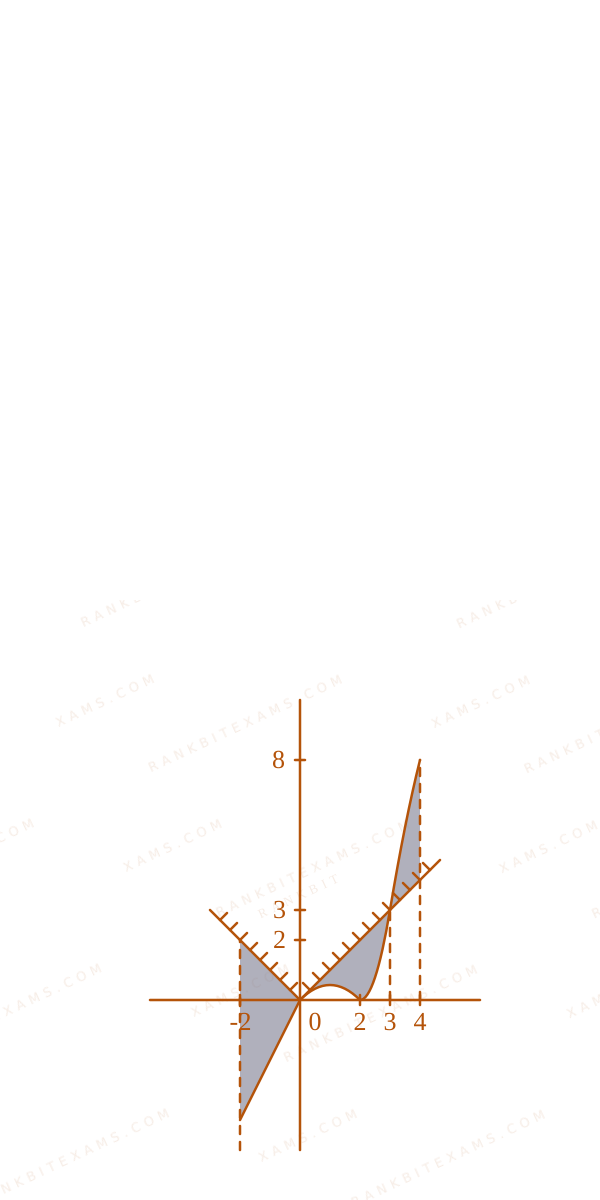
The area of the region bounded by the curve y = |x|, x|x - 2|$y = \max\left\{|x|, x|x - 2|\right\}$ [cite: 699], the x-axis and the lines x = -2$x = -2$ and x = 4$x = 4$ is equal to[cite: 699, 702]:
Numerical Answer.Answer: 12 to 12
Solution
Related Formula
Definite integration geometry area: Split boundary zones around intersections where functional dominant switches occur.
Area Under Bounded Curves diagram for Q75 - JEE Main 2025 Morning
Core Logic
Analyze intersection points between y₁ = |x|$y_1 = |x|$ and y₂ = x|x-2|$y_2 = x|x-2|$ across required integration span regions:
For x in [-2, 0]$x \in [-2, 0]$: |x| = -x$|x| = -x$ and x|x-2| = -x(2-x) = x² - 2x$x|x-2| = -x(2-x) = x^2 - 2x$. Max curve tracks through distinct segments.
For positive sectors, compute intersections: x = x(2-x) x = 1$x = x(2-x) \implies x = 1$ or x=0$x=0$. Also check switch locations where graphs swap dominance.
Step 1: Setting up separate area integral blocks
Using geometric area partitions calculated across continuous regions [cite: 1495]:
Area = (1)/(2) × 2 × 2 + (1)/(2) × 3 × 3 + (1)/(2) × 1 × 11 = 12$$\text{Area} = \frac{1}{2} \times 2 \times 2 + \frac{1}{2} \times 3 \times 3 + \frac{1}{2} \times 1 \times 11 = 12$$ [cite: 1495]
Alternatively, splitting the boundary metrics via continuous definite limits yields identical whole tracking blocks matching exactly to 12 total units[cite: 1495].
Class 12 Mathematics: Integrals (Application of Integrals)
Q68jee_main_2025_04_april_eveningProperties of Definite Integrals
Let f(x) + 2f((1)/(x)) = x² + 5$f(x) + 2f\left(\frac{1}{x}\right) = x^2 + 5$ and 2 g (x) - 3 g ((1)/(2)) = x, x > 0$2 \mathrm {g} (\mathrm {x}) - 3 \mathrm {g} \left(\frac {1}{2}\right) = \mathrm {x}, \mathrm {x} > 0$. If α = ∫_ 1 ^ 2 f (x) d x$\alpha = \int_ {1} ^ {2} f (x) d x$, and β = ∫_ 1 ^ 2 g (x) d x$\beta = \int_ {1} ^ {2} g (x) d x$, then the value of 9α + β$9\alpha + \beta$ is:
A.1$1$
B.0$0$
C.10$10$
D.11$11$
Solution
Core Logic
We have two functional equations to solve before integrating.
Functional equations involving x → (1)/(x)$x \to \frac{1}{x}$ are easily solved by treating the swapped forms as a system of linear equations, allowing direct isolation of the underlying function.
Chapter Mix
Class 12 Mathematics: Definite Integrals
Class 12 Mathematics: Functional Equations
Q72jee_main_2025_04_april_eveningIntegration by Substitution
If ∫ (√(1 + x²) + x)¹⁰(√(1 + x²) - x)⁹dx = (1)/(m) (( 1 + x ^ 2 + x) ^ n (n 1 + x ^ 2 - x)) + C$\int \frac{\left(\sqrt{1 + x^2} + x\right)^{10}}{\left(\sqrt{1 + x^2} - x\right)^9}\mathrm{d}x = \frac {1}{m} \left(\left(\sqrt {1 + x ^ {2}} + x\right) ^ {n} \left(n \sqrt {1 + x ^ {2}} - x\right)\right) + C$ where C$C$ is the constant of integration and m,nin N$\mathbf{m},\mathbf{n}\in \mathbf{N}$, then m + n$\mathfrak{m} + \mathfrak{n}$ is equal to
Numerical Answer.Answer: 379 to 379
Solution
Core Logic
Let's simplify the integrand by rationalizing the denominator term block. Notice that:
Comparing this directly with the given answer format, we identify:
m = 360$m = 360$
n = 19$n = 19$
Computing m + n$m + n$:
m + n = 360 + 19 = 379$$m + n = 360 + 19 = 379$$
Pattern Recognition
Expressions containing conjugate factors like √(1+x²) ± x$\sqrt{1+x^2} \pm x$ frequently simplify under rationalization because their product equals 1. This dynamic quickly reduces fractional components into single power blocks.
Chapter Mix
Class 12 Mathematics: Indefinite Integrals
Q66jee_main_2025_04_april_morningProperties of Definite Integrals
The value of ∫₋₁¹ (1 + √(|x| - x))e^x + (√(|x| - x))e-xe^x + e-x dx$\int_{-1}^{1}\frac{\left(1 + \sqrt{|x| - x}\right)e^x + \left(\sqrt{|x| - x}\right)e^{-x}}{e^x + e^{-x}} \, \mathrm{d}x$ is equal to
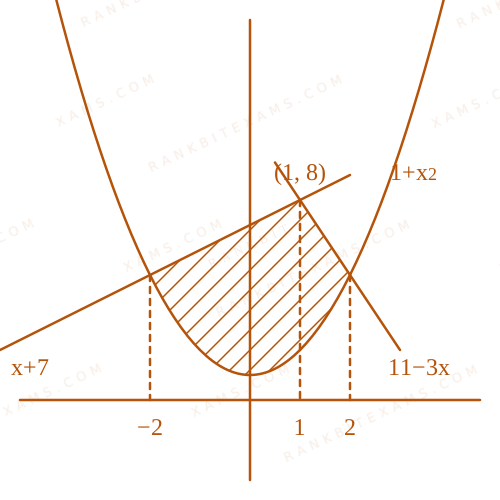
We need to find the intersection points of the curves to understand the x+7, 11-3x$\min\{x+7, 11-3x\}$ boundary transition:
x+7 = 11-3x 4x = 4 x = 1$x+7 = 11-3x \implies 4x = 4 \implies x = 1$.
Hence, the line switches behavior at x=1$x=1$.
Intersecting 1+x²$1+x^2$ with x+7$x+7$:
x² - x - 6 = 0 (x-3)(x+2) = 0 x = -2 or x = 3$$x^2 - x - 6 = 0 \implies (x-3)(x+2) = 0 \implies x = -2 \quad \text{or} \quad x = 3$$
Intersecting 1+x²$1+x^2$ with 11-3x$11-3x$:
x² + 3x - 10 = 0 (x+5)(x-2) = 0 x = 2 or x = -5$$x^2 + 3x - 10 = 0 \implies (x+5)(x-2) = 0 \implies x = 2 \quad \text{or} \quad x = -5$$
Area Under Curves diagram for Q57 - JEE Main 2025 Evening
Step 1: Set up Integrals
The transition points show that from x = -2$x = -2$ to 1$1$, the upper line is x+7$x+7$, and from x = 1$x = 1$ to 2$2$, the upper line is 11-3x$11-3x$.
When a boundary contains a $\min\{\}$ or $\max\{\}$ component, always solve for their internal intersection first to identify the exact splitting point of your definite integrals.
Practice past-year questions one chapter at a time. Pick an exam → subject → chapter and get every PYQ for that topic — pulled together from all past papers — with the chapter's key formulas alongside.